Key Points
- Itako are folk mediums from Japan’s Tohoku region, traditionally blind women. Through a ritual called kuchiyose, they let the dead speak to their families through their mouths. They also pray for people’s well-being and for cattle and horses.
- Itako are not born mediums. Their calling was an apprenticeship-based trade that let blind girls earn a living: they trained under a master, memorized dozens of ritual chants, and on completing their training received a sacred bundle and prayer beads.
- In the early Meiji era, there were about 500 itako in eastern Aomori alone. By 2026, only about five traditionally trained itako remain, and the only blind one is 93-year-old Take Nakamura.
- They are disappearing because, from 1948, blind children were required to attend school, and the measles vaccine became widespread, so blind girls no longer needed this path. Competition among itako also meant they rarely took apprentices. The longing for the dead remains, but the place society kept for the bereaved is vanishing.
In the autumn of 2019, Mount Osore, at the northern tip of Japan’s main island of Honshu, held its autumn grand festival. In a small tent in a corner of the temple grounds sat a single itako, a blind medium. Outside, five groups waited in line, hoping she would “call back” a dead family member to speak with them. A woman who had been coming for more than thirty years said there really were far fewer itako these days.
Thirty years earlier, the same festival had drawn about thirty.
Itako are folk mediums from Japan’s northeastern Tohoku region, traditionally women who were blind or had very poor sight. Their best-known work is letting the spirit of a dead person enter their body and speak to the living through their mouth. This ritual is called kuchiyose.
As of 2026, only about five itako in all of Japan have apprenticed and completed their training in the traditional way, and only one of them is blind: 93-year-old Take Nakamura, who lives in Hachinohe, Aomori Prefecture.
Strangely, the people who want to see an itako haven’t disappeared. People still miss their dead and still want to hear their voices one more time. If the demand is still there, why is this calling coming to an end? The answer starts with Nakamura’s eyes.
The measles at age three that decided her life’s work
Take Nakamura was born in 1932 in a hillside farming village on the outskirts of Hachinohe. At three she caught measles. She later recalled: “I didn’t cry. I just slept and slept. My parents were busy with the farm work, so they let me keep sleeping. Then the fever made my eyes bulge out. My father took me to an eye doctor in Hachinohe, but the doctor said it was too late.”
Measles is now a vaccine-preventable childhood disease, but in an era of food shortages and scarce medical care, children in Tohoku’s farming villages lost their sight to it every so often.
How did these children make a living as adults? In Tohoku at the time, most blind boys learned acupuncture and massage, or learned the shamisen and lived by playing and singing door to door. Many blind girls were sent off to become itako.
In other words, for a long time the itako tradition was an occupational system that let blind girls support themselves. People often imagine a medium as someone “born with spiritual sensitivity who is suddenly possessed by a god,” but itako weren’t like that. They apprenticed, trained, were tested and graduated, much like any apprenticeship, passed down from generation to generation.
Two years of training, built on memory
In 1944, at 13, Nakamura was apprenticed by her parents to a local itako named Haru Tanigawa. Her parents’ reasoning was practical: their daughter couldn’t see, so she needed some skill she could live on in the village.
Every day she walked more than four kilometers to her master’s house. The training was mostly memorization. Itako use many kinds of sutras and ritual chants, with separate ones for summoning the dead and for prayers of blessing. Blind apprentices couldn’t read or write, so everything was recited by the master line by line and memorized by the apprentice line by line. Even in old age, Nakamura remembered 61 ritual chants, something very few could match. Another itako, Hiroko Matsuda, has said that what an itako needs isn’t strong spiritual power, but memory and patience.
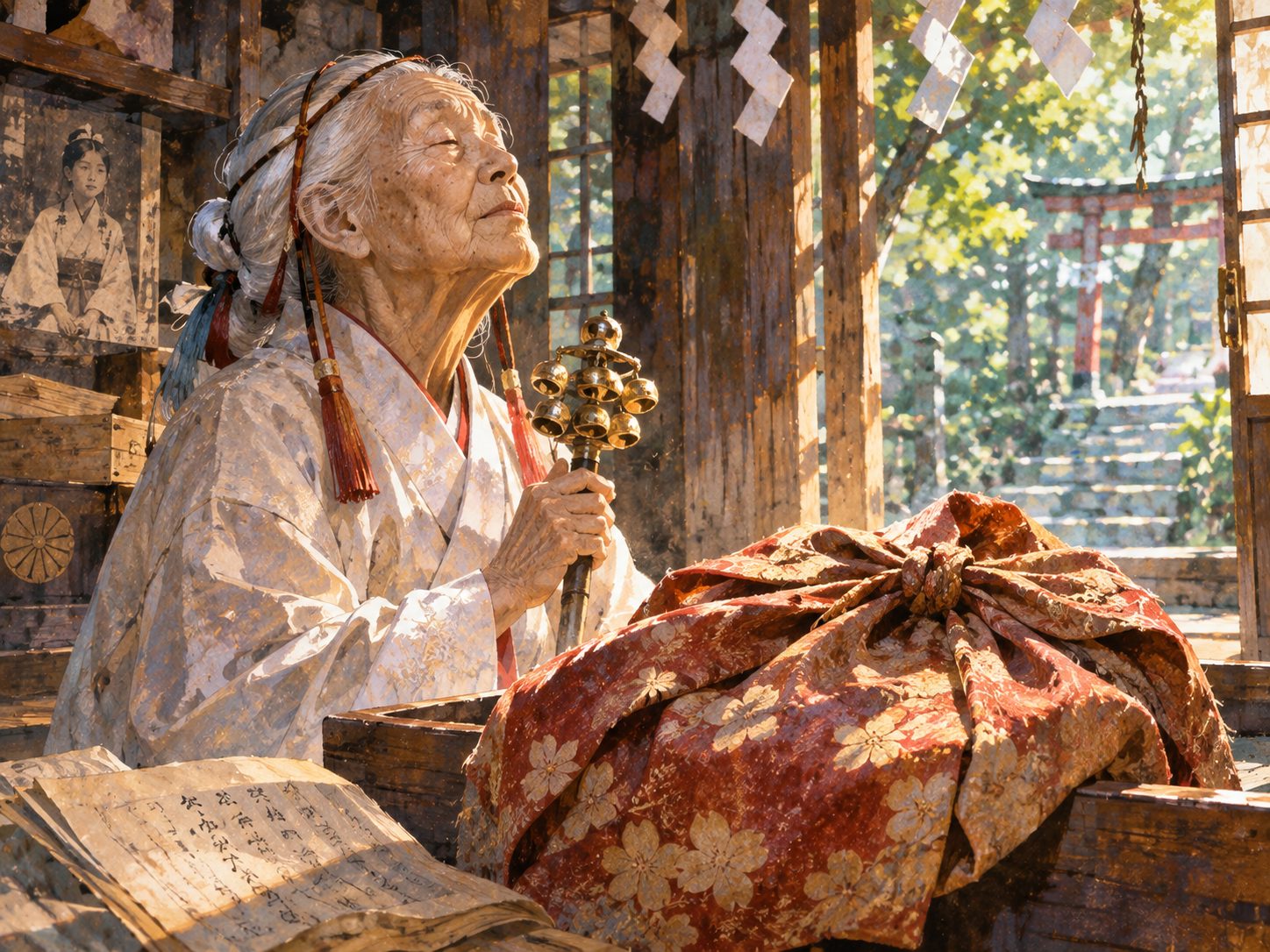
In late autumn 1947, Nakamura completed her graduation ritual and received two things from her master. One was a cloth bundle wrapping a bamboo tube sealed with scriptures. Called an odaiji, it is carried on the back, both as proof of graduation and as a protective charm to ward off evil spirits during kuchiyose. Her master warned her never to look at what was inside. Nearly eighty years later, she has never once opened it.
The other was a string of irataka prayer beads, threaded with old coins and wild boar tusks. The coins represent the ferry fare the dead must pay to cross the Sanzu River, the river to the afterlife in Buddhist lore, and the tusks drive away evil spirits trying to slip in. During kuchiyose, the itako rubs the beads together hard, making a metallic clatter completely unlike ordinary Buddhist rosaries.
After graduating, her first “clients” were cows and horses
Graduating at fifteen didn’t mean people immediately came knocking. Nakamura’s earliest work wasn’t summoning the dead but praying for the village’s sick cows and horses. On a farm, cattle and horses were a family’s livelihood, and when livestock fell ill, the owner would call an itako to recite sutras. Little by little, she built a reputation this way.
This also shows the itako’s real place in village life. Summoning the dead was only part of the job. They also divined harvests and fishing catches, prayed for sick family members, performed rituals in people’s homes to welcome the New Year, and listened to troubles families couldn’t solve on their own. Some have described traditional itako as “the local counselor,” which is roughly right.
As for kuchiyose itself, the process is actually quite plain. The client gives the name, date of death and address of the deceased. For someone who has recently died, the custom is usually to wait about a hundred days. Nakamura sits before the household altar in her home, first chanting in the local dialect to ask the gods and buddhas for help, then calling the dead down. The dead then “speak” in the first person while the client simply listens. A session usually lasts 30 to 40 minutes. Afterward, she mostly doesn’t remember what she said.
The fee is about ¥5,000 per deceased person, given in a red-and-white envelope used for happy occasions, not the white envelope used for funerals. What the summoned dead say is mostly a message to the living: all is well on the other side, there’s no need to worry.
Itako don’t live on Mount Osore. So why does everyone go there to find them?
Mention itako, and the first thing many people think of is Mount Osore, where this story began.
Mount Osore lies on the Shimokita Peninsula at the northern tip of Honshu, around the crater of a volcano. Volcanic rock covers the ground and the air smells of sulfur, yet right beside it lie a lake and a white sand beach. Since ancient times, people have seen this landscape as a place where hell and paradise exist side by side, and a local belief holds that “when people die, they go to Mount Osore.”
But itako don’t actually live on Mount Osore. They normally live in their own homes across Aomori and have no formal tie to the temple on the mountain. In the past, when the large temples around Aomori held festivals, itako from the area would gather to perform kuchiyose for worshippers, like vendors setting up stalls where the crowds are on market days. Mount Osore’s grand festival drew the most worshippers, and so it drew the most itako. Mount Osore is the place where people go to remember the dead, which made it the place where itako had the most clients.
Nakamura began climbing Mount Osore around age 33. The mountain road was hard going, and each time her husband held her hand on the way up. Around 2010, her body could no longer manage the climb, and since then she has only received clients at home.
Vaccines and schools for the blind brought this path to an end
In the early Meiji era, there were about 500 itako in the eastern half of Aomori alone. Today only about five remain. If people still want to see itako, what has disappeared?
What has disappeared is the people who would become itako. The system worked for centuries because farming villages always had a certain number of blind girls who had no other options. Both of those conditions vanished, one after another, in the second half of the 20th century.
First came education. Starting in the 1948 school year, Japan required blind children to attend schools for the blind. Before that, whether a blind child went to school depended entirely on the family. After that, they could learn braille and a trade, and no longer had to apprentice at thirteen and memorize scriptures. Nakamura’s apprenticeship came four years before that rule.
Then came medicine. Japan began vaccinating against measles in 1966 and added it to routine immunizations in 1978. Fewer and fewer children lost their sight to measles.
So blind itako are disappearing, first and foremost, because the world that produced them has disappeared. A world where a three-year-old girl goes blind because she couldn’t see a doctor in time, and has to decide at thirteen how she’ll make a living for the rest of her life, is not one anyone would want back.
But the line also lost its successors for reasons of the itako’s own. They had no fixed income and no license, their livelihood depended entirely on the number of clients, and once an apprentice graduated, she became a competitor for clients in the same area. Esashika, a local historian who has studied the itako of Hachinohe for many years, believes it’s precisely this competition that has led itako to take almost no apprentices for about half a century. Miyo Ogasawara, another itako now retired, never took an apprentice in her life. Her reason: she didn’t want anyone else to go through the hardships she had.
And because generations of itako were blind, all the ritual chants were passed on by word of mouth, with almost no written record. When an itako takes no apprentice, her lineage’s chants leave with her.
Can sighted successors carry on the work?
It isn’t that no one has followed Nakamura at all.
Hiroko Matsuda was born in Hachinohe in 1972. She was close to a local itako from childhood, decided to become one in her third year of junior high, and after high school moved into her master’s home, training for about five years in all. In the summer of 1991, she performed kuchiyose for the first time at Mount Osore’s grand festival.
She can see. According to Esashika, sighted apprentices learn faster and can graduate in about two or three years, while blind apprentices often take twice as long. The last two traditionally trained itako younger than Nakamura both have normal sight. The name hasn’t changed, but the people who carry it can now see.
Matsuda is often called “the last itako,” because she is the youngest of those with a traditional training. Her clients come from all over Japan, from Tokyo to Okinawa and Hokkaido, but she, too, takes no apprentices.
The gap in the market is being filled in other ways. Some people call themselves itako, others hang out a sign as “psychics.” Most have no master and do almost nothing but summon the dead.
So the statement “itako are disappearing” needs to be more precise. What’s disappearing is a calling carried by blind girls, handed down through apprenticeship, that prayed for cattle and horses and helped households welcome the New Year. Speaking for the dead itself will probably continue in other forms.
“Those were the words of the dead”
In 2013, a group of ethnomusicologists recorded Nakamura’s ritual chants and ceremonies on six CDs and two DVDs and released them as Itako Nakamura Take. The set later won an Excellence Award at the Agency for Cultural Affairs’ National Arts Festival. Chants passed down orally for more than two centuries were preserved in full for the first time.
But a recording can keep the voice, not the occasion: a grieving family sitting before an old woman’s altar, listening as she rubs her beads and calls out the name of the dead.
In the spring of 2026, a writer traveled all the way from Hokkaido to ask Nakamura to summon his grandfather, who had died before he was born. When it was over, the writer thanked her. She replied that those were the words of the dead. In Japanese, the word hotoke means not only the Buddha but, commonly, someone who has died. What she meant was that the words were spoken by the dead, and the credit wasn’t hers.
That reply may be the most precious thing about the itako. They never talk about how great their powers are. They are simply people who trained for years, remember dozens of chants, and are willing to sit before an altar for an hour. I think what people will lose when the itako are gone isn’t some mysterious spiritual power, but a place society kept for the bereaved: a familiar person, at a set time and place, sitting with them properly while they remember their dead. Neither recordings nor psychics’ signs can fill that place.
Notes
- Sources differ on Nakamura’s age when she apprenticed and graduated, and her own memory puts it anywhere from 14 to 16. This article follows the most consistent dates: apprenticed in 1944, graduated in late autumn 1947.
- “About 500 in the early Meiji era” refers to the Nanbu region (from the eastern half of present-day Aomori Prefecture to northern Iwate Prefecture).
- Some of Hiroko Matsuda’s biography and quotes come from a promotional interview tied to a video game; the facts have been cross-checked against other reports.
- “Itako” originally referred to blind mediums. This article also uses the term for traditionally trained itako with normal sight.
References
- 道民の人|〈なぜ「イタコ」は恐山にいるのか?〉 (excerpt #1 from『日本遠國紀行』)|Bunshun Online|2026-03-25 (itako don’t live on Mount Osore, the itako market, how kuchiyose works, the hundred-day rule)
- 道民の人|〈「タケさーん! いだがねえー?」…日本最後のイタコの住まい〉 (#2)|Bunshun Online|2026-03-25 (five traditional itako remain, the last two are sighted, self-styled itako and psychics)
- 道民の人|『日本遠國紀行』excerpts #3 and #4|Bunshun Online|2026-03, #4 (Nakamura’s altar, the kuchiyose ritual and irataka beads)
- 道民の人|〈13歳で修行入り、名乗るのを許されたのは16歳の頃…日本最後のイタコ(93)の”知られざるプロフィール”〉|Bunshun Online|2026-03 (birth, blindness from measles, apprenticeship, the four-kilometer walk, graduation ritual, prayers for cattle and horses, Mount Osore, fees and red-and-white envelopes)
- 道民の人|『日本遠國紀行』excerpt (final installment)|Bunshun Online|2026-03 (“those were the words of the dead”)
- 鵜飼秀徳|〈高齢化で消滅の危機……青森恐山の”最後のイタコ”47歳が巫術を続ける理由〉|Bunshun Online|2019-11-12 (about 500 in early Meiji, about 30 at Mount Osore in the early Heisei era, only one at Mount Osore in 2019, why they don’t take apprentices, oral transmission with no records)
- nippon.com|〈あの世からの声を伝える青森の「イタコ」〉|2022 (blindness from measles and occupations for the blind, the odaiji and beads)
- 篠原匡 (text), 和多田アヤ (photos)|〈写真で語る「イタコのいる日常」(1)中村タケ〉|2022-03-26 (Nakamura’s own account of losing her sight, graduating in November 1947)
- POLA Foundation of Japanese Culture|第34回伝統文化ポーラ賞地域賞 中村タケ (61 ritual chants, the DVD’s National Arts Festival Excellence Award)
- National Diet Library|『イタコ中村タケ』(イタコ中村タケを記録する会, 2013) catalog record (6 CDs, 2 DVDs)
- Yahoo! News Feature|〈消えゆく「死者との交信」―― 青森のイタコを訪ねて〉|2016-12 (why Miyo Ogasawara took no apprentices, itako having no fixed income or license)
- Game*Spark|〈”日本最後のイタコ”が語る『鬼ノ哭ク邦』のリアリティ〉|2019-08-30 (Hiroko Matsuda’s biography, memory and patience, years of training)
- Tohoku Tourism Promotion Organization|恐山大祭 (Mount Osore’s landscape and grand festival)
- MEXT|『学制百年史』盲学校・聾学校教育の義務化 (compulsory education for blind and deaf children from 1948)
- Ministry of Health, Labour and Welfare|measles policy materials (2002) (measles vaccination from 1966, routine from 1978)
Follow the story in person
Join a small-group trip to the places in our stories and meet the people who live and work there.
See trips and dates
Water Mirror is a Tokyo-based company that helps more people step inside industries and explore the stories and cultures of different fields around the world. We design in-depth learning programs for individuals, companies, schools and organizations, combining company visits, exchanges with professionals, local learning and hands-on experiences, so participants can see how industries really work and meet the people and stories behind them. Water Mirror Perspectives is our content media, telling the distinctive stories of industries, local cultures and people, so that reading sparks curiosity and leads readers to go and see for themselves.
About Water Mirror →