Key Points
- The rules of kado, the “way of flowers,” trace back to the Ikenobo Sen’ei Kuden of 1537. Their core idea is to express, inside a vessel, how plants grow in the mountains and fields: where a flower is placed tells you where it originally grew.
- Atsunobu Katagiri, third-generation iemoto (grand master) of Osaka’s Kado Misasagi-ryu school, lived for eight months in 2013–2014 in the disaster zone of Minamisoma, Fukushima Prefecture. He arranged locally picked flowers in rubber boots, rubble and Jomon-period pottery, and photographed them.
- What he set aside was the “stage”: the vase and the tokonoma alcove. What he kept was the spirit of kado: returning the flower to the place where it grew.
- Kado’s obsession with placement is, at heart, a responsibility: if you cut a flower, you have to find it a reason to exist in its new place.
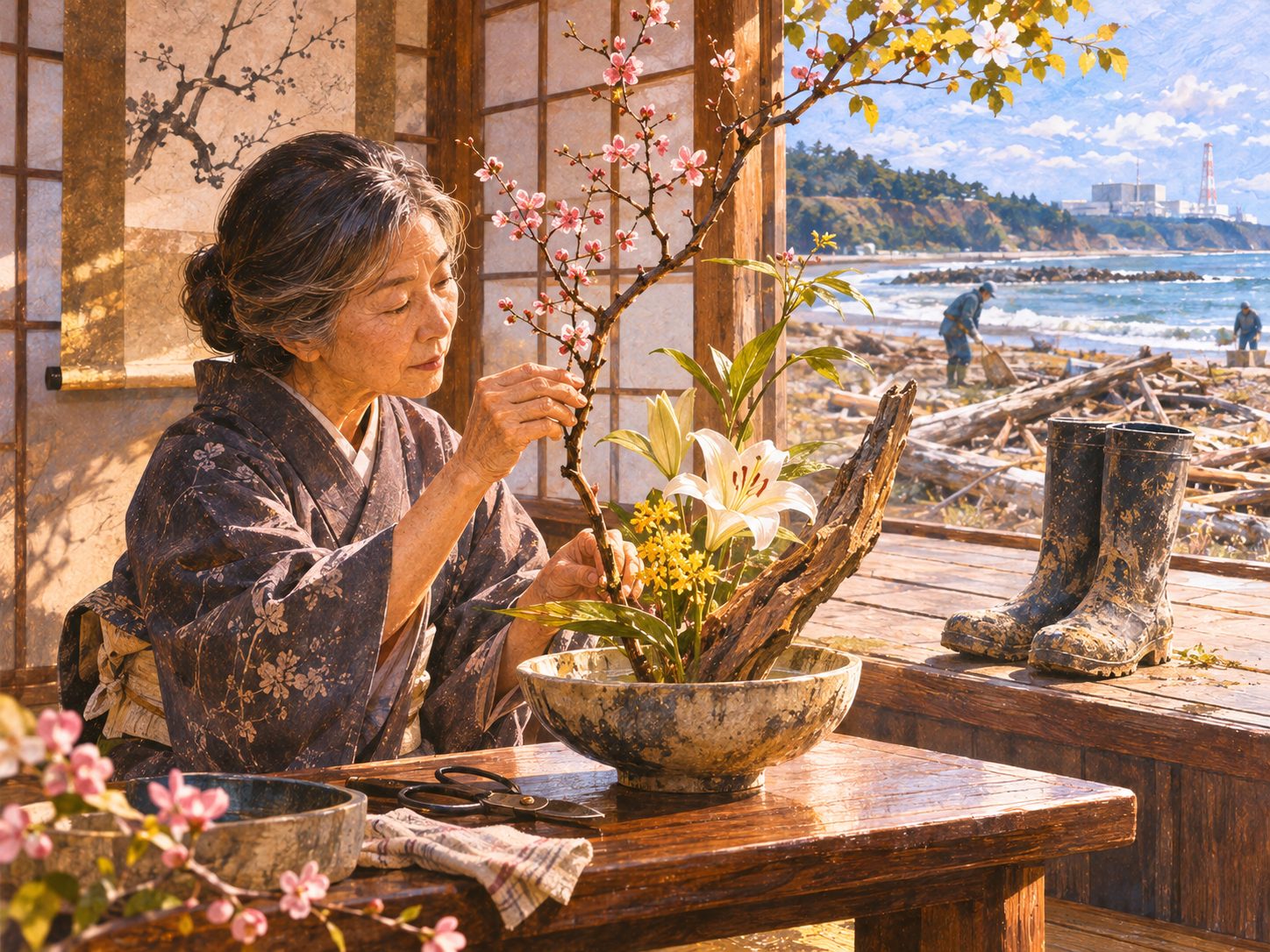
In 2013, on the coast of Minamisoma in Fukushima Prefecture, an ikebana artist picked a few wildflowers from the grass, but couldn’t find anything to put them in.
It wasn’t far from the Fukushima Daiichi nuclear power plant, where the accident had happened two years earlier, and the rubble from the tsunami was still lying where it had landed. The area seemed to have once been a fishing port, and the ground was strewn with rubber boots, the tall rain boots fishermen wear at work. He stared blankly at them for a while before it suddenly occurred to him: these can hold water. He scooped water from a puddle into a boot and put the flowers in.
The artist was Atsunobu Katagiri, the iemoto, or grand master, of an ikebana school in Osaka.
The scene is strange because Japanese ikebana is famously exacting. Which branch stands tall, which one leans, which way the flower faces, where in the room the vessel goes: all of it has names and rules. A grand master putting flowers into a pair of abandoned rain boots looks like throwing the whole rulebook away.
But Katagiri didn’t actually throw the rules away. Understand what he did on that coast, and you understand what all those rules in Japanese ikebana really care about.
Ikebana’s rules exist to bring the mountains and fields indoors
The Japanese word ikebana means arranging flowers: putting cut branches, leaves and flowers into a vessel to be admired. When it’s treated as a discipline that takes years of study and carries its own outlook, the Japanese call it kado, the “way of flowers,” in the same family as sado, the way of tea, and shodo, the way of calligraphy. The “way” means you’re learning not just a technique, but a way of seeing things.
Where do kado’s rules come from? You have to start with Ikenobo, the oldest school. The Ikenobo family has served for generations as head priests of Rokkakudo temple in Kyoto. In 1537, the 28th head, Ikenobo Sen’ei, organized flower arranging into a theory and passed it on to his disciples; later generations called it the Ikenobo Sen’ei Kuden. Its central idea is that arranging flowers isn’t just putting pretty flowers in a vase. It’s about expressing inside the vase how plants grow in the mountains and by the water, so the viewer can feel the environment the plant originally grew in.
In other words, from the very start kado wasn’t about “arranging pretty things nicely.” It was about “bringing nature into a small vessel.” Every rule that came after serves that purpose.
The most formal style is rikka. At its center stands the most important branch, called shin, surrounded by several branches, each with a fixed name and position, like actors in a play each with their own role. The Rikka Kudensho, a text from the early Edo period, says rikka takes as its emblem Mount Sumeru, the mountain at the center of the world in Buddhist cosmology, using the branches and leaves to represent the world’s mountains, fields and waters. The central branch symbolizes a mountain.
The simpler shoka style that later became popular follows the same logic, and developed a concept called shussho: the natural way a plant grows. Does it grow straight up in the wild, or lean out at an angle toward the water? The arranger has to make the plant in the vessel look as though it is growing out of the soil.
So kado’s obsession with placement isn’t a contest to see who can line things up most neatly. Where a flower goes is a statement about where it originally grew and what role it played in that landscape.
And this method assumes a stage: the vessel, and the tokonoma, the raised alcove set into the wall of a Japanese room, meant specifically for hanging scrolls and displaying flowers. Traditional ikebana was designed to be placed there and viewed by guests seated on tatami mats.
So when there is no vessel and no room, what can these rules still do?
Grand master at 24, yet he says his ikebana is self-taught
Atsunobu Katagiri was born in 1973 in Sakai, Osaka Prefecture. His family ran an ikebana school, Kado Misasagi-ryu, and his grandfather was its iemoto.
An iemoto who leads a school is more than a skilled flower arranger. In Japan’s iemoto system, students learn from teachers and, on reaching a certain level, apply to the school for a certificate. Only at a certain rank can they open their own classes, and the authority to issue certificates usually belongs to the iemoto alone. The iemoto is responsible for the entire tradition.
Yet Katagiri didn’t grow up sitting on tatami learning the rules. After junior high, he went to study in the United States and didn’t return to Japan until 1994. His father had died young, and in 1997, at 24, Katagiri took over as iemoto from his grandfather, becoming the school’s third grand master. By his own account, he taught himself how to arrange flowers.
His father’s death gave him a very direct understanding of flowers. When his father died, he says, he felt that while a flower’s life is short, a person’s isn’t all that different.
He later turned this feeling into his own definition of ikebana. The Japanese verb for arranging flowers, ikeru, is written with the same character as ikasu, “to keep alive.” A cut flower, Katagiri says, is a dying flower. To arrange it is to let a flower that has left its roots live for one more moment, in the world you want to show.
What sent a grand master to Fukushima was a water plant that bloomed again
On March 11, 2011, the Great East Japan Earthquake struck. A tsunami hit the Tohoku coast, a severe accident occurred at the Fukushima Daiichi nuclear plant, and residents of a wide surrounding area were forced to evacuate. Minamisoma lies on the Pacific coast of eastern Fukushima Prefecture. The parts of the city near the plant fell within the evacuation zone, and residents couldn’t return home. Most of the area wasn’t reopened until July 2016.
On the Minamisoma coast, the tsunami flooded former farmland and turned it back into lagoon: shallow, calm wetland where seawater and fresh water meet. Seeds buried in the mud for years woke up, and a water plant called mizuaoi bloomed everywhere in small blue-violet flowers. Before the disaster, mizuaoi had already been listed as a species at risk of extinction.
In 2013, the Fukushima Museum launched an art project inspired by these mizuaoi and approached Katagiri. He had no ties to Fukushima at all, but answered almost immediately: I want to go.
Starting in September 2013 he traveled back and forth between Osaka and Minamisoma, and in December he found a vacant apartment in the city, where he lived until August 2014. At the time, the coast still looked almost exactly as the tsunami had left it.
Why boots? Because they were the vessel that best told the flower’s story
The boots from the beginning of this story appeared during this period. At first, Katagiri didn’t know what he was supposed to do. He just walked through grass where you could no longer tell whether there had once been a road, picking flowers whenever he saw them in bloom.
Why boots? His explanation is very simple: things people wear are close to the body, and they have a very strong presence.
Put that back into the logic of kado, and it isn’t heretical at all. Kado asks that a flower be placed where it can tell its origins and the landscape it belongs to. On that coast, the vessel that could best tell a wildflower’s situation was a boot left behind by someone whose whereabouts were unknown.
His later works followed the same line of thinking. He placed flowers among the wreckage, on damaged cars and on the skulls of animals left after the disaster, then photographed them. The arranged flowers wilted within days. The photos were the only thing that remained.
He said he no longer needed vases, yet grew pickier about vessels than ever
After eight months, Katagiri says, the idea that “ikebana needs a tokonoma, needs a vessel” had vanished from his mind completely. If you look with real attention, you can find a flower that should be arranged anywhere.
It sounds like a grand master announcing that he’s abandoning tradition. But look at what he actually did, and you find the opposite: he became extremely particular about vessels.
When he picked the mizuaoi that had bloomed again, he arranged them in a piece of pottery several thousand years old. It was a deep bowl from the middle Jomon period, excavated from the Urajiri shell mound in the same city and normally kept at the Minamisoma City Museum. The Jomon period ran from more than 10,000 years ago to around 2,400 years ago, when people lived by gathering, hunting and fishing, and their pottery often bore patterns made by rolling cords across the clay.
Why an archaeological artifact, of all things? Because the museum’s researchers told him that from the Jomon period until this wetland was cleared for farmland about a hundred years ago, it had always been covered in mizuaoi. Katagiri drew a conclusion: the landscape the Jomon people saw was the same as this coast after the disaster. These mizuaoi could only go back into a vessel from that era.
He didn’t abandon the idea of shussho, either. Every flower was picked on site, and in the photos it stays on the very ground it grew from.
What he truly set aside was the stage. The room, the tokonoma, the vase were all devices needed to “bring in” the mountains and fields. In Minamisoma, the land itself and its wounds appeared directly in the frame. Some of the locations were only about six kilometers from the nuclear plant. He admits frankly that the scenery captured behind his flowers was far more dramatic than the flowers he arranged.
Nearly five hundred years ago, the Ikenobo Sen’ei Kuden asked arrangers to let viewers feel the setting in which plants grow. What Katagiri did in Fukushima was let that setting step out in front of the flowers.
Cut a flower, and you have to find it a reason to live
In 2015, these photos were collected in the photobook Sacrifice: The Ikebana of Regeneration. Katagiri says that every time he cut and arranged flowers, he had always felt a kind of dull, aching pain, and his days in Minamisoma made the meaning of that word clear.
He isn’t the only one troubled by cutting flowers. Ikenobo Senko, the next iemoto of Ikenobo, has said that when she was young she didn’t think deeply about how cruel it is to cut a flower, but in recent years she has come to feel that “cutting” is a weighty choice: once you cut, you end that flower’s life, and it has to live on in another form.
Looking back from here, kado’s obsession with placement takes on another meaning. Every flower has been cut from somewhere and has ended its original life. The arranger has to find it a reason to exist in its new place. The more detailed the rules, the more specifically that reason is demanded.
What the rules really care about is where the flower grew
Katagiri has kept going back to Fukushima. In 2024, he moved his home base to a roughly hundred-year-old traditional house on the southern outskirts of Sakai, where he grows flowers in the garden and cuts them to bring to his classes. Since Fukushima, he says, he has become more humble toward nature, and his dream is to one day arrange only what he has grown himself.
Why does Japanese ikebana care so much about where a single flower goes? I think the answer isn’t an aesthetic formula, but a responsibility. The rules are a way of connecting a cut flower to the place where it originally grew. When there is a vase and a tokonoma, that method grows into precise branches and angles, large enough to symbolize the mountain at the center of the world. When there isn’t, it can also be a pair of rubber boots by a fishing port, filled with puddle water.
The rules didn’t disappear in Fukushima. They simply showed what they had been all along.
Notes
- Katagiri’s experiences, thoughts and quoted words in Minamisoma come mainly from his own accounts in interviews and his photobook. Some English sources say he lived there for “a year”; this article follows his own account.
- The Ikenobo Senko mentioned here is the next iemoto of Ikenobo, who shares her name with Ikenobo Senko II, who perfected rikka in the early Edo period.
- The evacuation orders lifted in July 2016 were those for Minamisoma outside the “difficult-to-return zone.”
References
- ほぼ日刊イトイ新聞|片桐功敦さんが生けた、福島の花。(part 1)|2016-07-27 (how the commission came about, mizuaoi)
- ほぼ日刊イトイ新聞|片桐功敦さんが生けた、福島の花。(part 2)|2016-07-28 (when he moved)
- ほぼ日刊イトイ新聞|片桐功敦さんが生けた、福島の花。(part 3)|2016-07-29 (the boots, Jomon pottery and mizuaoi, no longer needing a tokonoma or vessel, six kilometers)
- ほぼ日刊イトイ新聞|片桐功敦さんが生けた、福島の花。(overview page, with quotes from the photobook)|2016 (the title Sacrifice and the pain of cutting flowers, mizuaoi as near-threatened)
- Museum of Anthropology at UBC (RRN collection record)|Sacrifice, Item 3542/1 (where the mizuaoi were picked, the middle Jomon pottery from the Urajiri shell mound)
- Edition Catalogue|Sacrifice: The Ikebana of Regeneration (works on wreckage, vehicles and animal skulls)
- Pen Online|Katagiri Atsunobu and the Ikebana of Regeneration (“more humble toward nature,” arranging only flowers he grows himself)
- Mammoth School|花をいけることは花を「生かす」こと|片桐功敦 華道家|2014-06 (grandfather as iemoto, his father’s early death, succession at 24, self-taught, ikeru = ikasu)
- MEBIC|花に耳を傾ける行為、花をいける行為|2019 (born in Sakai in 1973, studying in the U.S. after junior high)
- 森の芸術祭 晴れの国・岡山|片桐功敦 artist profile|2024 (returned to Japan in 1994, succeeded in 1997, photobook title)
- 宣伝会議|華道家・片桐功敦氏の広告観 (third-generation iemoto)
- 現代ビジネス FRaU|片桐功敦 古民家と庭の取材 (moving to an old house on the outskirts in 2024, garden flowers for his classes)
- JR West Blue Signal|いけばなの源流・池坊(vol.146) (Rokkakudo, the 1537 Ikenobo Sen’ei Kuden and its ideas)
- コトバンク|立花 (shin, the Mount Sumeru passage in the Rikka Kudensho)
- コトバンク|生花 (the theory of shussho)
- コトバンク|家元 (definition of iemoto and the certificate system)
- コトバンク|床の間 (definition of tokonoma)
- コトバンク|縄文時代 (dates and way of life of the Jomon period)
- Reconstruction Agency|南相馬市の取組(2017-08-01) (evacuation orders lifted on July 12, 2016)
- Newsweek Japan / WEB Asteion|いけばなという「道」について(池坊専好氏に聞く・前編)|2026 (the choice involved in cutting flowers)
Follow the story in person
Join a small-group trip to the places in our stories and meet the people who live and work there.
See trips and dates
Water Mirror is a Tokyo-based company that helps more people step inside industries and explore the stories and cultures of different fields around the world. We design in-depth learning programs for individuals, companies, schools and organizations, combining company visits, exchanges with professionals, local learning and hands-on experiences, so participants can see how industries really work and meet the people and stories behind them. Water Mirror Perspectives is our content media, telling the distinctive stories of industries, local cultures and people, so that reading sparks curiosity and leads readers to go and see for themselves.
About Water Mirror →