Key Takeaways
- Capsule toys come from vending machines that drop out a small toy when you insert coins and turn a handle. Measured by manufacturers’ shipment value, Japan’s capsule toy market was about 72 billion yen in fiscal 2022 and about 196 billion yen in fiscal 2025; by the end of January 2026, Japan had more than 900 dedicated capsule toy shops.
- The core reason the business took off is that products began to be made for adults. Bandai says about 60% to 70% of its capsule toy customers are women in their twenties and thirties, and the typical price has gone from 10 yen in 1965 to 300 to 500 yen today.
- Each recent hit has its own story: a pill bug enlarged ten times that can roll into a ball, created by a developer who is afraid of bugs; a small marker meant to tell umbrellas apart that became a bag charm, with more than 200 million shipped worldwide; and miniatures of classic furniture, with more than 1.2 million made in the series.
- Empty units in shopping malls gave capsule toy shops places to open, but what keeps a shop alive is its products. The head of an industry group says customers are shifting from “impulse buying,” spinning whatever they see, to “destination buying,” making a special trip for a specific product.
On December 12, 2025, a new shop opened on the third floor of an Ito-Yokado store in Yamato, Kanagawa Prefecture.
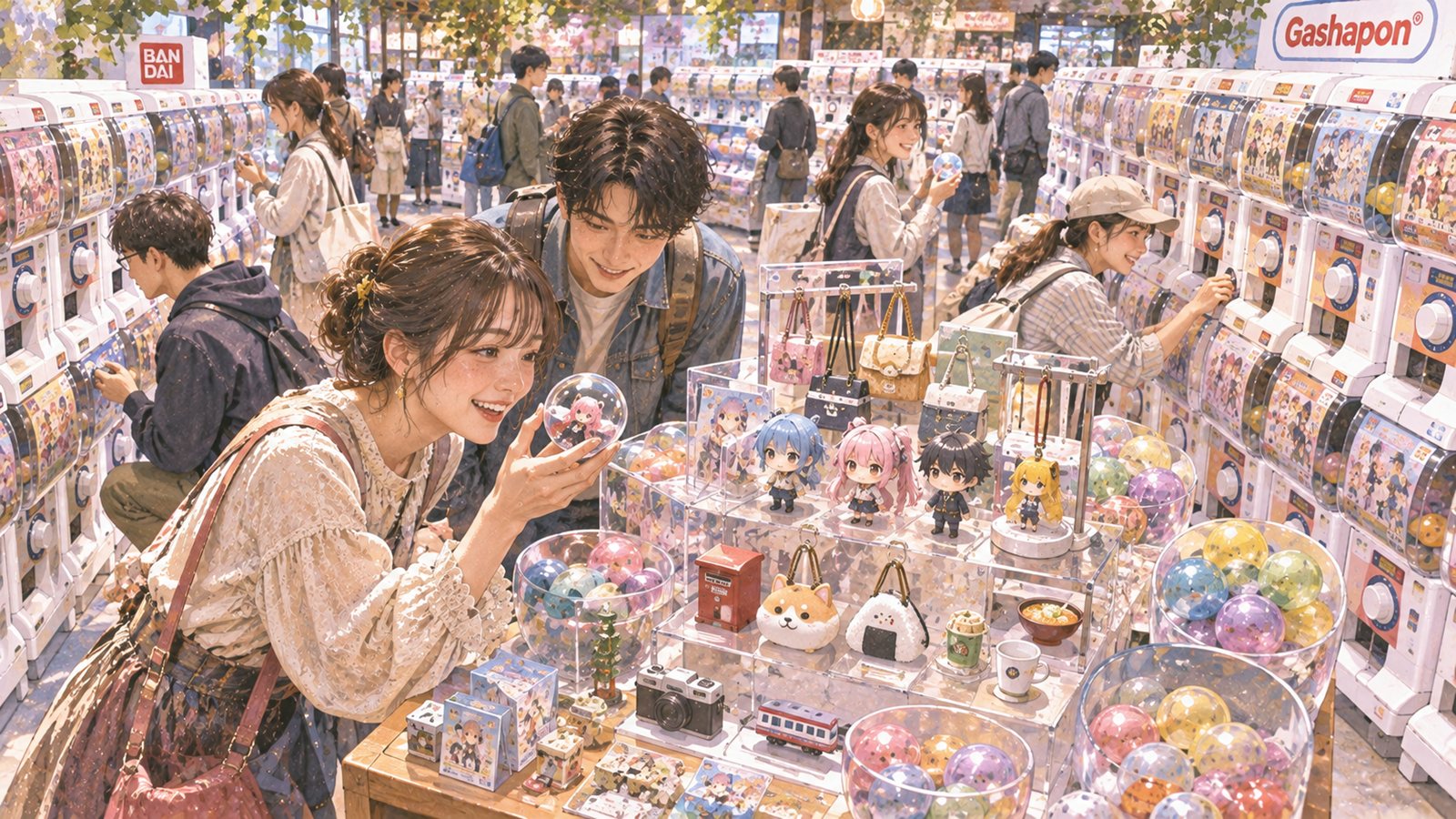
The shop covers just 85.2 square meters, about 25.8 tsubo, yet holds 540 capsule toy machines, each costing 300, 400 or 500 yen per turn. It is called “Gashapon no Department” (Gashapon Department Store), a capsule toy shop run by the group of toy maker Bandai.
A capsule toy is a small toy in a plastic ball that drops out when you insert coins and turn a handle. Shops filled entirely with these machines numbered more than 900 in Japan by the end of January 2026, over 200 more than a year earlier. The business has grown with them: measured by manufacturers’ shipment value, Japan’s capsule toy market was about 72 billion yen in fiscal 2022 and had reached about 196 billion yen by fiscal 2025.
Many people seeing this would say it is because Japanese people love collecting little things. But capsule toys have existed in Japan for 60 years, and the Japanese love of collecting is nothing new. So what has made more and more people willing to spend 500 yen on a single turn? The answer starts with a few capsule toys.
A 10-yen business for kids should have shrunk with the falling birthrate
Japan’s first capsule toy machine was imported from the United States in 1965. A company called Penny Shokai placed it in front of a candy shop in Tokyo, filled with small toys made of early plastics, at 10 yen a turn.
In 1977, Bandai entered the market with cartoon character goods at 100 yen a turn. The norm at the time was 20 yen, so 100 yen was a bold price. But characters gave kids a reason to collect: the Kinnikuman eraser figures launched in 1983 sold a cumulative 180 million units.
In that era, the customers were children, the machines stood outside toy shops, candy stores and supermarkets, and they sold small toys that pocket money could buy. The problem is that Japan has been having fewer and fewer children. In 2024, fewer than 700,000 babies were born in Japan. By that logic, capsule toys should have slowly shrunk. The opposite happened.
“I knew there would be fewer kids, so I focused on adults from the start”
In 2006, 30-year-old Daiki Furuya left the capsule toy maker Yujin and founded Kitan Club.
His reasoning was simple: “I knew the declining birthrate would mean fewer and fewer children, so I focused on adults from the start.”
In 2012, Kitan Club teamed up with a manga artist to launch “Fuchiko on the Cup” (Koppu no Fuchiko), a little figure of a woman that hangs on the rim of a cup. It spread through social media among women in their twenties to forties and had sold more than 20 million units by 2021.
Fuchiko proved one thing: adults buy capsule toys, and they buy them for themselves. Over the next decade, capsule toy companies released one product after another that got adults to open their wallets, and the story behind some of them is even more interesting than the products themselves.
A developer afraid of bugs secretly made a 500-yen pill bug
In 2018, Bandai released a capsule toy called “Dangomushi” (pill bug). The pill bug is a common little creature that rolls itself into a ball when touched, and many children love catching them. Bandai enlarged it ten times into a model that can change from stretched out to rolled up, and did not put it inside a capsule: the rolled-up pill bug is itself the ball, rolling straight out of the machine.
The idea came from Tsuneyuki Honda of Bandai’s capsule toy division. He is actually very afraid of bugs and could barely look at the 3D data of the pill bug’s underside on his computer. But he remembered that kids all love pill bugs, and he thought the image of a bug rolled into a ball dropping out of a capsule machine would be fun.
Bandai’s capsule toys center on cartoon characters, so a bug was a hard sell inside the company. At first Honda did not tell the company and worked on it quietly by himself. At the pitch, he started by playing a video of pill bugs and spent a long time explaining their structure. His colleagues’ first reaction: we get how amazing pill bugs are, but it’s still impossible, isn’t it? He did not give up, and the project was finally approved.
The hard part was “rolling up.” The underside of a pill bug has many parts, and when you roll it they jam against each other, ending up in a “<" shape rather than a ball; make the shell plates bigger and gaps appear between them, make them smaller and the model will not open. He made prototype after prototype, and after about a year, on the fifth or sixth prototype, the head and tail finally met cleanly. Real pill bugs have fine hairs on their legs; he deliberately left them out so the model would look cuter.
The pill bug cost 500 yen. Most capsule toys at the time cost 200 to 300 yen, so 500 yen was a premium price aimed at adults. After its release it quickly became a hot topic online, and the first batch stayed sold out for a long time. Honda says that after about two or three days, everyone starts calling it cute.
This line of enlarged, realistic creatures later became Bandai’s “Ikimono Daizukan” (Big Encyclopedia of Living Things) series, which had sold a cumulative 10 million units by 2023. The pill bug proved that adults will pay 500 yen for something that is “realistic and surprising.”
Made to tell umbrellas apart, now hanging all over bags
Another hit started from something even more modest.
In 2020, Bandai launched “Mejirushi Accessory” (marker accessories). Their original purpose was simple: hang one on an umbrella that looks just like everyone else’s so you can recognize your own.
Then buyers discovered they did not have to stay on umbrellas. People hung them on bags, keys and phones, several at a time, and some wore their favorite characters as part of oshikatsu. Oshikatsu means supporting a favorite idol or anime character by buying merchandise and displaying your collection. The main buyers are women in their twenties and thirties.
By September 2026, the series had shipped more than 200 million units worldwide. Bandai’s development lead observes that more people now enjoy customizing the things around them to their own taste, rather than caring about practicality.
A small marker for finding your umbrella became a way for adults to decorate themselves. Capsule toys now sell not just toys, but small accessories for everyday life.
Vintage furniture you can no longer buy, shrunk to palm size
The third hit sells nostalgia.
Karimoku 60 is a furniture brand launched in 2002 by the Japanese furniture maker Karimoku. In July 2019, the capsule toy company Kenelephant obtained a license and turned the furniture into miniatures, right down to the brand nameplate on the real chairs. Each cost 500 yen and was recommended for ages 15 and up.
The series later added discontinued pieces from the 1960s to 1980s. By November 2022, more than 1.2 million units had been produced across the series.
It targeted not children but capsule toy fans and adults who love furniture. You may not be able to afford or fit a real sofa, and some models were discontinued long ago; as a capsule toy, 500 yen puts one on your desk.
A puppy doing its business sold 270,000 units
The last one is a capsule toy that makes people laugh the moment they see it.
In November 2024, toy company Takara Tomy A.R.T.S launched “Funbari-nu,” depicting a puppy squatting to relieve itself. The idea came when developer Wakana Morita saw a friend’s toy poodle squatting to pee and immediately thought, “This is it.”
The pose needs no explanation; anyone gets it at a glance. To make the puppies look real, the sculpts were shaped by hand by a sculptor rather than modeled only on a computer, because a slight asymmetry makes them look more alive. Morita says she did not want to make it a gag product. The instructions are printed in brown and come with a few strips of brown paper, which buyers roll into “poop” and place behind the puppy.
The first series sold more than 270,000 units.
All of these hits were made for adults
Put these products side by side and one thing stands out: none of them was designed for children.
The pill bug amazes adults with its realism; the marker accessories let adults decorate bags and phones; the miniature furniture sells adult nostalgia; Funbari-nu gets a laugh with a pose that needs no words. A head of Bandai’s capsule toy business says about 60% to 70% of its capsule toy customers are now women in their twenties and thirties.
When the customers became adults, prices changed too. The typical price is now 300 to 500 yen, Bandai also sells 800-yen and 1,500-yen capsule toys, and its machines now accept 500-yen coins. A child’s pocket money has a ceiling; an adult’s wallet is much deeper. And because adults will pay 500 yen, products like the pill bug, which took a year to develop and has many parts, can be made at all.
The number of products is growing as well. Bandai releases more than 120 new capsule toys a month, about 1,530 a year. The more variety there is, the more adults with different interests can find a machine they want to turn in a long row.
Empty mall units gave capsule toys a place to be seen
Once products were made for adults, they needed somewhere adults would pass by.
In 2014, capsule toy operator Lulu Ark opened three shops designed for collectors, and within three months sales had fallen by half. Its head, Ippei Matsui, found that the real regulars were adult women who did not usually play capsule toys. In 2017 they renamed the shops “Gachagacha no Mori” (Capsule Toy Forest), targeted adult women as their main customers and stacked machines only three or four high so adults could see everything while standing. During the pandemic years, the chain’s sales were about six times those of 2016.
During the pandemic, many shopping malls had more empty units, and capsule toy shops spread by using the spaces left by closed stores. Capsule toy machines need no electrical work; you line them up and start selling. They need no cashiers either, just someone to restock and fix breakdowns. Yusuke Tsuzuki, representative director of the Japan Capsule Toy Association, says that grouping several hundred machines into a dedicated shop brought in more sales than expected.
But empty units can explain why capsule toy shops could open; they cannot explain why customers want to walk in. Matsui himself says the pandemic is not what drove their store openings. What really brings people in are products worth a special trip.
Very profitable, but whether a shop survives depends on its products
This business is very profitable right now. The entertainment division of Happinet, Japan’s largest capsule toy wholesaler, had sales of about 31.1 billion yen from April to September 2025, up 22.6% year on year, of which capsule toys made up about 25 billion yen, or 80%. Bandai holds about 57% of Japan’s capsule toy market and shipped more than 220 million capsules in fiscal 2024.
The risks are also clear. Some already call this the problem of “too many capsule toy shops.” Tsuzuki himself says the current boom is somewhat overheated and that customers are shifting from “impulse buying,” turning a machine just because they see it, to “destination buying,” making a special trip for one particular product. Capsule toys are usually ordered three months before release and produced to order, and popular items often are not restocked once they sell out, so a shop that picks the wrong products has a hard time recovering.
Customers shifting to “destination buying” pushes the center of gravity of this business back to the products themselves. The shops that survive will be those that choose their products well, not those that simply fill the floor with machines.
Back to the opening question. Capsule toy machines are everywhere in Japan not because Japanese people suddenly love collecting more, nor only because shopping malls freed up space. A business that the falling birthrate seemed to have doomed to shrink switched its customers from children to adults, thanks to a pill bug that rolls into a ball, a little marker hanging on a bag and a vintage sofa you can no longer buy.
Notes
- The market size figures are the Japan Capsule Toy Association’s numbers based on manufacturers’ shipment value; Bandai publishes its own estimate using a different method, which this article does not use.
- “About 60% to 70% are women in their twenties and thirties” refers to Bandai’s capsule toy customers, not the entire capsule toy market.
- The 200 million Mejirushi Accessories are cumulative worldwide shipments; the 1.2 million Karimoku 60 miniatures are cumulative production for the whole series; the 270,000 Funbari-nu are cumulative sales of the first series.
- The 10 million units of the Ikimono Daizukan series is the 2023 figure.
- “Funbari-nu” combines the Japanese words for “straining to squat” and “dog.”
References
- Bandai Namco Amusement | 「ガシャポンのデパート イトーヨーカドー大和鶴間店」 opening press release | 2025-12-05 | Link (opening date, floor area, number of machines, prices)
- Real Sound | カプセルトイ市場 2025年度 1,960億円 | 2026-05-12 | Link (FY2024 and FY2025 market size, more than 900 dedicated shops)
- Monex Securities Manecli | カプセルトイ市場と関連銘柄 | 2024-05-16 | Link (FY2022 and FY2023 market size)
- Monex Securities Manecli | カプセルトイ関連銘柄 | 2026-08-20 | Link (number of dedicated shops)
- Business+IT | 人気すぎて「販売中止」「ガチャ活疲れ」も…カプセルトイ市場に異変 | 2026-09-22 | Link (Yusuke Tsuzuki on dedicated shops, overheating, shift from impulse to destination buying)
- nippon.com | ガチャガチャの歴史 | 2021-11-17 | Link (first machine in 1965, early prices, Bandai’s entry in 1977, Kinnikuman erasers, Fuchiko on the Cup, Daiki Furuya)
- Shukan Josei PRIME | カプセルトイのブームの歴史 | 2026-07-27 | Link (spread of Fuchiko among women in their twenties to forties)
- ITmedia NEWS | 「まさかのダンゴムシです」 商品化を勝ち取った虫嫌いの開発者 | 2018-06-10 | Link (development of the pill bug, price, Tsuneyuki Honda’s comments)
- MONOist | 大ヒット商品はこうして生まれた! カプセルトイ「だんごむし」ができるまで | 2019-02-07 | Link (ten-times scale, online buzz and sellouts)
- Business Insider Japan | Gashapon | 2023-07-19 | Link (Ikimono Daizukan series cumulative 10 million units)
- FASHIONSNAP | Bandai Gashapon “Mejirushi Accessory” | 2026-11-11 | Link (origin, uses, customers, 200 million shipped worldwide)
- value-press | Kenelephant 「カリモク60 ミニチュアファニチャー」 | 2022-07-05 | Link (2019 launch, license, 500 yen, ages 15 and up)
- value-press | Kenelephant 「オールドカリモクコレクション 第2弾」 | 2022-11-07 | Link (discontinued models, 1.2 million produced in the series)
- @DIME | Takara Tomy A.R.T.S 「ふんばり~ぬ」 | 2025-12-18 | Link (developer Wakana Morita, handmade sculpts, paper strip play, sales)
- PRESIDENT Online | Bandai Gashapon | 2026-02-28 | Link (customers mainly women in their twenties and thirties, typical prices, annual new releases, market share)
- Toyo Keizai Online | Bandai “Gashapon” | 2025-09-07 | Link (shipments, premium products and 500-yen coins)
- Business Journal | 「ガチャガチャの森」売上6倍の秘策 | 2022-09-06 | Link (Lulu Ark’s 2014 setback and 2017 rename, Ippei Matsui, ordering three months before release)
- Real Sound | 「カプセルトイショップ増えすぎ問題」は解決できる? | 2024-10-12 | Link (empty mall units, no electrical work needed, “too many shops” problem)
- Gendai Business | GEO 「カプセル楽局」 | 2025-06-18 | Link (use of empty units after the pandemic)
- gamebiz | Happinet interim results to September | Link (entertainment division and capsule toy sales)
- Toyo Keizai Online | Happinet (Shikiho sponsored article) | 2025-10-01 | Link (number of births)
Follow the story in person
Join a small-group trip to the places in our stories and meet the people who live and work there.
See trips and dates
Water Mirror is a Tokyo-based company that helps more people step inside industries and explore the stories and cultures of different fields around the world. We design in-depth learning programs for individuals, companies, schools and organizations, combining company visits, exchanges with professionals, local learning and hands-on experiences, so participants can see how industries really work and meet the people and stories behind them. Water Mirror Insights is our content media, telling the distinctive stories of industries, local cultures and people, so that reading sparks curiosity and leads readers to go and see for themselves.
About Water Mirror →