Key Takeaways
- Onigiri (rice balls) are the best-selling food at Japanese convenience stores. When 7-Eleven opened its first store in Japan in 1974, it sold only two or three a day; in fiscal 2021 it sold about 2 billion in a year, and the company calls onigiri its most important product.
- Industry analysts estimate that ingredients make up about 70% of an onigiri’s price, so the margin is thin. Convenience stores still treat it as a core product because many customers come in to buy onigiri and pick up a drink or dessert while they are there; steady, massive demand also makes dedicated factories and delivery networks pay off.
- Three systems keep fresh onigiri on the shelves every day: since 1979, suppliers have formed a cooperative to share know-how and buy ingredients together; joint delivery cut the trucks arriving at each store daily from about 70 to about 9, with rice products made and delivered three times a day; and each store forecasts and orders on its own based on the weather and local events.
- Since rice prices began rising in 2024, 7-Eleven’s tuna mayo onigiri has gone from 128 yen to 196 yen, yet it remains the top seller at every chain. Using new hygiene technology to keep onigiri at good quality longer, 7-Eleven began cutting production from three times a day to twice in 2026, using the savings to hold down prices.
In May 1974, 7-Eleven opened its first store in Japan. Onigiri were on the shelves from day one, but only two or three sold each day.
Half a century later, 7-Eleven alone sold about 2 billion onigiri in fiscal 2021, more than 5 million a day on average. A company executive put it plainly: onigiri are 7-Eleven’s most important product.
The odd thing is that this “most important product” is not very profitable. According to industry analysis, ingredients account for about 70% of an onigiri’s price. For a 150-yen onigiri, the rice, nori, filling and packaging cost over 100 yen, and what is left has to cover the factory, the trucks and the store.
Japanese people can make onigiri at home, so why do they pay for them every day? And why do the three big convenience store chains push such a low-margin product so hard? The answer is not in the rice ball itself, but in an entire invisible system behind it.
A plastic film and a schoolchild made onigiri something you cannot make at home
In 1970s Japan, onigiri were something a mother made in the morning for the family to take to school or work. Paying for a cold rice ball at a store seemed a little strange at the time, and some people inside 7-Eleven worried it would not sell at all. Toshifumi Suzuki, then president, disagreed: he believed more and more people would buy their meals outside the home, so it was worth doing.
But store-bought onigiri had a problem homemade ones did not: time. Homemade onigiri are eaten soon after they are made, while store onigiri sit on the shelf for hours, and nori turns soft and sticks to the rice once it absorbs the moisture.
In 1978, 7-Eleven launched the industry’s first “hand-rolled onigiri.” A layer of plastic film separated the nori from the rice; when customers opened the package, the film slid out and the nori wrapped around the rice, staying crisp. In 1986, 7-Eleven and a packaging maker developed the tear-strip wrapper that everyone knows today.
That film gave convenience store onigiri, for the first time, a texture you could not get at home.
The same went for flavors. Early fillings were mostly kombu, salmon and pickled plum. In 1983, 7-Eleven launched tuna mayo onigiri, reportedly inspired by a schoolchild who ate rice mixed with mayonnaise. It was a flavor rarely found in homemade onigiri, yet it became the signature of convenience store onigiri. In 2025, it was the best-selling onigiri at all four chains: 7-Eleven, FamilyMart, Lawson and Ministop.
From 70 trucks to 9: many factories making the same rice ball
Once there was a product that sold, the next question was how to sell equally fresh, equally tasty onigiri every day across thousands of stores, and later more than 20,000.
7-Eleven does not make onigiri itself; it outsources production to outside food factories. As the number of stores grew, different regions were supplied by different factories, and a “salmon onigiri” could taste different depending on where you bought it. In 1979, the companies supplying onigiri and prepared foods to 7-Eleven formed a cooperative, NDF (Nihon Delica Foods Cooperative), to share know-how and narrow quality gaps among manufacturers, and later to buy ingredients together.
It is a bit like a group of small restaurants forming an alliance, using the same recipe book and going to the wholesale market together. Each still cooks on its own, but customers get roughly the same taste wherever they eat, and the purchase prices are lower than going it alone. By 2025, 7-Eleven had 154 dedicated fresh-food production sites nationwide, with central kitchens running 24 hours and robots helping shape the rice in some steps.
This division of labor works for both sides. 7-Eleven can keep a single national standard without building a hundred factories itself, and small and mid-sized food makers, with a stable major customer and the scale of joint purchasing, can afford dedicated equipment.
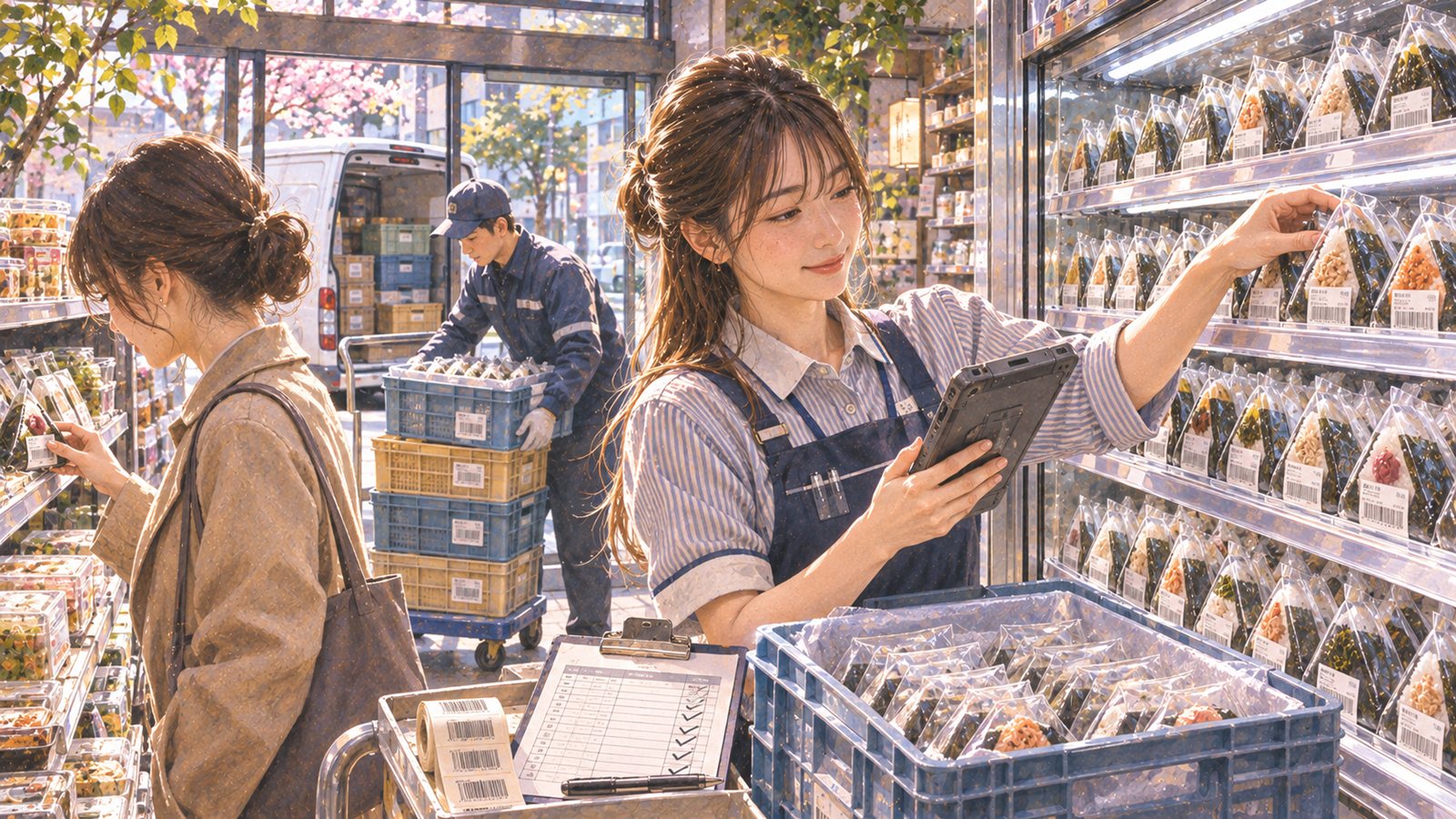
The finished onigiri then have to reach the stores. When 7-Eleven first opened, each supplier delivered separately, and a single store received about 70 trucks a day. It then switched to “joint delivery”: suppliers first send products to a dedicated distribution center, where they are sorted by the right temperature, and one truck delivers to several stores in a single run. The number of delivery trucks per store per day fell from about 70 to about 9.
Delivery frequency changed too. Rice products went from one delivery a day to being made three times and delivered three times a day. Convenience store onigiri cannot be made fresh to order, yet they stay fresh, not because they last long, but because they spend very little time on the shelf.
The person deciding how many plum onigiri to order tomorrow is a high school part-timer
Delivering three times a day assumes that every store can calculate exactly how many it will need in the next batch. Order too many and they get thrown away; order too few and customers find nothing to buy.
In 1983, 7-Eleven became the first company in Japan to install POS systems in all its stores, recording at checkout how many of each item sold and when. But Toshifumi Suzuki stressed again and again that data is only for testing hypotheses. 7-Eleven’s approach is called “single-item management”: for each item, store staff first make a forecast and place the order, then use the sales data to check whether they guessed right.
Suzuki often gave an example. At a seaside 7-Eleven, the forecast called for fine weekend weather, good for fishing, with a hot afternoon. The staff guessed that anglers heading out early would want plum onigiri, which do not spoil easily, so they ordered extra, put them in a more visible spot and added a handwritten recommendation card. If plum onigiri really did sell well the next day, that judgment could be used again next time.
Headquarters sends each store’s computer an hour-by-hour weather forecast for the coming week, and orders are placed not only by the store manager but also by part-timers in charge of specific product categories, sometimes even high school students. In Suzuki’s words: you order not because something “sold,” but because you “think it will sell.”
In fiscal 2025, an average 7-Eleven store sold 699,000 yen a day, while FamilyMart and Lawson were both below 600,000 yen. Not all of the gap comes from onigiri, but this ordering method, in which each store makes its own forecasts, is often cited as one reason for 7-Eleven’s lead.
Scaled up nationwide, this method also reveals regional differences. People in Hokkaido, Tohoku and Niigata prefer onigiri with salted salmon roe, while Okinawa loves beef and shrimp mayo. One set of factory standards plus each store’s own judgment means the onigiri on the shelf can be consistent nationwide and still suit local tastes.
Sweet even when cold: re-blending the rice itself
With factories, trucks and ordering in place, one fundamental problem remained: convenience store onigiri are eaten cold, and rice tends to harden and lose its sweetness once it cools.
In 2023, 7-Eleven brought in Hachidaime Gihey, a Kyoto rice shop founded in 1787, to supervise the rice for its onigiri. They cooked and tasted all 70 regional varieties, adjusted ratios in 5% steps and tried 50 blends. In the end they chose not a single brand-name rice, but a blend that “stays sweet even when cold.” It is the same idea as a café’s house blend of coffee beans: to make a latte that still tastes good cold, you usually need a blend.
Ingredients at 70% and still a top priority, because customers come in for it
Back to the question at the start. If onigiri margins are so thin, why do convenience stores treat them as their most important product?
The main reason is that onigiri are the reason people walk into the store. Among the foods convenience stores sell, onigiri sell the most units. Many people come in at lunchtime to buy one or two, then grab a bottle of tea, a coffee or a dessert. When 7-Eleven launched smaller onigiri, the person in charge noted that customers like to buy items together, and a smaller rice ball makes them willing to pick up one more thing. The onigiri earns little, but the bottle of tea it brings in may earn a lot.
High onigiri volume also supports the whole system. Factories running 24 hours and trucks making several runs a day only pay off with steady volume. Demand of more than 5 million a day lets the cost of factories, distribution centers and temperature control be spread across every single rice ball.
So onigiri are a “traffic driver”: they earn little themselves but decide whether customers come in every day. The moat of this business is not any particular flavor; anyone can make tuna mayo. What is hard to copy is the network of more than 20,000 stores, over a hundred factories and about 9 trucks per store per day. The flip side is that this is also where the risk lies: when rice, labor and logistics costs rise, the already thin margin is the first to be squeezed.
After rice prices rose, 7-Eleven cut production from three times a day to two
That risk became real in 2024. Japanese rice prices rose sharply, and 7-Eleven’s tuna mayo onigiri went from 128 yen in 2024 to 196 yen by February 2026.
The price increase did not change what customers chose; tuna mayo remains number one at every chain. What changed was the shelf: on one side, cheaper onigiri without nori; on the other, larger ones, so customers can buy one big rice ball instead of two small ones. Lawson and FamilyMart also began selling frozen onigiri, which keep longer and do not need several deliveries a day.
7-Eleven’s response went back to the system itself. Working with universities, it identified the bacteria and contamination routes that spoil food and raised hygiene standards at its factories, so onigiri can stay at good quality longer. From February 2026, about 1,000 stores in Hokkaido switched onigiri and bento production from three times a day to twice, cutting manufacturing labor costs by about 10% and delivery costs by about 15%. In September of that year it expanded to 1,750 stores in parts of Tohoku, Shikoku and Chiba, aiming for nationwide rollout in spring 2027, with the savings used to hold down prices.
Fifty years ago, 7-Eleven bought freshness by “delivering more often.” Now it keeps things fresh by “making them last longer.” The method has changed, but the goal has not: making a rice ball that costs just over 100 yen worth walking into the store for, every day.
There is a 49-year-old man who has eaten two 7-Eleven onigiri every day for ten years. Asked whether he ever gets tired of them, he said he does not. Behind that remark are more than a hundred factories, trucks making several runs a day and countless store staff placing orders while watching the weather forecast.
The cheaper and more everyday a product is, the more it tests the invisible system behind it. Anyone can learn the recipe for tuna mayo; what is truly hard to imitate about Japanese convenience stores is the ability to put millions of onigiri on the shelves, on time and fresh, every single day.
Notes
- 7-Eleven’s annual onigiri sales vary by year: about 2.27 billion in fiscal 2018 and about 2 billion in fiscal 2021. This article uses the fiscal 2021 figure.
- The estimate that ingredients account for about 70% of the price comes from a retail researcher; the chains do not disclose onigiri cost ratios.
- There are two accounts of where the tuna mayo idea came from, “the developer’s own child” and “a supplier’s child”; this article says only “a schoolchild.”
References
- Impress Watch | 一口食べて違いが分かる、セブン-イレブン×八代目儀兵衛の「おにぎり」4品発売 | 2023-03-15 | https://gourmet.watch.impress.co.jp/docs/news/1485795.html (2 billion in FY2021, most important product, first store in 1974, three daily production and delivery runs, rice blending tests)
- Walker Plus | “コンビニおにぎり”はセブン-イレブンが元祖だった! | 2024-02-23 | https://www.walkerplus.com/article/1179363/ (two or three a day at launch, 1978 hand-rolled onigiri, 1986 tear-strip packaging, 1983 tuna mayo)
- PRESIDENT Online | おにぎりの絶対王者「ツナマヨ」誕生秘話 | 2018-10-29 | https://president.jp/articles/-/26552 (Toshifumi Suzuki’s decision, internal doubts)
- Money Post WEB | 【コンビニ解剖】業界トップ「セブン-イレブン」の強みは”食”へのこだわり | 2024-03-17 | https://www.moneypost.jp/1124359/2/ (early fillings, origin of tuna mayo)
- PRESIDENT Online | 「コメ価格高騰」の折りも折り…コンビニ3社がこぞって原価率の高い”おにぎり”を強化する意外な理由 (Kazuo Shiratori) | 2025-04-05 | https://president.jp/articles/-/94022 (about 70% ingredient cost, 154 production sites, 24-hour central kitchens, frozen onigiri)
- Toyo Keizai Online | コンビニの王者セブンの棚を支える納品システム 全国2万店超、1店に1日9台のトラックが到着 | 2025-02-24 | https://toyokeizai.net/articles/-/858536 (NDF’s founding in 1979 and role, 20,000+ stores, 9 trucks per store per day)
- Ministry of Economy, Trade and Industry | セブン-イレブン物流:エコへの取組み (Energy Conservation Subcommittee, Document 5-1) | 2017 | https://www.meti.go.jp/shingikai/enecho/shoene_shinene/sho_energy/pdf/023_05_01.pdf (trucks per store per day cut from about 70 to about 9, temperature-zone joint delivery)
- PRESIDENT Online | Toshifumi Suzuki on POS and hypothesis testing (interviewer: Akira Katsumi) | 2014-01-06 | https://president.jp/articles/-/11579 (POS in all stores in 1983, data for testing hypotheses, high school part-timers placing orders)
- Gendai Business | 作業をするな、仕事をしろ! 〜ビジネスのキモは「仮説の立て方」にある (Toshifumi Suzuki) | 2016-01-22 | https://gendai.media/articles/-/47473 (plum onigiri example, ordering because you “think it will sell”)
- PRESIDENT Online | Akira Katsumi on 7-Eleven’s single-item management | 2026-06-26 | https://president.jp/articles/-/115186 (definition of single-item management, FY2025 average daily sales per store at the three chains)
- Weathernews | Seven & i public relations on weather and ordering | 2017 | https://weathernews.jp/soramagazine/201707/02/ (hourly forecasts for the week sent to stores, ordering divided by category)
- Wa-gaku web | セブン-イレブンで一番売れるおにぎりは? 地方によって差はあるの? 大調査! | 2019-09-30 | https://intojapanwaraku.com/rock/gourmet-rock/33864/ (FY2018 sales, regional preferences)
- Gendai Business | Hideko Yoshioka on convenience store onigiri | 2018-05-18 | https://gendai.media/articles/-/55661 (onigiri sell the most units, smaller onigiri encouraging add-on purchases)
- Ichioshi | 【コンビニ順位】なぜ値上げしても「ツナマヨ」を買う?2025年「おにぎりランキング」各社ベスト5! | 2026-03-10 | https://ichioshi.allabout.co.jp/articles/limited/36804 (tuna mayo is number one at all four chains, low-price and large-size items, frozen onigiri)
- Ichioshi | 【悲報】コンビニおにぎり200円時代到来? (Ichika Aiba) | 2026-02-26 | https://ichioshi.allabout.co.jp/articles/limited/36580 (price rise to 196 yen in February 2026)
- Nihon Shokuryo Shimbun | 7-Eleven cuts rice product production in Hokkaido to twice a day (Hitoshi Yamamoto) | 2026-02-10 | https://news.nissyoku.co.jp/flash/1261110 (Hokkaido change from three times a day to two)
- Nihon Shokuryo Shimbun | セブン-イレブン・ジャパン、供給網改革で売価抑制 | 2026-04-13 | https://news.nissyoku.co.jp/news/yamamotoh20260410063148176 (savings used to hold down prices)
- Newswitch | セブンが国内物流再構築、コスト下げて価格競争力高める | 2026-04-27 | https://newswitch.jp/p/49031 (labor costs down about 10%, delivery costs down about 15%)
- LOGI-TODAY | セブン‐イレブン、食品製造3回から2回へ広域化 | 2026-09-01 | https://www.logi-today.com/994756 (1,750 stores, spring 2027 target, hygiene technology extending quality retention)
- Bunshun Online | 10年にわたり”セブンイレブンのおにぎり2個生活”を続ける男性 | 2025-10-04 | https://bunshun.jp/articles/-/82372 (man who has eaten two onigiri a day for ten years, Hachidaime Gihey’s founding year)
Follow the story in person
Join a small-group trip to the places in our stories and meet the people who live and work there.
See trips and dates
Water Mirror is a Tokyo-based company that helps more people step inside industries and explore the stories and cultures of different fields around the world. We design in-depth learning programs for individuals, companies, schools and organizations, combining company visits, exchanges with professionals, local learning and hands-on experiences, so participants can see how industries really work and meet the people and stories behind them. Water Mirror Insights is our content media, telling the distinctive stories of industries, local cultures and people, so that reading sparks curiosity and leads readers to go and see for themselves.
About Water Mirror →