Key Points
- Harajuku’s influence on global fashion didn’t come from any one brand, but from the way ordinary young people put their own outfits together. In the mid-1990s, Harajuku’s youth mixed kimono sashes and wooden geta with secondhand and hand-altered clothes, each with a look all their own.
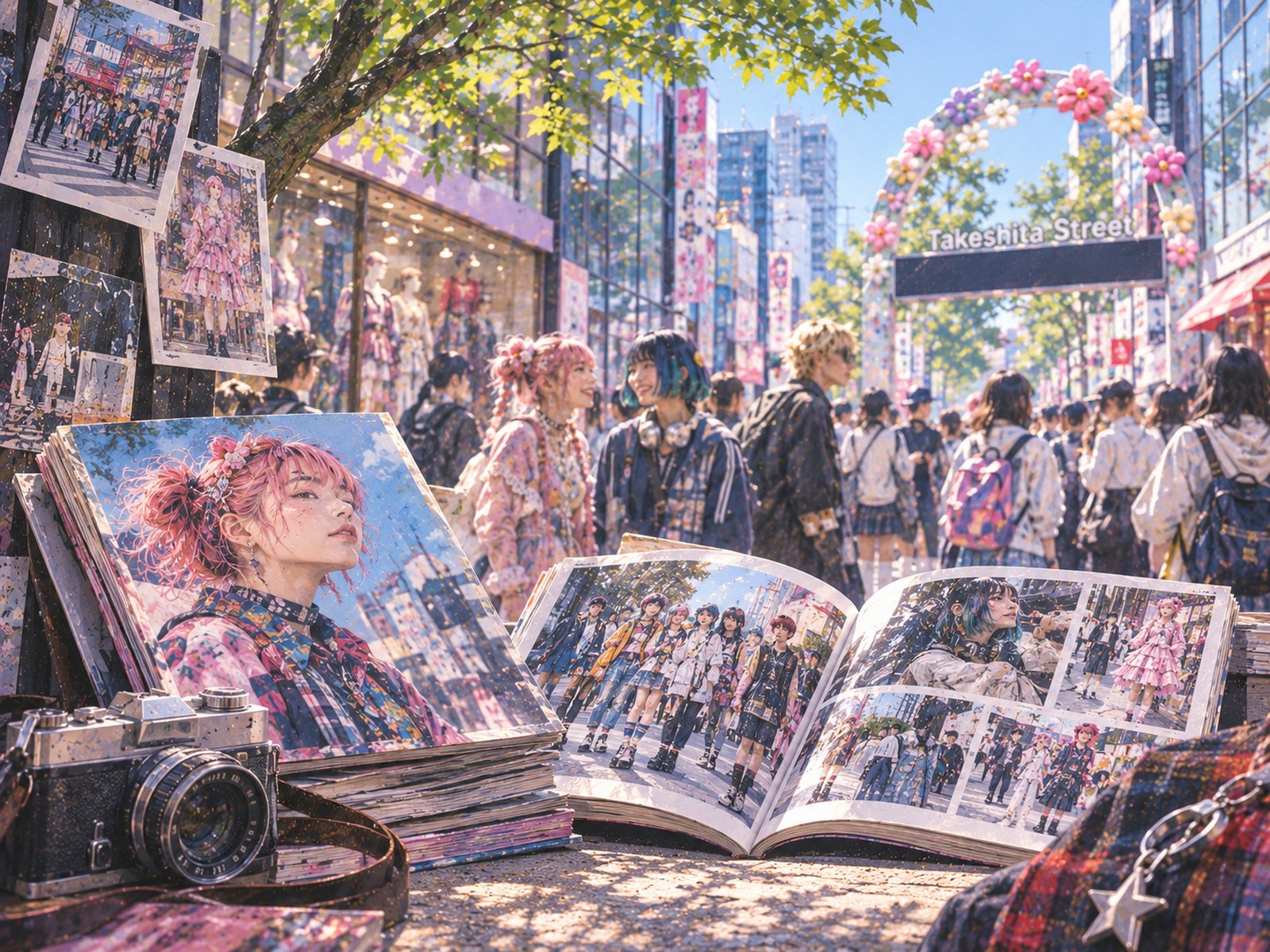
- Photographer Shoichi Aoki launched the street snap magazine FRUiTS in 1997. Each page showed a single Harajuku passerby, with notes on where their clothes came from, their age and their interests. Over 20 years it published 233 issues, and through photo books from an overseas publisher and touring exhibitions, it made Harajuku street style widely known in Europe, the U.S. and Australia.
- Harajuku could produce these styles because several conditions overlapped. The pedestrian-only streets closed to cars every Sunday from 1977 to 1998 gave young people a place to “be seen.” Laforet Harajuku and the shops in the back streets gave new brands a place to start. And young people arriving from all over Japan brought every kind of taste.
- In 2017, FRUiTS stopped publishing monthly. Aoki explained that the streets no longer offered an environment where style could slowly mature, and that young people now showed themselves off online. But he still shoots in Harajuku, and in 2024 he held a retrospective at Laforet Harajuku.
In June 1997, an unusual magazine appeared in Tokyo. It was called FRUiTS, and it did just one thing: photograph interestingly dressed young people on the streets of Harajuku. No celebrities, no models. Each page was a single passerby, shot head to toe.
Its founder, Shoichi Aoki, photographed Harajuku for twenty years and published 233 issues. Those street photos were later turned into photo books that reached bookshops and museums overseas, showing people around the world how young people in Harajuku dressed.
How did ordinary young people on one street come to influence the way the whole world dresses? To answer that, we need to go back to when Aoki first started photographing strangers.
Why did a programmer go to Paris to photograph strangers?
Shoichi Aoki was born in Tokyo in 1955 and started out as a computer programmer. In the 1980s he quit his job and wandered around Europe for about six months. In Paris he noticed that the way locals dressed was completely different from the Japanese, and arrived at an idea that would run through the rest of his life: real fashion is what people on the street actually wear.
In 1985 he launched his first magazine, STREET, devoted to street fashion in London and Paris. At the time almost nobody was systematically documenting what passersby wore. “It just wasn’t a concept back then,” he recalls. He compares the work to collecting butterfly specimens in junior high, except this time he was collecting clothes.
In 1996, Harajuku’s youth stopped dressing alike
In 1980s Japan, young people were into “DC brands,” clothing from a wave of Japanese designer and character brands. The craze lasted about a decade, but despite being called “character” brands, people on the street often wore the same few labels in the same style.
After the craze faded, Aoki noticed that Harajuku’s streets had suddenly changed. Around 1996, young people began mixing different brands, altering their clothes themselves, and even pairing kimono, sashes and geta with secondhand clothes, handmade pieces and work by alternative designers. Each person had a look that was theirs alone, and many of those leading the way were fashion school students. As he puts it, “a new kind of fashion was emerging, but no one understood how important it was.”
One day, near Laforet Harajuku, the fashion building at a major Harajuku intersection, he saw two young people dressed so strikingly that he felt fashion was truly on the move. He decided to start a new magazine for Harajuku.
On the first Sunday after making that decision, he walked into Harajuku’s pedestrian zone with his camera, a little nervously. The first person he stopped was a girl who later appeared on the cover of the trial issue. She had “a really strong presence,” he says. In June 1997, the first issue of FRUiTS came out.
Why Harajuku? A road closed to cars on Sundays
The road Aoki walked into had a story of its own.
In 1977, Harajuku began holding “hokoten,” short for “hokosha tengoku,” or “pedestrian paradise.” Every Sunday, the road next to Yoyogi Park was closed to traffic and handed over to people on foot. It’s said this was originally meant to stop biker gangs from making noise on Omotesando. As it turned out, the empty asphalt became Tokyo’s biggest open-air stage.
Around 1980, groups of young people in brightly colored, baggy outfits, dancing together to disco music from boomboxes, became a social phenomenon there. The media called them the “Takenoko-zoku,” the “bamboo shoot tribe,” a name that came from Boutique Takenoko, a clothing shop that opened on Takeshita Street in 1979. The shop made a two-piece dance outfit with wide sleeves that was easy to move in. It cost a little over 3,000 yen and sold 150 sets on the day it launched. The story goes that the first person to dance outdoors was a high school boy the owner knew. Too young to get into discos, he played music in front of the shop and started dancing, and more and more young people like him gathered. The shop is still open on Takeshita Street today. In the late 1980s, bands took over the pedestrian zone, and groups like THE BOOM, which later became famous, got their start there.
If people are performing in the street, there needs to be somewhere nearby to buy clothes. Laforet Harajuku, which opened in 1978, remade its shops to be wide and shallow so that you could see every store from the central staircase. Brands that later became famous, like Hysteric Glamour, opened their first stores there. In the 1990s, small shops began appearing in the residential back streets on the other side of the station. In 1993, NIGO and Jun Takahashi used their modest savings to open NOWHERE, and the area later came to be called “Ura-Harajuku,” the back side of Harajuku.
Aoki says the kids hung out in Harajuku because their friends also dressed up cool and came there, and because Tokyo has so many people from different places that “it’s not just about age.”
A road where you could stand and be seen, a building where small brands could start out, a few back streets with affordable rent, and a crowd of young people who wanted their friends to see them. Harajuku wasn’t designed by anyone to be a fashion center. It grew slowly out of these conditions stacking up.
One person per page: how FRUiTS was made
FRUiTS had a simple layout. One photo filled the page, and a narrow white strip at the bottom listed what the person was wearing, where they bought it, their style inspiration, their age and their interests. The magazine carried almost no ads, and the few it did run were only from Harajuku shops.
Most fashion magazines tell readers “here’s how to dress this season.” FRUiTS handed the spotlight back to the people wearing the clothes: she came up with this herself, and she found these clothes herself.
Aoki says he only cared about “how beautiful an outfit is,” and that he felt like he was collecting works of art. He deliberately never waited in a fixed spot, because once people knew where the photographer stood, a crowd of people who just wanted to be photographed would gather and scare off the genuinely interesting kids. At his peak he shot about 80 people a month. On Sundays he could shoot more than ten, but on weekdays often only two or three.
In the late 1990s, a style called “decora” took off in Harajuku: bright colors, heads full of little hair clips, and bodies hung with accessories and toys. Many people thought it was over the top, but Aoki said this was real fashion, born in Harajuku.
From a small Harajuku magazine to bookstores and museums abroad
How did a small magazine published only in Tokyo let the whole world see Harajuku?
First, distribution. Aoki had built up overseas distribution experience with STREET, so FRUiTS could be stocked at Tower Records and independent bookstores in many countries, giving it overseas readers before social media existed. Then came books. In 2001, the London art publisher Phaidon published the photo book Fruits, followed in 2005 by Fresh Fruits, both edited specifically for international readers. Later, Australia’s Powerhouse Museum turned the photos into a touring exhibition that traveled across Australia and New Zealand.
That’s very different from how fashion trends usually spread. Trends from Paris or Milan come from designers showing new collections on the runway. What Harajuku sent around the world was photo after photo of ordinary young people. What readers abroad saw wasn’t “what to buy this season,” but “oh, so clothes can be worn like this.”
The clearest example is the singer Kyary Pamyu Pamyu. She started as a fashion blogger and later modeled for Harajuku-style fashion magazines. In 2011, her music video for “PONPONPON” went viral on YouTube. Its art director was Sebastian Masuda, an artist who opened the accessory shop 6%DOKIDOKI in Ura-Harajuku in 1995. The next year she performed at Japan Expo, the Japanese culture convention in Paris, in front of 13,000 people, and from 2013 she toured the U.S., Europe and Asia several times. Aoki said of her that when she first appeared, she looked really “weird.” The kind of Harajuku style that strikes people as strange at first glance went out to the world through a single music video.
After the pedestrian zone disappeared, how did Harajuku’s streets change?
In 1998, Harajuku’s pedestrian zone was abolished, and the road reopened to cars on Sundays. The open space where the Takenoko-zoku danced, bands played and Aoki stopped his first girl disappeared. Around the 2000s, international fast-fashion brands opened large flagship stores in Harajuku one after another.
In December 2016, issue 233 hit the shelves, the last issue of FRUiTS published monthly. Aoki explained the decision by saying the streets no longer offered an environment where fashion could slowly mature. Young people now showed off their outfits online, and “they don’t need to express themselves on the street anymore.” Without a place to gather face to face, one way of dressing would often give way to the next before it had a chance to fully grow.
Back at Laforet’s door
The story didn’t end in 2017.
From late April into May 2024, Laforet Harajuku held “FRUiTS ARCHIVE EXHIBITION 1997-2003+2024,” showing street snaps from 1997 to 2003 along with new photos Aoki had taken of Laforet staff, and lining the basement floor with every back issue. Twenty-seven years earlier, he had seen two young people near this building and decided to start a magazine. Now the photos had come back to the same building.
Aoki still shoots in Harajuku. He says many kids have grown tired of days without dressing up, and he hopes something new will spring up in Harajuku again, though “it’s easy to say and hard to do.”
Looking back, Harajuku’s influence on global fashion never came from a single garment or brand. What it offered was a place: somewhere an ordinary young person in strange clothes could walk out on a Sunday, be seen by friends, be taken seriously by a photographer, and finally be seen by someone on the other side of the planet opening a book. What Harajuku exported to the world was the very idea of “dressing the way you want.”
So Harajuku’s power was never about what was in fashion in any given year. It was about whether the streets had room for people to step forward. As long as someone still walks into Harajuku in an outfit they put together themselves, the street still has its power.
Notes
- Most sources give 1998 as the year the pedestrian zone ended, though a few say 1996. This article uses 1998.
- In some interviews Shoichi Aoki says FRUiTS was founded in 1996, but the first issue was published in June 1997. This article goes by the publication date.
- The account that the pedestrian zone was originally created to stop biker gang noise comes from Ruki Matsumoto, vice chair of the Harajuku Omotesando Keyaki-kai merchants’ association, who says she heard it secondhand herself.
- Shoichi Aoki’s explanations for ending the monthly magazine come from his answers in several interviews and are translated here by meaning.
References
- Wikipedia|Fruits (magazine) (first issue June 1997, 233 issues, monthly publication ended February 2017, Phaidon photo books, 2024 Laforet exhibition)
- Wikipedia|Shoichi Aoki (born 1955, former programmer, founded STREET in 1985, features of mid-1990s Harajuku style, Phaidon books edited for overseas readers)
- TOKION|Shoichi Aoki interview part 1|2021-11-19 (changes after the DC brand boom, the two young people near Laforet, shooting in the pedestrian zone on the first Sunday, the trial issue cover, “collecting works of art”)
- sabukaru|The FRUiTS Magazine Phenomenon|2023-08-29 (the Paris experience, about 80 people a month, why he avoided fixed spots, six months on the first issue, why it stopped, hopes for Harajuku)
- AMBUSH|Interview with Shoichi Aoki (six months in Europe, collecting butterflies, why kids gathered in Harajuku, “no street environment for fashion to mature,” kids tired of not dressing up, his wish for 100 years from now, Kyary Pamyu Pamyu)
- CNN Style|Shoichi Aoki, FRUiTS street style photographer (what makes Harajuku special, people from everywhere and age, decora, young people moving to online self-expression)
- Something Curated|How FRUiTS Magazine Embedded Harajuku Fashion Into The World’s Consciousness|2020-03-31 (layout and caption strip, ads only from Harajuku shops, distribution through Tower Records and independent bookstores, Phaidon and exhibitions)
- FASHIONSNAP|”オシャレな子が撮れなくなった” スナップ誌「FRUiTS」が月刊発行を終了した理由|2017-02-03 (issue 233, released December 23, 2016, as the last monthly issue)
- FASHIONSNAP|FRUiTS ARCHIVE EXHIBITION 1997-2003+2024|2024-04-12 (contents and dates of the Laforet Harajuku exhibition)
- Wikipedia|Harajuku (pedestrian zone from 1977 to 1998, Laforet opening in 1978, international fast-fashion flagships)
- Tabinesu|原宿・竹下通りの歴史 (Boutique Takenoko opening in 1979, the Takenoko-zoku)
- WWDJAPAN|竹の子族を生んだ「ブティック竹の子」43年の歩み|2022-07-21 (dance outfit price and first-day sales, the high schooler dancing in front of the shop)
- Walkerplus|渋谷区Walker 小宮山雄飛×松本ルキ|2015-08-28 (pedestrian zone from 1977, abolished in 1998, secondhand account of its origins)
- Money Post WEB|原宿ホコ天、ワンダーエッグ… 平成前期に東京から消えたモノ|2019-02-24 (Takenoko-zoku, the band boom, bands like THE BOOM)
- Wikipedia|Laforet (opened 1978, remodeled into wide, shallow shops, Hysteric Glamour’s first store)
- YOKOGAO|NOWHERE – The Tiny Tokyo Shop That Revolutionized Streetwear (opened by NIGO and Jun Takahashi in 1993)
- Wikipedia|Sebastian Masuda (opened 6%DOKIDOKI in Ura-Harajuku in 1995, art director for “PONPONPON”)
- Wikipedia|Kyary Pamyu Pamyu (started as a blogger and Harajuku magazine model, “PONPONPON” in 2011, 13,000 people at Japan Expo 2012, world tours)
Follow the story in person
Join a small-group trip to the places in our stories and meet the people who live and work there.
See trips and dates
Water Mirror is a Tokyo-based company that helps more people step inside industries and explore the stories and cultures of different fields around the world. We design in-depth learning programs for individuals, companies, schools and organizations, combining company visits, exchanges with professionals, local learning and hands-on experiences, so participants can see how industries really work and meet the people and stories behind them. Water Mirror Perspectives is our content media, telling the distinctive stories of industries, local cultures and people, so that reading sparks curiosity and leads readers to go and see for themselves.
About Water Mirror →