Key Points
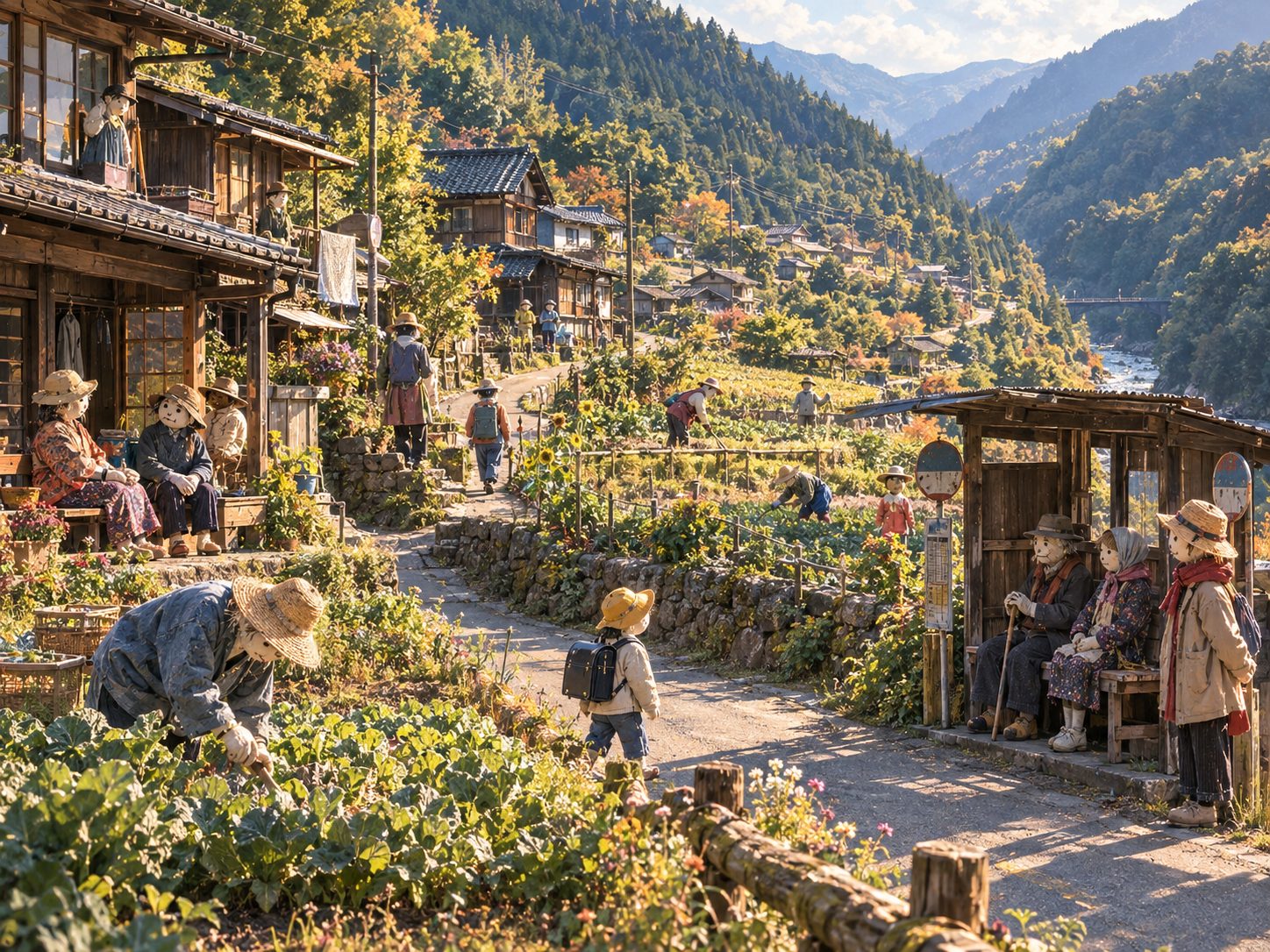
- Nagoro is a tiny village deep in the mountains of Tokushima Prefecture. In 2023 it had only about 25 residents, yet about 350 life-size scarecrows stand there, more than ten times the number of people.
- The scarecrows are made by villager Tsukimi Ayano. In 2002 she moved back home and started farming. To drive off the birds eating her seeds, she made the first one in her father’s likeness. Many since have been modeled on real neighbors.
- Nagoro boomed briefly thanks to a dam project completed in 1961, then lost people year after year, becoming one of more than 10,000 “marginal villages” in Japan. After its elementary school closed in 2012, the classrooms filled with scarecrow children.
- A short documentary in 2014 brought Nagoro worldwide attention. The scarecrows didn’t bring the population back, but they kept alive the village habit of greeting anyone who passes by.
Around 2003, in a tiny village called Nagoro deep in the mountains of Tokushima Prefecture, an old man in worn clothes appeared beside a field. Neighbors passing by in the morning would call out to him: “Good morning! Hard at work so early?”
The old man didn’t answer, because he was a scarecrow. He was made by Tsukimi Ayano, who had just moved back to her hometown from Osaka. She made him in her father’s likeness, dressed him in her father’s clothes and set him in her field to scare off birds. When a neighbor mistook him for a person, she found it funny, and made a second, then a third.
More than twenty years later, about 25 people live in Nagoro, yet some 350 life-size scarecrows stand around the village, more than ten times the number of people.
Nagoro lies in the very center of the island of Shikoku, about 900 meters above sea level, the last village at the head of its valley; beyond it there are no more settlements. Many people seeing photos for the first time find it creepy and assume it’s a ghost village filling empty houses with dummies. But up close, most of Nagoro’s scarecrows have names and identities, and some are neighbors who really lived there. Why would a village make its people all over again?
Seeds dug up by birds became a man who looked like her father
Tsukimi Ayano was born in Nagoro. When she was about 12, her father found work in Osaka and the family moved with him. She lived in Osaka for about forty years, married, raised two children and spent more than thirty years making dolls. All along, she says, she thought she would someday go back to where she was born.
In 2002, she returned to Nagoro to look after her aging father. The first thing she did on returning was plant a garden. She sowed daikon radish and pea seeds, and waited a long time, but nothing came up. She later realized the birds had dug up the seeds and eaten them.
An ordinary scarecrow is bamboo poles, straw and old clothes tied together, good enough if it looks human from a distance. Ayano’s were different. She dressed hers in her father’s old clothes, sewed a face with features out of fabric, and made the body life-size. It worked better than expected: the birds mostly stayed away, and passersby were fooled too. Word got around the village, people found it amusing, and she went on making them one after another in the likeness of other villagers.
A scarecrow’s frame is made of wooden sticks. The body is filled out with more than eighty sheets of newspaper rolled into rods to give the shoulders and belly some bulk. The face is cotton wrapped in stretchy fabric and stitched, and at the end she uses a makeup brush to add a touch of pink to the lips and cheeks. The clothes are donated by villagers and outsiders, so every scarecrow wears something a real person once wore.
Each scarecrow takes two or three days to make, and left outdoors in the wind and rain, it fades and sags within about two years. So Nagoro’s scarecrows are constantly being replaced, and the ones you see today aren’t necessarily the same “people” you’d have seen five years ago. Nagoro doesn’t have a fixed exhibition. It has residents who age, wear out and are made again.
The busy years came from a dam
To understand why Ayano cares so much about there being “people in the village,” you need to know how lively Nagoro once was.
On a stream near Nagoro stands a hydroelectric dam, completed in 1961. During construction, Nagoro had about 150 residents plus another 150 dam workers. With that many people crowded into one valley, the village had inns, a general store, a barber and even a pachinko parlor. That was the Nagoro Ayano saw as an elementary school girl.
But once the dam was built, the workers left. Nagoro’s land is poor; Ayano says only small potatoes and buckwheat grow well around here. After construction ended, the village could no longer hold on to so many people, and families moved away to the cities one after another.
Much of the bustle Nagoro’s people remember was brought by a construction project. It came fast and left just as fast. The population loss that followed was quiet: no disaster, no factory closing, just a few fewer households each year. When Ayano left, the village had about 100 households. When she returned in 2002, about 20 were left.
Japan has a word for villages like this: genkai shuraku, literally “settlements at their limit,” meaning villages where more than half the residents are over 65 and shared community life, like maintaining roads or holding festivals, is hard to keep going. In 2013, there were more than 10,000 such villages nationwide, Nagoro among them. In 2019, Ayano said: “There are no children now. The youngest person here is 55.”
Whom did she bring back?
As the scarecrows multiplied, Ayano began making specific people.
When an elderly woman in the village died around 2014, Ayano made a scarecrow in her likeness and sat it in front of the empty house where she used to live. Seeing it doesn’t make her sad, Ayano says, because it’s wearing clothes the woman often wore when she was still healthy. She greets it every time she passes. “It feels like she’s still here.”
When a neighbor she often had tea with moved into a care facility, Ayano made that neighbor and another friend, and set the two scarecrows side by side so they could keep each other company. Once, a woman visiting from Hokkaido saw a scarecrow that looked just like her late mother and stood there crying.
At this point, it’s easy to imagine Nagoro as a lonely memorial. But Ayano doesn’t see it that way. She says she doesn’t make scarecrows because she’s lonely, and doesn’t think of it as art. It’s just fun. “Every morning, I say hello to them.” Of course the scarecrows never answer, “but that’s all right.”
A family register for scarecrows
As the scarecrows multiplied, villagers began thinking together about what they could do with them. In 2009, villagers and the city formed a “Scarecrow Project” and gave the village a name: Village in the Sky, Home of the Scarecrows.
They also made a “Scarecrow Basic Register” for them. A daicho is a register, something like a family registry. Every scarecrow has a name, age, height, weight and personality, and some come with a life story. The register is kept at a rest stop near Ayano’s family home, where anyone can leaf through it.
The first resident entered in the register is the village head, a 68-year-old named Yujiro. According to his backstory, he was the leader of the village kids as a boy, got into a prestigious university, joined a major trading company, came home at thirty, married his childhood sweetheart, and is now the third village head.
Yujiro isn’t a real person. But his life is almost exactly the kind Nagoro’s people wish would happen: leave to study, leave to work, then come back. The register reveals what Nagoro really lacks: not just numbers, but young people who come home.
The last two students left themselves in the classroom
Nagoro’s quietest place is its elementary school. It closed in March 2012, when its last two students finished sixth grade and graduated, leaving the school with no pupils.
In a home economics class before graduating, those two children made scarecrows of themselves and dressed them in their own clothes. The two scarecrows still sit at their desks in the classroom. Ayano has filled the other classrooms too: a teacher in a suit stands at the front, a dozen or so children sit at their desks, and at the back are parents watching the lesson.
A village with no children filled its school with children. “It would be livelier with a few more kids,” Ayano says. “So I made some.”
Those two scarecrows in real clothes are the closest thing in all of Nagoro to the real thing. They aren’t residents anyone imagined. They’re the selves the last two children left behind with their own hands.
A six-minute video brought the world knocking
What made Nagoro visible to the world was a short film. In 2014, Fritz Schumann, a German photojournalist studying in Hiroshima, came to Nagoro and shot a six-and-a-half-minute documentary, The Valley of Dolls. Posted online, it drew nearly half a million views. Then media outlets from Europe and North America arrived one after another, and foreign travelers followed. “Before I started making scarecrows, nobody ever stopped here,” Ayano says. “Now lots of people come.”
Since 2013, every October, Nagoro has held a Scarecrow Festival at the school that no longer has students. In 2019, Ayano turned it into an undokai, a sports day, a shared childhood memory for many Japanese people, when the whole village turns out to cheer. That day, more than forty scarecrows were set out on the school grounds, some running a race, some on the swings. For the tug-of-war, the scarecrows’ hands were sewn to the rope, and they pulled alongside villagers in their eighties.
Not every villager thinks this is a good thing. One 67-year-old woman said Nagoro became famous because of the scarecrows, not the people who live there, and that makes her a little sad. On the school blackboard, a visitor left a note: Where did all the living people go?
The scarecrows didn’t bring the people back, but they kept the greetings
Ayano doesn’t pretend to know the answer. “I don’t know what Nagoro will look like in ten or twenty years,” she says, “but I’ll keep making scarecrows.”
She turned the village’s abandoned nursery school into a Scarecrow Workshop, where she makes scarecrows with friends around a big table, and it’s open for visitors to join in. One foreign traveler stayed nearby for a week, came to the workshop every day to make scarecrows, and has kept in touch with her since going home. “It’s because of encounters like that,” she says, “that it’s so much fun.”
Think back to that first scarecrow in her father’s clothes. It was only meant to drive off the birds eating her seeds. Instead it fooled the neighbors and made people stop to say good morning.
I think what Nagoro’s scarecrows have done is more concrete than “making a village famous.” They didn’t bring the population back, but they let the village keep one habit: when someone passes by, someone says hello. It’s just that now, the people stopping by the roadside to say good morning are mostly strangers from around the world, and standing across from them are the neighbors Ayano made one by one. A village truly disappears not on the day the last household moves away, but on the day no one stops to say hello anymore. Nagoro hasn’t reached that day yet.
Notes
- Figures for Nagoro’s population and number of scarecrows vary by report in year and method (some count only scarecrows on display in the village, others the total Ayano has ever made). This article uses the figures most consistent across reports from each year.
- The elderly woman who died around 2014 and the woman who spoke at the 2019 festival were named in the original English-language reports, but their names couldn’t be confirmed in Japanese, so this article doesn’t give them.
- The village head Yujiro is a fictional character from the Scarecrow Basic Register, not a real person.
References
- Ina Jaffe|A Dying Japanese Village Brought Back To Life — By Scarecrows (NPR, 2016-08-25, via KPBS) (neighbors saying good morning to the scarecrow, returning to care for her father, the scarecrow of the late grandmother, daily greetings, the last two students’ scarecrows, not out of loneliness)
- Motoko Rich|There are no children here. Just lots of life-size dolls (The New York Times, 2019-12-18, via bdnews24) (moving to Osaka at 12, daikon and pea seeds, “so I made some,” the 2019 sports day, tug-of-war, the 67-year-old villager and the blackboard note)
- AFP|Scarecrows outnumber people in Japan village (Taipei Times, 2019-04-18) (how they’re made and the makeup brush, youngest resident 55, “nobody ever stopped here,” “in ten or twenty years”)
- みどりの文化賞・花の達人|第22回 かかしで地域を活性化 海外も注目する山里 (2018-01) (returning home in 2002, the first scarecrow modeled on her father, the 2009 Scarecrow Project, the register, school closure in 2012, the Scarecrow Festival, The Valley of Dolls)
- COREZO Prize|綾野月美さん/奥祖谷かかしの里 (40 years in Osaka, 30-plus years of doll making, about 100 households when she left, only potatoes and buckwheat grow, the neighbor in a care facility, the woman from Hokkaido)
- Miyoshi City portal|かかしの母 綾野月美さん パート2 (2022-08) (the workshop in the former nursery, the scarecrow school, 150 residents and 150 workers during dam construction, inns and a pachinko parlor, foreign travelers)
- Ryoko Yomiuri (tabi-mag)|名頃ダム (completed 1961)
- nippon.com|Scarecrows Stand Watch over Village on Borrowed Time (2014-09-11) (80-plus sheets of newspaper, about two years outdoors, the register and the village head’s backstory, more than 10,000 marginal villages, Schumann’s film)
- 中山道雄|祖谷峡の「かかし村」集落の記憶を語る人形たち (note, 2025-03-26) (the open workshop, about 350 scarecrows, population of 25 in October 2023)
- Bunshun Online|葉上太郎「外国人に大人気 徳島の”かかし村”は、なぜ「世界の秘境」になったのか」(2019-06-24) (about 900 m elevation, the end of the line for settlements)
Follow the story in person
Join a small-group trip to the places in our stories and meet the people who live and work there.
See trips and dates
Water Mirror is a Tokyo-based company that helps more people step inside industries and explore the stories and cultures of different fields around the world. We design in-depth learning programs for individuals, companies, schools and organizations, combining company visits, exchanges with professionals, local learning and hands-on experiences, so participants can see how industries really work and meet the people and stories behind them. Water Mirror Perspectives is our content media, telling the distinctive stories of industries, local cultures and people, so that reading sparks curiosity and leads readers to go and see for themselves.
About Water Mirror →