Key Points
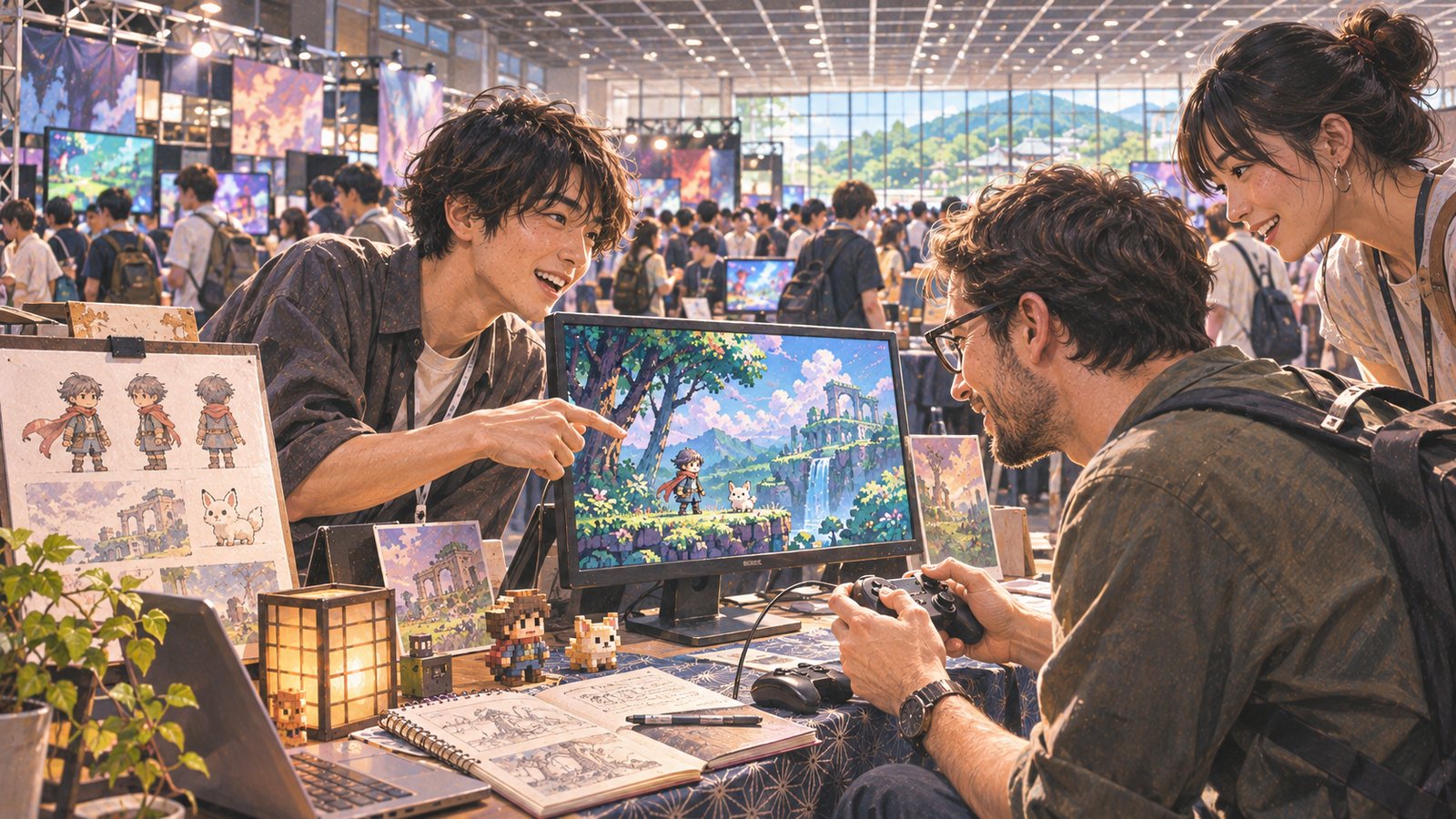
- BitSummit is Japan’s largest indie game festival. In recent years it has been held at the Kyoto City Kangyokan, better known as Miyako Messe, next to Heian Shrine. Over three days in May 2026 it drew a record 68,208 visitors and featured 496 exhibits.
- The first BitSummit was held in March 2013. It was started by James Mielke, a producer at the Kyoto game company Q-Games, to help Japanese independent developers get noticed overseas. About 170 people came.
- Kyoto became the home of Japanese indie games because several things lined up at once: Nintendo has kept its headquarters in Kyoto since 1889, and small development studios grew up around it; Kyoto Prefecture wanted to keep local creative talent and joined as an organizer; and the city is small enough that developers, publishers and government officials run into each other easily.
- BitSummit has become the place where small teams find publishers. Masahiko Murakami, who went from 2014 award winner to organizer, says emails to publishers rarely get a reply, but having them play your game in person at the show is a real chance. The number of game studios in Kyoto grew from about 15 in 2013 to more than 60 in 2023.
A queue wrapped around the hall
In late May 2026, next to the giant torii gate of Heian Shrine in Kyoto, a long line formed outside a boxy exhibition hall. It wrapped all the way around the building.
The building is the Kyoto City Kangyokan, nicknamed Miyako Messe. Over those three days it housed 496 exhibits, many from teams of just a few people. Attendance came to 68,208, up 17% on the year before and a new record.
The event is called BitSummit, and it is Japan’s largest indie game festival. “Indie games” here means games made by small teams or individuals who decide for themselves what to make, without funding from a big game company.
Here is the odd part. Most of Japan’s game companies are in Tokyo, and the Tokyo Game Show is held every autumn at Makuhari in Chiba, right next to Tokyo. You would expect an event meant to show Japanese games to the world to be held in Tokyo. Yet BitSummit has called Kyoto home since its very first edition and hasn’t moved in thirteen years. And that first edition drew only about 170 people.
How did a city famous for temples and historic sites become the home base of Japanese indie games? To answer that, we have to start with a shop that sold playing cards.
Nintendo began as a Kyoto card shop and hasn’t left in 137 years
In 1889, Fusajiro Yamauchi opened a shop in Kyoto’s Shimogyo ward to make and sell hanafuda, a traditional Japanese card game played with a deck of 48 cards decorated with the flowers, plants, birds and animals of the twelve months. In 1902 the shop began producing Western playing cards, the first company in Japan to do so.
The shop later took the name Nintendo.
From cards and toys to the Famicom and the Switch, Nintendo’s products have changed many times over, but its headquarters has always been in the city of Kyoto, moving to its current site in Minami ward in 2000. Its Ogura factory in Uji, just south of Kyoto, once printed playing cards and hanafuda and repaired game consoles. After that work moved elsewhere in 2016, the old factory was turned into the Nintendo Museum, which opened in October 2024. Visitors can see Nintendo’s products through the years, and can book a session to make their own deck of hanafuda.
When a game company stays in one city for more than a century, people who understand games naturally gather around it. Some of those who developed games for Nintendo or worked with Nintendo set up studios nearby. One of them came from Britain.
A British engineer who worked on Star Fox sets up shop in Kyoto
As a young man, Dylan Cuthbert worked at the British game company Argonaut and took part in Star Fox, the Super Nintendo game the company made with Nintendo. He later moved to Sony, working his way from the US to its development division in Japan. In August 2001 he left Sony and founded his own game company in Kyoto, Q-Games. It went on to make Star Fox 64 3D for Nintendo’s 3DS, and for Sony it built the PlayStation 3 home menu and the PixelJunk series of small games.
Kyoto had other small studios like it, such as Vitei, which worked on the Nintendo 3DS game Steel Diver. Masahiko Murakami, who would later run BitSummit, puts it bluntly: Kyoto has so many small development studios because Nintendo is there.
The problem was that almost nobody outside knew what these studios, or the individual developers scattered around Kyoto, were making.
“Japanese games are finished”: a former games journalist pushes back
James Mielke, a producer at Q-Games, is American. Before moving into game development he spent about 15 years as a games journalist, including a stint as editor-in-chief of the US games site 1UP.
At the Tokyo Game Show he kept hearing foreign media say the Japanese game industry was finished, and it bothered him. When he asked Western indie developers privately, many had no idea there were people in Japan making games independently. To him the reasons were easy to understand: the language barrier, time differences, no connections, and a Tokyo Game Show that had long been built around big companies, which left individual developers hard to see.
Japan had no shortage of good work. Cave Story, made single-handedly by Daisuke Amaya in 2004, has players all over the world. But in Japan the word “indie” was often taken to mean “amateur,” so Mielke deliberately used “independent” instead, stressing that the point is deciding for yourself what to make, not being less professional.
On March 9, 2013, the first BitSummit was held in Kyoto. It came together in about two and a half months, staffed almost entirely by volunteers. Around 50 Japanese independent developers took part, including Daisuke Amaya. Valve came to explain how to get games onto Steam, and foreign outlets such as Wired, IGN and GameSpot showed up too. The event was open only to developers and press. Mielke had expected about 100 people; about 170 came.
Asked why he didn’t hold it in Tokyo, he said Kyoto is admittedly inconvenient, but nearly every game event happens in Tokyo or Osaka and the press is tired of them. Coming to Kyoto feels fresh, and it gives BitSummit a character of its own.
If the story ended there, BitSummit might have been a fun gathering of enthusiasts that fizzled out after a few years. What made it stick was an unexpected player: the Kyoto prefectural government.
Why would Kyoto Prefecture back a group of people making small games?
In the audience at the first BitSummit was Akinori Nakamura, a professor at Ritsumeikan University who studies the game industry. Two days after the event, he contacted the prefecture’s industrial promotion department. On March 19 he brought prefectural officials to the Q-Games office to meet Dylan Cuthbert and James Mielke. Three days later, the prefecture said it wanted to work together.
The government moved so fast because it was already looking for an opportunity. In autumn 2012, the city of Kyoto had held the first Kyoto International Manga Anime Fair, known as Kyomaf, and it went down well. The prefectural official in charge later admitted that seeing Kyomaf succeed was what got the prefecture thinking about a game event. The prefecture had already run events with Nintendo and The Pokémon Company and held its own public “Kyoto Game Festival,” but the budget it could set aside for games in fiscal 2013 was far smaller than for the manga and anime fair. It needed a theme that would draw people.
The deeper reason was talent. Kyoto has programs such as Kyoto Seika University’s Faculty of Manga and Ritsumeikan University’s College of Image Arts and Sciences, with more than 4,000 students studying fields related to manga, anime and games. But most jobs in the content industries are in Tokyo, and many students leave Kyoto when they graduate. An event that brought developers, publishers and students together could give local talent a reason to stay.
You might ask: if talent is heading to Tokyo, wouldn’t holding the event in Tokyo be more effective? The trouble is that Tokyo already has plenty of game events, and a small indie show there gets lost easily. Kyoto has few big game events, so it is easier to stand out, the government is willing to invest, and the press is willing to make the trip.
So the two sides joined forces. In March 2014, BitSummit moved into Miyako Messe next to Heian Shrine and opened to the general public for the first time, with tickets at 500 yen. The number of exhibiting developers grew to about 130, and about 5,000 people came over three days. As of 2026, Kyoto Prefecture is still one of BitSummit’s organizers.
A taxi full of zombies brings in the next organizer
In 2014 the top prize, the Vermillion Gate Award, went to MODERN ZOMBIE TAXI DRIVER by the Kyoto studio Vitei. It is a driving game played on a VR headset in which you drive a taxi and every passenger is a zombie.
Masahiko Murakami, who brought the game to the show and won the prize, joined BitSummit’s operations team the following year. He went on to become president of the Kyoto company Skeleton Crew Studio, which has handled BitSummit’s day-to-day running since its early years, from liaising with overseas exhibitors and finding sponsors to managing staff.
An exhibitor turning into an organizer says a lot about Kyoto. Asked why BitSummit grew from around 200 people to 60,000, the first thing Murakami pointed to was that Kyoto is a “compact city.” People live close together and everyone seems to know each other, so even when there was little money, personal connections kept the event going. In Tokyo, he says, people are too spread out to come together like that.
He also noted that for a city its size, Kyoto has a surprising number of art universities, and that it is a city many foreigners want to visit and live in, which makes it easy for talent from abroad to gather.
Dylan Cuthbert initially felt BitSummit should be run by Japanese people. Later, when the association’s previous head stepped down, Murakami asked him to take the chair, and Cuthbert now holds the post. A company founded by a Briton got it started, someone who won an award there took it over, and the prefecture backed it with a budget. That kind of relay is hard to pull off in a big city.
Big companies started paying attention too. Murakami recalls that Nintendo became a sponsor around 2015, and from then on BitSummit became a place developers felt was worth going to. By 2026, the platinum sponsors included Nintendo, Sony and Cygames.
Emails don’t work; meet in Kyoto
For a team of two or three people, the hardest part often isn’t making the game. It’s getting a company that can publish it to notice.
Murakami speaks from his own experience as an exhibitor: emailing publishers rarely leads anywhere. At the show, though, publishers can sit down and play, and developers can explain in person what they are trying to do. He gives two examples. One is Sakuna: Of Rice and Ruin, a rice-farming action game by the doujin circle Edelweiss, which passed one million copies shipped worldwide in 2021. The other is Urban Myth Dissolution Center, a mystery game by the creative team Hakababunko, which sold 300,000 copies in the three months after its 2025 release. In both cases, the developers first set up their own booths at BitSummit and met their eventual publishers there.
That is also why BitSummit chooses games differently from a typical trade show. Submissions are played and scored by overseas partners, and the final decision also takes into account the story and philosophy the developers want to convey. It isn’t only about whether a game is fun, but also about the ideas behind it.
The change on the show floor has shown up in Kyoto’s industry too. By Akinori Nakamura’s count, Kyoto had about 15 game studios when BitSummit began, and more than 60 by 2023. In 2026, TOSE, a Kyoto-based company that has long developed games on contract for others, announced at the prefecture’s booth a plan to create original titles together with indie developers.
What Kyoto kept was the distance at which people can meet
Back to that queue around Miyako Messe in May 2026. This edition was moved up from its usual July slot to May, partly because Kyoto in July is too hot and clashes with the crowds of the Gion Festival. James Mielke, who launched the first BitSummit thirteen years earlier, is now involved as creative director, and said he was looking forward to seeing everyone again in Kyoto’s best season.
Kyoto didn’t become the home of Japanese indie games because of its fame as a thousand-year-old capital. Nintendo stayed for more than a century, drawing people who make games to the city. The prefecture wanted to keep young talent and was willing to put in money and effort. And its biggest advantage turned out to be that it isn’t too big. Developers, publishers, universities and prefectural officials are never far apart: a professor could see the event and bring government officials through the door two days later, and an award-winning exhibitor could become an organizer the following year.
For teams of one or two people making games, the rarest thing is the chance to be seen and to have someone play their game in front of them. Kyoto turned itself into a place where these people can easily meet. Money and venues matter, of course. But when a city wants to grow a new industry, making it easy for the right people to find each other may be the condition hardest to copy.
The next BitSummit is scheduled for May 21 to 23, 2027, in the same exhibition hall next to Heian Shrine.
Notes
- On attendance at the first BitSummit, James Mielke said in an interview right after the event that about 170 people came. Other reports and later interviews often round this to “about 200.” This article follows the organizer’s statement at the time.
- The figure of Kyoto game studios growing “from about 15 to more than 60” is from a 2023 count. No figure for 2026 has been published.
- That Sakuna: Of Rice and Ruin and Urban Myth Dissolution Center first met their publishers at BitSummit is according to Masahiko Murakami in an interview. The two publishers have not separately described how this happened.
References
- Kyoto Prefecture|Report on “BitSummit PUNCH,” one of Japan’s largest indie game events: organizers, venue, 2026 attendance and number of exhibits
- gamebiz|「BitSummit PUNCH」過去最大となる68,208人の累計来場者数を記録 (2026-05-26): daily attendance, submissions and exhibits for 2024–2026
- Video Games Chronicle|BitSummit just smashed its attendance record (2026-05-26): queues, attendance
- Famitsu|ビットサミット パンチのスポンサー企業と出展企業が公開 (2026-03): 2026 dates, platinum sponsors
- Nintendo|Company History: founding in 1889, headquarters moves
- Nintendo|ニンテンドーミュージアム開館日決定のお知らせ (2024-08-20): opening date, hanafuda workshop
- Tokyo Art Beat|Nintendo Museum opening news (2024-05-09): former uses of the Ogura factory and when they moved
- Wikipedia|Q-Games: founding date, Dylan Cuthbert’s career and key titles
- GameBusiness.jp|Interview with James Mielke (2013-03-11): motivation, why Kyoto, about 170 attendees
- Game Developer|BitSummit: The secret world of independent Japanese game development (2013): how it started, “indie” vs “independent”
- Game*Spark|BitSummitが京都で明日開催 (2013-03-08): first-year participants and media
- Famitsu|Akinori Nakamura’s game industry research notes, global edition (2023-08): how the prefecture joined, Kyomaf as the trigger, number of Kyoto studios
- Kyoto Prefecture|Materials on BitSummit and the Kyoto Cross Media Creative Center: merger with the Kyoto Game Festival, student numbers, 2014 venue and ticket price
- Engadget|Japan’s BitSummit indie festival hosts 5,000 people, 130 developers (2014-03-12)
- Inside Games|BitSummit 2014 award results (2014-03-09): Vitei wins the top prize
- Game*Spark|『スティールダイバー』のViteiが贈るOculus版『クレタク』? (2014-03-09): Vitei as a Kyoto studio, game content
- Inven Global|What is the Secret to BitSummit’s Success, According to Director Murakami? (2025): Kyoto’s advantages, Nintendo’s sponsorship, publisher matchmaking, selection process
- Famitsu|Interview with the BitSummit team (2024-02): Murakami asking Dylan Cuthbert to head the association
- Famitsu|Interview with the BitSummit PUNCH team (2025-12): association chair, creative director, reasons for moving to May
- Skeleton Crew Studio|BitSummit: operations the company handles
- Kinki Bureau of Economy, Trade and Industry|Skeleton Crew Studio company profile: location, number of employees
- GameBusiness.jp|Sakuna: Of Rice and Ruin passes one million copies shipped (2021-06-05)
- Denfaminicogamer|Urban Myth Dissolution Center passes 300,000 copies sold (2025-05-30)
Follow the story in person
Join a small-group trip to the places in our stories and meet the people who live and work there.
See trips and dates
Water Mirror is a Tokyo-based company that helps more people step inside industries and explore the stories and cultures of different fields around the world. We design in-depth learning programs for individuals, companies, schools and organizations, combining company visits, exchanges with professionals, local learning and hands-on experiences, so participants can see how industries really work and meet the people and stories behind them. Water Mirror Perspectives is our content media, telling the distinctive stories of industries, local cultures and people, so that reading sparks curiosity and leads readers to go and see for themselves.
About Water Mirror →