Key Takeaways
- Japan’s ramen shop market was estimated at a record 885.5 billion yen in fiscal 2025, up more than 60% in ten years. Yet the industry’s combined net profit fell from 35.6 billion yen the previous year to 17.1 billion yen, roughly half. In 2024, 79 ramen shops went bankrupt, the most on record.
- Ramen is hard to profit from because of its cost structure. On an 800-yen bowl, ingredients alone cost about 290 yen, leaving only about 180 to 200 yen in the end. The most expensive part is the broth, which takes bones, high heat and over ten hours of simmering, and a ramen cost index rose 40% between 2020 and 2025.
- Costs went up, but prices are stuck at the “1,000-yen wall.” Japanese people see ramen as everyday food, and more than 90% feel a bowl over 1,000 yen is expensive. With low barriers to entry and more than 20,000 ramen shops nationwide, a shop that raises prices easily loses customers.
- Almost all the bankruptcies are small shops, which make their own broth and cannot spread the cost. The winners have moved broth and noodle making into factories: Gift Holdings, which runs the Machida Shoten chain, charges its partner shops no franchise fee and earns money by supplying broth and noodles, with more than 900 shops in its network. At the other end are famous shops selling a bowl for 3,000 yen.
In fiscal 2025, Japanese people spent an estimated 885.5 billion yen at ramen shops, a record high. Ten years earlier it was 541.8 billion yen; at this pace, the market could pass 1 trillion yen as early as fiscal 2027.
The same survey had another number: the industry’s combined net profit fell from 35.6 billion yen the year before to 17.1 billion yen, nearly halved.
More and more customers, less and less money left for the shops. In 2024, 79 ramen shops in Japan went bankrupt with debts of 10 million yen or more, the highest number on record. In 2025 the figure fell to 59, but it remains high.
Over the same period, Gift Holdings, which runs the ramen chain Machida Shoten, grew its revenue 26% in a year to 35.8 billion yen.
Both are selling ramen. Why do some keep growing while others cannot survive? To answer that, start with the math of a single bowl.
On an 800-yen bowl, the shop ends up with about 200 yen
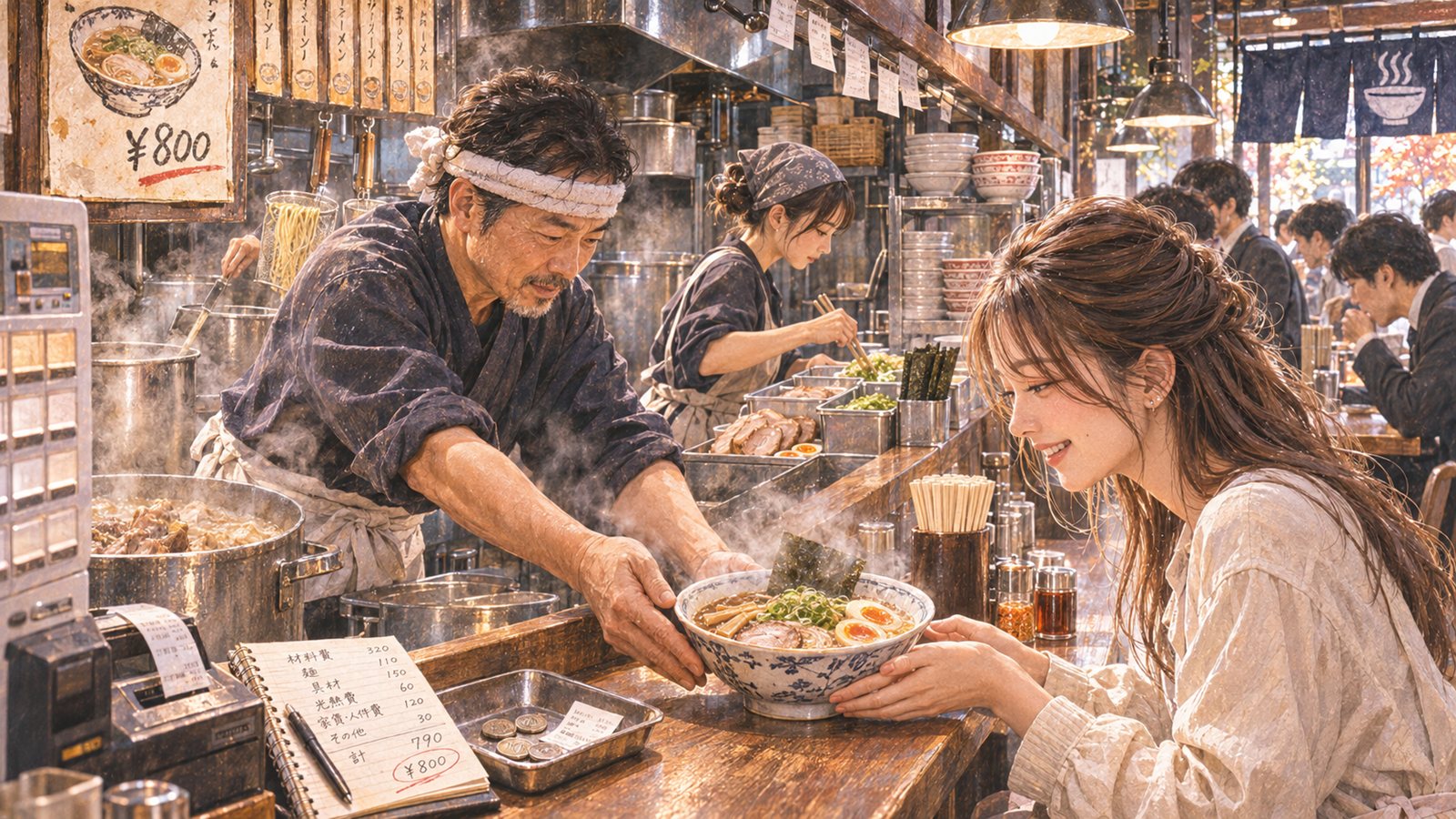
A Tokyo ramen shop known for its scallop and soy sauce broth sells a bowl for 800 yen and serves about 100 bowls a day. The owner once broke down the cost of one bowl: about 130 yen for broth ingredients, about 60 yen for noodles, and about 100 yen for toppings such as chashu pork, egg, green onion and bamboo shoots.
That is 290 yen in ingredients alone. After labor, rent, utilities and supplies, each bowl leaves only about 180 to 200 yen.
How high is that ingredient share? For a typical restaurant, food costs are about 25% to 30% of the menu price; for ramen they often run 35% to 40%.
At a café, much of what customers pay goes toward a seat and time to linger. A ramen shop is the opposite: customers eat and leave, and most of what they pay goes straight into the broth and noodles in the bowl.
The most expensive part is the broth: bones, high heat and over ten hours
The key to ramen’s high cost is the broth.
At many shops, the broth is made by simmering pork and chicken bones for a long time. For a tonkotsu broth, where pork bones are boiled until the soup turns milky white, simmering it in-house for 12 hours, including labor, can cost 100 to 150 yen per bowl.
Making broth also burns a lot of gas. The owner of a long-established shop says that making broth from scratch means keeping the flame on high the whole time, and the gas bill is “insane”; simply reheating factory-made broth uses far less. And the hours the owner spends watching the pot are often not counted as a cost at all.
It is like making a big pot of beef stew at home: the ingredients are not that expensive, but the stove is on for half a day and you are stuck in the kitchen for half a day. The difference is that a ramen shop does this every day, for dozens or hundreds of servings at a time.
Costs up 40% in five years, but prices stuck at the “1,000-yen wall”
If costs were stable, a ramen shop with thin margins could survive by selling a lot. The problem is that in recent years, all the costs have gone up together.
Teikoku Databank, a Japanese credit research company, built a “ramen cost index” from the ingredients of a tonkotsu soy sauce ramen in Tokyo’s 23 wards. With 2020 set at 100, the index reached 141 in 2025. Pork, pork back fat, noodles, nori and bamboo shoots all rose; wheat became more expensive after Russia’s invasion of Ukraine, electricity and gas followed crude oil upward, and the minimum wage rises every year.
If costs go up, why not just raise prices? Ramen shops are raising prices, but they run into an invisible line the Japanese industry calls the “1,000-yen wall.”
The origin of the line is very everyday. An owner who runs three shops in Tokyo says most ramen shops stop at 800 to 900 yen because customers can pay with a single 1,000-yen bill and still get change back. A survey of 500 consumers also found that more than 90% felt ramen over 1,000 yen was “expensive” or “somewhat expensive,” and about 70% said they would eat ramen less often if prices rose.
Customers care this much because, in the Japanese mind, ramen is an everyday meal, not a special-occasion feast. A gourmet burger selling for over 1,000 yen is not unusual, but a 1,500-yen ramen often draws the complaint that “that’s not a ramen price.”
And with more than 20,000 ramen shops in Japan, the next one may be on the same street. The industry has observed that chains raising prices by more than 10% tend to lose customers.
Easy to open, expensive to make broth: the bankruptcies are almost all small shops
Rising costs and capped prices hit every ramen shop. But almost all the shops that go under are small: of the ramen shops that went bankrupt in 2025, 42.3% had less than 1 million yen in capital.
The first reason is an endless supply of new competitors. Opening a ramen shop in Japan does not require a cook’s license; you only need one person to take a one-day food hygiene course costing about 10,000 yen, then apply for a business permit. If you lease a space that was already a ramen shop, with the kitchen equipment in place, you can sometimes open for about 1 million yen. There are 21,017 ramen shops listed in Japan’s phone directory, and about two thirds are independently run.
The second reason matters more: a small shop has to carry its costs at the scale of a single shop.
When a small shop makes its own broth, its own customers pay for all the bones, gas and labor. A chain can make broth in a central kitchen and ship it to dozens or hundreds of shops, buy in bulk, and spread fuel and labor across every location. Commercial concentrated broth, once diluted, may cost just over ten yen per bowl, several times cheaper than broth made in-house.
So why do so many small shops still insist on making their own? Because for an independent ramen shop, the broth is often its signature, and the very reason the owner opened the shop. Teikoku Databank puts it bluntly: the ramen shops that survive are shifting from competing on craftsmanship to competing on management efficiency.
No broth, no toppings: the small shop’s cost-cutting menu
Small shops are trying, too. The most direct move is to skip the broth altogether: more and more shops serve brothless mazemen-style noodles, eliminating the most expensive, most gas-hungry part.
Another is to remove the toppings. “Su-ramen,” just noodles and broth, has become popular in Japan in the past couple of years. A basic 1,000-yen bowl loaded with chashu, a soft-boiled egg, bamboo shoots and nori might need to cost 1,500 yen to make sense; su-ramen keeps the base price within what customers accept, and those who want toppings can add them. Ticket machines and smartphone ordering are spreading, and rice that used to be free now comes with a charge.
What these approaches have in common: shops no longer assume a bowl of ramen must have everything, and instead figure out which parts customers are truly willing to pay for.
No franchise fee, yet 900 shops: leaving the broth and noodles to factories
If making your own broth is too expensive, why not stop making it?
Gift Holdings offers one answer. Besides its own company-run shops, it has what it calls “produce shops”: owners in principle pay no deposit, no franchise fee and no monthly royalty, and can even choose their own shop name instead of using the Machida Shoten sign.
So how does Gift make money? Ingredients. Produce shops sign a contract to keep buying its private-label noodles, sauces, broth, gyoza and chashu.
It is a bit like the printer business: the printer itself may not make money, but the ink cartridges you keep buying do. Gift does not charge owners for its brand; instead, every shop uses its broth and noodles every day.
To support this, it has built five noodle factories, two broth factories, one chashu factory and four distribution centers in Japan. As of the end of October 2025, it had 287 company-run shops and 614 produce and franchise shops, more than 900 in total. The benefits the company lists match small shops’ pain points exactly: lower utility costs, less waste, no need to train broth specialists; and since simmering raw bones creates odors that limit where a shop can be located, factory-delivered broth solves that problem too.
The real key to the model is the factories. The same factories supply both company-run and produce shops, so the more shops there are, the higher the volume and the cheaper each serving of broth and noodles; meanwhile, the capital and risk of opening each produce shop are borne by its owner. A typical restaurant’s operating margin is about 5% to 8%; Gift’s was 9.4% for the year ended October 2025. Still, it is not immune to rising costs: the margin fell from 10.2% the year before, and the company that runs Ippudo saw operating profit drop 17.3% in the same period. Everyone feels the cost pressure; the difference is who can absorb it better.
The other path: a 3,000-yen bowl of ramen
Scale is not the only way out. Teikoku Databank observes that Japanese ramen prices are splitting into three tiers: about 500 yen, about 1,000 yen, and 1,500 yen or more.
The top tier sells an experience. Tsuta, which in 2016 became the world’s first ramen shop to earn a Michelin star, sells its signature soy sauce ramen for 3,000 yen. The famous Iida Shoten in Yugawara raised its soy sauce ramen to 1,600 yen in 2022, explaining that the reason was not ingredient costs. A shop that opened in 2024 and earned a Michelin Bib Gourmand also charges 1,600 yen for its basic bowl; its owner once drew online criticism for replying to a review that called it overpriced, yet its newly opened branch still set sales records.
These shops show that the 1,000-yen wall is not a real wall. How much customers will pay depends on what they feel they are buying: an everyday lunch, or a special experience.
Ramen has not become unprofitable; the profitable position has moved
Why is it hard for Japanese ramen shops to make money? Because most of what a bowl costs goes into broth and noodles, those costs have risen 40% in five years, prices are capped by the 1,000-yen wall, and low barriers to entry mean plenty of rivals. Under these conditions, a single shop tending its own pot and selling bowls at 900 yen is in the toughest position of all.
But the market is still growing, and customers have not left. What has changed is where the money flows: on one side, companies that move broth and noodle making into factories and use scale to cut costs; on the other, famous shops that make customers willing to pay 3,000 yen for a bowl.
When a craft can be broken down into parts that can be mass-produced, money flows to two kinds of people: those who can produce the parts at scale, and those who make something others cannot easily copy. Next time you eat a bowl of ramen in Japan, ask yourself whether the broth simmered in the shop for over ten hours or came from a factory. Both answers are paths this business has found today.
Notes
- The ramen shop market size, net profit and price tiers are Teikoku Databank figures by fiscal year (April to the following March); the bankruptcy counts of 79 and 59 are by calendar year.
- The cost breakdown of the 800-yen bowl is one Tokyo ramen shop’s example, not an industry average.
- The cost comparison between concentrated and house-made broth comes from industry estimates; actual differences vary by shop.
References
- Teikoku Databank | ラーメン店市場、25年度は8855億円 | 2026-07-01 (market size, net profit, rising cost items, labor and menu changes, three price tiers, gap between chains and small shops)
- Teikoku Databank | 「ラーメン店」の倒産、2025年は59件 | 2026-01-10 (bankruptcies, capital size, cost index, brothless noodles, shift from craftsmanship to efficiency)
- Web Tantosha Forum | 2025年のラーメン店倒産、4年ぶりに減少 | 2026-01-19 (cost index of 141)
- Gift Holdings | Financial results for the year ended October 2025 | 2025-12-15 (revenue, operating profit and margin)
- Gift Holdings | Annual securities report (year ended October 2025) (produce shop terms, factories and distribution centers, store count, benefits of central production)
- FISCO | Gift Holdings company research report | 2023-10-23 (customer decline after price increases over 10%)
- Money Post WEB | 2023-10-23 (cost breakdown of an 800-yen ramen, food cost ratio, 1,000-yen wall, causes of rising costs)
- Money Post WEB | 2023-10-23 (cost of concentrated broth vs. 12-hour house-made tonkotsu broth)
- Money Post WEB | 2018-05-30 (gas costs of making broth, owner’s labor not counted)
- Nihon Shokuryo Shimbun | 国民食「ラーメン」の厳しい実情 | 2025-04-07 (consumer survey, comparison with burger prices)
- Bunshun Online | 2026-06-17 (“not a ramen price,” su-ramen, topping cost example)
- PRESIDENT Online | 2024-07-10 (number of ramen shops nationwide and share of independents)
- freee | Guide to opening a ramen shop | 2025-10-15 (qualifications and startup costs)
- Money Forward Cloud | 2025-05-16 (typical restaurant operating margin)
- NetIB-News | 力の源HD、26年3月期は増収も営業益17.3%減 | 2026-05-15 (operating profit of Ippudo’s operator)
- Financial Field | 高価格な「ラーメン」3選 | 2024-04-11 (Tsuta’s price and Michelin star)
- Gendai Business | 「ラーメン1杯1600円」の衝撃 | 2022-06-16 (Iida Shoten’s price increase)
- Gendai Business | 値上げが止まらないラーメン業界の裏事情 | 2026-07-24 (1,600-yen Bib Gourmand shop, online criticism and sales records)
Follow the story in person
Join a small-group trip to the places in our stories and meet the people who live and work there.
See trips and dates
Water Mirror is a Tokyo-based company that helps more people step inside industries and explore the stories and cultures of different fields around the world. We design in-depth learning programs for individuals, companies, schools and organizations, combining company visits, exchanges with professionals, local learning and hands-on experiences, so participants can see how industries really work and meet the people and stories behind them. Water Mirror Insights is our content media, telling the distinctive stories of industries, local cultures and people, so that reading sparks curiosity and leads readers to go and see for themselves.
About Water Mirror →