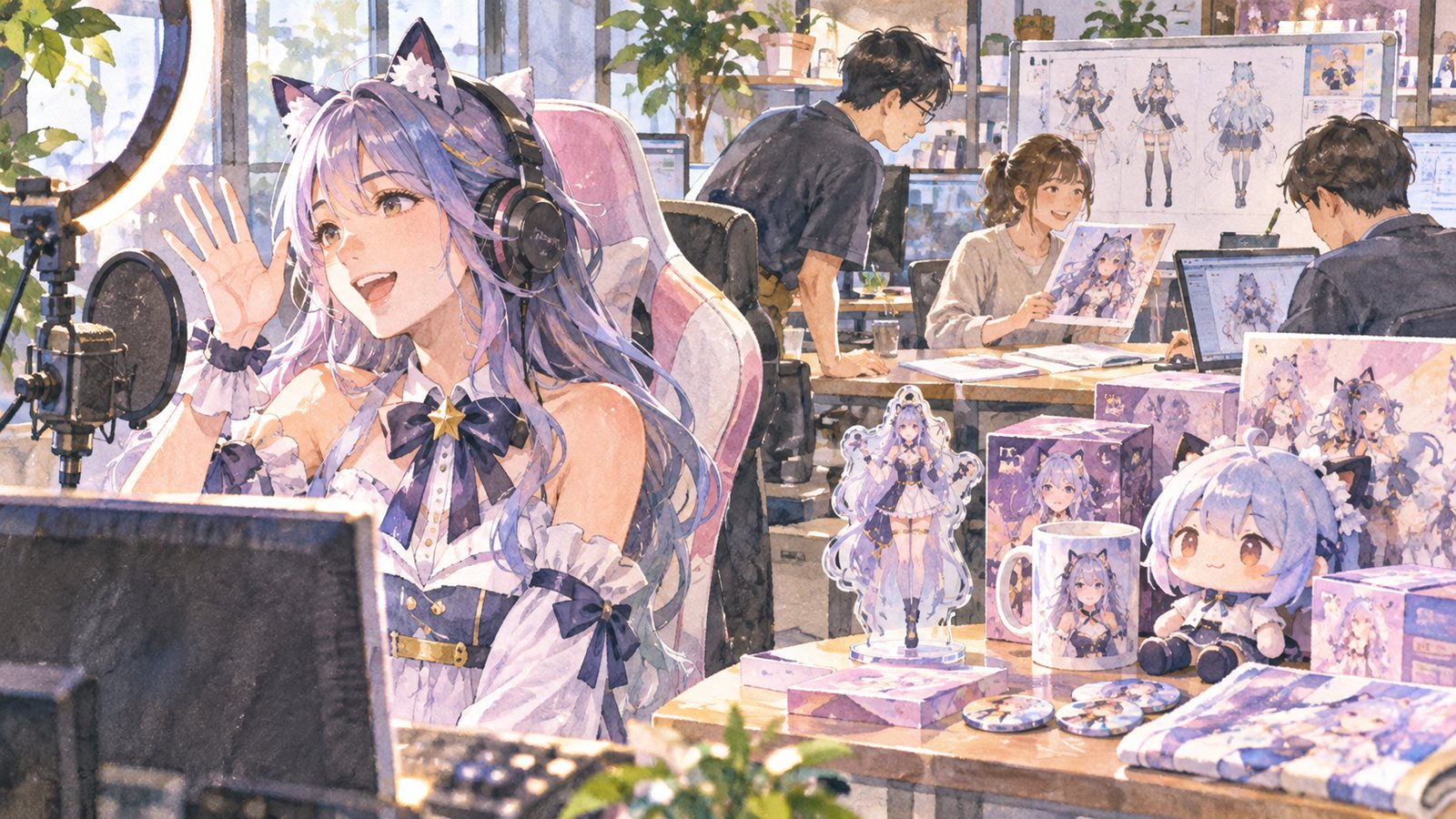
Key Takeaways
- VTubers (virtual YouTubers) are anime characters performed live by real people and streamed for free on YouTube. ANYCOLOR, a major Japanese VTuber agency that runs the group NIJISANJI, posted revenue of about 55.68 billion yen for the year ended April 2026; streaming brought in about 5.6 billion yen, roughly a tenth, while merchandise brought in about 38.1 billion yen, close to 70%.
- The whole industry looks the same: in fiscal 2023, Japanese VTuber agencies had total revenue of about 80 billion yen, with merchandise at 55.6% and streaming at 20%. Streaming draws viewers and builds attachment; merchandise, concerts and licensing are the main sources of income.
- The key to scaling the business is that the company owns the characters. It designs them, provides studios and product planning, and releases limited-edition merchandise for each VTuber’s birthday and debut anniversary. ANYCOLOR ran 203 merchandise campaigns in a year, and each VTuber generated about 311 million yen in revenue on average.
- The model is highly profitable but carries risks: in 2025–2026, both major agencies booked inventory losses of about 1.8 billion yen each on unsold merchandise. Free streaming is not a cost but a reason for people to stay; what is really being sold is the relationship built after they do.
In August 2025, preorders opened for a set of birthday merchandise.
It included an acrylic panel, a T-shirt, four badges, a key case and a voice recording only buyers could hear, titled “Drive Date with Chiha.” The full set cost 17,270 yen, preorders closed on the evening of August 12, and the items would not ship until late January of the following year. Fans paid first, then waited five months.
This was birthday merchandise for VTuber Chihaya Rindo. VTuber is short for “virtual YouTuber”: on screen is an anime character, performed live behind the scenes by a real person using motion capture, who streams chatting, gaming and singing on YouTube. Anyone can watch Chihaya Rindo’s streams every day for free.
Many people assume VTubers make money from viewer “tips,” namely YouTube’s Super Chat, where viewers pay to have their comment highlighted and pinned in the chat. But open an agency’s books and the answer is very different. ANYCOLOR, one of Japan’s largest VTuber agencies, had revenue of 55.681 billion yen for the year ended April 2026, earning 36 yen of profit on every 100 yen. Of that, streaming revenue was about 5.6 billion yen, only a tenth; merchandise revenue was about 38.1 billion yen, close to 70%.
How do livestreams that cost nothing to watch support a business worth more than 50 billion yen a year?
The top tip earner made 62.92 million yen in a year; each agency VTuber brings in 300 million
The barrier to becoming a VTuber is low. One person, a character illustration and face-tracking software are enough to start streaming. Independent VTubers can genuinely make money. The VTuber with the highest Super Chat income in Japan in 2025 was Nekomoto Pato, who belongs to no agency, receiving about 62.92 million yen in a year.
Nekomoto Pato’s signature show is the “bad game patrol.” Many people have seen over-the-top game ads on their phones and wondered whether the games really play like that; Nekomoto Pato downloads them on viewers’ behalf and says plainly how they differ from the ads. Most streams are not archived, so you have to show up on time to watch, and some run for more than 24 hours. Viewers who sit through those marathon streams together naturally become the most devoted supporters.
Yet ANYCOLOR’s 179 VTubers each brought in about 311 million yen in revenue on average over the year, nearly five times the top tip earner.
Tipping itself is not a growing business, either. In 2025, the top 10 Japanese VTubers by Super Chat income received about 396 million yen combined, more than 20% less than two years earlier. Super Chat is like the hat in front of a street performer: passersby toss in money when they like what they hear. There can be quite a lot in the hat, but it depends on the performer standing on the street every day, and with limited hours to perform, income has a ceiling.
What the agencies found was income beyond the hat.
In 2020, merchandise revenue overtook streaming for the first time
ANYCOLOR began as a startup founded in Tokyo in 2017 with 1 million yen in capital. In February 2018, the first eight VTubers of its group NIJISANJI began streaming; that fiscal year, the company’s revenue was only 16.62 million yen.
The turning point came two years later. For the year ended April 2020, ANYCOLOR’s domestic merchandise revenue was about 1.52 billion yen, surpassing streaming’s roughly 1.24 billion yen for the first time. That autumn, the company opened its own official online store and fan club, so it could release products for any VTuber at any time.
After that, the two lines kept moving apart. Merchandise revenue grew from 3.36 billion yen in fiscal 2021 to 38.09 billion yen in fiscal 2026, while streaming revenue stayed around 5 billion yen.
This is not one company’s exception. In fiscal 2023, all of Japan’s VTuber agencies together had revenue of about 80 billion yen, with merchandise at 55.6% and streaming at 20%. Another major company, COVER, which runs the VTuber group hololive, had revenue of 49.33 billion yen for the year ended March 2026, nearly half of it from merchandise.
Streaming draws people in; merchandise makes the money. The question is: why would people who watch free streams pay for merchandise?
Hours of streaming every day create an “oshi” worth paying for
An anime series airs one 24-minute episode a week. A VTuber may stream several times a week for hours at a time, and viewers watch the character play games, chat about what they ate yesterday and occasionally hear their own comments read aloud. Streaming is two-way, and over time the character goes from a figure on a screen to an acquaintance you see every day.
The Japanese call a relationship built this way an “oshi”: someone you especially support and want to cheer on. Spending time and money to support your oshi is called oshikatsu. Oshikatsu differs somewhat from traditional fandom: the object is often an anime or game character, and it centers on collecting merchandise and self-expression, such as taking your oshi’s acrylic stand on trips for photos, or covering your bag with badges so others can tell at a glance whom you support.
A VTuber happens to be both at once: an anime character, with a real person behind it who talks to you every day.
The fans are also not who many people imagine. In 2022, 60% of ANYCOLOR’s members were women, and 58% were in their twenties.
Birthdays and anniversaries are the best-selling days of the year
Once you have an oshi, when do you buy merchandise? The agencies wrote the answer into the calendar.
Every VTuber has a character birthday and a debut anniversary. These dates bring limited-edition merchandise, usually with a voice recording only buyers can hear, in which the oshi speaks to you alone in their own voice. ANYCOLOR’s CFO has said that anniversary merchandise has been the best-selling campaign every fiscal year.
In fiscal 2026, ANYCOLOR ran 203 merchandise campaigns, about one every two days. With 179 VTubers, each with a birthday, an anniversary and new outfit reveals, the company has “holidays” all year round.
Streaming and merchandise connect into a loop here. In May 2025, hololive VTuber Tokino Sora introduced the designs of her birthday merchandise item by item during a chat stream. Streams build attachment, then streams tell fans that new merchandise has arrived.
Most of this merchandise is made to order. By taking payment first and producing afterward, the company does not have to guess how much to make.
Because the company owns the character, the same affection can become trading cards and concerts
Back to the earlier question: independent VTubers also receive tips, so why is revenue per VTuber so much higher at agencies?
The key is who owns the character. At ANYCOLOR, the VTubers’ character designs and names belong to the company. The company designs the characters, provides home streaming equipment, 2D and 3D studios and recording studios, and also handles harassment and legal issues. VTubers sign two-year, auto-renewing exclusive contracts, and revenue from streaming, merchandise and sponsorships is shared at set rates.
When the company owns the character, it can release merchandise at scale and license the character to other companies. An independent VTuber is like a food stall run by its owner: very profitable when business is good, but limited by one person’s time. An agency is like a chain brand with a central kitchen and logistics, where the same process can serve more than a hundred VTubers.
How far can one character go? hololive launched its own trading card game in 2024, which brought in about 7.2 billion yen in revenue for COVER in the year ended March 2026, with more than 20 million packs sold cumulatively.
Characters can also take the stage. An agency’s 3D studios and motion capture equipment let VTubers hold concerts. ANYCOLOR sold 632,000 online viewing tickets in fiscal 2026, nearly 40% more than the year before; hololive’s 2025 world tour visited seven cities: Sydney, Hong Kong, Vancouver, New York, Seoul, Kuala Lumpur and Taipei.
Make too much merchandise and it ends up as inventory in a warehouse
The merchandise model has its costs. In 2025–2026, COVER booked a loss of about 1.8 billion yen on slow-selling merchandise left over from expanding its product range in earlier years; ANYCOLOR also booked about 1.8 billion yen in the same year, mostly on limited merchandise made for past events. Event merchandise has a short sales window, and once it passes, the goods are hard to sell.
Both companies responded by tightening up: cutting the number of items, managing inventory by turnover days and setting more conservative plans for the new fiscal year.
From an investor’s perspective, this is a highly profitable but concentrated business. ANYCOLOR’s operating margin reached 36.2%, but its top 10 VTubers bring in about 30% of revenue and the top 25 about 50%, and VTuber contracts have fixed terms, with no guarantee of renewal. Whether the company can keep developing new talent and avoid overproducing merchandise matters more than how fast revenue grows.
Streaming is free time spent together; merchandise takes the relationship home
Japan’s VTuber industry revenue is forecast to reach 126 billion yen in fiscal 2025. Growth is slower than during the boom years, but the market is still expanding. The next moves for the two big companies are clear: make less of what does not sell, and more products, like trading cards, that can sell for years.
Looking back at this business, free streaming was never the money-losing part. It is like a café that lets you sit all afternoon with free Wi-Fi; people who stay long enough naturally order a second cup, maybe even take a bag of beans home. What agencies really sell is not the streams but the relationship between viewers and characters, which birthdays, anniversaries and concerts turn into something you can take home.
Fans paid for Chihaya Rindo’s birthday merchandise in August and will not receive it until late January. Throughout those five months, her streams carry on, free, every day.
Notes
- ANYCOLOR’s fiscal year ends in April and COVER’s in March; “fiscal 2026” in this article means the year ended April 2026 (ANYCOLOR) or March 2026 (COVER). The two companies classify revenue differently: COVER’s “streaming and content” includes content revenue beyond streaming, so this article does not directly compare their ratios.
- The Super Chat rankings cover Japanese channels only, and the 2025 period runs through December 9.
- Industry revenue refers to the related revenue of Japanese VTuber agencies and projects, including overseas business.
- The voice title “Drive Date with Chiha” is a translation of the original 「ちはとドライブデート」.
- “Pato” in Nekomoto Pato comes from the Japanese word for a patrol car’s warning light (patoranpu).
References
- ANYCOLOR | Annual securities report, 9th fiscal year (year ended April 2026) | https://edinetdb.jp/company/E37573/text?fy=2026 (revenue, segment revenue, operating margin, number of VTubers, ownership of character IP, exclusive contracts, revenue share of top 10/25)
- gamebiz | ANYCOLOR、26年4月期決算 | 2026-06-10 | https://gamebiz.jp/news/427533 (decline in Super Chat within streaming revenue, inventory write-downs, new-year forecast)
- MoguraVR | ANYCOLOR FY2026 annual results | https://www.moguravr.com/anycolor-fy2026-annual-results/ (203 merchandise campaigns, revenue per VTuber, online viewing tickets)
- MoguraVR | ANYCOLOR FY2025 annual results | 2025-06-11 | https://www.moguravr.com/anycolor-fy2025-annual-earnings-report/
- logmi Finance | ANYCOLOR Q3 results briefing for the year ending April 2026 | 2026-03-16 | https://finance.logmi.jp/articles/384031 (anniversary merchandise as the best-selling campaign each year)
- gamebiz | ANYCOLOR results report: write-downs on past event merchandise | https://gamebiz.jp/news/422691
- the-shashi | ANYCOLOR chapters 1 and 2 | https://the-shashi.com/tse/5032/chapter-1/, https://the-shashi.com/tse/5032/chapter-2/ (founding, first VTubers, early revenue, merchandise overtaking streaming in 2020, official store and fan club)
- Business Insider Japan | ANYCOLOR results for the year ended April 2022 | 2022-06-15 | https://www.businessinsider.jp/article/255404/ (member gender and age)
- ITmedia NEWS | 2025年、最も多くの“スパチャ”を集めたVTuberは? | 2025-12-11 | https://www.itmedia.co.jp/news/article/2512/11/1251211100/ (Super Chat rankings and top-10 totals by year, ANYCOLOR merchandise revenue)
- KAI-YOU | VTuber年間スパチャ1位は個人勢 | 2025-12-11 | https://kai-you.net/article/94107
- 4Gamers | 2025 global VTuber Super Chat rankings (Chinese) | 2025-12-11 | https://www.4gamers.com.tw/news/detail/75792 (most streams not archived)
- 4Gamer.net | Profile of independent VTuber Nekomoto Pato | 2025-05-28 | https://www.4gamer.net/games/999/G999905/20250523020/ (bad game patrol, marathon streams)
- Yano Research Institute | VTuber market survey (2025) | 2025-04-28 | https://www.yano.co.jp/press-release/show/press_id/3806 (80 billion yen in FY2023, revenue structure, 126 billion yen forecast for FY2025)
- gamebiz | COVER results for the year ended March 2026 | https://gamebiz.jp/news/425890 (revenue, merchandise revenue, inventory losses, world tour)
- Inside | COVER results for the year ended March 2026 | 2026-05-14 | https://www.inside-games.jp/article/2026/05/14/181307.html (trading card game revenue and cumulative sales)
- Inside | Chihaya Rindo 2025 birthday merchandise | 2025-08-10 | https://www.inside-games.jp/article/2025/08/10/170437.html
- AppBank | Tokino Sora 2025 birthday merchandise | https://www.appbank.net/?p=2773985
Follow the story in person
Join a small-group trip to the places in our stories and meet the people who live and work there.
See trips and dates
Water Mirror is a Tokyo-based company that helps more people step inside industries and explore the stories and cultures of different fields around the world. We design in-depth learning programs for individuals, companies, schools and organizations, combining company visits, exchanges with professionals, local learning and hands-on experiences, so participants can see how industries really work and meet the people and stories behind them. Water Mirror Insights is our content media, telling the distinctive stories of industries, local cultures and people, so that reading sparks curiosity and leads readers to go and see for themselves.
About Water Mirror →