Key Takeaways
- Akihabara is a shopping district in Tokyo with a history of more than seventy years. It started after the war with stalls selling radio parts, then moved on, in turn, to home appliances, personal computers, and anime figures and doujinshi (self-published fan works). Today it is a must-visit for anime fans from around the world coming to Japan.
- The key to Akihabara becoming an anime mecca was its customers. The first were students building their own radios, followed by hobbyists soldering computer kits and building their own PCs; people who love computers often love anime and games too, and around 1998 model and figure shops began moving in one after another, following those customers.
- In 1976, NEC opened a shop on the seventh floor of Akihabara Radio Kaikan selling the TK-80 computer kit, drawing up to about 3,000 visitors a day and selling about 66,000 units in two years. In 1998, the same building welcomed the model maker Kaiyodo, which displayed a life-size figure of Rei Ayanami on the fourth floor, an event seen as the start of Akihabara’s turn toward figures.
- No major developer led Akihabara’s transformation; small specialty shops moved in following the enthusiasts, which in turn drew more shops. For a shopping street, the real asset is the people it gathers: products can change, but if the people stay, the street can find its next business.
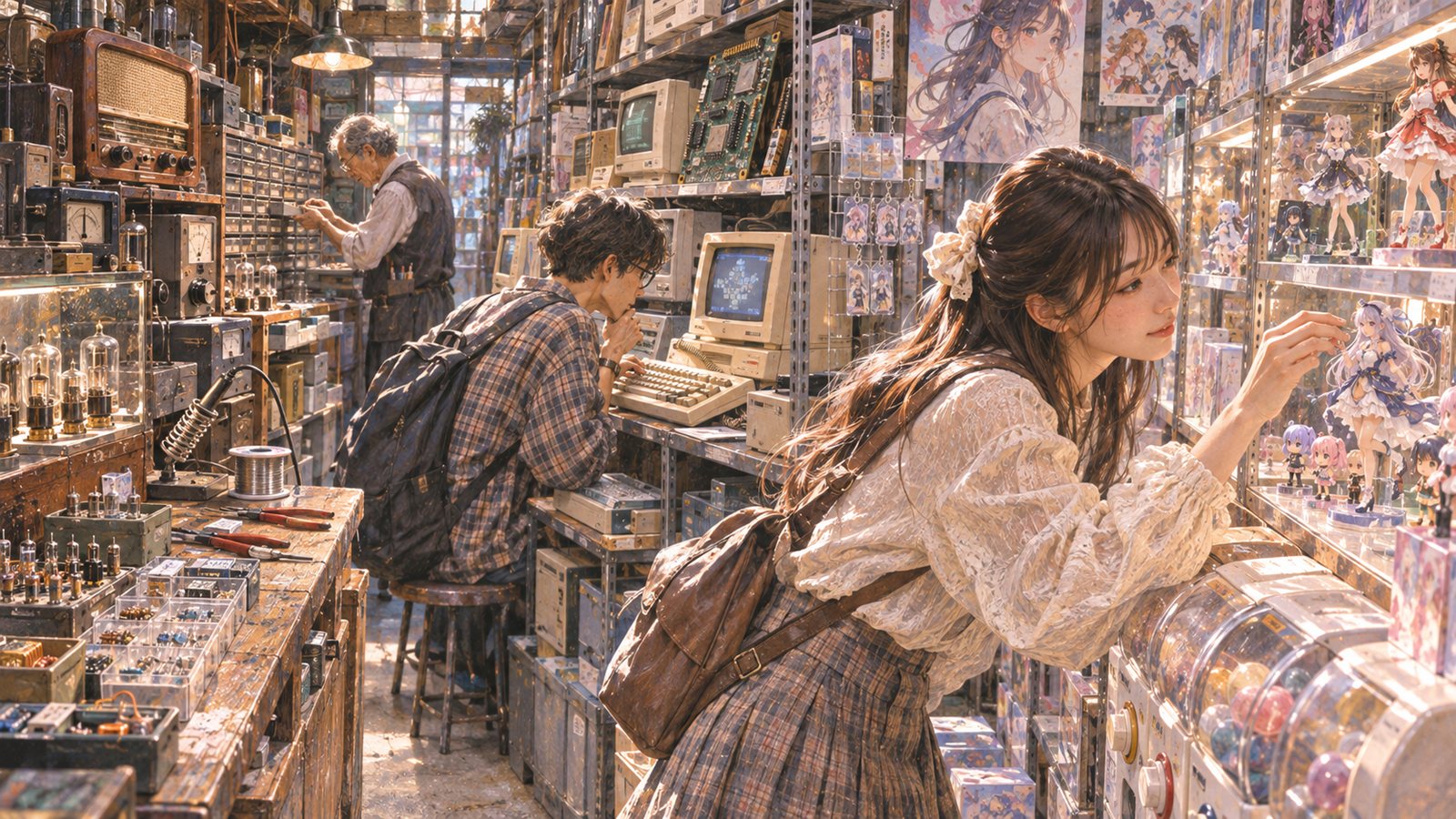
Step out of the Electric Town exit of JR Akihabara Station, and directly across stands a ten-story building: Akihabara Radio Kaikan. Despite “radio” in its name, you will hardly find a radio inside. The third floor is a doujinshi and anime bookstore, the fourth is packed with figures and models, and the ninth is a trading card shop.
Walk a few steps to the side and duck under the railway viaduct, and you enter another world. About 40 tiny shops crowd both sides of a narrow passage, selling transformers, capacitors and sensors, each sorted into little drawers.
Anime fans on one side, electronics hobbyists on the other, with only a street between them.
Today, Akihabara is a place anime fans from all over the world make sure to visit in Tokyo. During two months in spring 2024, more than 30% of the Google Maps reviews for over a thousand restaurants around the station were written in foreign languages.
How did it get this way? The usual story is that the electronics stores declined and anime shops took over the empty spaces. That is only half right. Japan has empty storefronts everywhere, so why did anime shops choose Akihabara in particular?
On a firebreak, a group of students building their own radios
The name Akihabara originally had nothing to do with electronics. After a great fire in the early Meiji era, the area was left open as a firebreak, and a shrine to a fire-protection deity was built in the middle. Locals called it “Akiba-san,” and the open ground became known as “Akihabara.” In 1890, the railway built a freight station here and took the same name.
What turned it into an electronics town was the postwar ruin. In 1945, Tokyo was bombed to ashes, and black markets sprang up around the major stations, with an especially large number of stalls selling vacuum tubes and other radio parts.
The boom was sparked by students. Students from a nearby electrical engineering college (today’s Tokyo Denki University) earned money on the side by assembling radios from parts and selling them; they were a big hit, and other stalls followed suit. The reason was practical: a ready-made radio cost two to three times the price of its parts. With prices soaring after the war and radio essential for news and music, building your own was the best deal. It is the same logic as people who build their own PCs today: cheaper, and you can choose the specs yourself.
In 1949, the Allied occupation headquarters ordered street stalls cleared away. The stall owners secured space under the viaduct at Akihabara Station and opened Akihabara Radio Center there in 1949; the next year, the two-story wooden Radio Kaikan opened in front of the station.
Why Akihabara? Large electrical wholesalers had been based here since before the war, so stalls next to the wholesalers could get stock quickly and cheaply, and the station and streetcars made the area easy to reach. Its first customers were not ordinary households but people who wielded soldering irons and wanted to build things themselves. What they cared about was being able to “find it”: for any part of a particular spec, if you walked the whole street, some shop would have it.
Why did high school students line up for a computer you had to solder yourself?
Over the next twenty-plus years, Akihabara became Japan’s most famous appliance district. Televisions, washing machines and refrigerators made their way into every home: in 1957, fewer than one in ten households had a TV; by 1965, 95% did. Akihabara’s reputation as “the cheapest place” spread nationwide.
But the people who loved to build things never went away. In 1976, someone brought them back to center stage.
Kazuya Watanabe was then head of NEC’s semiconductor division. NEC had developed a microprocessor, the “brain” chip of a computer, but Japanese companies did not yet know how to use it. Watanabe’s solution was an educational assembly kit that would let engineers solder it themselves, write their own programs and learn to use the chip.
The kit was called the TK-80. It went on sale in August 1976 for 88,500 yen. What you got was a circuit board, a row of keys and a few numeric display lights, which you had to solder together at home.
Watanabe opened a showroom on the seventh floor of Akihabara Radio Kaikan, named Bit-INN. He expected corporate engineers as customers, but what flooded in were students, young office workers and even high school students. At its busiest, about 3,000 people came in a day, and on weekends some lined up from the morning with packed lunches. Masayoshi Son, who later founded SoftBank, was one of the students who went there often.
The TK-80, with a first run of just 2,000 units and slow early sales, sold about 66,000 units in two years. NEC later carried this approach, letting other companies make peripherals and software, into its own line of personal computers. The starting point of Japan’s personal computer industry was on the seventh floor of a building in Akihabara.
A product designed for companies was snatched up by Akihabara’s hobbyists. This was the first time Akihabara’s customers decided what the street would sell.
After the bubble burst, computer enthusiasts caught Akihabara
After 1989, the appliance business weakened, and when the bubble economy burst in 1993, several long-established electronics stores pulled out of appliance retail. Newspapers at the time asked: is Akihabara going to sink?
It did not sink. In 1994, Akihabara’s computer sales surpassed appliance sales for the first time. A former manager of a major computer store recalled that Akihabara’s appliance business once exceeded 200 billion yen a year, and after computers took over, sales again reached more than 200 billion yen at the 2000 peak. When Windows 95 launched in 1995, Akihabara even held a celebration for it.
Computers chose Akihabara for the same reason radios had. Computers back then were things you “had to understand and assemble”: you bought a motherboard, memory and a hard drive and put them together at home. On a single street in Akihabara, big stores sold complete machines, small shops sold parts and used-goods shops in the back alleys took in old gear, so you could buy everything from scratch to finished system. People who want to cook go to a market, not a convenience store; the logic is the same.
Kaiyodo brings Rei Ayanami to Radio Kaikan
At the height of the computer boom, other kinds of shops appeared in the back alleys. In 1994, a small manga and doujinshi shop called Toranoana opened on a back street in Akihabara.
In 1998, Radio Kaikan welcomed the model maker Kaiyodo, along with a doujinshi bookstore and a doll shop. Kaiyodo placed a life-size figure of Rei Ayanami, a character from the anime Neon Genesis Evangelion, on the fourth floor, gazing down on the main street from the window. Radio Kaikan marks that year as the starting point of Akihabara’s turn toward figures.
Why did model shops move in? Kaichiro Morikawa, an architectural scholar who studies Akihabara, observed that people who love computers often love anime and games too. He himself used to frequent model shops in Kichijoji and Shibuya, and around 1998 those shops moved to Akihabara one after another.
Morikawa also pointed out something crucial: no big company planned this transformation. Shibuya was built by large corporate groups that bought land and built department stores; in Akihabara, small specialty shops moved in first, did well and others followed, and the big electronics stores only later began selling anime goods.
In August 2001, Bit-INN on the seventh floor of Radio Kaikan closed, and the building put up a plaque on the site marking it as “the birthplace of the personal computer.” That same year, Akihabara’s first permanent maid café opened, with staff dressed as maids serving anime fans.
In the same building, the goods changed from radios to computer kits to figures. The high school students who lined up here for the TK-80 and the young people who later lined up for limited-edition figures were the same kind of people: willing to spend time and money on their hobbies, and to make a special trip for them.
The crowds came first; big capital came later
In 2005, railways and large-scale development caught up. The Tsukuba Express opened, linking Tsukuba in Ibaraki directly to Akihabara in 45 minutes; the same year, a large electronics megastore opened on the east side of the station, and a 22-story office building was completed the following year.
This is the opposite of Shibuya’s order. In Shibuya, developers came first and crowds followed; in Akihabara, a crowd of people who came to browse every day came first, and big capital only later saw the value of the place.
From a business perspective, this is what makes Akihabara most noteworthy. The appliance era was actually the exception: ordinary households buying refrigerators only look at price and go wherever is cheapest, with no loyalty to any street, which is why Akihabara faced a “will it sink?” crisis as soon as appliances declined. What held it up were the enthusiasts who had been there since the radio days. A shopping street that attracts customers with low prices loses them as soon as somewhere cheaper appears; one that attracts them because “everyone who shares my interest is here” is hard for anywhere else to copy.
An old shop that has sold everything from vacuum tubes to LEDs
Today, this community of enthusiasts has spread worldwide. From April to June 2024, Tokyo received about 6.83 million foreign visitors, more than 60% more than the same period in 2019. Radio Kaikan was rebuilt in 2014, and on its fifth floor is a Kaiyodo flagship store, the owner of that Rei Ayanami figure; the new building also has several trading card shops, another new hobby that Akihabara has taken in.
Akihabara is still changing. Toranoana shifted its focus to Ikebukuro in 2022, and a 170-meter tower combining offices, a hotel and an electronics store is planned beside the station.
But go back under the viaduct and the earliest generation of shops is still there. On the third floor of Tokyo Radio Department Store is a parts shop that moved in among the first tenants in 1950 and still sells more than a hundred kinds of coaxial connectors and variable capacitors hard to find elsewhere. At the entrance is an LED specialty shop whose roots go back to a radio shop founded in 1947. It started with radio parts and vacuum tubes, later switched to light bulbs and taillights, and moved to LEDs as soon as they appeared. Its best seller today is 12-volt LED strip lighting.
A shop that went from vacuum tubes to LEDs has changed its shelves many times, yet its customers are still people who love to build things. Akihabara is the same. Step out of the Electric Town exit and you see a building of figures on one side and tiny parts shops on the other. They look like two different worlds, but they are footprints left by the same people in different eras. Anime fans from around the world come to Akihabara because, for more than seventy years, this street has kept changing its shelves to follow these people.
Notes
- Sources give the date of the early Meiji fire as either 1869 or the 12th month of Meiji 2 (January 1870 in the Western calendar); the article says “the early Meiji era.”
- Sources differ on the month of the 1949 order to clear street stalls (August or September); the article gives only the year.
- The figure of 6.83 million foreign visitors to Tokyo is the Tokyo Metropolitan Government’s preliminary figure for April to June 2024.
References
- Sumitomo Mitsui Trust Realty “Kono Machi Archives” | Kanda: the origin of the Akihabara name and station (origin of the name, freight station)
- Toyo Keizai Online | Origin of the Akihabara name | 2015-12-29
- Sumitomo Mitsui Trust Realty “Kono Machi Archives” | History of Kanda’s specialty shopping streets (students building radios, opening of Radio Center and Radio Kaikan)
- Akihabara Electric Town Association | History Chapter 2 (1945-1954) (black markets, radio prices, why Akihabara became an electronics town)
- Akihabara Electric Town Association | History Chapter 3 (home appliance penetration rates)
- Akihabara Electric Town Association | History Chapter 6 (1985-1996) (old stores leaving appliance retail in 1993, computers overtaking appliances in 1994, Windows 95)
- Akihabara Electric Town Association | History Chapter 7 (Tsukuba Express, UDX)
- Akihabara Radio Kaikan | History (1950 opening, Bit-INN, Kaiyodo moving in in 1998, 2001 plaque, 2014 rebuild)
- Information Processing Society of Japan Computer Museum | TK-80
- Mynavi News | History of NEC, Part 9 | 2025-01-14 (Kazuya Watanabe, crowds at Bit-INN, TK-80 sales)
- PC Watch | Looking back at Akihabara’s Bit-INN | 2001-11-12
- ASCII.jp | Interview with a former manager of Laox The Computer Kan | 2004-10-02 (appliance and computer sales, “is Akihabara going to sink?”)
- The Japan Times | Anime invade Akihabara’s electronics monopoly | 2001-01-06
- artscape | Conversation between Masato Nakamura and Kaichiro Morikawa | 2004-02
- Anime Hack | Figure trends | 2023-04-22 (life-size Rei Ayanami in 1998)
- nippon.com | Maid cafés | 2015-07-18
- Tokyo Metropolitan Government | Survey of tourist numbers, preliminary results for April–June 2024 | 2025-01-20
- Honichi Lab | Akihabara restaurants popular with foreign visitors | 2024-06-07 (share of foreign-language reviews)
- Unseen Japan | Akihabara: Why Otaku are Fleeing | 2024-06-15 (Toranoana moving to Ikebukuro)
- Kenbiya | Redevelopment of the southern Sotokanda 1-chome district | 2023-12-07
- GDM | Exploring Tokyo Radio Department Store #1 | 2024-02-25
- GDM | Exploring Tokyo Radio Department Store #8 | 2024-08-13
- at home VOX | Akihabara Radio Center | 2016-11-10
Follow the story in person
Join a small-group trip to the places in our stories and meet the people who live and work there.
See trips and dates
Water Mirror is a Tokyo-based company that helps more people step inside industries and explore the stories and cultures of different fields around the world. We design in-depth learning programs for individuals, companies, schools and organizations, combining company visits, exchanges with professionals, local learning and hands-on experiences, so participants can see how industries really work and meet the people and stories behind them. Water Mirror Insights is our content media, telling the distinctive stories of industries, local cultures and people, so that reading sparks curiosity and leads readers to go and see for themselves.
About Water Mirror →