Key Points
- The most expensive trading card in history is the Pokémon “Illustrator” card. In February 2026, a copy owned by influencer Logan Paul sold at a U.S. auction for $16,492,000 (about 2.5 billion yen), more than three times the $5,275,000 he paid for it in 2021.
- The card was never sold in stores. It was a prize handed to winners of three illustration contests run by the Japanese children’s manga monthly CoroCoro Comic between 1997 and 1998, and only 39 were officially given out. It will never be printed again, and that’s the first reason it’s rare.
- The second reason is grading. U.S. grading company PSA scores cards from 1 to 10, and of the 20 Illustrator cards it had graded as of 2022, only one received a 10. In the summer of 2021, a 9 and a 10 of the same card changed hands for about $1.27 million and about $5.27 million respectively.
- The same logic of scarcity plus grading now applies to every new booster pack. Japan’s domestic trading card market passed 300 billion yen in fiscal 2024, new sets are snapped up and resold the moment they launch, and lotteries for official merchandise have even required identity checks with the national My Number card.
On February 16, 2026, Goldin, an auction house in New Jersey, closed an online auction. Lot 1 was a card smaller than the palm of your hand, sealed in a clear hard case. It sold for $16,492,000, about 2.5 billion yen. It was the highest price ever paid for a trading card anywhere in the world, more than $3 million above the previous record, set the year before by a basketball card signed by Michael Jordan and Kobe Bryant.
In the middle of this card is a line of text. Roughly translated, it says: “This certifies that your illustration was selected as an outstanding work in the Pokémon Card Game Illustration Contest.”
In other words, it was originally a certificate of merit. In 1998, a Japanese children’s manga magazine mailed it to a few dozen winners of a drawing contest, and some of their names and hometowns were even printed in the magazine: Fukuoka, Nagano, Shizuoka, Osaka. It was never sold in any store.
How did a paper certificate become worth 2.5 billion yen? To answer that, we first need to know how it was made, and then see who pushed its price up, layer by layer, over the next 28 years, and how. That same method is now being applied to every pack of Pokémon cards on Japanese store shelves.
This card was never sold in a store
Pokémon began as a video game released in February 1996, and in October of the same year the Pokémon Trading Card Game went on sale in Japan. Two players each bring a deck they’ve built and take turns playing cards to make their Pokémon battle. The cards caught on with elementary school kids right away.
The publication that championed Pokémon hardest was CoroCoro Comic, published by Shogakukan. A monthly manga magazine aimed mainly at elementary school boys, it carried Pokémon manga, strategy guides and news on new cards. In the autumn of 1997, the magazine announced a “Pokémon Card Game Illustrator Contest,” inviting readers to draw their favorite Pokémon and send it in.
There were two kinds of prizes. The top three winners had their artwork actually printed as cards and received 20 copies of their own card. The other 20 runners-up each received a single card made just for the contest, the one later known as the “Pikachu Illustrator.” In 1998 the magazine held two more similar contests, themed around the first Pokémon movie and the Pikachu short that screened with it, handing out 16 more. Across the three contests, the official number of these cards given out was 39.
The artwork on the card was drawn by Atsuko Nishida, one of the original designers of Pikachu and Charmander. Ordinary item cards are labeled “Trainer” at the top, but this one says “Illustrator,” and in the bottom right corner it carries a unique pen-shaped symbol. The bottom of the card even lays out a perfectly serious game rule: at the start of your turn, flip a coin; if heads, you can’t do anything this turn, and if tails, your opponent can’t do anything next turn. It’s a joke card, almost useless in an actual battle.
For the winners in 1998, its meaning was simple: the magazine was officially saying you could draw.
Rarity comes from “it will never be printed again”
Ordinary Pokémon cards are products sold in packs, and as long as they sell, they keep being printed. The first thing that sets the Illustrator card apart is that it never entered the sales channel at all. The number was fixed in 1998, and it was never reprinted.
Being scarce didn’t make it valuable from the start. For years after those 39 cards arrived at the winners’ homes, no one paid much attention to where they went. In 2016, an Illustrator card sold at a U.S. auction for about $55,000, and the media already reported it as “the most expensive Pokémon card.” At the time, even the auction house couldn’t say exactly how many had been given out, estimating only “20 to 39.”
Rarity is actually fragile. It depends on everyone believing “there won’t be any more.” From 2019, a few prize cards that had never been formally awarded began turning up on Japanese auction sites. In 2020, two more Illustrator cards appeared on the market, sold by one of the designers who had helped write the rules of the Pokémon Trading Card Game, bringing the known total from 39 to 41. Both were authenticated as genuine, but they made collectors realize for the first time that “only 39 in the world” wasn’t an iron law, just a story everyone had agreed to accept.
Even so, 41 is a tiny number. What sent the price into the stratosphere was the score that came next.
The same card: a 9 and a 10 were $4 million apart
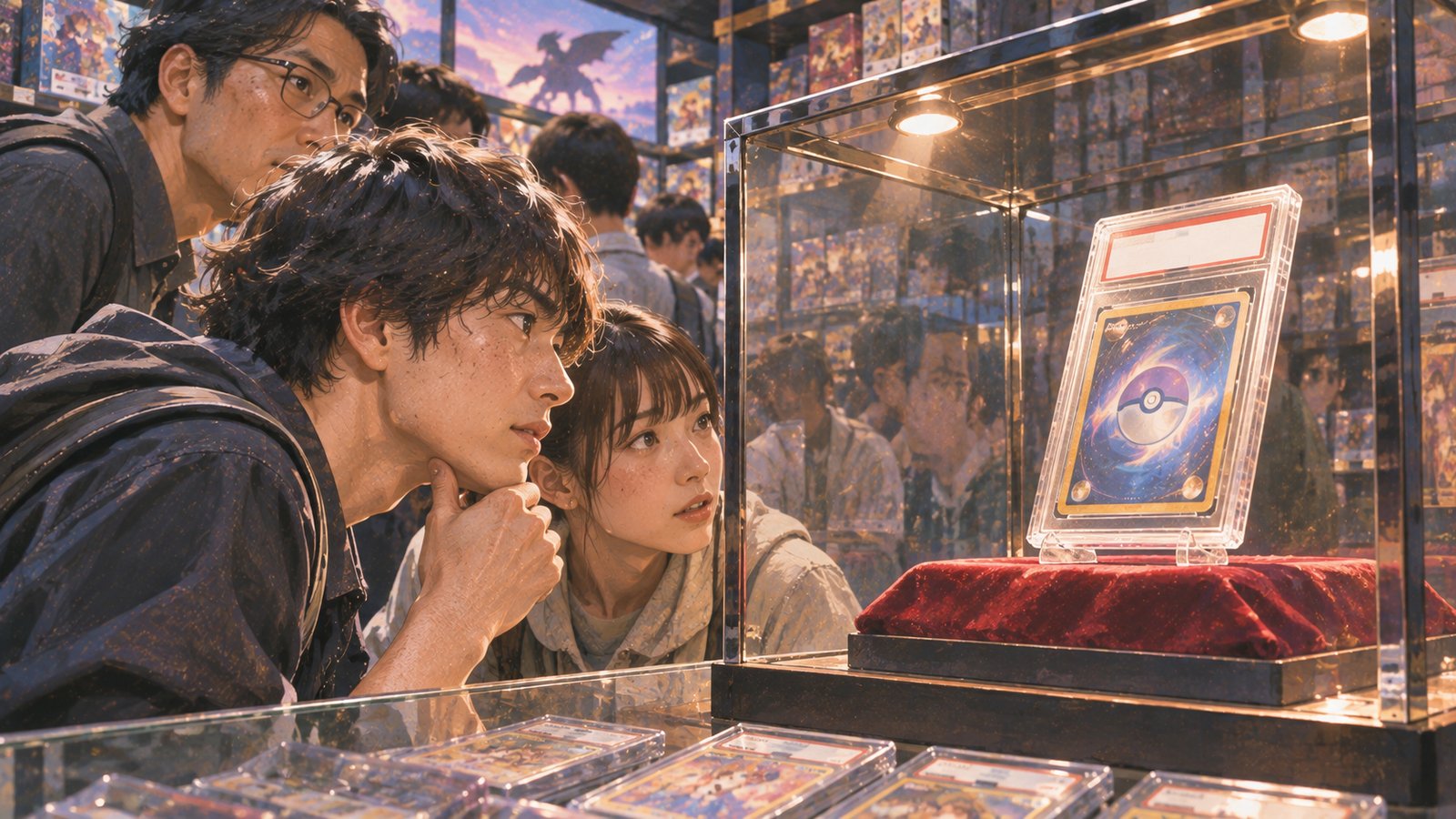
If you’ve ever seen an expensive Pokémon card online, you’ve probably noticed that almost all of them are sealed in a clear hard case with a label on top showing the card’s name, a serial number and a number from 1 to 10. This is “card grading.”
The best-known company doing it is PSA, founded in the United States in 1991 and originally focused on sports cards like baseball cards. Collectors mail in their cards. A grader first confirms that a card is genuine, then checks whether the four corners are sharp, whether the edges are worn, whether the image is printed centered, and whether the surface has scratches or has lost its gloss. Finally the grader assigns a score and seals the card in a case. PSA defines a 10 as “virtually perfect”: four perfectly sharp corners, crisp printing, and the full original gloss from the factory. In 2018 PSA opened an office in Tokyo and began accepting Japanese cards for grading directly.
For a card from 1998 that was mailed, handled by its winner and left in a drawer for 20 years, keeping all four corners free of wear is extremely hard. As of 2022, PSA had graded 20 Illustrator cards: eight received a 9, and only one received a 10.
How much does the score affect the price? In the summer of 2021 there happened to be a pair of deals that can be compared directly. That June, Logan Paul bought a PSA 9 Illustrator card from a collector on the shores of Lake Como in Italy for $1,275,000. A month later, he flew to Dubai and met the owner of the only PSA 10 at the Burj Al Arab. It was a public holiday and the banks were closed, so he couldn’t wire the money on the spot. In the end, he paid with the 9 he had just bought plus a handwritten IOU promising $4 million. The total came to $5,275,000, about 600 million yen at the time.
Same card, same year, same buyer. One point apart, and the price differed by $4 million.
This deal shows the core mechanism of the collectible card market. For buyers, a card’s condition is hard to judge: photos can be edited, sellers can lie. Grading companies turned “how good is this card” into a number even a stranger can understand. That allows cards to be bought and sold between people who have never met, even traded across the world with an IOU. And with only one 10 in existence, that number itself became another form of scarcity.
A necklace and a livestream: the price seen by more people
Logan Paul is no ordinary collector. He’s an American influencer and pro wrestler whose YouTube channel has more than 20 million subscribers. In late 2020 he started filming himself opening boxes of early Pokémon cards. Other influencers followed, and auction bids climbed with them. It was the middle of the pandemic, and many people stuck at home dug out their childhood cards or started buying cards as investments. U.S. grading companies were flooded with submissions, and one major company at one point only accepted cards from people willing to pay a $250-per-card express fee, while regular submissions waited more than a year.
Logan Paul made the 10 his signature. He had an $80,000 diamond-studded pendant made and wore the case with the card around his neck. In April 2022, he wore it into WrestleMania 38, the biggest annual event in American wrestling, where Guinness World Records presented him on the spot with a certificate for “the most expensive Pokémon card sold in a private sale.” He said, “This card is worth more than my ranch.”
Once a card has been seen by that many people, its value comes not only from the card itself but from its story and its fame. Logan Paul later decided to put the card up for auction with Goldin. To win the consignment, founder Ken Goldin first wrote him a personal check for $2.5 million and promised him a share of the auction proceeds. Bidding opened on January 5, 2026, at $500,000, and by early February had passed $5 million. When it closed on February 16, the price, including the buyer’s premium, was $16,492,000, three hundred times what the same card sold for in 2016.
The money bought more than a card. The diamond necklace Logan Paul wore into the wrestling arena went to the buyer too, and the handover happened on his YouTube livestream. The history of the card being seen became part of the product.
The same logic now applies to every new pack
The Illustrator card is an extreme case, but the two conditions that made it valuable, “limited numbers” and “authoritative proof of perfect condition,” don’t belong only to vintage cards.
The cards in a new pack of Pokémon cards are random. A few beautifully designed rare cards turn up with very low odds. If someone pulls one and gets a 10 from a grading company, it can sell on the secondary market for more than a whole case of packs would cost. That turns a pack costing a few hundred yen into, for many people, a lottery ticket.
As a result, Japan’s domestic trading card market passed 300 billion yen in fiscal 2024, yet new cards often vanish from shelves on release day, and bulk buying for resale has become a social problem. In 2026, when The Pokémon Company ran an online lottery for its 30th-anniversary merchandise, it required applicants to verify their identity with the My Number card, a national ID issued by the Japanese government, to block mass applications from resellers. One electronics retailer in Okayama went further, ruling that only holders of its own credit card could buy popular packs, which meant children without credit cards couldn’t buy them on their own.
Back then, CoroCoro readers could enter the contest with a postcard and a drawing. Today, kids who want a new pack sometimes need an adult to step in first.
What 2.5 billion yen bought was a 1998 that can’t be repeated
Looking back at that $16.49 million, how much of it paid for the piece of paper? Almost none. The paper and ink are about the same as the Pokémon cards you can buy at a convenience store.
What the buyer paid for was several layers of “proof” stacked on top of each other. The bottom layer is a 1998 children’s magazine certifying that a reader could draw. The next is an American company certifying that the card has barely been touched since that year. The top layer is countless people having seen it on streams and in the news, certifying that it is “the one.” None of these three proofs can be made again: the contest won’t be held again, time can’t be turned back, and that necklace and that wrestling event only happened once.
So I’d argue that a Pokémon card fetches a sky-high price not just because Pokémon is popular, but because it seals a stretch of time that can never be repeated inside a hard case that can be appraised and passed on. Pokémon’s popularity decides how many people want it. Only “it can’t be repeated” decides how many people can’t have it.
How many of those 39 winners still have their cards today is something no public data can answer. But one thing is certain: when the magazine sent out that card in 1998, all the editors wanted to say was this: you draw really well.
Notes
- Yen conversions are based on exchange rates at the time of each report: the 2026 sale of $16,492,000 is about 2.5 billion yen, and the 2021 price of $5,275,000 about 600 million yen.
- Total number of Illustrator cards: 39 were officially given out across the three contests. In 2020, two more were sold by a designer who had helped write the early game rules, bringing the known total to 41. Estimates of how many survive and how many are in good condition vary by source (from about 10 to more than 20). This article uses PSA’s grading figures as of 2022.
- Reports do not consistently state the grade of the card sold for about $55,000 in 2016.
- The text in the middle of the card is a rough translation based on an English rendering.
References
- Japan Today / Kyodo|Pokemon card sold at auction for world record $16.49 million|2026-02 (2026 sale price, Goldin auction, previous record basketball card)
- Shukan Josei PRIME|《ポケモンカードが25億円で落札》5年前は6億円、1998年製、世界で約40枚|2026-02-19 (yen conversion, Logan Paul’s background)
- Bulbapedia|Pokémon Illustrator (CoroCoro promo) (winners in each of the three contests, 39 cards, Atsuko Nishida, card text and rules, the two extra cards)
- Pokumon|Early Pokémon Illustration Contests (issues announcing and revealing the contests, winners’ prefectures, prizes)
- Wikipedia|List of most expensive cards from collectible card games (sales history, 41 cards)
- Guinness World Records|The $5 million Pokémon card: Inside Logan Paul’s record-breaking trade|2022-07 (Lake Como and Dubai deals, the IOU, PSA population, definition of a 10, the necklace, “worth more than my ranch”)
- TheValue|Logan Paul’s “Pikachu Illustrator” is on track to become Pokémon’s most expensive card|2026-02 (opening bid, bidding progress, Goldin’s $2.5 million check)
- GeekWire|Elusive Pikachu Illustrator Pokémon card sells for record $54,970 at auction|2016-11 (2016 sale price, “20 to 39”)
- PSA|PSA Opens New Office in Tokyo|2018-12-22 (PSA founded in 1991, Tokyo office in 2018)
- News4JAX / AP|Collectible prices skyrocket to the dismay of hobbyists|2021-09-02 (the late-2020 boom and Logan Paul’s box openings, grading backlogs and the $250 express fee)
- Bulbapedia|Starter Deck (TCG) (Pokémon Trading Card Game released in Japan in October 1996)
- Toy People News|Article on the trading card market and MINT (Japan’s domestic trading card market passed 300 billion yen in fiscal 2024)
- Shukan Josei PRIME|Debate over an Okayama electronics retailer’s Pokémon card purchase rules|2026-06-12 (My Number card verification for the 30th-anniversary lottery, the Okayama retailer’s purchase rules)
Follow the story in person
Join a small-group trip to the places in our stories and meet the people who live and work there.
See trips and dates
Water Mirror is a Tokyo-based company that helps more people step inside industries and explore the stories and cultures of different fields around the world. We design in-depth learning programs for individuals, companies, schools and organizations, combining company visits, exchanges with professionals, local learning and hands-on experiences, so participants can see how industries really work and meet the people and stories behind them. Water Mirror Perspectives is our content media, telling the distinctive stories of industries, local cultures and people, so that reading sparks curiosity and leads readers to go and see for themselves.
About Water Mirror →