Key Points
- The number of game centers (ゲームセンター) in Japan fell from 16,069 in fiscal 2013 to 8,548 in fiscal 2023, roughly halving. But nationwide revenue recovered from a low of 422.2 billion yen in fiscal 2014 to 614.8 billion yen in fiscal 2024, higher than the pre-pandemic 540.8 billion yen in fiscal 2019.
- The rebound was led by “prize games” such as crane games. Their share of game center revenue rose from 41% in fiscal 2013 to 68% in fiscal 2024, and crane games alone took in 391.8 billion yen in a year.
- Game centers declined mainly because home consoles and smartphones let people play great games at home, so fewer came out to play fighting or racing games. And the 100-yen price per play was hard to raise, so margins grew thinner and thinner. Crane games turned things around because they offer something you cannot get at home: a physical prize you actually take home.
- In 2022 the Japanese government raised the price limit for crane game prizes from about 800 yen to about 1,000 yen. Together with exclusive anime goods, snack and everyday-item prizes, social media videos and foreign visitors, this shifted game centers from “selling time to play” to “selling the moment you take something home.”
From fiscal 2013 to fiscal 2023, the number of game centers in Japan fell from 16,069 to 8,548. In ten years, almost one in every two closed.
By that figure, this should be a dying business. Many people’s image of game centers is also stuck in the 1990s: rows of fighting game cabinets, with crowds behind them watching skilled players battle. Since then, games have long been playable without leaving home, and game centers look like a place from a past era.
Yet over the same period, nationwide game center revenue in Japan climbed from a low of 422.2 billion yen in fiscal 2014 to 614.8 billion yen in fiscal 2024, higher than before the pandemic. Half as many shops, but a bigger business.
What drove the rebound was one of the least flashy and oldest machines in the arcade: the crane game.
Once games moved home, what was left for game centers?
The 1990s were the golden age of Japan’s game centers. Street Fighter II, released in 1991, set off a fighting game boom, and shooting and racing games followed. Back then, game centers had three things homes did not: the best graphics, the biggest machines, and opponents to play face to face.
Then those three things moved into the home one by one. Home consoles caught up with arcade graphics. As the internet spread, players could battle strangers from their living rooms. And with smartphones, even a few minutes waiting for a train came with games. People who had gone to game centers to play video games no longer needed to go out. Japan’s game center revenue peaked at 702.9 billion yen in fiscal 2006 and then slid steadily.
Losing customers hit game centers especially hard, because they could hardly make it up by raising prices. Since the 1970s, “one 100-yen coin per play” has been the industry standard, and most machines still charge that today. Electricity, wages and machine prices kept rising while the price of a play stayed put. By the 2020s, operators kept on average only about 6 yen in profit for every 100 yen they took in.
The first to give up were small independent shops in front of stations and in shopping streets. Without the money of the big chains to buy new machines, they closed one after another. Those that remained were mostly large chains and family-oriented shops inside shopping malls.
The one thing you can’t do at home: hold the prize in your hands
If video game players went home, why didn’t crane game customers disappear with them?
However fun a game at home is, it can’t give you a plush toy you can actually hug.
In Japan, crane games are classed as “prize games” (プライズゲーム). In 1985 SEGA released UFO CATCHER, which was not popular at first.
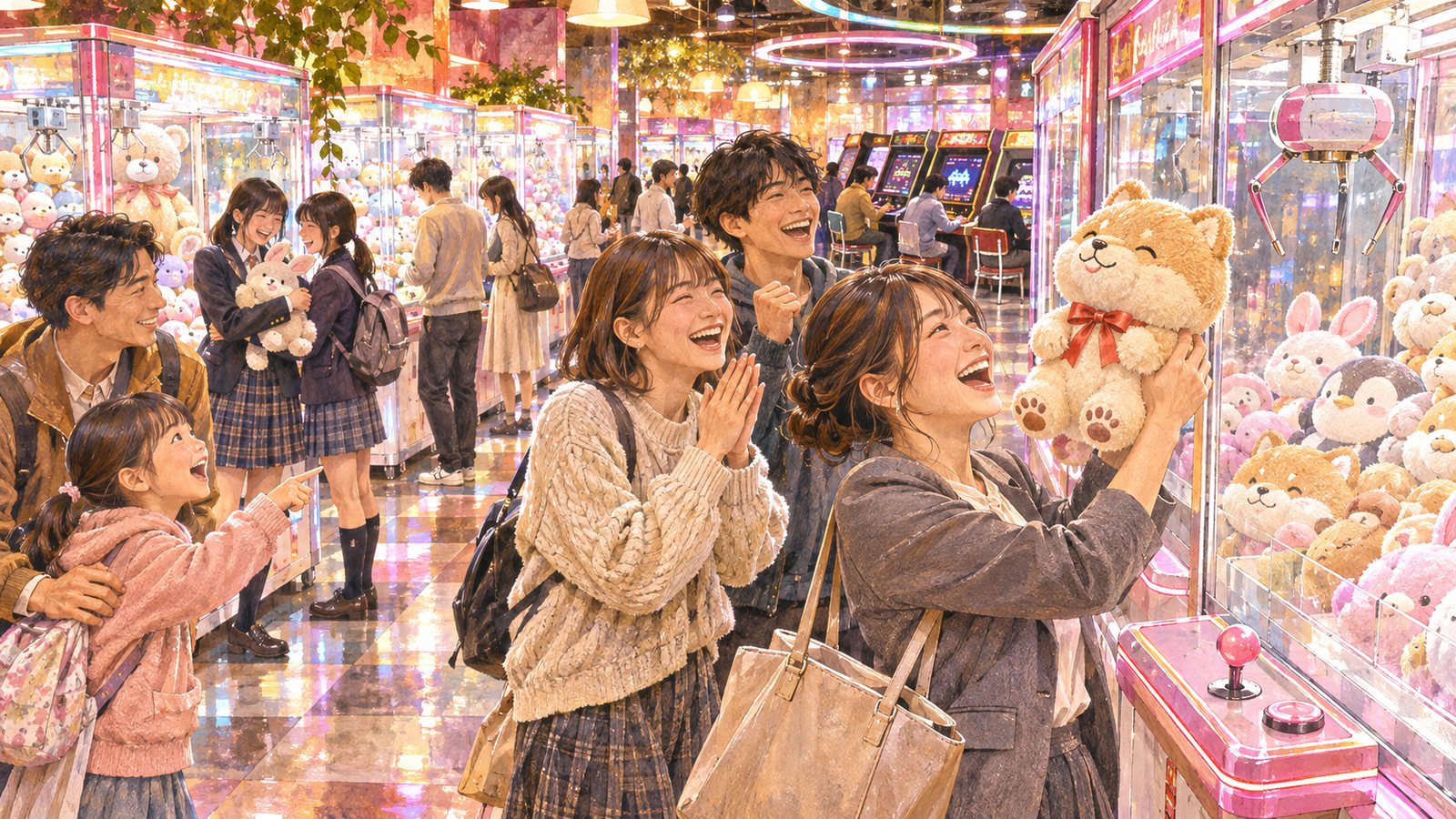
The turning point came in the early 1990s. The prizes were changed to plush toys of characters such as Anpanman and Doraemon and cute stuffed animals, and game centers began putting the machines at their entrances. High school students and young women passing by stopped to play, and from then on crane games became almost synonymous with game centers in Japan.
Whether a crane game sells depends on what is inside the box.
Prize games made up 41% of game center revenue in fiscal 2013, more than half in fiscal 2017, and 68% by fiscal 2024. Crane games alone earned 391.8 billion yen in fiscal 2024, up 17.7% from the year before. One crane game machine earns on average about 1.5 million yen a year, roughly twice a video game cabinet.
So game centers have not “come back” as a whole. It is more accurate to say they replaced the star of the show.
How a rule unchanged for 20 years changed what’s in the box
How good the prizes can be is limited by government rules in Japan. Game centers are in principle banned from handing out goods based on game results, to draw a clear line from gambling. Crane games can give prizes because the government has a separate rule: prizes with a retail price below a certain amount do not break the law.
That line was set at about 800 yen in 2001 and did not move for more than 20 years. Meanwhile, factory labor and materials became more expensive. After years of lobbying by the industry, the limit was finally raised to about 1,000 yen in March 2022, letting manufacturers make bigger, more carefully crafted figures.
Many of these prizes are versions designed by manufacturers specifically for crane games and cannot be bought in ordinary shops. For fans of a particular anime or idol, that is reason enough to go.
In Japan, people call the character or idol they love most and want to support their “oshi” (推し), and spending time and money on your oshi is “oshikatsu” (推し活). It differs a little from traditional fandom: the object is often a character from an anime or game rather than a real person, and the point is not just watching performances but collecting merchandise and using everyday items to show who you love. When an exclusive prize of a certain character arrives, a player’s goal is no longer “win something, anything” but “I have to win that one.” The prize itself has become the reason customers come in.
Prizes have also become more everyday. Besides anime goods, snacks, drinks, instant noodles and household items are now prizes. Since supermarket prices for these are well known, players can easily judge how many tries are worth it, and people who don’t usually play games are more willing to give it a go.
From game centers into convenience stores
As prizes improved, crane games began appearing in more and more places.
Game centers themselves changed first. Many new shops are devoted entirely to crane games, or combine them with capsule toys and merchandise sales. Walk into one and you no longer see rows of screens and joysticks, but rows of lit glass cases full of plush toys, figures and snacks, less an amusement arcade than a variety store where you “check out” by skill. Legally, these shops are still game centers. The Japanese game company Capcom turned some of its existing arcades into crane game shops, and its amusement facilities business grew revenue by 12.8% in fiscal 2025, its best result in recent years.
Another push came from smaller mini crane games that fit into spaces where big machines never could. The Japanese convenience store chain Lawson began trialing crane games in stores in 2022, at 100 yen a play, filled with character goods not sold in the store. By the end of 2025, more than 1,300 stores had them.
Another chain, FamilyMart, places crane games in the space freed up by shrinking magazine racks or in a corner of the eat-in area, with prizes from the popular character Chiikawa, aiming to expand to about 5,000 stores. FamilyMart president Kensuke Hosomi said that in the saturated convenience store market, “adding value such as entertainment is a necessary strategy.” With few machines taking little space, convenience stores do not need a game center business license. Crane games have thus left the game center and moved to street corners people pass every day.
Social media lets even more people see crane games before they leave home. The internet is full of “crane game strategy” guides and challenge videos, with players sharing which machine has which new prize and how to win it. This makes crane games look less like a game of luck and more like a skill you can practice.
Foreign visitors are another push. Lawson’s crane games do especially well in stores with many tourists, such as in Kyoto and Odaiba in Tokyo, and Capcom’s amusement facilities have also gained business from rising visitor numbers. For many foreign travelers, what makes Japanese game centers special is precisely these prizes you can only win in Japan.
A game center losing money in the pandemic, profitable a year later
The clearest example of this shift is SEGA’s game centers.
When the pandemic hit in 2020, game centers were forced to close, and nationwide revenue fell from 540.8 billion yen the year before to 418.7 billion yen. That year, the SEGA subsidiary running its game centers lost about 2.8 billion yen. At the end of the year, GENDA, a company founded only in 2018, bought 85% of the subsidiary.
GENDA’s founder Takashi Kataoka had worked for 21 years at the amusement arcade company of a major Japanese shopping mall group. When he made the acquisition, he was certain that customers would come back to game centers 100% once the pandemic ended. The business turned a profit about a year after the purchase and was later renamed GiGO. By June 2026, GiGO had 422 locations in Japan and 11 abroad.
GiGO’s turnaround did not come from waiting for customers to return, but from exclusive prizes, mini crane games and new store formats.
What game centers sell is no longer time to play
Of course, this path is not without pressure. Prizes have to be bought from factories, so a weak yen and rising prices push costs straight up, while the 1,000-yen limit makes it hard to attract customers with pricier prizes. In fiscal 2023, bankruptcies and closures of Japanese game centers hit a five-year high, mostly small and mid-sized operators that could not hold on. The gains from the transformation have not been shared evenly among all shops.
But overall, Japan’s game centers have found a new path.
In the past, game centers sold “time to play”: put in 100 yen for a few minutes of excitement you couldn’t get anywhere else. Home consoles and phones took that business away. Now they sell “the moment you take something home”: the same 100-yen coin buys the feel of the claw catching a prize, and a physical object you can put on your desk and share in photos.
A crane game is a game, and also a purchase. The 100-yen coin has stayed the same from the 1970s to today. What has changed is what sits inside the glass case, and the reason people are willing to go out for it.
Notes
- The number of game centers in fiscal 2024 was 14,407, a sharp jump from the year before that may reflect a change in how they were counted, so this article does not compare it with the previous year.
- The fiscal 2006 peak of 702.9 billion yen and the figures from fiscal 2013 onward come from different compilations whose methods may not be fully consistent; they are given only as a guide to the long-term trend.
- “About 6 yen per 100 yen” is an estimate of operators’ average operating margin; individual shops vary widely.
- The official wording of the crane game prize limit is “a retail price of roughly 1,000 yen or less.” Before 2001 the limit was about 500 yen.
Sources
- 日本アミューズメント産業協会(JAIA)|メディアのみなさまへ(店數、營業額、獎品遊戲比例與營業額、獎品價格基準的變遷,2013–2024 年度)
- 日本アミューズメント産業協会(JAIA)|JAIA 會報 2026 年 4 月號:2024 年度アミューズメント産業界の実態調査速報(オペレーション売上高 6,148 億日圓)
- アミューズメントジャパン|10年で2倍超、クレーンゲーム売上3918億円(夾娃娃機營業額、成長原因、迷你機台與社群影片)|2026-09-04
- PRESIDENT Online|日本人の「ゲームセンター離れ」はウソ(100 日圓投幣自 1970 年代起為標準、大型與小型店增加)|2024-08-26
- BCN+R|100円で利益はわずか「6円」!?「街のゲーセン」の倒産・廃業が増加(每 100 日圓營業利益約 6 日圓、2023 年度倒閉停業 18 件、成本上升原因)|2024-04-09
- ITmedia NEWS|「ゲーセンはなくならない」 復活の鍵は電子マネーか(2006 年營業額高峰 7,029 億日圓、家用主機與手機遊戲的競爭)|2015-12-12
- THE GOLD ONLINE|ゲームセンター業界とクレーンゲーム(網路與手機遊戲吸走客人、個人店消失、每台機台年營業額)|2024-10-27
- ビジネス+IT|ゲーセンの売上の半分以上がクレーンゲーム(1990 年代電玩中心熱潮、《快打旋風 II》、GENDA 沿革)|2026-01-15
- GAME Watch|UFOキャッチャー40周年(1985 年推出、1991 年前後擺到店門口、布偶獎品帶動流行)|2025-05-01
- 弁護士ドットコムニュース|クレーンゲームの賞品上限価格、20年ぶり値上がり(2022 年 3 月 1 日 800→1,000 日圓、JAIA 陳情與中國人工成本)|2022-03-03
- アニメハック|フィギュアトレンド(獎品公仔品質、上限調整前為 500 日圓)|2022-12-29
- 現代ビジネス|コンビニのクレーンゲーム(羅森超過 1,300 家、全家計畫 5,000 家)|2025-12-27
- SoraNews24|Lawson adds UFO catcher crane games to convenience stores in Japan(一次 100 日圓、店內不販售的獎品、京都與台場觀光客)|2024-07-20
- gamebiz|カプコン、アミューズメント施設は直近で最高業績(2025 年度營業額 +12.8%、訪日需求、夾娃娃機專門店)|2026-05-20
- MEDIAMIXI|店は減っても売上はコロナ前水準へ プライズが支えるゲームセンターの回復(GiGO 國內 422 家、海外 11 家)|2026-11-09
- ビジネス+IT|GENDA 片岡尚インタビュー(2020 年收購世嘉電玩中心事業、約 28 億日圓虧損、一年轉虧為盈)|2024-12-26
- 熊本日日新聞(共同通信)|ファミマ景品ゲーム設置5千店に 「遊べるコンビニ」拡大(設置位置、吉伊卡哇獎品、一次 100 日圓、社長談話)|2026-01-19
- マネーフォワード クラウド|ゲームセンター開業に必要な風俗営業許可(遊戲區面積在客席面積 10% 以下免申請許可)
- ニッセイ基礎研究所|「推し活」の消費(推活的範圍與和過去粉絲消費的差異)
Follow the story in person
Join a small-group trip to the places in our stories and meet the people who live and work there.
See trips and dates
Water Mirror is a Tokyo-based company that helps more people step inside industries and explore the stories and cultures of different fields around the world. We design in-depth learning programs for individuals, companies, schools and organizations, combining company visits, exchanges with professionals, local learning and hands-on experiences, so participants can see how industries really work and meet the people and stories behind them. Water Mirror Perspectives is our content media, telling the distinctive stories of industries, local cultures and people, so that reading sparks curiosity and leads readers to go and see for themselves.
About Water Mirror →