Key Points
- At the opening ceremony of the Tokyo Olympics on July 23, 2021, the athletes’ parade used Japanese video game music from start to finish. The first piece was the “Overture” composer Koichi Sugiyama wrote for Dragon Quest, followed by more than ten game scores from Final Fantasy, Monster Hunter, Kingdom Hearts and others.
- Japanese game music adapts well to orchestras partly because of early hardware limits. The 1980s Famicom (the NES outside Japan) could play only three melodic voices at once, so composers could not hide behind rich sounds. They had to write pieces that stood up on melody alone, and that players would not tire of after hundreds of hearings.
- The world’s first orchestral concert of game music was “Family Classic Concert: The World of Dragon Quest,” held by Sugiyama at Suntory Hall in Tokyo in August 1987. The idea was to use a game children loved to introduce them to classical music. It was held every year until 2019.
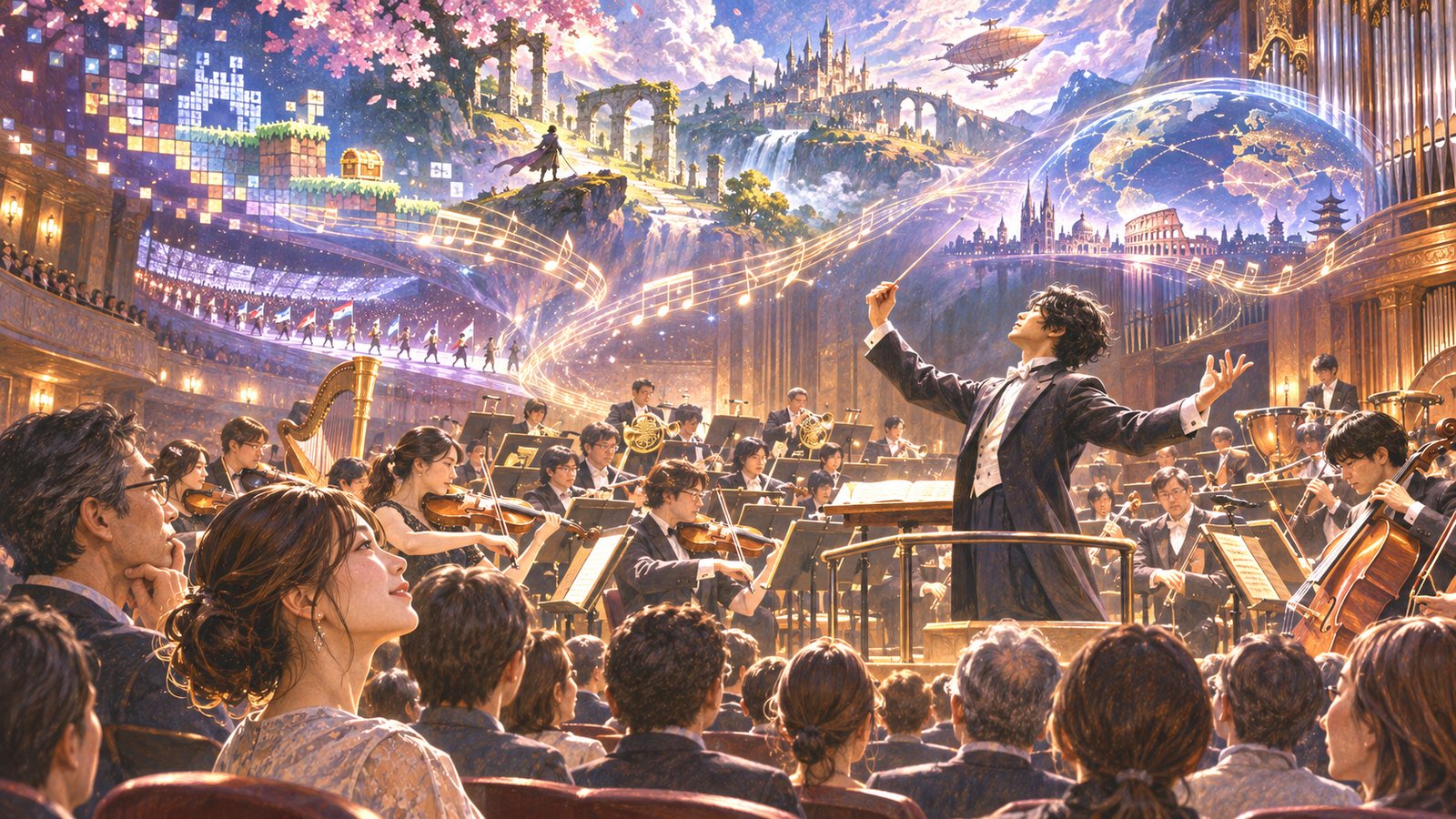
- Such concerts later spread worldwide. The Final Fantasy concert series “Distant Worlds” has played more than 200 shows in 19 countries since 2007, and in 2026 Square Enix launched a world tour of 15 shows in 11 cities. For orchestras, game concerts bring in large numbers of 25- to 35-year-olds who rarely went to concert halls before.
On the evening of July 23, 2021, at Japan’s National Stadium in Tokyo, the stands were nearly empty because of the pandemic. By tradition, the Greek delegation entered first. The music filling the stadium was a rousing orchestral piece with fanfare horns.
Players around the world recognized it at once: the “Overture” from Dragon Quest, the opening music of a role-playing game released on Nintendo’s Famicom in 1986. As more than 200 delegations entered, one piece followed another, all from Japanese games: Final Fantasy, Monster Hunter, Kingdom Hearts, Sonic the Hedgehog…
These pieces have no lyrics, and they are not classical masterpieces like Beethoven or Mozart. They were written to play through TV speakers while players fought monsters. But they did not appear only at the Olympics. In 2026, Square Enix took its game music on a world tour, starting at Tokyo International Forum and visiting 11 cities including Los Angeles, London and Paris. The same year, Atlus took an orchestral concert of Metaphor: ReFantazio to six countries.
Why would people around the world buy tickets to a concert hall to hear game music? The answer begins with a game console that could play only three sounds at once.
A console that could play only three notes at once: how do you compose for that?
The Famicom, released by Nintendo in 1983, had a sound chip that could play only three melodic voices at a time: two “square waves,” thin, electronic whistle-like sounds, usually one for the melody and one for the harmony, and one “triangle wave,” a rounder sound used for the bass. There was also a noise channel used to imitate drums. In other words, a piece could have at most three lines of melody plus a little rhythm.
Dragon Quest composer Koichi Sugiyama was already 55 when he took the job. Born in 1931, he graduated from the University of Tokyo, worked first at a radio station and a TV network, then became a full-time composer, writing many hits for popular 1960s groups such as The Peanuts and The Tigers. He got into games through a reader feedback card. After playing a computer shogi game, he wrote on the card that the game had no music and suggested they do something about it. Yukinobu Chida, a producer at the game company Enix, noticed the card. He already believed games would need better and better music, and here was a composer who had written hit songs, genuinely loved playing games and had offered his opinion unprompted. So he invited Sugiyama to write music for a game.
Sugiyama did not complain about the three-voice limit. He said a professional composer cannot claim that too few sound sources make it impossible to write music. His example was Bach’s partita for solo flute: a flute plays only one note at a time, yet Bach used it to write works complete with melody, harmony and rhythm. He also noted that with only two or three voices, game music has nowhere to “fudge” anything; you can tell at once whether a melody is good.
There was another condition that film scores do not have: repetition. As players walk across fields, wander through towns and fight monsters, the same piece plays dozens or even hundreds of times. Sugiyama said that because his music would be heard hundreds of times, what he cared about most was that it never became tiresome.
Together, these two limits forced a particular kind of music into being: the melody itself had to be clear and memorable, without relying on tone colors or sound effects. And a piece that stands on its melody alone does not fall apart when a full orchestra plays it. If anything, it has more room to grow.
1987: a concert written for children
Sugiyama himself was the first to prove it. In the year Dragon Quest came out, he rewrote the game’s music as an orchestral suite and had the Tokyo String Music Combination Playing Group record it. Most of its members came from the NHK Symphony Orchestra, the orchestra of Japan’s public broadcaster and the country’s leading professional orchestra.
The next year, on August 20, 1987, he conducted “Family Classic Concert: The World of Dragon Quest” at Suntory Hall in Tokyo. Suntory Hall had opened only the year before as Tokyo’s first hall designed specifically for classical music. Playing game music in such a venue had no precedent, and the concert is considered the world’s first orchestral performance of game music.
The concert was cleverly designed. Besides the Dragon Quest suite, the program included Saint-Saëns’s The Carnival of the Animals, a classical piece often used to introduce children to the instruments of the orchestra, and an association of Tokyo elementary school PTAs (parent-teacher associations) lent its support. Sugiyama’s goal was not to dress up games as high art, but the reverse: to use the games children loved most as a way in, bringing them into a concert hall to hear a real orchestra.
The approach struck a chord. Symphonic Suite Dragon Quest won the planning award at Japan’s Record Awards in 1988, and the concert was held every year from then on, mostly in August during the summer holidays, until 2019. For more than thirty years it was part of the summer for many Japanese families.
From Tokyo to Leipzig: how Japanese game music went abroad
After Dragon Quest, another role-playing game, Final Fantasy, took the same path. Composer Nobuo Uematsu’s music was first performed as a symphonic suite in 1989, and the first official concert covering the whole series was held at Tokyo International Forum in 2002.
What truly took the trend beyond Japan was a German producer. In August 2003, Thomas Böcker held a symphonic game music concert at the Gewandhaus in Leipzig. The Gewandhaus is a center of classical music in Leipzig, where the 19th-century composer Mendelssohn once led the orchestra. That night, Final Fantasy music was played by a symphony orchestra outside Japan for the first time. The audience reaction was enthusiastic, and the concert is now seen as the start of game music concerts in Europe and America.
The response in the US was even more direct. In May 2004, the Final Fantasy concert “Dear Friends” opened in Los Angeles. Tickets sold out in three days, and the organizers turned the one-off show into a tour. In December 2007, another series, “Distant Worlds,” premiered in Stockholm, Sweden, and has since played more than 200 shows in 19 countries. In 2025, even Carnegie Hall in New York hosted the orchestral tour of Final Fantasy VII Rebirth.
A hundred hours of memories in forty-five minutes
Good melodies alone are not enough to make people buy tickets across the sea. What audiences hear in the concert hall also includes their own time.
A film score is heard once, over two hours. A role-playing game often takes 70 to 100 hours to finish, and players control the characters, make the choices and win every battle themselves. “Final Symphony,” a concert produced by Böcker, turned the score of Final Fantasy VII into a symphony of three movements lasting about 45 minutes, in effect condensing a player’s journey of a hundred-plus hours into music you can sit and hear in one go.
Kazuya Yamamoto, producer of JAGMO, a Japanese professional orchestra devoted to game music, has described something similar. He has cried playing games himself, and when he hears that music again later, the scene comes back vividly. Players control the game themselves, and the music stays with them through every stage, so what these melodies hold is the listener’s own experience.
Why do orchestras welcome this new audience?
For orchestras, this audience arrived at just the right time.
The average age of audiences at traditional top orchestras is over 60, while most people at game music concerts are 25 to 35. The Mann Center for the Performing Arts in Philadelphia found that game music concerts drew nearly twice as many people as typical classical concerts. A manager at the Nashville Symphony put it more bluntly: when the orchestra’s finances were tight in 2010, without game music concerts they would have had to borrow money.
Not every classical music fan likes the change. Some critics say it is like using fine old wine to sell cheap cocktails. But the numbers show the door really is letting new people in. A 2025 survey by the Royal Philharmonic Orchestra found that one in six young people in the UK under 25 first encountered orchestral music through games. In Japan, too, JAGMO’s audience is mainly people in their twenties and thirties, most of whom had never been to a classical concert.
This is exactly what Sugiyama set out to do at Suntory Hall in 1987: let children who loved games hear a real orchestra for the first time. The children of that time have grown up, and the idea has spread from Tokyo to concert halls around the world.
2026: concerts become another stage for games
By 2026, game music concerts had grown from fan events into a business run officially by game companies.
Square Enix’s world tour “The Music of SQUARE ENIX” opened at Tokyo International Forum on April 25, with 15 shows planned in 11 cities. The program spans series such as Final Fantasy, Kingdom Hearts, Chrono Trigger and NieR, and the tour runs into 2027. Atlus’s Metaphor: ReFantazio concert, arranged from composer Shoji Meguro’s music, sold out its 2025 premiere in Japan and from October 2026 expanded into a world tour of eight shows in six countries, including the US, Singapore, Thailand, the UK and France.
A few years after a game’s release, players may have finished it long ago and moved on to a new console. Concerts keep people buying tickets and talking about the work, and let those who never played it get to know it through its music first.
Back to that Olympic night in 2021 with no audience. As the athletes walked into the stadium to the “Overture,” few would have guessed the melody was first written for a console that could play only three notes at once. That limit forced composers to put all their effort into melody, writing tunes you remember after one hearing and never tire of after hundreds. And Sugiyama’s concert, which brought children into a concert hall, gave these melodies a second stage. Japanese game scores fill concert halls around the world because the melodies themselves are strong, and because they opened a door to the orchestra that young people are willing to walk through.
Notes
- The Famicom’s sound chip also had a channel for playing samples (DPCM), which early games rarely used for melody. This article describes it as “three melodic voices plus a noise channel.”
- Records of the orchestra at the first Family Classic Concert variously name the “Tokyo String Music Combination Playing Group” and “selected members of the NHK Symphony Orchestra”; both refer to the same group of players, mostly NHK Symphony Orchestra members.
- The “one in six young people” survey was conducted in May 2025 among 2,000 people in the UK; the figure refers to respondents under 25.
Sources
- Shacknews|Tokyo 2020 Olympics opening ceremony video game song list|2021-07-23
- Wikipedia(日本語)|すぎやまこういち
- Wikipedia|Koichi Sugiyama
- ドラゴンクエスト大辞典を作ろうぜ!!第三版 Wiki|【すぎやまこういち】
- Opera Hearts|音楽家すぎやまこういちを偲んで~ドラゴンクエストで融合し、受け継がれるクラシック音楽とゲーム音楽~
- 東京都交響楽団|すぎやまこういち氏追悼特集(PDF)|2021-12
- サントリーホール|サントリーホールの歴史
- Wikipedia|Ricoh 2A03(紅白機音效晶片)
- Wikipedia|Final Fantasy concerts
- Wikipedia|Final Symphony
- Gramophone|The power of video game music to inspire audiences – old and new
- 東洋経済オンライン|ゲーム音楽専門オーケストラ JAGMO に関する記事|2017-07-30
- GIGAZINE|ゲーム音楽がオーケストラを救っている|2015-10-14
- Royal Philharmonic Orchestra|The Royal Philharmonic Orchestra brings the video game world to life at London’s Royal Albert Hall|2025
- RPG Site|The Music of SQUARE ENIX – Magic, Memories, and Melodies concert world tour will take place from April 2026
- Carnegie Hall|FINAL FANTASY VII REBIRTH Orchestra World Tour|2025-01-11
- Game Informer|Metaphor: ReFantazio Orchestra Concert World Tour Kicks Off This Fall|2026-03-03
Follow the story in person
Join a small-group trip to the places in our stories and meet the people who live and work there.
See trips and dates
Water Mirror is a Tokyo-based company that helps more people step inside industries and explore the stories and cultures of different fields around the world. We design in-depth learning programs for individuals, companies, schools and organizations, combining company visits, exchanges with professionals, local learning and hands-on experiences, so participants can see how industries really work and meet the people and stories behind them. Water Mirror Perspectives is our content media, telling the distinctive stories of industries, local cultures and people, so that reading sparks curiosity and leads readers to go and see for themselves.
About Water Mirror →