Key Points
- The Exit 8 is a game made single-handedly by the Japanese indie developer KOTAKE CREATE. It was released on Steam on November 29, 2023, for 470 yen, and one playthrough takes about 15 minutes to an hour. By September 2026, it had sold more than 3 million copies worldwide.
- The first reason for its popularity is its extremely simple rules. In a station underground passage that repeats over and over, turn back if you see an anomaly and keep going if you don’t; judge correctly eight times in a row and you get out. The setting is a passage most people have walked through, so players understand it at a glance and are quick to notice when something is off.
- The second reason is that it is fun to watch other people play. Viewers can hunt for anomalies along with the streamer, and the developer allows monetized streams and videos. Streaming spread the game online and spawned a whole wave of imitators, known as “Exit 8-like” games.
- The game deliberately tells no backstory. Director Genki Kawamura filled that blank with a plot and made a live-action film, which was selected for the Midnight Screenings section at Cannes in 2025 and earned more than 5 billion yen at the box office in Japan, bringing the game to many new players.
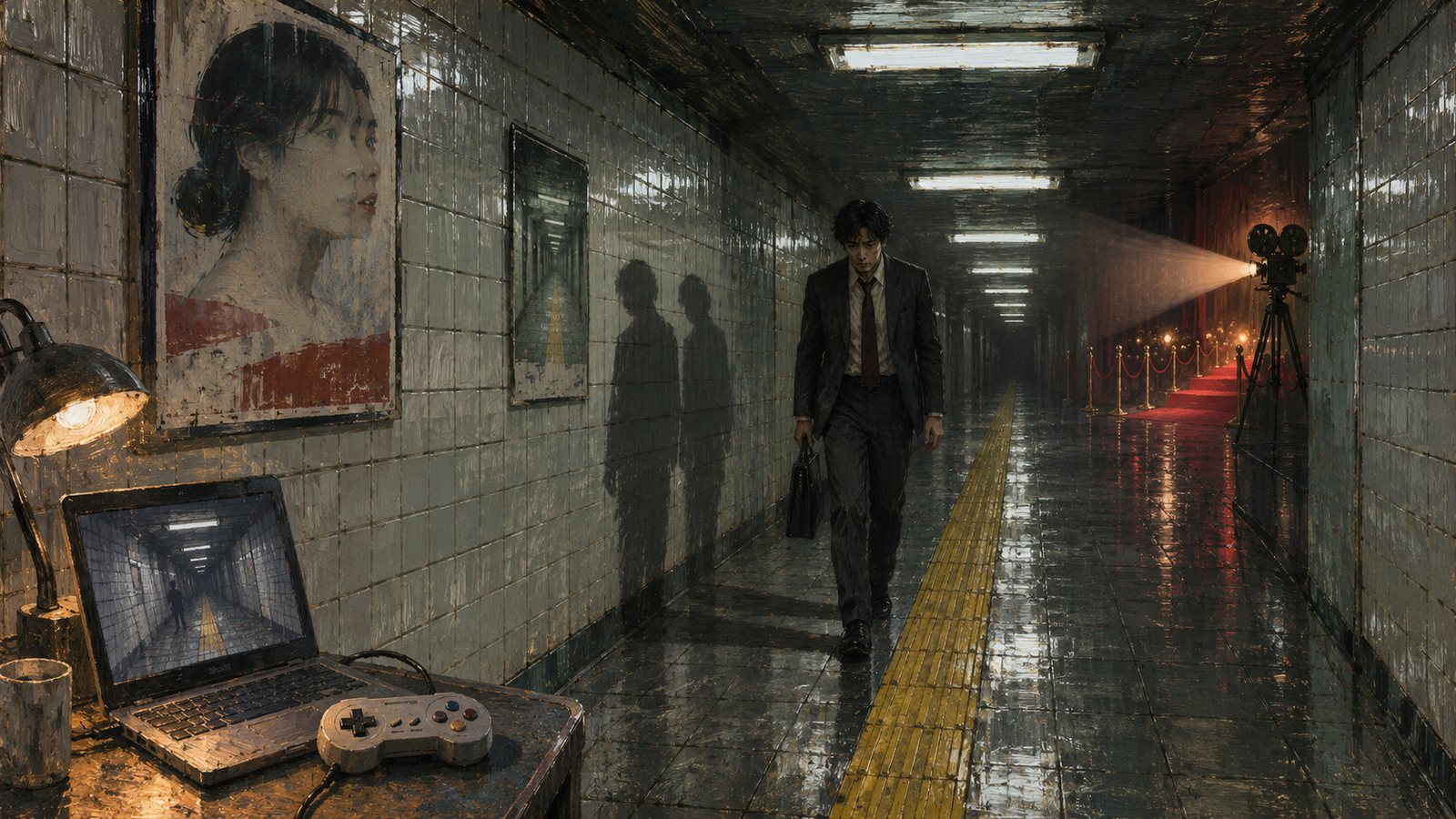
On screen is an underground passage lined with white tiles. Fluorescent lights shine down from the ceiling, a row of advertising posters hangs on the wall, and yellow signs overhead show the exit numbers. A middle-aged salaryman carrying a briefcase walks toward you, passes you and heads off behind you.
A notice on the wall lists four rules: Don’t overlook any anomalies. If you find an anomaly, turn back immediately. If you don’t find an anomaly, do not turn back. Go out from Exit 8.
That is all there is to The Exit 8 (8番出口). No plot, no character names, no monsters chasing you. Players walk back and forth along the same passage, judging whether anything is different from last time. It was made by one person and sells for 470 yen on Steam, the world’s main download platform for PC games.
Normally a game like this would struggle to get much attention. Yet it sold 30,000 copies on its first day, passed 3 million copies in a little over two years, was adapted into a film by Toho, one of Japan’s largest film companies, and premiered at the Cannes Film Festival. Why are so many people happy to get lost in a passage where nothing happens?
Only four lines of rules, so why does everyone want to try it once?
You can think of The Exit 8 as a walk-through spot-the-difference game. Players start from “Exit 0,” and at the end of each stretch of passage they decide whether to go forward or turn back. Judge correctly and the exit number goes up by one. Judge wrong and, no matter how far you’ve come, you are sent back to 0. Only after eight correct answers in a row do you reach the surface.
The anomalies range from small to large. Sometimes the face on a poster turns eerie, sometimes a door disappears, sometimes the salaryman suddenly sprints toward you, or a flood of water surges down the passage.
The rules are so simple there is no tutorial. The Steam store page says you can reach the ending just by reading the instructions. A playthrough takes about 15 minutes, and even players who get stuck mostly finish within an hour. At under 500 yen, it costs about as much as a simple lunch for a short but complete experience, a low enough barrier that many people are willing to “just try it.”
Interestingly, this simplicity was carved out. KOTAKE CREATE has said that in early prototypes, players could photograph anomalies and even shoot at them. He later decided these features did not fit the mood of an underground passage and would raise development costs, so he removed them all, leaving only the single action of going forward or turning back. Making the passage repeat endlessly was likewise a way to cut the workload for one person.
The limits of developing alone produced a set of rules with almost nothing to learn.
A passage everyone has walked through: why does it feel so unsettling?
The passage in the game looks very familiar. White walls, neat signs and row after row of lit advertising panels: this is what subway stations in Japan’s big cities typically look like. KOTAKE CREATE says he has always liked enclosed spaces such as subways and elevators, and the game states plainly that it was inspired by Japanese underground passages.
When director Genki Kawamura was later drawn to the game, the first thing that caught him was also the passage. He described it as an underground passage design that is “very Japanese and extremely orderly.”
Because it is so familiar, the slightest change stands out. After the game came out, Japanese users on social media said that stations such as Umeda, Shinjuku and Kiyosumi-shirakawa were “basically a real-life Exit 8.” A place you pass through on your daily commute suddenly becomes a space you have to inspect carefully, and that gap is where the fear comes from.
There is an online term for this feeling: “liminal space.” Liminal originally means a threshold or boundary, and describes transitional places such as stations and corridors that you only pass through and never stay in. From around 2019, photos of empty shopping malls and late-night station concourses became popular online, as people found that places meant to be busy feel strangely unsettling once they are empty. The Exit 8’s store page lists liminal spaces as one of its inspirations.
The unease is kept at just the right level. KOTAKE CREATE places the game on the borderline of “barely counting as horror”: players never die, and the scariest moments end with the screen going dark. Even people who are afraid of ghosts dare to play, which widened its audience at once.
Played alone, it’s a game; watched by a crowd, it’s a show
Being fun alone does not explain how fast it spread. What really launched The Exit 8 was “let’s play” streaming: players talking to the camera as they play, for audiences on YouTube or live-streaming platforms. That includes VTubers, streamers who appear as animated characters instead of showing their faces.
A spot-the-difference game is made to be watched. The streamer hesitates on screen while viewers rush to point out in the chat which poster looks wrong, or groan together when the streamer misses an anomaly and gets sent back to 0. Viewers can join in without buying the game.
On the store page, KOTAKE CREATE explicitly allows monetized streams and videos, as long as simple guidelines are followed. For streamers, a game that delivers a complete arc in 15 minutes, with guaranteed scares and reactions, is almost ideal material for a show.
Genki Kawamura has quoted a view of Nintendo’s legendary designer Shigeru Miyamoto: a good game is fun even to watch someone else play. The Exit 8 is exactly that kind of game.
The numbers followed. In April 2024, PC sales passed 500,000 copies, and a Switch version came out the same month. By August, combined downloads across both versions passed 1 million. A clearer signal was the wave of similar games that appeared, taking “find the anomalies in a repeating space” to all kinds of settings. Players call them “Exit 8-likes” (8番ライク).
KOTAKE CREATE does not mind being imitated. He says ideas have no copyright, and that The Exit 8 itself was influenced by other games, such as I’m on Observation Duty, in which you look for anomalies in security camera footage. He is happy to have started a genre.
Why won’t the game’s maker finish the story?
KOTAKE CREATE is no overnight newcomer. He worked as an artist at a game company for about four years, making his own games in spare moments after work. He admits he is not good at dealing with people, that working with others at a company tired him a bit, and that “making things freely on my own is more fun.”
The Exit 8 was not even his main project. He was developing another game, got a little tired of it and made this small one for a change of pace. Actual development took about three months. One of the game’s most famous traps, the “fake exit,” occurred to him just two days before release, and he rushed to add it.
The key choice was deliberately not writing a story. Why is the player here? Who is the salaryman? Why does the passage repeat? The game never says. KOTAKE CREATE explains that the premise is that “the person playing is the one who got lost,” and that once you spell out the background, it stops being creepy.
This blank space lets every player bring in their own experience: the anxiety of rushing for a train, the frustration of not finding the exit in a huge station. What each person sees in the passage has a little of themselves in it.
The game’s success also changed his life. With higher income he became a full-time indie developer, and in 2024 released a sequel, Platform 8 (8番のりば), set on a moving train. He is now working on his next game, still on his own.
How did a game with no plot become a film at Cannes?
That blank story eventually drew in a filmmaker.
Genki Kawamura is a well-known Japanese film producer who has worked on more than forty films, including Train Man, Confessions and Your Name., and he also writes novels. In 2022, A Hundred Flowers, the first feature he directed, won Best Director at the San Sebastián International Film Festival in Spain.
He says he played the game almost as soon as it came out in November 2023, then watched a great many streams. In the passage he saw the “Purgatory” of Dante’s Divine Comedy: a person walking the same path over and over, their sins appearing before them as anomalies. He also noticed that every player acts out a different story in the passage.
“This game has no story. If I could create a story inspired by this space, maybe I could make a film no one has ever seen,” Kawamura said.
So the filmmaking process was reversed. Films usually start with a script and then build sets. This one started with the set, then placed characters in it, and only then wrote the story. The crew built two identical passages connected back to back, so the lead could walk from one into the next in a single long take. An editing room was set up on set so they could check the results while shooting, rewriting and reshooting on the spot when something did not work. Lead actor Kazunari Ninomiya also took part in developing the script.
KOTAKE CREATE told the crew that the lead character’s personality and background were “up to you.”
Most of the film takes place in a single space, and its budget was under US$4 million. Shooting began in November 2024, and the adaptation was officially announced on December 27. Cannes’ selection team encouraged Kawamura to send the film even before the visual effects were finished. On May 19, 2025, the film premiered at Cannes in the Midnight Screenings section, which mostly shows thrillers, horror and other genre films. After the screening, the audience gave it an eight-minute standing ovation.
On August 29 the same year, the film opened in Japan and drew 3.57 million viewers in 62 days, passing 5 billion yen at the box office. Before the US distributor Neon released it in North America in April 2026, its worldwide gross was already about US$39 million. From Steam to Cannes took just 18 months.
The film also gave the game a push in return. On the day the film opened in Japan, the game announced cumulative sales of more than 2 million copies, and in September 2026 it passed 3 million.
Less makes you want to walk in
Looking back, almost every reason for The Exit 8’s popularity comes from what it doesn’t do.
It has no complex controls, so anyone can play. It has no invented fantasy setting, only a passage everyone has walked through, so the smallest change gives you chills. It does not rely on gore to scare, so even people who avoid horror films dare to try it. And it does not finish its story, so players, streamers, viewers and finally a film director could all fill it with their own imagination.
Most of these “don’ts” began as trade-offs one person had to make while developing alone. But it was precisely these trade-offs that turned a 470-yen game into an underground passage the whole world wants to walk through.
Next time you walk into a subway station in a big Japanese city and see the rows of lit ad panels and the exit signs overhead, you may find yourself taking a second look, checking whether this stretch of passage is exactly the same as the last.
Notes
- The game is known in English as The Exit 8 and the film as Exit 8 (Japanese title: 8番出口). The sequel Platform 8 is 8番のりば in Japanese.
- Accounts of development time differ. In one interview KOTAKE CREATE said actual production took about three months; another mentions about six months of concept and prototyping plus about three months of production, around nine months in total. This article uses the production period.
- The film’s budget of “under US$4 million” is a US media estimate; no budget has been published in Japan.
Sources
- Steam|The Exit 8 商店頁面(遊戲說明、四條規則、遊玩時間 15–60 分鐘、靈感來源)
- INSIDE|『8番出口』開發者インタビュー(470 日圓、2023 年 11 月 29 日上市、靈感、開放實況收益)|2023-12-11
- AUTOMATON|Latest Steam hit horror game The Exit 8 sells over 30,000 copies within a day of release|2023-12-01
- AUTOMATON|The Exit 8 dev reveals how he made a top-selling Steam game in UE5 in 9 months(刪除拍照與射擊玩法、恐怖程度定位)|2024-02-14
- AUTOMATON|『8番出口』『8番のりば』コタケクリエイト氏インタビュー(遊戲公司經歷、一個人開發、點子沒有著作權)|2024-06-20
- AUTOMATON|Interview: The Exit 8 developer Kotake Create on the perks of being a solo dev(8號風格遊戲、開創類型)
- ファミ通|『8番出口』梶裕貴×KOTAKE CREATEスペシャル対談(開發約三個月、假出口、不寫背景設定、對電影的態度)|2025-08
- ファミ通|『8番出口』1周年(遊玩時間、異變例子、模仿作品、100 萬下載)|2024-11
- 現代ビジネス|『8番出口』ヒットの理由(實況主與 VTuber、閾限空間)
- BCN+R|「8番出口」は実在している!?(網友指出相似車站)|2024-01-02
- AUTOMATON|The Exit 8 tops 1 million downloads and makes debut on PS5 and PS4(50 萬套、100 萬下載)|2024-08-09
- Game*Spark|大ヒットゲーム『8番出口』がまさかの実写映画化(2024 年 12 月 27 日宣布、東宝發行)|2024-12-27
- 映画.com|『8番出口』川村元気監督インタビュー(日本式通道設計、沒有故事、先美術後故事)
- Real Sound|川村元気監督インタビュー(宮本茂的觀點、拍攝時程、坎城投件)|2025-10
- TechRadar|Exit 8 director Genki Kawamura on why he adapted the indie horror game into a movie(立刻玩、看實況、煉獄)
- TheWrap|How ‘Exit 8’ Went From Indie Game to Hit Horror Movie in 18 Months(兩條背對背通道、片場剪接、預算、全球票房)|2026-04-10
- MOVIE WALKER PRESS|川村元気監督『8番出口』(四十多部電影、坎城 8 分鐘起立鼓掌)
- Asian Film Festivals|Three Asian films were awarded at San Sebastian 2022(《百花》最佳導演)|2022-09-25
- 映画.com|『8番出口』興収 50 億円突破(357 萬人次、62 天)|2025-10-30
- Gematsu|The Exit 8 sales top two million(2025-08-29、各平台上市日期)|2025-08-29
- GameBusiness.jp|『8番出口』販売本数300万本突破|2026-09-07
Follow the story in person
Join a small-group trip to the places in our stories and meet the people who live and work there.
See trips and dates
Water Mirror is a Tokyo-based company that helps more people step inside industries and explore the stories and cultures of different fields around the world. We design in-depth learning programs for individuals, companies, schools and organizations, combining company visits, exchanges with professionals, local learning and hands-on experiences, so participants can see how industries really work and meet the people and stories behind them. Water Mirror Perspectives is our content media, telling the distinctive stories of industries, local cultures and people, so that reading sparks curiosity and leads readers to go and see for themselves.
About Water Mirror →