Key Points
- “Seichi junrei,” or anime pilgrimage, is when fans travel to the real places that appear in a series. Oarai in Ibaraki Prefecture is one of the most-cited success stories: in 2012, the anime Girls und Panzer was set in this fishing port of fewer than 20,000 people.
- In the 2011 Great East Japan Earthquake, Oarai was hit by a tsunami up to 4.2 meters high, then by fears over the nuclear disaster, and almost all hotel bookings were cancelled. After the anime aired, the town’s annual November Anglerfish Festival grew from 20,000–30,000 visitors to about 140,000 in 2019.
- Producer Kiyoshi Sugiyama and local businessman Yoshihiko Tokiwa agreed from the start not to set economic targets or seek the whole town’s endorsement. What really kept fans coming was shops treating them like regulars, and fans responding by following the rules, picking up litter and joining local events.
- A 2014 survey found that 70% of travelers who came because of the anime had never visited Oarai before the earthquake, and more than 40% had come four or more times since. By 2016, about 20 had moved there.
One morning in November 2012, a local railway in Oarai, Ibaraki Prefecture, was getting ready to unveil a train wrapped in artwork of characters from an anime that had only just started airing. The organizer had said not long before that for a first-time event, he’d be happy if 100 people came.
About 500 showed up.
That day was Oarai’s annual Anglerfish Festival, which normally drew 20,000 to 30,000 people. In 2011, because of the earthquake, it had fallen to about 70% of the previous year. In 2012, organizers estimated more than 60,000 attended. Seven years later, in 2019, the number reached about 140,000, roughly eight times the town’s population.
Oarai is just a fishing port of fewer than 20,000 people. The puzzle isn’t why fans came, but why they never left. Many popular anime locations buzz for a year or two and then go cold. Oarai’s fans, more than ten years on, still say the same thing: “I’m going home to Oarai.”
The “sacred sites” anime fans talk about are ordinary streets
Japanese anime fans call the real places that appear in anime “seichi,” or sacred sites, and traveling to them “seichi junrei,” a pilgrimage, a word borrowed from religion. For fans, standing on a street corner a character walked down and taking a photo that matches the anime frame exactly is like confirming that the story really happened.
Backgrounds in Japanese anime are often painted by art staff who photograph real locations and then paint from those photos stroke by stroke, so utility poles, shop signs and station platforms all match. Fans work out locations from clues in the frames, share them online, and those who come after follow the maps.
This kind of travel became widely known around 2007. That year, the anime Lucky Star brought crowds of fans to Washinomiya Shrine in Saitama Prefecture, and the local shopping street began working with the fans, becoming the first famous example. After that, nearly every hit series had its own sacred sites, and the boom usually faded along with the buzz around the show.
What set Oarai apart was that when it was chosen, it was a place that could least afford another blow.
After the tsunami, even regulars stopped coming
Oarai sits on the eastern side of Ibaraki Prefecture, facing the Pacific, about an hour and a half from Tokyo by limited express. It has a swimming beach, an aquarium, a harbor and an observation tower, the Oarai Marine Tower, and before the earthquake it was the most-visited place in Ibaraki.
On March 11, 2011, the tsunami from the Great East Japan Earthquake struck Oarai. Waves reached up to 4.2 meters, nearly 10% of the town’s land was flooded, and more than 1,700 buildings were damaged. Total losses were about 21.4 billion yen, around 16% of which were attributed to “harmful rumors” about the nuclear disaster: after the accident at the Fukushima nuclear plant, many people avoided the beaches in the area and its seafood. A survey of 40 hotels and inns in Oarai recorded that bookings for March and April 2011 were “almost entirely cancelled,” and not a single one got its guest numbers back to the previous year’s level that year.
Yoshihiko Tokiwa is an Oarai businessman who runs a tonkatsu restaurant and helped run the local farmers’ and fishermen’s market, Oarai Maiwai Ichiba. The market was destroyed by the tsunami, and the restaurant had so few customers that he had to temporarily stand down his staff. In the autumn of 2011, an anime producer came to see him through a local acquaintance.
The producer and the businessman’s deal: nobody leans on anybody
The visitor was Kiyoshi Sugiyama, a producer at the anime company Bandai Visual. His new project was Girls und Panzer, known in Japan as “GaruPan.” It’s set in a fictional world where tank battles are treated as a traditional accomplishment for young women, like flower arranging or the tea ceremony, and high school students form teams to fight in tanks. The school in the story is built on a gigantic aircraft carrier, and the carrier needed a home port.
Sugiyama had originally wanted to set the story in a city in the San’in region of western Japan, but the anime team needed at least ten people for each location scouting trip, and it was too far to go back and forth several times. He lived in Ibaraki and had taken his family to the beach in Oarai, so he knew it had a port where large ships could dock, the Marine Tower as a landmark, a torii gate standing on a rock in the sea, a local railway line, and plenty of everyday character. Director Tsutomu Mizushima went to see it once and said only, “Looks good, doesn’t it?” Oarai was settled.
Sugiyama later recalled that on the day he first met Tokiwa, the tonkatsu restaurant was unusually full, and Tokiwa was serving customers on the floor himself. After hearing why Sugiyama had come, Tokiwa was cautious and only said, “If we can do something fun in town, then let’s think about it.”
The two made a few decisions. First, at the start, they would not seek the backing of the town hall or all the residents. Second, they wouldn’t talk about economic impact or set any targets. Third, Sugiyama told people in Oarai, “We won’t lean on the town too much, so please don’t lean on us too much either.” He worried that an original anime might not be a hit, and that if the town pinned all its hopes on one show, the hope would turn to disappointment when it ended.
There was one more thing that troubled Tokiwa: Oarai doesn’t appear in the anime until episode 4, and the town’s shopping street gets smashed up in a tank battle. Residents who had just been through a tsunami would naturally feel uneasy seeing their own shops destroyed on screen.
A zero-budget wrapped train, and an inn a tank drove into
The anime began airing in October 2012, and at first people in Oarai weren’t sure what was happening. Marugo Suisan, a fish shop, said, “Everyone wanted to know what was going on, and people on the shopping street started watching the anime on TV.” Kazuko Ishii, the proprietor of the Oarai Seaside Hotel, heard from her eldest son, who worked in Tokyo, that “Oarai is in an anime,” and put a standee of the main character, Miho Nishizumi, in front of the hotel. As soon as the standee went up, fans started coming in, and the hotel’s friendship with fans began from there.
That year’s wrapped train for the Anglerfish Festival was made by Tokiwa and Sugiyama on a budget of zero. The local Kashima Rinkai Railway and Ibaraki Kotsu let the train and buses be wrapped for free and didn’t charge advertising fees. The sticker materials came from sponsors, and the stickers were applied by three regulars from Tokiwa’s restaurant and students from Ibaraki University’s manga club. None of them had any experience, and they had only three days. Tokiwa said later, “Experience? Nobody had any.” The volunteers went on to call themselves a self-appointed GaruPan cheering squad and became a fixture of Oarai’s anime events.
Sakanaya Honten, a traditional inn that a tank crashes into in the anime, saw its guest numbers rise by 50%. Fans scrambled to book rooms just to stay at the place that “got hit.”
Shops didn’t charge, and fans picked up litter
If the story ended there, Oarai would be just another sacred site that enjoyed a moment in the spotlight. What made it different was how shops and fans treated each other over the following years.
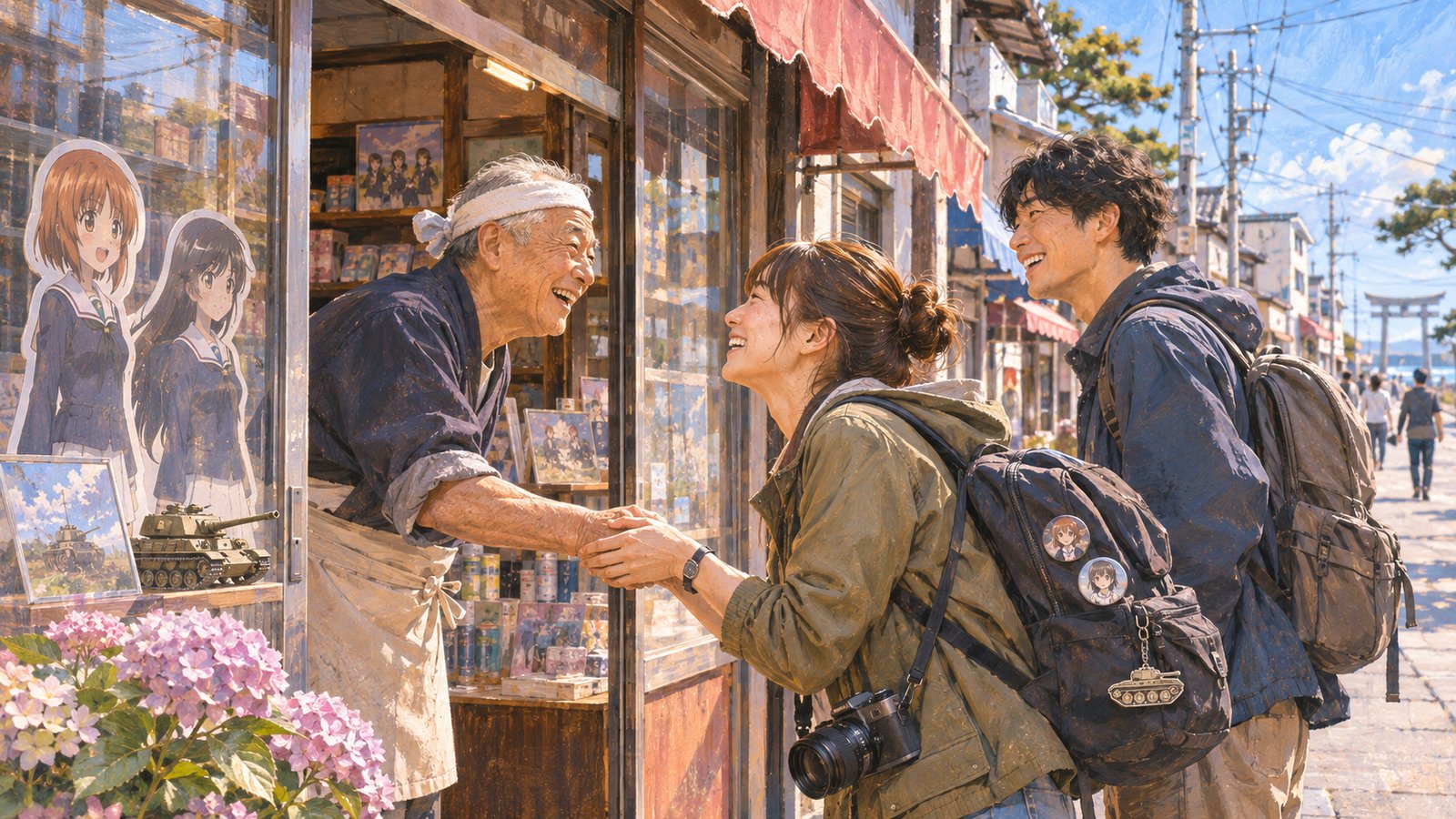
From 2013, the Oarai Chamber of Commerce and Industry, a local business association, began placing life-size character standees in front of shops, sights and inns, so that a character stood outside every store. There were 56 by 2015 and 151 locations by 2020, and fans could take a map and hunt for them shop by shop along the shopping street. Many shops also put up an “owner’s board” introducing the proprietor and that day’s recommendations, giving fans something to talk about when they walked in.
The hospitality often wasn’t about business. One New Year’s Eve, when fans gathered at the beach to wait for the first sunrise of the year, the butcher shop Usuya stayed open until 5 a.m. and gave everyone free amazake, a sweet rice drink. Hinoya Shoten, a tofu shop, built a rest area for fans hunting for standees around town and offered free soy milk to any fan it saw. Oarai’s early character merchandise barely made money, and fans often asked, “Is this price really okay?”
Fans gave back too. Sugiyama says the early core fans were mostly office workers in their 30s and older who were terrified of hearing people say “that’s otaku for you.” Even when tens of thousands packed the Anglerfish Festival, there was hardly any litter in the streets. Fans joined beach cleanups and the shopping street’s “100-yen shopping street” events, and even entered competitions for the local volunteer fire corps. When Typhoon Hagibis devastated Daigo in Ibaraki Prefecture in 2019, a fan from Kochi Prefecture donated money and supplies, which the youth division of Oarai’s Chamber of Commerce delivered to the disaster area.
In August 2014, researchers distributed 1,053 questionnaires at hotels and inns in Oarai. Of the respondents, 139 had come because of the anime, and 70% of them had never visited Oarai before the earthquake. Of that group, 42% had visited four or more times since the disaster, compared with 13% of other travelers. By 2016, Sugiyama estimated that about 20 people had simply moved to Oarai.
The producer himself says: anime can’t save a town
In 2016, Girls und Panzer der Film earned more than 2.1 billion yen at the box office, and Oarai became one of the most famous anime pilgrimage sites in Japan. At that point, Sugiyama said something that ran against everyone’s expectations: “Anime has no power to revitalize a town.”
His reasoning was practical. Late-night anime is watched mainly by men, and a 1% rating counts as a success. Staking a place’s fate on a show like that never made sense. He also dislikes the phrase “machi okoshi,” or town revitalization. To him it sounds like something planned in advance, and what happened in Oarai was a result, not a plan.
He believes the key to Oarai was that it was “already a tourist town.” Shops were used to dealing with visitors and knew to make people fall in love with the place first, without rushing for a return. He’s also candid that not everyone in town loved GaruPan: at first some parents worried there were too many otaku and didn’t want their kids out on the streets. The head of the Oarai Tourism Association has said that the enthusiasm lasted not only because the show was popular, but because fans followed the rules, the right people were in the right roles, and shops went out of their way to make friends with fans.
Sugiyama says his real hope is that a few percent of the people who visit Oarai will, because of GaruPan, build a personal connection with the town and keep coming back.
Eleven years later, fans are still “going home” to Oarai
Yuji Hirooka, who once handled publicity for Girls und Panzer at the anime company, opened a shared office in Oarai in 2019. In February 2020 he launched a crowdfunding campaign to support local shops with a target of 3 million yen. In the end, 511 people pledged about 6.11 million yen. That year, the pandemic cancelled both Oarai’s spring Kairaku Festa and the autumn Anglerfish Festival. He says the fans he got to know in Oarai used to gather there once or twice a year before the pandemic.
In 2023, the Anglerfish Festival drew about 100,000 people over two days. In March 2024, the GaruPan voice cast took the Kairaku Festa stage for the first time in about five years, and the parking lots were lined with “itasha,” cars wrapped in character art. More than eleven years had passed since the anime first aired.
I think Oarai’s story shows where the real power of anime pilgrimage lies. An anime can get someone to buy a ticket to an unfamiliar small town for the first time. But what brings them back a second time, a tenth time, is the butcher that stayed open until 5 a.m., the cup of soy milk nobody charged for, and the board outside the shop introducing its owner. Fans say “going home to Oarai” rather than “going to Oarai” because the people they met there weren’t only anime characters, but townspeople they know by name. The anime put Oarai on the map. What made people stay was Oarai itself.
Notes
- Anglerfish Festival attendance figures are organizers’ estimates: about 30,000 in 2011, about 60,000 to 65,000 in 2012 (reports vary slightly), about 100,000 in 2013, about 130,000 in 2016, about 140,000 in 2019, and about 100,000 over two days in 2023. Oarai’s population is given in various reports as about 17,000 to 20,000.
- “Going home to Oarai” is an expression used among fans, as reported by GAME Watch in 2016.
- The figure of about 20 people moving to Oarai is what Kiyoshi Sugiyama said in a 2016 interview, not an official statistic.
- The number of character standees varies by year and how they’re counted: a 2015 Ministry of Economy, Trade and Industry document records 56 life-size standees, while a 2020 TV program cited 151 locations.
- The butcher Usuya is written “Usuya Seinikuten” in the ASCII article and “Usuya Nikuten” in the TV Tokyo program.
- Exact figures for the visitor surge at Washinomiya Shrine driven by Lucky Star vary by counting method, so this article doesn’t give one.
References
- Atsushi Matsumoto|ガルパン杉山P「アニメにはまちおこしの力なんてない」: ASCII.jp, 2016-08-06, six pages; why Oarai was chosen, meeting Yoshihiko Tokiwa, “don’t lean on each other,” Oarai not appearing until episode 4, Usuya open on New Year’s Eve, about 20 people moving in, fans following the rules
- Li Fu-hsin and Katsuya Yamori|Study of the relationship between Oarai and Girls und Panzer fans: paper presented at Kyoto University’s Disaster Prevention Research Institute; fans joining beach cleanups, 100-yen shopping street events and fire corps activities, a Kochi fan’s support for Daigo, the tourism association head on why the enthusiasm lasted
- University of Tsukuba|Survey of Oarai’s post-disaster hotel recovery and anime travelers: JSSS 27-02; tsunami up to 4.2 meters, building damage, losses of about 21.4 billion yen, cancelled bookings, the 2014 survey of 1,053 questionnaires
- Response|大洗クリエイティブマネジメント 常盤良彥氏: 2015-08-30; Yoshihiko Tokiwa’s background, the market washed away by the tsunami, the zero-budget wrapped train, the volunteer group, 2012 Anglerfish Festival attendance, 500 people instead of the expected 100
- Yo Matsuoka|Oarai Anglerfish Festival 2016 report: Nlab, 2016-11-14; Marugo Suisan, Kazuko Ishii and her eldest son, Sakanaya Honten’s guests up 50%, 130,000 visitors
- Kazuo Ishida|20th Oarai Anglerfish Festival report: GAME Watch, 2016-11-16; attendance over the years, “going home to Oarai,” fans’ queues and cleanups, Chamber of Commerce banners
- Small and Medium Enterprise Agency|30 Thriving Shopping Streets 2015: Oarai shopping street: 56 character standees, owner’s boards, fans joining events and moving in
- TV Tokyo, Shutsubotsu! Ado Machikku Tengoku|Oarai in winter: 2020-01-25; 151 character standee locations, Usuya Nikuten, Hinoya Shoten’s rest area and free soy milk
- Dengeki Online|Interview with Yuji Hirooka: 2020; shared office, crowdfunding from 511 people for about 6.11 million yen, fans gathering in Oarai every year
- Famitsu.com|23rd Oarai Anglerfish Festival report: 2019-11; about 140,000 visitors
- JR East Media|Oarai Anglerfish Festival: updated 2025-07-29; about 100,000 over two days in 2023
- Ryu Yamazaki|Oarai Spring Festival Kairaku Festa 2024: MotorFan, 2024-04-14; stage events return after about five years
- KAI-YOU|Oarai Anglerfish Festival 2013: 20,000–30,000 in earlier years, about 60,000 in 2012, about 100,000 in 2013
- Hokkaido University Collection of Scholarly and Academic Papers|Research paper on Washinomiya and Lucky Star: definition of anime pilgrimage and Lucky Star
Follow the story in person
Join a small-group trip to the places in our stories and meet the people who live and work there.
See trips and dates
Water Mirror is a Tokyo-based company that helps more people step inside industries and explore the stories and cultures of different fields around the world. We design in-depth learning programs for individuals, companies, schools and organizations, combining company visits, exchanges with professionals, local learning and hands-on experiences, so participants can see how industries really work and meet the people and stories behind them. Water Mirror Perspectives is our content media, telling the distinctive stories of industries, local cultures and people, so that reading sparks curiosity and leads readers to go and see for themselves.
About Water Mirror →