Key Points
- The most profitable model for mobile games is free-to-download, with a small share of players paying again and again to pull characters. Console games are paid for once, buying a complete, fully designed adventure. They sell different things, which is why smartphones didn’t replace consoles.
- Nintendo posted operating losses for three straight years from 2012 to 2014 and moved into mobile with DeNA in 2015. But even though Super Mario Run, a one-time 1,200-yen purchase, passed 200 million downloads, president Tatsumi Kimishima said it “has not reached an acceptable profit level.”
- Nintendo merged its separate handheld and home consoles into one, creating the Switch, which you can take out of the house and whose controller splits in half so you can hand part to the person next to you. It sold more than 150 million units worldwide, becoming Nintendo’s best-selling console ever.
- Switch 2, launched in June 2025, sold 947,931 units in its first week in Japan and about 3.78 million that year. Japanese players aren’t choosing one side: about 24.78 million play on two or more kinds of devices.
On June 5, 2025, Switch 2 launched in Japan. The Japan-only version was priced at 49,980 yen, about the price of a mid-range smartphone, and it can only play games. It sold 947,931 units in its first week, nearly three times the original Switch’s first-week sales. By the end of the year, Switch 2 had sold about 3.78 million units in Japan, and retail sales of home consoles and physical games in Japan were up nearly 40% from the year before.
That’s especially strange in Japan. Japan is one of the world’s most developed mobile gaming markets, and in 2023 Japanese people spent about 1.2 trillion yen on mobile games. Even in 2025, the year Switch 2 was a smash hit, retail sales of consoles and physical games were only about 420 billion yen. Most mobile games are free to download and can be played anytime. By rights, the number of people willing to pay an extra 50,000 yen for a machine that only plays games should be shrinking.
Stranger still, ten years ago almost everyone thought exactly that, and even Nintendo nearly came around to it. At the time, Nintendo had lost money three years running, and shareholders and analysts kept asking: why not put Mario on phones? The best way to answer “phones are so convenient, so why do Japanese players still buy consoles?” is to look back at how Nintendo got out of that crisis. It tried mobile, and from mobile it learned what a console should really be selling.
Three years of losses: smartphones took the players Nintendo cared about most
Nintendo’s Wii, released in 2006, and its handheld DS, released in 2004, each sold more than 100 million units worldwide. The key to their success was attracting huge numbers of people who didn’t normally play games, like older people swinging a remote to play tennis or adults doing brain training with a stylus.
But those were exactly the people smartphones took first. After the iPhone came out in 2007, phones filled up with free mini-games you could play in a few minutes. For someone who just wanted to kill time waiting for a bus, if there was already a machine in their pocket that could play games, there was no reason to buy another.
At the end of 2012, Nintendo released a new console, the Wii U, to a lukewarm reception. In January 2014, Nintendo cut its annual Wii U sales target from 9 million units to 2.8 million and revised its full-year operating forecast from a 100 billion yen profit to a 35 billion yen loss. It was Nintendo’s third straight year of operating losses. President Satoru Iwata cut his own pay in half for five months. In the end the Wii U sold only 13.56 million units, Nintendo’s worst-selling home console.
During that period, the most common advice was simple: the whole world knows Mario and Pokémon, so turn them into mobile games and the money will roll in.
Why wouldn’t Satoru Iwata “move” Mario onto phones?
At a corporate strategy briefing on January 30, 2014, Iwata said Nintendo would start making use of smartphones, but that the purpose was “to build connections with players through smart devices, and through those connections convey the appeal of Nintendo’s games, giving people a reason to join Nintendo’s platforms.” He stressed that this did not mean simply moving Nintendo’s existing games onto phones.
At the time, many saw this stance as stubborn. But his reasons weren’t mysterious. He explained them several times later, and they boil down to two points.
The first was controls. Nintendo’s games are designed around controllers: the timing of a jump, the angle of a turn, all depend on the feel of buttons and sticks. Touchscreens have no physical buttons, so porting a game over unchanged would just make it worse than the original. Iwata later said it plainly: console games wouldn’t be ported straight to phones, because the controls are too different, and a simple port couldn’t give players the best experience.
The second was value. Mobile games have short life cycles and fierce competition, and it’s hard for any one game to hold its value for long. Nintendo’s business rests on one thing: players being willing to pay for its games and characters. If Mario became just one more free game on a phone, players’ sense of “what a Mario game is worth” could change along with it.
A change of heart in 2015: partnering with DeNA, without giving up on consoles
Iwata eventually changed his mind. On March 17, 2015, Nintendo announced a business and capital alliance with Japanese mobile game company DeNA, with each taking a stake in the other to co-develop mobile games. DeNA ran the mobile game platform Mobage at the time and knew how to operate mobile games, exactly the capability Nintendo lacked.
At the press conference, Iwata said he was “not opposed to making games on smart devices.” He had hesitated because he hadn’t yet found a way to protect the value of Nintendo’s characters: “If we’re going to do it, we need an absolute chance of winning.” He wanted to “build a bridge” between phones and consoles, using mobile games to bring more people into Nintendo’s world rather than having the two fight over the same players. At the same press conference, he also revealed that Nintendo was developing a new console code-named “NX.”
Iwata didn’t live to see the bridge completed. He died of a bile duct growth on July 11, 2015, at the age of 55.
Why didn’t a one-time 1,200-yen Mario game make money?
Nintendo’s first major mobile game, Super Mario Run, launched in December 2016. Its pricing was very “Nintendo”: the first few levels were free to try, and unlocking the full game cost a one-time 1,200 yen, with nothing more to pay after that. Tatsumi Kimishima, who succeeded Iwata as president, said the price was set so parents wouldn’t have to worry about their kids overspending in the game.
Downloads were astonishing: 40 million in four days, later passing 200 million. The problem was that not many people were willing to pay. In January 2017, Kimishima revealed that of 78 million downloads at the time, a little over 5% of players had bought the full game. In October that year, he admitted the game “has not reached an acceptable profit level.”
Around the same time, another Nintendo mobile game, Fire Emblem Heroes, took the opposite route. It was free to download and made money from “pulling characters”: players pay for chances at a random draw to get characters they want. In Japan this mechanic is called “gacha,” after capsule toy machines. Kimishima said the game was performing in line with its profit targets. By 2022, its lifetime player spending was estimated at over $1 billion, more than half of it from Japan.
The contrast between these two games answers a question readers will naturally ask: if Japanese players are so willing to spend money on their phones, why doesn’t Nintendo just go all in on mobile?
The answer lies in what kind of game players will “pay for” on a phone. Mobile players are used to downloading for free. Most never spend a yen, and revenue comes mainly from a small group of players who pay again and again. That model suits games with lots of characters to collect and a steady stream of new ones. But what Nintendo does best, Mario and Zelda, are adventures designed from start to finish. When you finish, it’s over, and there’s nothing to keep pulling. The most natural way for games like these to make money is a one-time payment, like buying a book, and the place where players are willing to pay several thousand yen for that is a console.
In other words, phones and consoles both thrive in Japan not because they’re two ways to buy the same thing, but because they’re two different things. Money spent on phones mostly goes to “the anticipation of pulling something new,” while money spent on consoles goes to “a complete experience.”
Merging two machines into one: Switch decided not to compete with phones on convenience
Since consoles couldn’t beat phones at “killing time anytime, anywhere,” Nintendo had to rethink what consoles should do.
The answer had actually been brewing since 2013. That year, Nintendo merged its separate handheld and home console development divisions into one. Iwata explained in 2014 that as technology advanced, the design approaches of the two could be unified, and that in the future home and handheld consoles “won’t be two completely different things, but more like closer siblings.” Merging the divisions meant the next console no longer had to be split into “one you play at home” and “one you take out.”
That machine was the Nintendo Switch, released on March 3, 2017. Plug it into its dock and it plays on the TV; pull it out and it’s a handheld. The most important design choice was the detachable left and right Joy-Con controllers. Every console comes with two controllers, so you can split them, each take one, and play with the person next to you. Nintendo calls this “osusowake play,” meaning sharing a portion of what you have with someone else.
Yoshiaki Koizumi, the producer in charge of Switch hardware, boiled the concept down to one line: “Anytime, anywhere, with anyone.” Shinya Takahashi, who oversaw game development, said that when Nintendo looked back at its own history, it realized it had always been “an entertainment company,” and he hoped the places where people share the fun of games wouldn’t only be social media, but also the streets and neighborhoods.
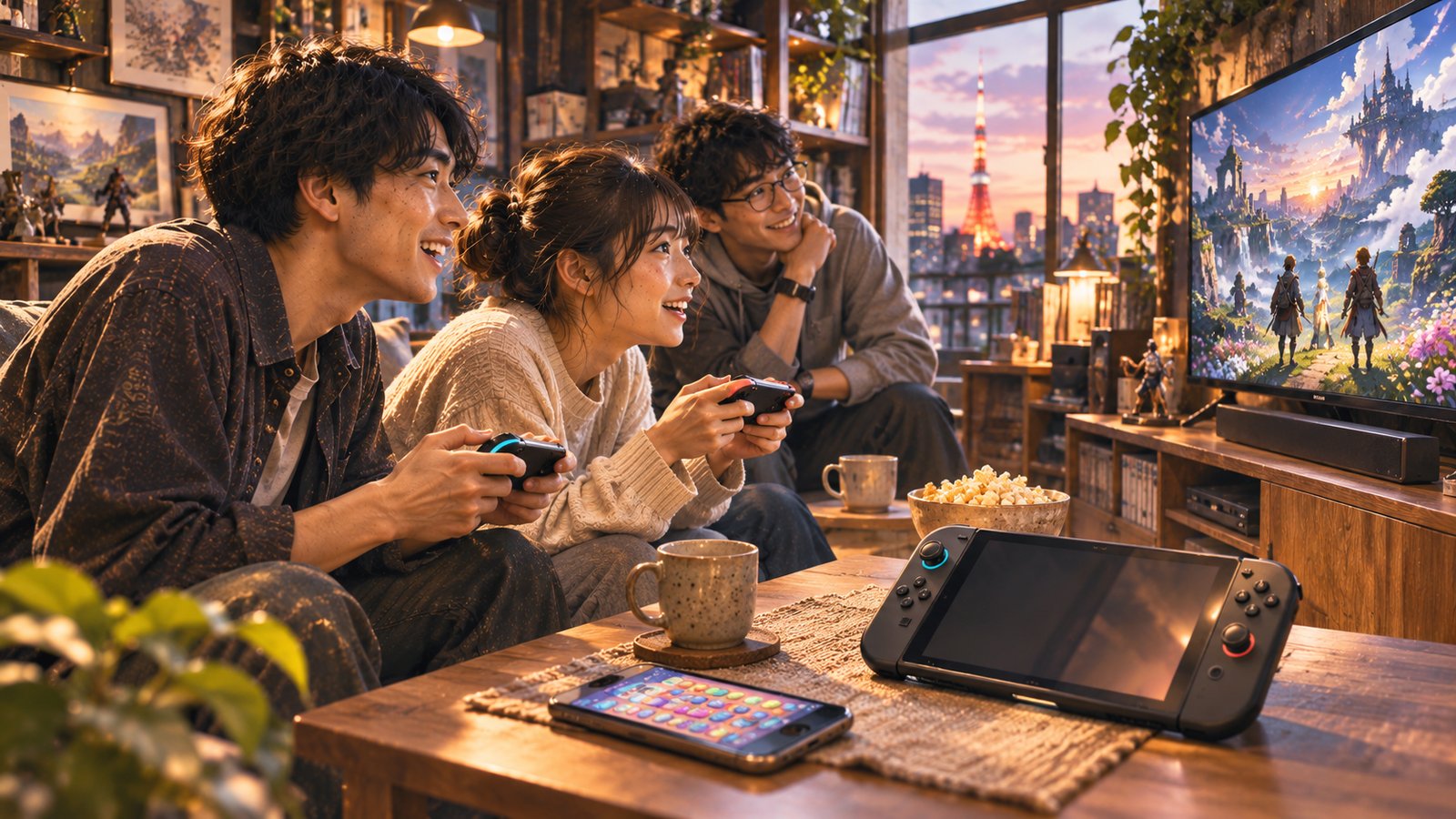
Here you can see the real difference between Switch and a phone. A phone is a device for one person. It has one screen, and when you’re playing, everyone else can only watch from the side. Switch was designed from the start assuming there’d be a second person: a friend over at your place, family on the same sofa, classmates huddled together at break time. Phones sell spare minutes. Switch sells time spent with other people.
As a result, Switch had sold 155.37 million units worldwide by the end of 2025, passing the DS to become Nintendo’s best-selling console ever. Nintendo’s mobile games are still running, but their role is closer to the bridge Iwata described: helping more people get to know Mario and Pokémon, then step into the world of consoles.
Raised to 60,000 yen, and Japanese players are still buying
Back to Switch 2. In May 2026, Nintendo raised the price of the Japan-only Switch 2 from 49,980 yen to 59,980 yen, while the multilingual version supporting 16 languages stayed at 69,980 yen. The Japan-only version can only be set to Japanese and only used with a Japanese account. This lets Nintendo offer Japanese players a lower price while preventing people from buying in bulk to resell overseas.
Even after the price hike, Switch 2 is still Japan’s best-selling console, and Japan’s best-selling game of 2025 was Mario Kart World on Switch 2, with about 2.67 million physical copies sold in a year. Racing games are the genre best suited to four people gathered around a screen.
Japanese players aren’t choosing between phones and consoles. In 2024, Japan had about 54.75 million gamers, and about 24.78 million of them played on two or more kinds of devices, a number that’s still growing. For more and more people, phones and consoles are used side by side.
So the question “phones are so convenient, why buy a console?” starts from a wrong premise. Consoles have never beaten phones on convenience, and Nintendo learned from the Wii U’s failure that competing with phones on convenience is a losing battle. What it chose in the end was to sell what phones can’t: a carefully designed adventure from start to finish with no waiting for the next gacha pull, and a controller you can pop off and hand to the person next to you. When Japanese players pay 50,000 or 60,000 yen for a game console, those two things are what they’re really buying.
Notes
- The 1.2351 trillion yen figure for Japan’s mobile game market is for 2023 (Famitsu Game White Paper). Switch 2’s first-week and annual sales figures are Famitsu’s retail tallies and don’t include download sales from Nintendo’s official online store.
References
- ITmedia NEWS|「やる以上は絶対の勝算を」 任天堂、スマホ本格進出の狙い 岩田社長語る|2015-03-17 (the DeNA partnership, no direct ports, building a bridge, NX)
- Nintendo|Notice regarding the business and capital alliance between Nintendo and DeNA (joint press conference)|2015-03-17
- gamebiz|任天堂、経営方針説明会を開催 スマートデバイス活用で「自社プラットフォーム参加のきっかけつくる」|2014-01-30
- Nintendo IR|Q&A from the January 2014 corporate strategy briefing
- Game*Spark|家庭用機と携帯機のアーキテクチャーを統一していく 任天堂・岩田社長|2014-02-03
- J-CAST News|Nintendo’s third straight operating loss and lowered Wii U sales target|2014-02-09
- GameBusiness.jp|任天堂の岩田聡社長が逝去―胆管腫瘍のため|2015-07-13
- iPhone Mania|Why Super Mario Run costs 1,200 yen (Tatsumi Kimishima interview with the Kyoto Shimbun)|2016-12-24
- PocketGamer.biz|Super Mario Run official revenues (78 million downloads, a little over 5% paid)|2017-01-31
- Engadget|’Super Mario Run’ isn’t as profitable as Nintendo would like|2017-10-31
- Sensor Tower|Fire Emblem Heroes Surpasses $1 Billion in Lifetime Revenue|2022-06
- Famitsu|Yoshiaki Koizumi interview (“anytime, anywhere, with anyone”)|2017-10-25
- TweakTown|Shinya Takahashi interviewed by The Wall Street Journal|2017
- 4Gamer.net|Koichi Kawamoto interview (Joy-Con sharing)|2017-02-23
- GamesRadar+|Switch 2 overtakes Wii U lifetime sales (Wii U at 13.56 million)|2026
- Nintendo Wire|Switch 1 sales top 155 million, Nintendo’s best-selling console ever|2026-02-03
- GAM3S.GG|Nintendo Switch 2 sells 947k+ units in Japan (Famitsu first-week data)|2025-06
- Web Tantosha Forum (PR TIMES)|Japan’s 2025 home game market at 418.1 billion yen (Famitsu preliminary figures)|2026-01
- techno-edge|Switch 2 Japan-only version at 49,980 yen, multilingual version at 69,980 yen, to prevent cross-border reselling|2025-04-02
- J-CAST News|Anti-reselling measures for the multilingual Switch 2 (Japan version raised to 59,980 yen in May 2026)|2026-06
- gamebiz|23年の国内ゲーム市場規模は2兆1255億円 アプリ1兆2351億円 (Famitsu Game White Paper 2024)|2024-08
- Famitsu|Famitsu Game White Paper 2025 overview (gaming population, multi-device players)|2025-08
Follow the story in person
Join a small-group trip to the places in our stories and meet the people who live and work there.
See trips and dates
Water Mirror is a Tokyo-based company that helps more people step inside industries and explore the stories and cultures of different fields around the world. We design in-depth learning programs for individuals, companies, schools and organizations, combining company visits, exchanges with professionals, local learning and hands-on experiences, so participants can see how industries really work and meet the people and stories behind them. Water Mirror Perspectives is our content media, telling the distinctive stories of industries, local cultures and people, so that reading sparks curiosity and leads readers to go and see for themselves.
About Water Mirror →