Key Points
- “Special cleaning” (tokushu seiso) means clearing the homes of people who died alone and weren’t found for a long time. The work involves disinfecting bodily fluids, removing odors and tearing out soaked flooring. Ordinary cleaning companies won’t take it on.
- In 2024, 76,020 people in Japan who lived alone died at home. About three-quarters were 65 or older. Of those, 6,945 weren’t found for more than a month.
- In lonely deaths in rental housing, nearly half are first discovered by landlords, property managers and police, while family members account for only just over 30%. More than 80% of those who die are men.
- Paying rent on time while living in a trash-filled home is often a sign of self-neglect: after blows like job loss and illness pile up, a person stops looking after themselves and stops asking anyone for help. The real problem with lonely deaths is that no one sees the years leading up to them.
The moment the door opened, the first thing to hit was the smell of ammonia, so sharp you could only keep your eyes half open.
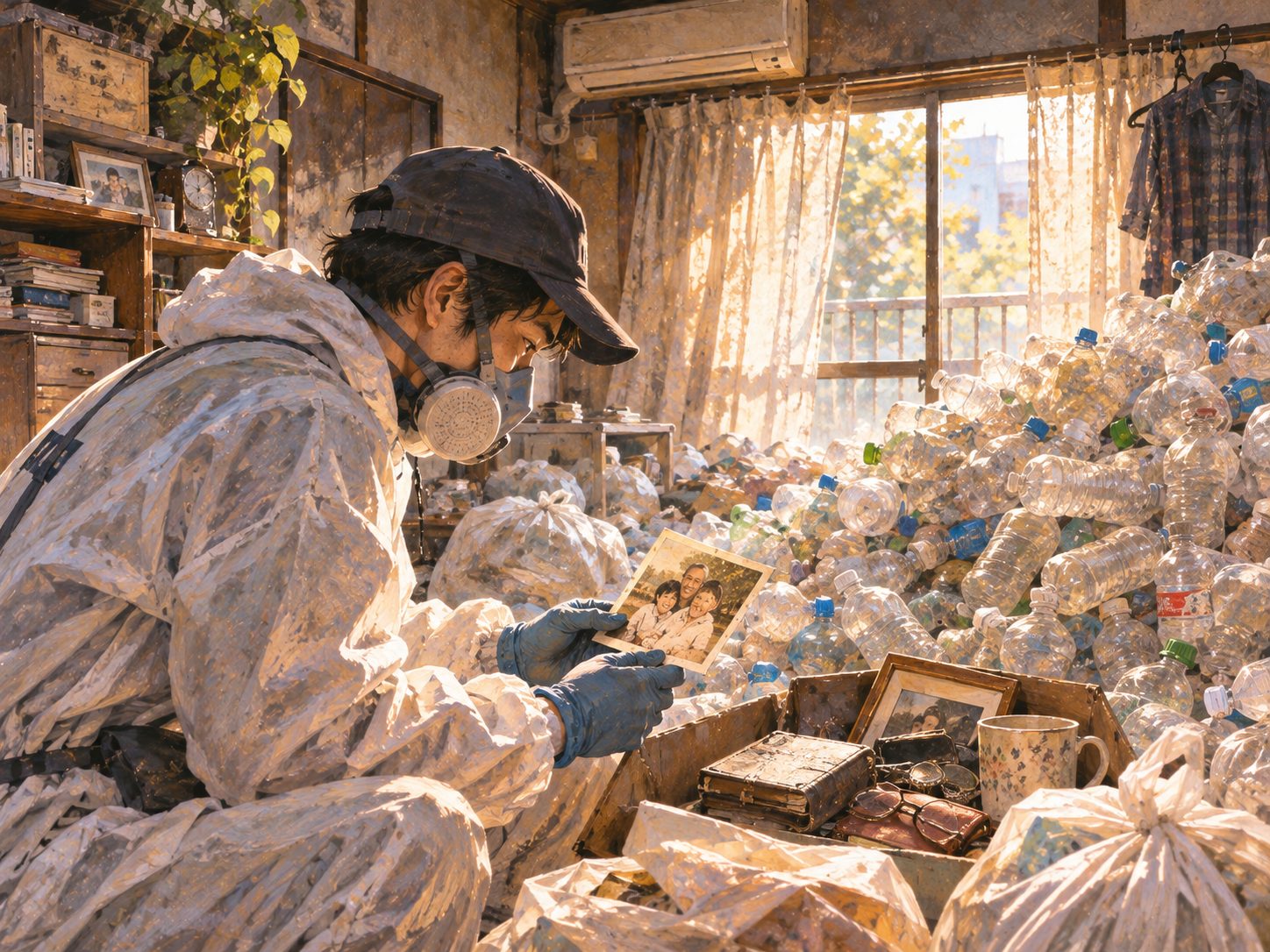
It was the summer of 2018, on the second floor of a detached house on the outskirts of the Kanto region around Tokyo. The floor had been partitioned into a rental unit: a 4.5-mat wooden-floored room in front, a 6-mat tatami room in back (one mat, or jo, is about 1.6 square meters). There was no air conditioning, and when the tenant died, the weather agency had issued a heat warning. Trash was piled into a slope, up to shoulder height in places, and the tatami was completely buried. Four-liter plastic shochu bottles stuck up out of the trash everywhere, each one filled with a pale yellow liquid. It was urine.
The man who lived here was Koji Sato (a pseudonym). He was 65 when he died. The landlord later said Sato had lived there for 34 years, brought the rent by hand every month, and was never once late.
How does a man who paid his rent on time and worked diligently end up living in a room like this, and finally dying in it? The answer was dug out, layer by layer, by the person who came to clean. His name is Hisayoshi Joto, and he does the work Japan’s ordinary cleaning companies won’t: clearing the rooms left behind by people who died alone at home and weren’t found for a long time. In Japan, this line of work is called “special cleaning.”
76,000 people a year die alone at home. Who opens the door first?
First, why this job exists. Every year, Japan’s police compile statistics on the bodies they handle, meaning people who died outside a hospital and whose cause of death police had to confirm. In 2024, 76,020 people who lived alone died in their own homes. About three-quarters of them were 65 or older.
Most are found quickly: nearly 40% on the same day or the next, about 70% within a week. But 6,945 waited more than a month.
Time is everything. After death, the body begins to decompose. Fluids seep into the bedding, the tatami and the floor, and the smell drifts through door gaps and ventilation ducts into neighbors’ homes. In summer this happens much faster, which is why special cleaners’ busy season runs every year from the rainy season through August.
So who opens the door first? An industry association of Japanese small-amount, short-term insurers has compiled more than 10,000 insurance claims for lonely deaths in rental housing. Among those who made the discovery, family members accounted for only just over 30%. Nearly half were people who found the body through their work: landlords, property managers and police. More than 80% of those who died were men, and on average they were found after 18 days.
In other words, the first person into the room is often not family but a landlord worried about the property. Once the landlord sees the state of the room, the next call goes to someone like Joto. Sato’s case was a little different: the day after he died, his supervisor came looking for him and found him already cold. He was found quickly, but the room was already in a state that needed a professional.
The first thing a cleaner does isn’t cleaning. It’s looking
Along with Joto, the nonfiction writer Kumiko Sugano entered the room that day. She has followed Joto to many sites, and her book records what happened in this unit.
Joto didn’t start working right away. First, he looked.
Beside the bedding stood a bucket with a spout, a ring of brown urine scale crusted around the rim, about 80% full. He grabbed the handle and gave it a shake to check what was inside. From this bucket he worked out Sato’s habit: he would urinate into the bucket first, then pour it into those shochu bottles.
He went to the wall of the tatami room and pulled open, one by one, the drawers of a wooden wardrobe half buried in trash. He found a worn leather card case holding business cards from Sato’s workplace and a tattered rental contract. The wallet wasn’t there. The police had probably already handed his valuables to his family.
Then he said it: “A room lays a person’s whole life bare.”
What he meant is that what illness a person had and how they collapsed often shows in which part of the home gets dirty first. In his experience, people with heart problems usually let the living room go first. “The living room is like the heart of the house. It’s connected to every room.” People whose mental health is starting to slip let the kitchen and bathroom, the places that use water, go first. This isn’t a scientific theory. It’s a rule of thumb drawn from hundreds of rooms. But it captures the biggest difference between special cleaning and ordinary cleaning: before you touch anything, you have to read the room. Where the person fell, how they lived before they fell, and which things the family will want.
Sato had collapsed in the middle of the room. Joto climbed the mountain of trash and dug down a dustpan at a time. Beneath a middle layer of manga magazines, a dark, wet patch about two meters square appeared. He called over his only employee, Junji Suzuki, and pointed: “Look, only this spot is black and wet.” That was where Sato died. His bodily fluids had seeped through every layer of trash, all the way down to the tatami at the bottom.
Under the magazines they also dug out a rusted electric fan, its neck crushed and snapped in two. In other words, in a summer when temperatures approached 40°C with no air conditioning, the only thing in the room that could have cooled it had been broken by the trash years earlier. Joto believes the heat played a part in the man’s death: Sato already had a tendency toward diabetes, and in the end it was a heart attack.
The plastic bottles: the answer was in the toilet
Only after reading the room did the work begin.
Joto and Suzuki first gathered the documents. Bankbooks, insurance policies and other things to do with money are what families most often ask for. Sato’s bankbook showed almost nothing left.
Next came the bottles. They opened each cap and carried it to the kitchen to empty into the sink. Suzuki pulled the bottles out of the trash one at a time and handed them over, and Joto poured them out.
Why would someone store urine in bottles? The answer was in the toilet. The bowl was completely black, probably uncleaned for years, maybe decades. It looked as though the toilet had clogged, and instead of getting anyone to fix it, he started using the bottles.
Twenty minutes in, Joto was drenched in sweat. As he poured, he asked, “So what did he do when he needed to go number two?” Suzuki answered, “Probably used the convenience store over there.” They did not, in fact, find any feces in the unit. The bathtub was buried under trash too. The landlord later said that winter and summer alike, Sato washed himself at the faucet for the washing machine outside.
That day, they cleared about 500 bags of trash from that 4.5-mat-plus-6-mat space.
To the landlord, he was a good tenant
After the cleaning, Sugano went to see the landlord, Fujimoto (a pseudonym). He had rented the second floor to Sato for 34 years.
As Fujimoto remembered him, Sato said little and wasn’t good with people, but nobody disliked him, and he was a hard worker at the restaurant where he was employed. Around 40, he was let go from the restaurant. For the next twenty-plus years he worked part-time at various food-related jobs, the last at a fruit and vegetable wholesaler. He never married. No matter where he worked, he handed the ¥65,000 monthly rent to the landlord himself, always on time.
Fujimoto had actually known about the trash for a long time. Sato never sorted his garbage, so the collection trucks wouldn’t take it, and the landlord ended up sorting it and putting it out for him. Starting about four or five years earlier, Sato stopped taking out the trash at all, piling the bags on the balcony railing. They blew down in the wind and neighbors complained. He apologized every time, and nothing changed. He also never let anyone up to the second floor. Only later did Fujimoto understand: “Looking back, I think he was afraid people would find out it was a trash house.”
After Sato died, Fujimoto tried to enter the back tatami room and found he couldn’t even walk in standing up. He had to crawl over the garbage bags. There was no longer anywhere to lie flat in the room, and Sato had slept curled up in a hollow in the middle of the trash. A year before he died, he had collapsed on the street near his home and been diagnosed with a brain tumor.
Paying rent on time and working hard while letting your own room fall apart seem contradictory, but the two can coexist. In Japan, this condition is called serufu negurekuto, from the English “self-neglect”: a person stops looking after their own life and health, doesn’t see a doctor, doesn’t clean up their surroundings, and doesn’t ask anyone for help. It isn’t laziness. It’s often the result of blows like job loss and illness slowly piling up. On the outside, the person can still keep up a minimum of respectability, like paying the rent on time. On the inside, they have been giving up on life piece by piece. The gomi yashiki, or “trash house,” piled with garbage and impossible for outsiders to enter, is its most visible form.
Why the hardest part of the job isn’t the smell
Joto has seen countless rooms like this. He once said: “I think people who die alone are probably good people at heart.” In his observation, many are simply too honest to forgive themselves, so they keep enduring until they can’t anymore.
That’s why he feels the hardest part of the job isn’t the smell or the insects, but that “you end up seeing into the person’s heart.” As he put it: “From just one plastic bottle, you can see how much that person was suffering.”
This view is tied to his own experience. Joto was born in 1970. He once ran a company with a friend, but the friend fell ill, couldn’t afford his medication, went without it, and died.
Of course, the physical toll of the work isn’t light either. In rooms where a body went undiscovered for a long time, the hardest thing to deal with is the bodily fluid: it’s oily and has to be washed again and again. After cleaning and disinfecting, the room is fumigated with an ozone machine. Ozone is a highly reactive gas that breaks down the molecules causing the odor. Wallpaper that has absorbed the smell is stripped, and flooring soaked through with fluids is torn out entirely. Deodorizing alone takes two to three days. Windows usually can’t be opened during the work, because the smell would spread to the neighbors, so at another site Joto first sealed the entire front door with a blue tarp.
Many people assume infectious disease is the biggest danger. Joto says what’s really frightening is the invisible dust and mold. After years of working in these conditions, he developed bald patches on his scalp and skin so itchy he couldn’t sleep at night. His doctor told him his immune system was overreacting to the dust and mold he’d been breathing in. Only after he switched from short-sleeved work clothes to full-body coverage did the symptoms gradually subside.
After the cleaning, the room carries a record for three years
Once the room is clean, it goes back on the rental market. But it now carries a new label.
In 2021, Japan’s Ministry of Land, Infrastructure, Transport and Tourism issued guidelines on when real estate agents must tell tenants or buyers that someone died in a property. The principle: natural deaths, or everyday accidents such as a fall at home, don’t need to be disclosed. But if the body was found long after death and special cleaning was carried out, disclosure is required. For rentals, agents can generally stop raising it on their own after about three years.
This rule reveals something. When a person dies quietly alone at home, if they’re found the next day, the room carries nothing in the eyes of the law. If a month passes, the room carries a record for at least three years. What makes the difference isn’t the death itself, but whether anyone noticed in time.
That record has a price, too. In the 10,000-plus insurance claims mentioned earlier, restoring a room to its original condition cost about ¥470,000 per case on average, and removing belongings about ¥300,000. If no family member covers the cost, it falls on the landlord. That’s why Japan now has insurance specifically for landlords, covering cleaning costs and lost rent after a tenant’s lonely death.
The last person to see how he lived was the one who came to clean
Back to that summer sink. Joto poured out Sato’s urine one bottle at a time. Those bottles were the record of Sato’s last few years.
The landlord knew he didn’t take out his trash, but learned only after his death that he had been sleeping in a hollow in the garbage. His supervisor only knew he hadn’t shown up for work. The neighbors only noticed the smell. Everyone saw a small piece. No one saw the whole. The rent Sato paid on time kept the people around him believing he was getting by.
I think the real problem with lonely deaths isn’t the moment of death, but the years before it: a person has long since started giving up on their own life, while the outside world sees only the thin layer of respectability they still manage to keep up. The special cleaner is the last person to walk into the room, and often the first to see the whole picture. By the time he arrives, it’s too late. If anyone is to see the whole picture before that, what’s needed probably isn’t better cleaning technology. It’s someone climbing, a few years earlier, the stairs no one has gone up.
Notes
- Japan has no single legal definition of kodokushi (“lonely death”). The figure of 76,020 in this article is the National Police Agency’s count of “people living alone who died at home,” and includes suicides.
- The insurance association’s data (days until discovery, who discovered the body, cleaning costs) comes from claims on rental homes it insures. The sample is insured rental housing and doesn’t represent all lonely deaths.
- Joto’s birth year is taken from the National Diet Library’s author records. Some 2019 reports gave his age as 46 at the time, which doesn’t quite match, so this article doesn’t state his age.
- Koji Sato and Fujimoto are pseudonyms used in Sugano’s book. On Sato’s cause of death, the landlord believes it was heatstroke, while Joto mentions a tendency toward diabetes and a heart attack. This article treats the heat as the common background.
- Sealing the door with a tarp and the health problems caused by dust and mold come from Sugano’s 2020 account of accompanying Joto to a different apartment, not Sato’s unit.
References
- 菅野久美子|〈「ゴミの山から尿入りペットボトルがニョキッと頭を出していた」その数なんと数百本…孤独死の現場からわかる65歳男性の”生前の生活”とは〉 (excerpt #5 from 『超孤独死社会 特殊清掃の現場をたどる』)|Bunshun Online|2024-12-21 (layout of the unit, the bucket, the wardrobe, where he died, emptying the urine bottles, 500 bags of trash, the exchange between Joto and Suzuki)
- 菅野久美子|〈65歳男性が立って入れないほどのゴミ屋敷で孤独死…「4、5年前まではゴミをちゃんと出してたんですよ。でも…」大家が語る”悪化のきっかけ”〉 (excerpt #6 from the same book)|Bunshun Online|2024-12-21 (the landlord Fujimoto’s account, the rent, 34 years, the brain tumor, sleeping in a hollow)
- 菅野久美子|〈孤独死の現場に見える「生きづらい現代」の断面 日本で「特殊清掃人」が増え続ける重い意味〉|Toyo Keizai Online|2019-03-23 (the summer 2018 site, Joto on people who die alone and on his own experience)
- 菅野久美子|〈「壁の黒い模様が動いていた」孤独死現場の清掃員が見たゴキブリ地獄〉|PRESIDENT Online|2020-12-02 (sealing the door with a tarp, the order of work, dust and mold, Joto’s health problems)
- 菅野久美子|〈「50代なのに歯が1本もない」元エリート会社員が酷暑のなかで孤独死を迎えたワケ〉|PRESIDENT Online|2021-06-25 (busy season from the rainy season to August, ozone deodorizers)
- 特掃隊 (Risk Benefit Co., Ltd.)|〈感染症の危険も…過酷な「孤独死現場清掃」の実際〉|Gentosha Gold Online|2022-01-09 (removing bodily fluids, disinfection, ozone fumigation, tearing out floors, two to three days of deodorizing)
- ONLY STORY|〈株式会社開祥・上東丙唆祥のインタビュー〉|2015-03-26 (Joto’s company with a friend, the friend’s death from illness)
- National Diet Library|上東丙唆祥『家じまいのススメ』catalog record|メディアパル|2025-11 (Joto’s birth year)
- The Japan Times|report on the number of older people in Japan who died alone at home in 2024|2025-04 (76,020 people in 2024, how long until discovery)
- Japan Small Amount & Short Term Insurance Association, Lonely Death Committee|『第9回 孤独死現状レポート』|2024-10 (18 days on average, who discovered the body, share of men, costs of restoration and removing belongings)
- at home|〈人の死の告知に関するガイドライン〉glossary entry (the ministry’s 2021 disclosure guidelines and the three-year rule)
- Xataka On|”Many Elderly People Die in Japan With No One Noticing. These Are the Companies Cleaning Up Their Final Traces”|2025-04-19 (landlord insurance covering cleaning costs and lost rent)
Follow the story in person
Join a small-group trip to the places in our stories and meet the people who live and work there.
See trips and dates
Water Mirror is a Tokyo-based company that helps more people step inside industries and explore the stories and cultures of different fields around the world. We design in-depth learning programs for individuals, companies, schools and organizations, combining company visits, exchanges with professionals, local learning and hands-on experiences, so participants can see how industries really work and meet the people and stories behind them. Water Mirror Perspectives is our content media, telling the distinctive stories of industries, local cultures and people, so that reading sparks curiosity and leads readers to go and see for themselves.
About Water Mirror →