Key Points
- Miyu Kojima, born in 1992, is an estate cleaner in Tokyo who has handled more than 3,000 sites. She recreates the scenes of lonely deaths and other cases as miniatures, which went viral after she exhibited them at a funeral industry expo in 2016.
- She entered the field because her father nearly died alone when she was 17, and because of the flood of complaints online from bereaved families about unscrupulous cleaning companies.
- She uses miniatures rather than photos because photos make people look away and could identify the deceased, while miniatures can be seen clearly without revealing who died. Each piece has a theme, such as neighborly ties or heat shock.
- She hopes people who see the miniatures will treasure those close to them and contact their families now, before it’s too late.
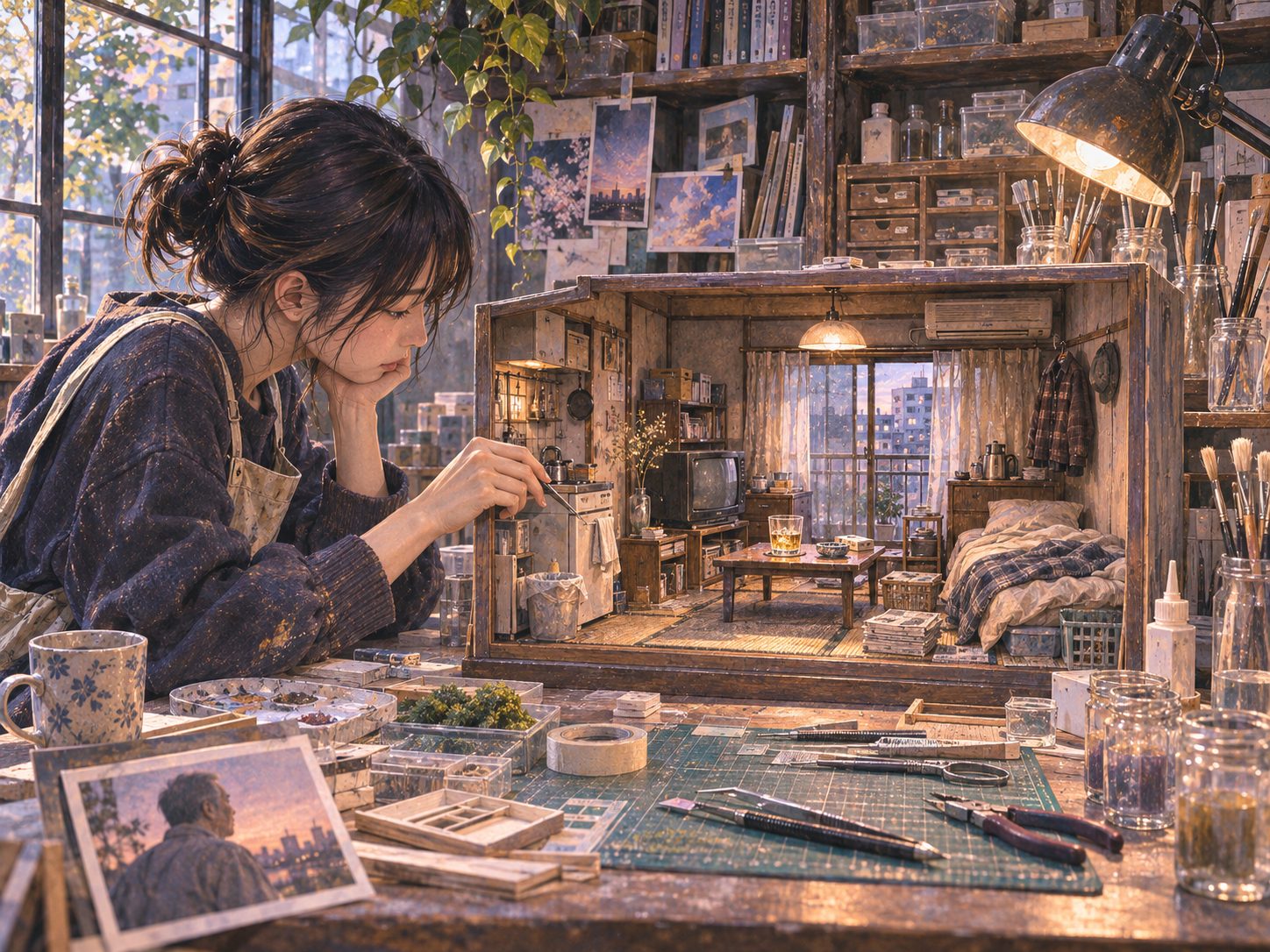
It’s a small room, small enough to hold in your hands.
A futon lies in the middle of the floor, with a large brown stain at its center, its edges spreading outward and seeping into the floor. Around the futon are scattered horse-racing betting slips, an open newspaper, convenience-store bento boxes and several empty cups of sake.
There is no one on the futon. The brown stain is bodily fluid. The person who lived here was a man in his fifties or sixties who lived alone and wasn’t found until three to six months after he died.
This room doesn’t exist. It’s a miniature made by a woman named Miyu Kojima. Her day job is estate cleaner: at a company in Tokyo, she clears out the homes left behind by people who have died, many of them people found long after death. By 2022, she had handled more than 3,000 sites.
Clearing these rooms is hard enough. Why, in her spare moments at work, does she also turn them into miniatures, one room at a time, and put them in front of strangers? The answer goes back to the year she turned seventeen.
Her father nearly died alone
Miyu Kojima was born in 1992 in Saitama Prefecture, just north of Tokyo. She remembers two versions of her father.
One was the father who drove a truck for a transport company. When she was in kindergarten, he often let her ride in the truck, and the family went to play in the river together. The other was the father who drank. He loved alcohol and often made scenes at home when he’d been drinking, while her mother kept the household afloat. When he wasn’t drinking, Kojima says, he was a good dad.
Her last memory of her father is grappling with him to protect her mother.
Later, her parents decided to divorce and separated first. Two months later, her mother went to see her father with the divorce papers and found him collapsed at home. It was a stroke. Kojima was in her second year of high school, and saw her father for the last time at the hospital. He was 54.
If her mother hadn’t gone that day, she says, her father would probably have died alone.
Kodokushi, or “lonely death,” isn’t a legal term in Japan. It generally refers to someone dying at home with no one around, and being found only after some time has passed. Her father had been spared that ending only by divorce papers that happened to arrive that day.
After he died, what came over her first was intense regret. She realized he had been an important person to her after all, and wished she had talked with him more while he was alive.
Complaints about crooked cleaners made her quit the post office
After high school, Kojima went to work at the post office. One day an acquaintance told her about a job called special cleaning: when someone dies at home and isn’t found for a long time, the room is left with bodily fluids, odors and insects after the body is removed, and specialists are needed to disinfect and deodorize it. This work often goes hand in hand with estate clearing, sorting the deceased’s belongings on behalf of the family, keeping what should be kept and disposing of the rest according to the rules.
When she looked it up online, what she found was complaint after complaint. Many bereaved families said they’d run into crooked operators: one figure in the estimate, a pile of extra charges at the end, belongings thrown away carelessly, no respect at all for the dead. Families who had just lost someone, at their most vulnerable, were being taken for a ride.
She was angry. And she thought that someone whose own father had nearly died alone should understand bereaved families better than most. Maybe this was work she should be doing.
She quit the post office and spent about two years preparing. She read books written by estate clearing companies, and deliberately looked at unpixelated accident photos on foreign websites to build up some tolerance for gruesome sights. While job hunting, she was uneasy about companies whose listings described “simple work anyone can do.” The company she finally chose said plainly that this was “hard work,” and its listing repeatedly mentioned compassion for the bereaved and the deceased.
In 2014, at 22, Kojima joined Ihin Seiri Clean Service in Tokyo’s Itabashi Ward, becoming the only woman on staff. Her mother and older sister strongly opposed it. She explained her sense of mission by telling them about her father, and in the end her mother said: do as you like.
Money laid out neatly on the floor, proof of “I lived another day”
On her fourth day on the job, Kojima cleaned up her first lonely-death site. There were bodily fluids on the floor, maggots and swarms of insects. She had expected to be frightened, but found that what she’d imagined beforehand was worse than the reality. Her first thought was that she wanted to clean up for this person as quickly as she could.
Her workflow goes roughly like this. First she goes in alone in a protective suit and gas mask, sprays disinfectant where the body lay, and bags and seals the fluid-soaked bedding so her colleagues can come in safely to carry things out. Once the room is clean, an ozone deodorizer runs continuously for one to two days. When all the work is done, she lights a stick of incense at the entrance and sets out flowers, leaving them for about five minutes before clearing them away, because the home has to be returned to the landlord.
One site early in her career left her with an image she has never forgotten: money laid out on the floor in neat, separate portions. She asked the company president what it meant. He told her it was proof from the person who lived there that “I lived another day.” Each day that passed, this person set out a little more money on the floor, confirming they’d made it through one more day.
Details like this gradually changed how she saw each site. Even in the worst rooms, she says, she thinks about how the person who lived there felt joy, anger and sorrow just like her, and since then she hasn’t been afraid. She tidies up after the dead as if they were family.
Her boss laughed, “Who would look at that?” Then the miniatures were retweeted 17,000 times
What made Kojima known to the public wasn’t the cleaning but an exhibition.
Every summer in Tokyo, Japan holds the Ending Industry Expo, where funeral homes, cemeteries, estate clearing companies and other businesses involved in the last stage of life set up booths. Her company exhibited too, at first with posters and photos of actual sites.
She noticed that the photos had many problems. Many people turned away as soon as they saw real photos of a site. Photos could reveal who the deceased was and bring back painful memories for the bereaved. And when the media reported on it, the site photos were pixelated, so the most important part ended up hidden. At this rate, people would always think of lonely death as something that happens to other families.
The solution she came up with was miniatures: they could show everything clearly without anyone recognizing the deceased.
When she told her boss, he laughed: who would look at that? She had never made a miniature, so she taught herself from YouTube and built them bit by bit in the office between jobs. The wallpaper is real wallpaper, and many of the other materials came from a hardware store. She hardly looks at photos, instead combining from memory the things she saw often across many sites, and changing any details that could identify the deceased. Three rooms take about three months.
In 2016, the miniatures went on display at the company’s booth at the Ending Industry Expo. Visitors took photos and posted them on social media, one of which was retweeted about 17,000 times, and media outlets in Japan and abroad lined up for interviews.
Every miniature asks: could this person have been found sooner?
Each of her works, Kojima says, has a theme.
The futon room from the beginning is about connection. She has seen countless rooms like it at sites, and believes that if the man had greeted and talked with his neighbors, he would probably have been found in two or three days, not three to six months. At sites like this, the person who finally calls the police is often someone who just happens to pass by regularly, like a newspaper delivery person.
Another piece is a bathroom, the tub filled to overflowing with red water. It’s modeled on someone who died of heat shock in winter while getting ready for a bath. Heat shock refers to what happens when a person goes from a warm room into a cold bathroom and then into hot water: the sharp swing in temperature over a short time causes blood pressure to change rapidly, which can trigger a heart attack or stroke. Many older Japanese homes have unheated bathrooms, so accidents are especially common in winter. This person’s daughter called several times with no answer before going to the house, by which point about a week had passed. Kojima says heat shock is less a sudden death from illness than a death that might have been prevented.
There’s also a room of a suicide: a rope hangs from above, a large blue tarp covers the floor, and on the wall, taped up, is a single word: gomen, “sorry.” She says the suicide sites she has been to were mostly neat and tidy. The tarp on the floor is there so bodily fluids won’t stain it, so the family won’t be charged heavy repair costs by the landlord. Her reading is that these people were trying hard to live right up to the very last moment.
At the first exhibition, a woman looked at the room piled with garbage and said: I like things clean, I’d never end up like that. Kojima’s reply was that this could happen to anyone. When you’re not doing well, you may not even have the energy to take out the trash.
She’d rather not use the words “lonely death”
In 2019, Kojima published her first book, Toki ga Tomatta Heya (The Room Where Time Stopped), introducing her miniatures and the sites behind them. It went into a second printing within two weeks.
As interview requests poured in, she said something a little unexpected: she’d rather not use the term “lonely death,” because dying alone at home doesn’t necessarily mean someone was lonely.
It sounds like something said to her father. In his last few years, he really had drifted away from his family. Yet the man who let her ride in his truck and took the family to play in the river had been real too. How a person dies is not the same as how they lived.
Her focus has gradually shifted, too. When she started, she mostly thought about the people who had died. After a few years, she cared more about the bereaved, and hoped they could look forward a little sooner.
What the miniatures want you to see is the moment when there was still time
So why does she turn rooms into miniatures? Her own answer is very simple: she wants people who see them to think, “treasure the important people around you, and don’t leave yourself regrets.” She also keeps urging people to do something very concrete: once someone has died, anything you do is too late, so start reaching out to your parents back home now.
I think what Kojima’s miniatures most want people to see isn’t how the dead looked at the end, but the point at which there was still time: a call that wasn’t made, words that weren’t said, a neighbor no one ever greeted. She herself missed the chance to talk more with her father, and he was spared being left alone at home only because her mother happened to visit. Most of the people in her miniatures didn’t have that luck. She shrinks these rooms and puts them in front of strangers in the hope that those who see them will pick up the phone first, without waiting for luck.
Notes
- Most interviews give the cause of Kojima’s father’s death as a stroke; one article says heat shock. This article follows the majority.
- Most reports say Kojima began making miniatures in 2016; the company’s 2019 press release says 2015.
- The company name 遺品整理クリーンサービス is rendered here as Ihin Seiri Clean Service, and the expo エンディング産業展 as the Ending Industry Expo. The descriptions of objects in the miniatures come from photos and captions in news reports and book descriptions; the author has not seen the pieces in person.
References
- 文春オンライン (北川真紀)|私が「孤独死のミニチュア」を作り続ける理由――遺書と、壁に「ゴメン」の3文字が残された部屋|2020-07-26 (the suicide-site miniature, the woman’s reaction at the expo, questions at talks)
- 文春オンライン (北川真紀)|父親の突然死に「後悔」 脱臭に3日…壮絶な「孤独死の現場」6年で見えた「人間の裏側」|2020-07-26 (her father’s stroke at 54, the separation, the truck and the river, the final struggle, regret, deodorizing steps, incense at the entrance, building miniatures from memory)
- 文春オンライン|遺品整理人・小島美羽さんインタビュー (4 parts; parts 1–3)|2022-08-27, https://bunshun.jp/articles/-/56771, https://bunshun.jp/articles/-/56772 (why she entered the field, two years of preparation, job listings, family opposition, 3,000 sites, the site on her fourth day)
- 週刊女性PRIME|小島美羽さん取材記事|2020-11-12 (only woman at the company, teaching herself in the office between jobs, going viral after the 2016 exhibit, money laid out on the floor, her feelings at her first site)
- ORICON NEWS (衣輪晋一)|孤独死現場を”ミニチュア”化する理由、遺品整理人が見た景色「父の死がきっかけに」|2019 (her boss’s “who would look at that,” problems with photos, the “connection” theme, the bathroom miniature, “contact your parents now”)
- テレ東プラス|毎日約76名が「孤独死」…。その現場で何が起きているのか|2019-10-03 (born in Saitama in 1992, joined in 2014, the bathroom miniature and the daughter’s calls, tidy rooms at suicide sites)
- テレ東プラス|遺品整理人・小島美羽さん取材記事|2019-10-10 (her mother finding her father while delivering divorce papers, not wanting to use “lonely death,” concern for the bereaved, real wallpaper and hardware-store materials)
- ねとらぼ (不義浦)|遺品整理人・小島美羽さん連載 parts 1 and 2|2019-09, https://nlab.itmedia.co.jp/cont/articles/3295734/ (post office job, preparing by looking at photos, “imagining it was worse,” learning from YouTube, second printing in two weeks)
- The Japan Times|Lonely death reconstructions|2019-11-25 (three months for three rooms)
- 遺品整理クリーンサービス (ToDo-Company Inc.)|press release on the publication of『時が止まった部屋』|2019-08-08 (publication details, about 17,000 retweets)
- Toyo Keizai Online|interview with Miyu Kojima, author of『時が止まった部屋』|2019-09-27 (heat shock, “a death that might have been prevented”)
Follow the story in person
Join a small-group trip to the places in our stories and meet the people who live and work there.
See trips and dates
Water Mirror is a Tokyo-based company that helps more people step inside industries and explore the stories and cultures of different fields around the world. We design in-depth learning programs for individuals, companies, schools and organizations, combining company visits, exchanges with professionals, local learning and hands-on experiences, so participants can see how industries really work and meet the people and stories behind them. Water Mirror Perspectives is our content media, telling the distinctive stories of industries, local cultures and people, so that reading sparks curiosity and leads readers to go and see for themselves.
About Water Mirror →