Key Points
- Yoshiro Nakamatsu, born in 1928, is one of Japan’s best-known inventors. At 14, to spare his mother the struggle of pouring soy sauce, he built a hand pump based on the siphon principle. He says the kerosene pumps found in Japanese homes evolved from it.
- His rule of invention is “suji, pika, iki”: theory, inspiration and practicality. He uses a noisy room, a gold-plated bathroom and holding his breath underwater to draw out ideas.
- From age 42 he photographed and analyzed every meal he ate, which won him the Ig Nobel Prize in Nutrition in 2005. Diagnosed with prostate cancer at 85, he treated the cancer as an invention project, and in 2019 announced he had beaten it.
- He ran for Tokyo governor and other offices more than a dozen times without ever winning, and treated elections, too, as experiments for collecting data. What’s most worth remembering about him is how he turned everything in life into the question “could this be done a better way?”
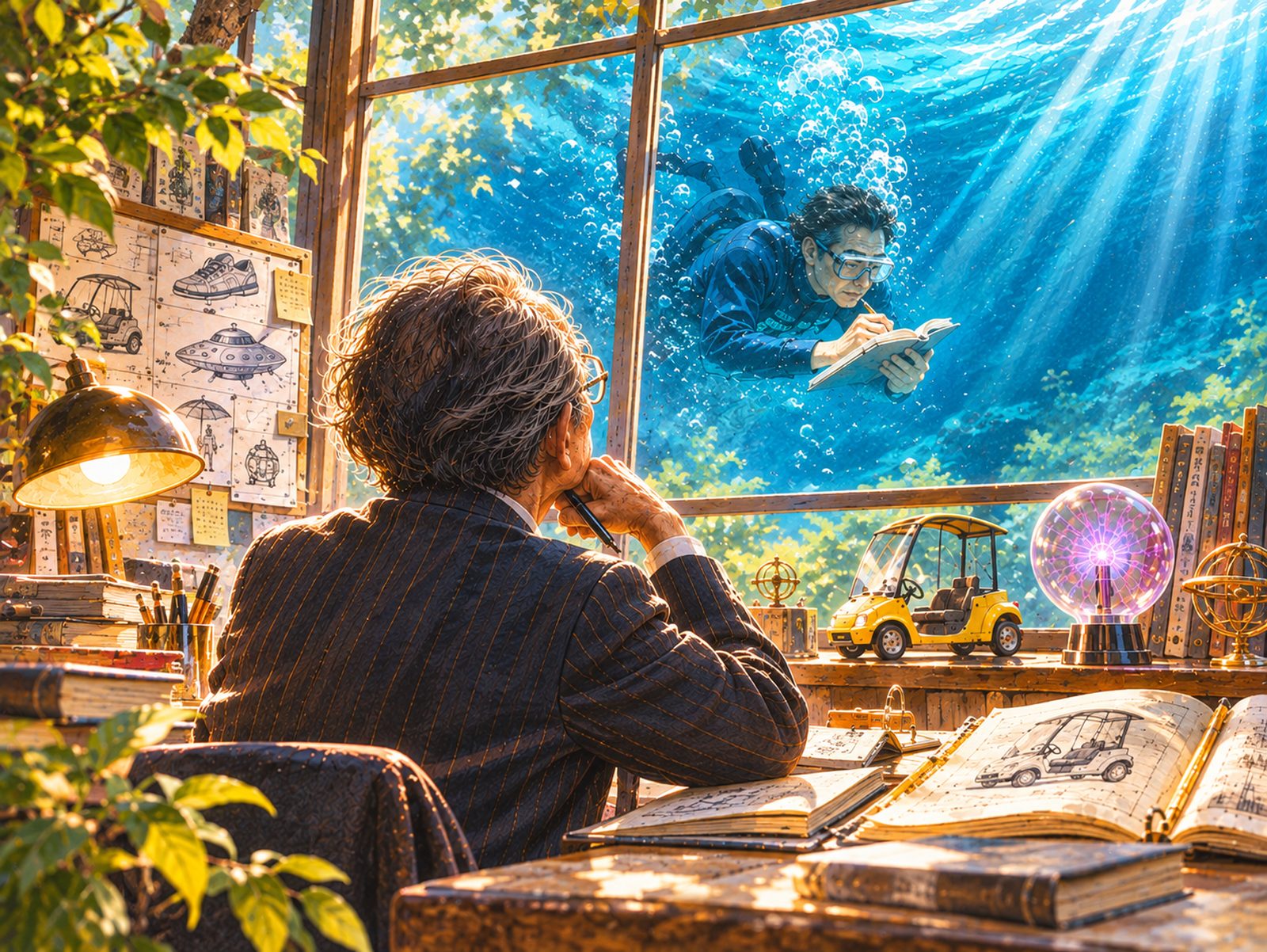
One evening in the spring of 2012, in a private pool at a Tokyo hotel, an 84-year-old man sank to the bottom and swam back and forth underwater. After about thirty seconds, he took out a waterproof notebook and began sketching furiously. When he surfaced, he held the notebook up to the American journalist who was there. On it was a tangle of lines that looked like a subway map. This, he said, was a new way to deal with radioactive waste from nuclear power plants.
The man was Yoshiro Nakamatsu, better known in Japan and abroad as “Dr. NakaMats.” He is a regular on Japanese TV variety shows, a candidate who ran for Tokyo governor wearing spring-loaded jumping shoes, and an Ig Nobel Prize winner. Diving deep and holding his breath starves the brain of oxygen, he explained, and “0.5 seconds before death, I visualize an invention.” He also added: he doesn’t recommend that anyone try it.
It sounds like an eccentric’s quirk. But lay out Nakamatsu’s whole life, and this habit isn’t sudden at all. He had long since turned his everyday life, including his meals, his illness and his election campaigns, into invention experiments. How does a person end up there? The story begins with his first invention.
His first invention was to stop his mother’s hands from shaking as she poured soy sauce
Nakamatsu was born in Tokyo in 1928. The person who truly shaped him was his mother, a graduate of one of the highest institutions Japanese women could attend at the time and a former teacher. Nakamatsu says his gift for invention “came from my mother’s side.” She began teaching him physics and chemistry when he was three, and when he built a model airplane at five, he gave it a device that automatically adjusted its center of gravity.
Then the war came. During the Pacific War, Japan suffered severe fuel shortages, and homes were cold in winter. Soy sauce was sold in large glass bottles of about 1.8 liters, and to transfer it into a small bottle you had to lift the big one in both arms and tilt it. One slip and it spilled. Nakamatsu watched his mother hold that big bottle in the depths of winter, her hands trembling the whole time.
His thought at the time, he says, was simple: “I felt I had to take care of my mother.”
At 14, Nakamatsu built a hand pump using the siphon principle: once a tube is filled with liquid and its outlet is lower than the liquid’s surface, the liquid flows down the tube on its own, with no need to lift the bottle. He gave it a cute name, Shoyu Churu Churu (roughly, “soy sauce slurp-slurp”), and filed for a jitsuyo shin’an, a Japanese utility model right that protects small improvements with a lower bar than a patent. It was the first invention he ever secured rights to.
If you’ve ever visited a home in northern or mountainous Japan in winter, you may have seen its descendant. Many Japanese households still heat their homes with kerosene stoves, and to transfer kerosene from a big plastic tank into the stove, they use a hand pump: squeeze the rubber bulb at the top a few times and the kerosene flows over by itself. Nakamatsu says this kerosene pump, found in practically every home, evolved from the soy sauce pump he made for his mother.
This invention set the pattern for how he would think from then on: see something that makes life hard for someone, and ask, “could this be done a better way?”
The boy who wanted to build planes ended up selling them
In 1945, at 16, Nakamatsu entered the Naval Engineering School, which trained engineers for the navy, because “no matter what, I wanted to build airplanes.” He was there for only about four months, and the training included swimming for 12 hours straight. When he came home in uniform four months later, he says, his mother at first didn’t recognize her own son.
In August 1945, Japan lost the war, and the Allied forces occupying Japan banned it from researching or building aircraft. The ban wasn’t lifted until 1952. A boy who had been building model airplanes since age five discovered, at seventeen, that for now no one in his country would be allowed to build a plane.
Nakamatsu went on to graduate from the University of Tokyo’s Faculty of Engineering and joined Mitsui & Co., one of Japan’s oldest trading companies, where he was assigned to sales in the aviation department. Most of his colleagues won business by wining and dining clients, he says, but he relied on understanding the technology, and ended up the department’s top salesman. The man who wanted to build planes didn’t get to, but in the place that sold them, he learned how to turn technology into business.
As he approached 30, he decided that to truly make the most of one’s abilities, it was best to go independent before turning 30, and he left the company. His early independent work, he says, all had to do with aviation. At the time, Japan had started using planes to spray pesticides over farmland, but planes could only coat the tops of leaves, so pests hiding underneath were unharmed. He realized that a helicopter’s rotor pushes air downward and could blow the spray onto the undersides of the leaves, and developed a spraying device for helicopters.
A gold bathroom and holding his breath underwater: how he “produces” ideas
In 2025, Nakamatsu’s second son, Yoshinari Nakamatsu, wrote an article about his father describing the three elements of invention his father always talks about: “ichi suji, ni pika, san iki.” Suji is theory: an idea needs long research behind it. Pika is a flash of inspiration that departs from existing ideas. Iki means being able to survive in the world, in other words, practicality. By Nakamatsu’s definition, inspiration is only one-third of it.
For that flash of inspiration, he turned his home into an idea factory. One room is covered in pictures with music blasting, to get his brain going; the house even has an elevator that plays Beethoven. Another room is actually a bathroom, finished entirely in gold from the walls to the toilet, used to shut out sound from the outside. Ideas come there sometimes in seconds, sometimes only after hours of sitting, he says.
The final stage is the pool from the beginning. After stimulation in the noisy room and settling in the quiet bathroom, he dives and holds his breath, waiting for the image that appears “0.5 seconds before death,” then records it with an underwater writing tool he invented himself. Even jotting down an idea is something he won’t do without first inventing a tool for it.
Why did he photograph every meal he ate?
In 1970, Nakamatsu turned 42. In Japanese tradition, 42 is the most dangerous “unlucky year” in a man’s life, because “four-two,” shi-ni, sounds like the Japanese for “to die,” and many men visit a shrine that year to ward off misfortune.
Nakamatsu took a different approach. He says 42 is exactly when the body begins to decline, so starting that year he decided to record every meal he ate and have regular blood tests to observe the link between his diet and his body and mind. Later he switched to photos, taking one picture before every meal.
His family paid the price. Yoshinari writes that every time, his father had to set up a tripod and start the camera, and the whole family could only wait patiently. By the time he finished, the food had gone cold.
The experiment went on for decades. In 2005, Nakamatsu received the Ig Nobel Prize in Nutrition at Harvard University “for photographing and retrospectively analyzing every meal he has consumed during a period of 34 years (and counting).” The Ig Nobel Prizes honor real research that “first makes people laugh, then makes them think.” At an event in Denmark in 2015, when an audience member asked what invention the world needed most, the 86-year-old answered with one word: “Everything!” The audience gave him a standing ovation.
Diagnosed with cancer at 85, he called it “the biggest invention project”
At the end of 2013, Nakamatsu was diagnosed during a routine checkup with a relatively rare form of prostate cancer. When he made his illness public, he said his doctors expected him to live only until the end of 2015.
For most people, that would be the end of the road. Nakamatsu said instead: “Cancer is the biggest invention theme heaven has given me.” He fought it his own way, spending two hours at the gym every other day and continuing to adjust his diet and keep working. On April 18, 2015, he released a song against cancer, making his debut as a singer.
That date is Japan’s Invention Day, marking the day in 1885 when Japan promulgated its first patent law. An inventor choosing Invention Day to fight his own cancer with a song is very much Nakamatsu’s style.
His doctors said he wouldn’t make it past 2015. He did. In 2019, he held a press conference to announce that he had beaten his cancer.
Running for office in jumping shoes, he said he was testing new technology
Nakamatsu says he originally had no interest in politics. Around 1990, an old friend dying of cancer asked him to become prime minister and get Japan back on its feet. In 1991, at 62, he ran for Tokyo governor for the first time.
His first campaign made him unforgettable. While another candidate was giving a speech from a campaign truck on the streets of Shinjuku, Nakamatsu approached, bouncing along in jumping shoes he had invented, and every camera immediately turned toward him. He had originally designed the shoes during the jogging boom, using springs to absorb the impact of the pavement and protect the knees and back.
Over the next twenty-plus years, he ran 16 times and never once won. In 2021, at 93, Nakamatsu announced his retirement from elections, with a very characteristic reason: “I’ve finished collecting the technical data I needed from elections.” Even elections, he treated as a data-gathering experiment.
But that wasn’t the end of the story. In 2024, a group of supporters arranged for him to run, and at 96, Nakamatsu became the oldest candidate in the Tokyo gubernatorial election, winning more than 20,000 votes.
At 98, he’s still inventing
In June 2026, Nakamatsu turned 98. He posted a photo on social media in a sharply tailored suit, saying he was heading off to his birthday party.
Looking back on his life, it’s easy to get distracted by the outlandish images: the gold bathroom, the jumping shoes, holding his breath underwater, decades of photographed dinners. But string those images together and you see one consistent thread. At 14, seeing his mother’s hands tremble, he asked, “could this be done a better way?” Later he put the same question to pesticide spraying, to his own diet, to his own cancer, even to his own election campaigns.
I think what’s most worth remembering about Nakamatsu isn’t any one invention, but that he never treated anything as simply “something that happened to me.” The unlucky year of 42 became an experiment of photographing dinners for decades. The deadline his doctors gave him for cancer became an unsolved problem. Invention long ago stopped being his profession and became his way of facing life. Even with the worst news, he first asks: what can this be used for?
Every winter, in countless Japanese homes, someone crouches beside a kerosene tank, squeezes the rubber bulb of that pump, and watches the kerosene flow into the stove by itself. Few ever think that the motion began more than eighty years ago with a boy who wanted his mother’s hands to stop shaking.
Notes
- Nakamatsu’s childhood experiences, his life at the naval school, his work at Mitsui & Co. and the origin of the kerosene pump come mainly from his own accounts in interviews, and are presented in the text with “he says.”
- When Nakamatsu enrolled in 1945, the Naval Engineering School had already been reorganized as the Maizuru branch of the Naval Academy, but he himself still calls it the Naval Engineering School, and this article follows him.
- His 2015 debut with a song against cancer and his 2019 announcement that he had beaten cancer were both made public by Nakamatsu himself.
References
- Franz Lidz|Dr. NakaMats, the Man With 3300 Patents to His Name|Smithsonian Magazine|2012-12 (the 2012 pool scene, “0.5 seconds before death,” the gold bathroom and the Beethoven elevator)
- 文春オンライン特集班|ドクター・中松(93)選挙引退宣言インタビュー (5 pages)|Bunshun Online|2021-12-26 (his mother, the soy sauce pump, the naval engineering school, Mitsui & Co., why he ran for office, the jumping shoes, his retirement announcement)
- Alec Jordan|Inside the Inventive Mind of Dr. Nakamats, Japan’s Most Prolific Inventor|Tokyo Weekender|2014-05-24 (cold wartime winters and his mother’s hands, recording meals from 42, the two rooms, writing underwater)
- 中松義成|ドクター・中松 一スジ、二ピカ、三イキ|Bungeishunju PLUS (Bungeishunju, August 2025 issue)|2025-07-09 (the three elements of invention, the family waiting while meals were photographed)
- Improbable Research|The 2005 Ig Nobel Prize Winners (reprint)|Phys.org|2005-10 (the Ig Nobel citation)
- Elizabeth Shaffer|Dr. NakaMats photographed all his meals for the past 34 years|University Post (University of Copenhagen) (the 2015 event, the answer “Everything!”)
- 日刊ゲンダイ|発明家 中松義郎さん(86) 前立腺導管がん|2014-12-25 (discovery of the cancer, his exercise routine, “the biggest invention theme”)
- 秋田魁新報|ドクター中松氏 98 歳の誕生日|2026-06-27 (98th birthday photo, cancer diagnosis, 2015 singing debut, 2019 press conference)
- The Japan Times|Dr. Nakamatsu, Japanese inventor|2024-11-18 (how he came to run in 2024)
- Wikipedia|2024 Tokyo gubernatorial election (vote count)
- Japan Patent Office|「発明の日」について (origin of Invention Day)
Follow the story in person
Join a small-group trip to the places in our stories and meet the people who live and work there.
See trips and dates
Water Mirror is a Tokyo-based company that helps more people step inside industries and explore the stories and cultures of different fields around the world. We design in-depth learning programs for individuals, companies, schools and organizations, combining company visits, exchanges with professionals, local learning and hands-on experiences, so participants can see how industries really work and meet the people and stories behind them. Water Mirror Perspectives is our content media, telling the distinctive stories of industries, local cultures and people, so that reading sparks curiosity and leads readers to go and see for themselves.
About Water Mirror →