Key Points
- In October 2018, the wholesale inner market of Tokyo’s Tsukiji Market moved 2.3 kilometers to Toyosu, while the 400-plus shops of the neighboring Tsukiji Outer Market stayed put.
- The inner market handled fish auctions and wholesale. The outer market sold “everything except the fish”: kelp, nori, knives, meals. Its main customers had always been chefs coming in at dawn to stock up.
- After the move, the early-morning professional customers dwindled, and shops helped themselves with events like the Tsukiji Hashigo-zake bar crawl. Since 2023, a flood of foreign tourists has also brought tourist prices, like an ¥18,000 seafood bowl.
- Tsukiji’s challenge today is deciding whom it serves. What makes it worth a special trip is that it’s still a market street working for everyday life.
In the five days after Tsukiji Market closed in October 2018, about 2,600 turret trucks and forklifts drove out of Tsukiji one after another, heading for Toyosu, 2.3 kilometers to the southeast. Turret trucks, known as tare, are small carts unique to Japanese fish markets: a driver stands at the front behind a drum-shaped steering column, with a flatbed behind for carrying crates of fish through narrow aisles. These vehicles had been zipping around Tsukiji for decades. Now they were moving out en masse.
On October 11, Toyosu Market opened. A week later, demolition of the old Tsukiji market began, and a fence about two meters high went up in front of the main gate.
But outside the fence, across the road, an entire neighborhood hadn’t moved. Shops selling nori, kelp, tamagoyaki rolled omelets and knives, and soba noodle restaurants: more than 400 of them raised their shutters at dawn as usual. This area is called the Tsukiji Outer Market.
Before the market moved, many predicted the outer market would decline along with it. Eight years later, it’s so crowded you can barely move on the sidewalks, and a seafood bowl can sell for ¥18,000. Tsukiji survived. But what it has survived as is something even the people who work there are still arguing about.
The inner market sold fish; the outer market sold everything else
To understand why the outer market panicked, you first need to know its relationship with the market.
Tokyo’s fish market was originally in Nihonbashi, where it had operated for more than 300 years. The fires that followed the Great Kanto Earthquake of 1923 burned it to the ground, and as part of post-disaster reconstruction the government moved the fish market to Tsukiji, where it officially opened in 1935. The place name Tsukiji means “built land,” land reclaimed from the sea. After a great fire in the 17th century, the shogunate filled in the area to relocate temples that had burned, one of which later became Tsukiji Hongwanji. After the 1923 earthquake, the temple’s cemetery was moved away, and on the freed-up land small shops selling seafood, kitchen tools and meals for market workers sprang up one after another. That was the beginning of the outer market.
What’s the difference between the inner and outer markets? The inner market is the wholesale market proper, where you need a license to trade. Fish from producing regions is auctioned first, then about 500 intermediate wholesalers break down whole tuna and crates of horse mackerel, grade them, and sell them to suit each restaurant’s needs. A sushi chef walks into the inner market at dawn and picks out the day’s fish with a wholesaler he knows.
Then he walks out of the inner market and into the outer market.
The outer market is a shopping street anyone can enter, selling what the inner market doesn’t: kelp for making stock, nori for wrapping sushi, eggs for tamagoyaki, well-sharpened knives, and a bowl of hot noodles to fill up people who start work at 3 a.m. For outer-market shops, the main customers were never tourists but chefs coming out of the inner market every morning, still carrying their fish. The inner market took care of “the fish”; the outer market took care of “everything except the fish.” For eighty years, both lived off the same customers.
So when the inner market was set to move, what the outer market feared wasn’t losing a neighbor. It was losing the reason customers came to the street at all.
If the market worked fine, why did it have to move?
Because it was too old and too cramped. Tsukiji Market’s buildings were a 1930s design. The main building curved in a quarter-circle so freight trains could pull right in to unload. But trucks had long since replaced trains, the refrigeration was outdated, and the aisles were narrow. In 2001, the Tokyo Metropolitan Government decided to move the market to Toyosu, a site nearly twice as large.
The trouble was that the Toyosu land had once been a gas plant, and its soil and groundwater were contaminated. The move, scheduled for November 2016, was halted by a newly elected governor, and later testing found benzene in the groundwater at more than a hundred times the environmental standard. The delay dragged on for almost two years before Toyosu was declared safe in 2018 and the move finally went ahead.
For the outer market, those two years had an unexpected benefit: time to prepare for life without the market.
In 2016, the outer market’s shopping association photographed the owner of each shop and made posters pairing the photos with the owners’ own words, put up near the station. The message was that this was a food street where you could become a better cook. In other words, even if the market moved, the knives, kelp and nori here, and the owners’ expertise, would still be things chefs needed. That same year, the ward built Tsukiji Uogashi next to the outer market, bringing in about sixty seafood and produce wholesalers, so professional buyers would still have a reason to come to Tsukiji after the market moved.
A Tsukiji kid who didn’t like Tsukiji
One person in the outer market sensed earlier than most how serious it would be if the market moved and the customers stopped coming. His name is Soichiro Matsumoto, second-generation owner of the soba restaurant Choseian.
His father opened Choseian in 1971. Its customers were market workers, and its fish came from the market. Matsumoto grew up in Tsukiji and was scared of the place as a child: the adults were loud and drank endlessly. “I never liked Tsukiji to begin with,” he says.
He had no plans to take over the restaurant either. Only after Choseian’s business went downhill did he start helping out, eventually taking it over from his father. As soon as he did, he switched the tuna his father used to sushi grade, convinced that with good tuna, good drink and good soba, it would work.
A bar crawl that let the street draw people in on its own
After the market’s move was decided, Matsumoto often drank with two friends from the outer market. One was Shingo Ito, fourth generation at Ito Nori Shop, which has stood on a corner since just after the Second World War and is known locally as “the nori shop on the corner.” The other ran an egg shop.
Their worries were practical. Once the market moved to Toyosu, the restaurant owners who came to the inner market to buy would stop coming to Tsukiji too. When that happened, how would the shops in the area help each other out?
In 2014, they held the first Tsukiji Hashigo-zake, a bar crawl. Participants bought a set of tickets and could hop from one restaurant to the next across the inner and outer markets. The first one drew 23 shops and about 800 people. By 2018, the year the market moved, 51 shops and about 2,000 people were walking Tsukiji’s streets. “I just love being on the ground,” Matsumoto says. “I just want everyone to have fun together.”
The bar crawl couldn’t keep the fish. What it did was something else: it let Tsukiji’s shops get to know each other and send customers each other’s way, giving the area its own reason, apart from the market, to draw people in.
When the market really moved, what did the outer market lose?
The most obvious change after the move came in the early morning. From 5 to 10 a.m., the outer market used to be packed with buyers and chefs stocking up. Now they were gone. Seven months after the move, one seafood dealer in the outer market said Tsukiji had become a completely different street, and his company’s sales had dropped by more than 20%.
Someone at another long-established seafood company was blunter: in the end, it’s just fish from Toyosu brought to Tsukiji to sell. The fish you eat in Tsukiji today was auctioned at Toyosu before dawn and then brought back.
Some old shops closed that year, too. The outer market’s oldest café, Kissa Mako, opened in 1961. Its owner, known as Mama Masako, ran it single-handedly for 57 years, and her ozoni, mochi soup with coffee, was the regular breakfast of many market workers. In 2018, she retired the same year as the market.
The café was taken over by Tetsuya Yoshida, who runs a bar in Ginza. He fell in love with the space and decided to keep it, and kept the ozoni too: the broth comes from a Tsukiji soba restaurant, the mochi from a Tsukiji rice shop. A bowl of mochi soup held up by the hands of several shops in the neighborhood.
The tourists came back, and the old shop owners grew more worried
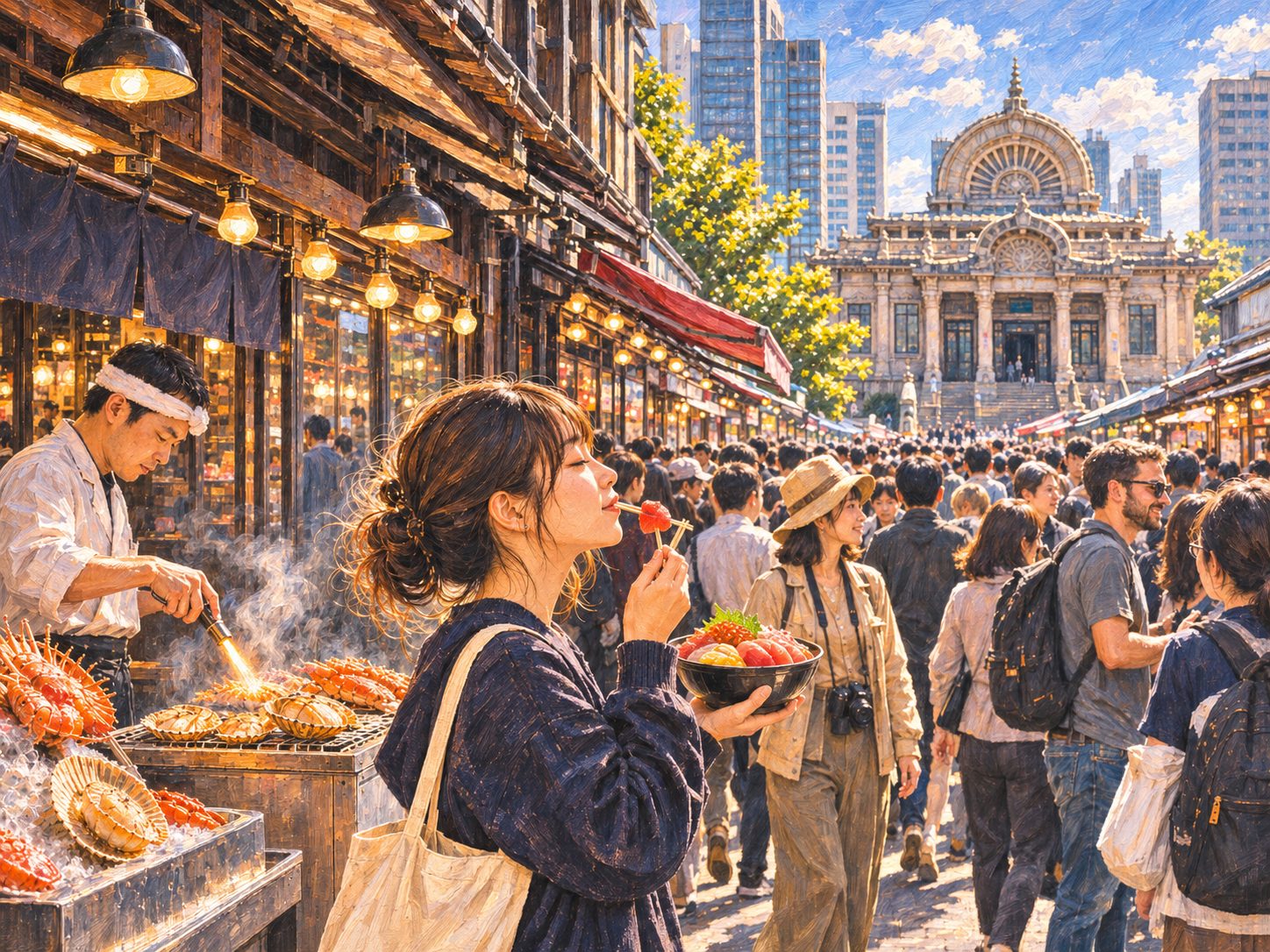
During the pandemic, the outer market got so quiet that many shops couldn’t hold on. After Japan eased border restrictions in autumn 2022, things turned around fast. By spring 2023, the tourist information center went from a handful of visitors a day to three or four hundred, and the two-meter-wide sidewalks of the main street were crowded with tourists from all over the world even at weekday lunchtime.
The crowds brought sales, and a different kind of price. One shop lists a seafood bowl at ¥18,000. Another puts sea urchin on a wagyu skewer and sells it for ¥6,000.
Kitada, whose family has sold processed seafood in Tsukiji since the Taisho era and who now chairs the local council, takes a dim view of these price tags. “Tsukiji’s pride is selling the real thing at a fair price,” he says. He worries that if business is only about appearances, Tsukiji may have no future. His regular customers, too, are finding it harder and harder to shop through the crowds.
Some shops are trying a different way of welcoming outside customers. Terade, president of Omiya Beef, a shop nearly a century old, puts it this way: “As professionals, we should properly ask customers when they’ll eat it and what they’ll eat it with, and then make a recommendation. That’s what Tsukiji should be doing most of all.” In other words, even if the customers have changed from chefs to travelers, what the outer market can sell is still advice from people who know the ingredients.
Matsumoto’s answer is a little different again. He’s noticed that affordable places for local workers are disappearing while tourist-priced shops multiply. He wants to open a standing soba or set-meal shop, with prices kept at ¥700 to ¥800, just for people who work nearby. Ito is more pragmatic: “It’s a trend. What matters is how you adapt to it.”
Toyosu wants to copy the “outer market” too
Interestingly, Toyosu has been trying all along to copy Tsukiji’s outer market. In 2024, Toyosu Senkyaku Banrai, a shopping complex of about 70 shops recreating an Edo-period streetscape, opened beside Toyosu Market, with a hot-spring facility on the other side. Toyosu Market itself is open to visitors, who can look down on the early-morning tuna auctions from above.
Each place has its own character. Toyosu has the real auctions, clean refrigerated warehouses and spacious walkways, but it’s a planned facility. Tsukiji’s outer market is a street that grew shop by shop over eighty years, with a nori shop on the corner, a bar owner who took over an old café, and a soba shop owner who never liked Tsukiji.
And Tsukiji’s changes aren’t over. In 2024, the Tokyo Metropolitan Government chose a development group to build a roofed multipurpose stadium holding 50,000 people on the site of the old market, with the first phase due for completion in fiscal 2032. Within a decade, the outer market’s neighbor will go from the world’s largest fish market to a venue that releases 50,000 people at once when an event ends. The outer market’s customers may change yet again.
A street that has to decide for itself whom it serves
When the market moved, many people thought Tsukiji would become an empty shell. It didn’t. Instead, it became a street that has to decide for itself whom it serves. In the past, it never had to think about this: every morning, the inner market delivered its customers. Now it has to find them itself. They might be tourists photographing tamagoyaki on their phones, crowds pouring out of a concert, or the people Matsumoto wants to keep: workers from nearby who just want to spend ¥700 on a bowl of soba.
These customers want different things, and how much room Tsukiji leaves for each will decide what kind of place it becomes. If one day the street has nothing left but ¥18,000 seafood bowls, Tsukiji will be a lively, photogenic tourist spot, but no longer the place Kitada describes, one that “sells the real thing at a fair price.”
I think the latter is the reason Tsukiji is worth a special trip. What travelers want to see, after all, is a market street still working for everyday life, not a market’s souvenir shop. As long as chefs still come at dawn to buy kelp and nori, and a ¥700 soba shop can stay in business, Tsukiji will still be Tsukiji.
Notes
- Kissa Mako’s name comes from Mako, the nickname of its owner, Masako.
- Reports differ on attendance at the Tsukiji Hashigo-zake. This article uses 23 shops and about 800 people for the first event and 51 shops and about 2,000 people in 2018.
- Most sources put the number of outer-market shops at “more than 400,” though some estimate about 500, depending on how it’s counted.
- Claims such as “sales dropped by more than 20%” come from outer-market business owners interviewed anonymously in 2019 and reflect individual shops, not overall statistics.
References
- Wikipedia|Tsukiji fish market (history of Tsukiji Market, the 1923 earthquake, opening in 1935, the building’s shape and relocation timeline)
- Tsukiji Outer Market Shopping Street Promotion Association|築地歴史年表 (dates of land reclamation and more)
- Inquirer / AFP|Sayonara Tsukiji! Exodus as Tokyo’s famed fish market relocates|2018-10 (2,600 vehicles, 2.3 km, a five-day move)
- Tokyo Weekender|Tsukiji Fish Market Closes, But Move Still Causing Controversy|2018 (history of the move, the delay, benzene levels)
- The Guardian (via inkl)|Tokyo fears losing a part of its soul as world’s biggest fish market moves|2018 (about 500 intermediate wholesalers, benzene 100 times the standard)
- Shukan Kinyobi|東京都の妨害に屈せず築地市場で「営業」続行する仲卸業者|2018-11-06 (start of demolition, the two-meter fence)
- Daiichi Kangyo Credit Cooperative (dfc)|レガシー・カンパニー 築地から豊洲へ (site area, Tsukiji Hashigo-zake attendance, the handover of Kissa Mako)
- AdverTimes (Sendenkaigi)|移転に揺れる築地 新しい魅力発信プロジェクト|2016-12-27 (the poster project, about sixty shops at Tsukiji Uogashi)
- Santatsu|interview with Choseian owner Soichiro Matsumoto|2026-10-01 (updated) (founding of Choseian, Matsumoto and his father, how the bar crawl started, plans for an affordable standing shop)
- Nikkan Gendai|【伊藤海苔店】海苔ひと筋 作り手の顔が見える|2015-05-24 (Ito Nori Shop and fourth-generation owner Shingo Ito)
- Toyo Keizai Online (栗田シメイ)|「築地場外」が直面するブランド存続の危機感|2019-06 (falling sales after the move, anonymous business owners’ comments)
- Gendai Business (大竹聡)|column on strolling the Tsukiji Outer Market|2023-05-31 (Kissa Mako opened in 1961, taken over by Tetsuya Yoshida)
- TV Tokyo, Admachick Tengoku|築地 (aired 2019-06-15) (Mama Masako’s retirement, where the ozoni’s broth and mochi come from)
- nippon.com|築地場外市場|2023 (the outer market’s origins on the former Hongwanji cemetery, tourist center visitor numbers)
- Toyo Keizai Online (山田稔)|report on the current state of the Tsukiji Outer Market|2025-03-31 (400-plus shops, two-meter sidewalks)
- TV Tokyo, Gaia no Yoake|「豊洲 千客万来」オープンまでの舞台裏|2024-02 (comments from Kitada and Terade, the ¥18,000 seafood bowl)
- GO TOKYO|豊洲 千客万来 (about 70 shops, hot spring)
- Impress Watch|築地市場跡地の再開発、三井不動産グループに決定|2024-04-20 (50,000-seat stadium, first phase completed in 2032)
Follow the story in person
Join a small-group trip to the places in our stories and meet the people who live and work there.
See trips and dates
Water Mirror is a Tokyo-based company that helps more people step inside industries and explore the stories and cultures of different fields around the world. We design in-depth learning programs for individuals, companies, schools and organizations, combining company visits, exchanges with professionals, local learning and hands-on experiences, so participants can see how industries really work and meet the people and stories behind them. Water Mirror Perspectives is our content media, telling the distinctive stories of industries, local cultures and people, so that reading sparks curiosity and leads readers to go and see for themselves.
About Water Mirror →