Key Points
- Goku, the hero of Dragon Ball, is voiced in Japanese by Masako Nozawa, born in Tokyo in 1936. She turned 90 in October 2026. She has been Goku’s voice since the first TV anime in 1986, and at 88 she voiced him again as a child in Dragon Ball DAIMA.
- One reason women often voice boys in Japanese anime goes back to dubbing foreign TV shows in the 1950s. Dubbing was done live, child actors were prone to mistakes, and adult men’s voices sounded too deep, so producers tried women whose voices were close to a child’s. Nozawa, then a teenage theater actor, was one of those chosen.
- Goku’s voice was chosen by the original creator, Akira Toriyama. The audition tapes had the names covered, and after listening, Toriyama said only this person could be Goku. When Goku later grew up and became a father, his sons Gohan and Goten and his father Bardock were all voiced by Nozawa too.
- In 2025, Nozawa became the first voice actor named a Person of Cultural Merit by the Japanese government. She said she was accepting the honor on behalf of the whole voice-acting profession.
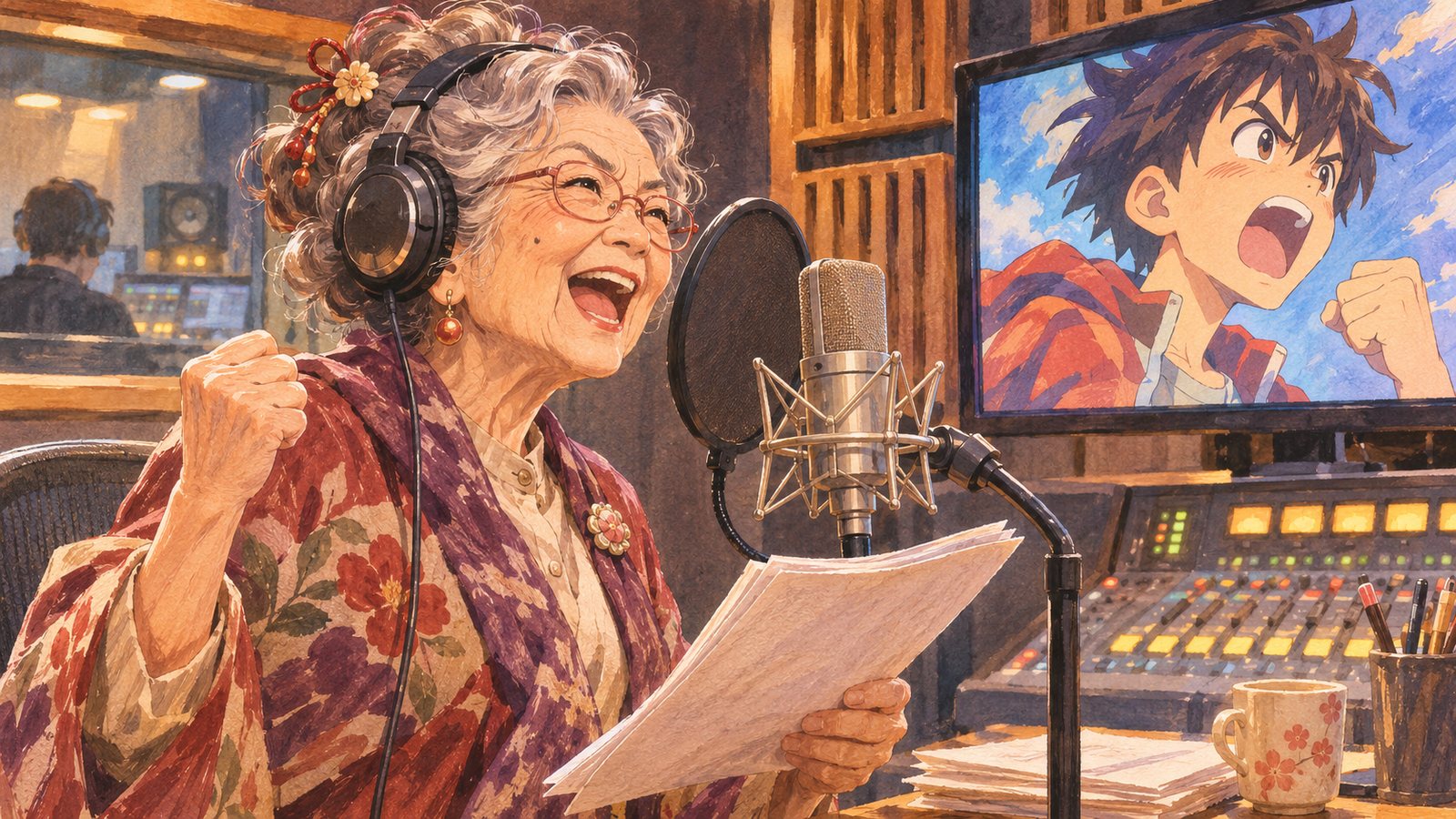
In October 2024, Dragon Ball DAIMA began airing. At the start of the story, someone uses a wish to turn Goku back into a child. The little Goku on screen sounded almost exactly like the boy in the first Dragon Ball anime in 1986.
The person who recorded those lines was 88 years old.
Her name is Masako Nozawa. In the English dub, the adult Goku is voiced by a man. In the original Japanese, Goku as a boy, a young man, a father and a grandfather has been voiced by this one woman for forty years. On October 25, 2026, she turned 90. Two weeks earlier, Dragon Ball Super: Beerus, a re-edited version with new animation, had just begun airing on Fuji TV, and the voice shouting “Kamehameha!” was still hers.
Many people do a double take when they first learn this. Why would a hot-blooded boy be voiced by a woman? The answer isn’t in Dragon Ball. It goes back further, to a time when Japan had no TV anime yet and nobody used the word “seiyu,” voice actor.
Live broadcasts with no retakes: why boys’ lines went to women
Masako Nozawa was born in Tokyo in 1936. Her aunt was an actress with the Shochiku film studio, and through that connection she became a child film actor at two or three. Near the end of the Second World War, her family moved to Numata in Gunma Prefecture to escape the air raids, and she lived there until she finished high school.
As a child she didn’t play house. She liked playing war games with the boys and was the leader of the pack. In high school, through an introduction from an NHK producer, she joined the Gekidan Tougei theater company as a trainee without telling her father. After graduating she moved to Tokyo, and made a deal with her father, who wanted her to go to university: “If I can’t support myself within ten years, I’ll give it up.”
Small theater companies in the 1950s were mostly poor, and Tougei was no exception. To earn money for the company, the teenage Nozawa was sent to audition for a voice job: Japanese dubbing for foreign films and TV series.
Japanese television was just getting started, and when foreign shows aired, viewers couldn’t always keep up with subtitles, so dubbed versions were popular. The catch was that dubbing back then wasn’t recorded first and aired later. Actors spoke live in front of the picture, and their voices went straight out to TV sets across the country. Finding someone to voice the boys in these shows became a problem.
Putting a real child on the job was too risky: one wrong line and the whole nation would hear it. Adult men’s voices, after they had broken, were too deep to sound like a child. So producers wondered whether women’s vocal cords might be closer to a boy’s, and invited theater companies to send people to audition. Nozawa didn’t know what the role would be until she got the script and found it was a boy. She got the part. She remembers someone on set saying it was the first time a woman had played a boy.
What came next, she later explained frankly at a university lecture: once the producers had used her and felt reassured, boys’ roles kept coming her way. Her stage and TV work with the theater company often fell through because of scheduling clashes, while her voice work kept growing, and before she knew it she had become a voice actor.
It wasn’t the identity she had wanted. In her twenties, when people asked what she did, she would always say “stage actor” and didn’t much like being called a voice actor.
From Kitaro to Tetsuro: listening to children in the sandbox
In 1963, Astro Boy (Tetsuwan Atom), Japan’s first weekly TV anime with 30-minute episodes, began airing. Its hero, Atom, was also voiced by a woman, and the practice of women voicing boys carried over from foreign dubs to anime. Nozawa made her anime voice debut in the series in a guest role, in her twenties.
She noticed that anime was very different from dubbing foreign films. In a foreign film, the actor on screen has already given a performance, and the dubbing actor’s job is to follow their tone and rhythm. Anime characters have no voice to begin with, so how fast they speak and where they pause is entirely up to the voice actor. She described anime as “making something from nothing”: however the actor plays it, that’s who the character becomes.
In 1968 she took her first lead role, voicing Kitaro in GeGeGe no Kitaro, a yokai boy who lives near a graveyard, created by manga artist Shigeru Mizuki. Ten years later, in 1978, she played the boy Tetsuro Hoshino in Galaxy Express 999. Its creator, Leiji Matsumoto, heard her voice at the audition and decided on the spot that she would play him.
To make boys sound like real boys, she would often go outside to the sandboxes in parks where children played, listen closely to how they talked, and then blend the many voices she heard into a character’s voice. Children of that era grew up listening to her Kitaro and Tetsuro.
The tape with the name covered: why Toriyama said “only her”
In 1986, Akira Toriyama’s manga Dragon Ball was being adapted into an anime. At the time, most of the main characters were cast directly by the production side, but Goku went to audition, and the tapes sent to the original creator had the names covered so he wouldn’t be biased.
Nozawa had wanted to be in one of Toriyama’s works. She had been hooked on his previous manga, Dr. Slump, and thought it was the funniest thing she’d ever seen. After listening to the unnamed tape, Toriyama decided only this person could be Goku. The production side had someone else in mind, but he insisted on her.
How did she imagine Goku? Goku grew up alone with his grandfather in the mountains, never went to school and knows nothing about social niceties. She felt a child like that would have his own rhythm and choice of words, not standard Tokyo speech. She told Toriyama this, he said it sounded great, and Goku became the character he is today. The line Japanese fans know best, his greeting “Ossu, ora Goku!” (“Hey, I’m Goku!”), was something she ad-libbed.
Toriyama later told her that after the anime started, when he was working out stories, the Goku in his head moved with her voice. In one conversation he also said that hearing her voice made his drawing go more smoothly.
She has also kept one habit for forty years: she doesn’t read the manga ahead of time. She doesn’t want to know who Goku will face next or whether he’ll lose. She wants to experience each moment for the first time in the recording studio, together with Goku. The staff and other cast members know not to talk about upcoming plot in front of her. She even tries not to chat with the actors who play Goku’s enemies, unless they speak to her first.
Goku grew up, but the voice stayed hers: three generations from one actor
If Goku were a boy who never grew up, the story would more or less end here. But Dragon Ball’s hero does grow up. In Dragon Ball Z, Goku marries and becomes a father, and his son Gohan appears. Later comes a second son, Goten, and later still, Goku even becomes a grandfather.
That led to something rare: Goku, his two sons, and Goku’s father Bardock, who appears in a TV special, were all voiced by Nozawa alone. In the 1990 film Dragon Ball Z: The Tree of Might, she voiced Goku, Gohan and the villain Turles, who looks exactly like Goku, all three appearing in the same movie.
She says she doesn’t consciously try to make the father and sons sound different. She explains it by going back to how each character was raised: Goku was brought up by his grandfather in the mountains and has no common sense; Gohan’s mother Chi-Chi cares a lot about education, and Gohan dreams of becoming a scholar; Goten grew up with both parents around and is more playful and childish. She says that once the picture is in front of her, she simply becomes that character.
Something similar happened with Kitaro. Having voiced Kitaro in 1968, in the sixth GeGeGe no Kitaro series in 2018 she voiced his father instead: Medama-oyaji, an eyeball with arms and legs.
The voice stayed the same while the characters grew from sons into fathers and grandfathers. That would be hard to do if a boy had the role, because a boy’s voice breaks within a few years. An adult woman’s voice won’t go through that change again. It can stay close to a boy’s range, and still has room to shift gradually toward an adult man’s. A workaround devised so live broadcasts wouldn’t go wrong turned out to let one voice grow up alongside its character.
She has noticed Goku changing too. Talking about the Beerus series in 2026, she said that as Goku gets stronger, his stance gets wider when he does the Kamehameha. Asked whether she gets tired of Goku always being told he’ll get even stronger, she said no: Goku “never looks back,” and all she can do is give it everything every time.
The first voice actor named a Person of Cultural Merit, accepted for the whole profession
Many children who watched Kitaro in 1968 are now grandparents. The children who watched Dragon Ball in 1986 are now parents. The next generation watched DAIMA in 2024. Three generations heard the same person’s voice as the boy hero of their childhood.
Over that time, voice acting went from a sideline to earn money for a theater company to a profession taken seriously, and Nozawa did her part for it. In 2004 she led a group of 361 voice actors as plaintiffs, suing an audio production company for payment owed when anime they had worked on was released and sold on video and DVD, and they won. As for her reluctance in her twenties to be called a voice actor, she later said she couldn’t name the day it changed, but she is now proud to be one.
In October 2025, the Japanese government announced that year’s Persons of Cultural Merit. The honor, established in 1951, recognizes people who have made major long-term contributions to scholarship, the arts and other areas of culture, and recipients receive an annual government pension. Nozawa was the first voice actor ever chosen. In her statement she said she was accepting it on behalf of the voice-acting world, as recognition of those who came before, her peers and those who follow. She said energy was her only strong point, and that she would keep putting everything into her voice in the hope of giving something back to culture.
She is still working. In 2026 she voiced characters in newly aired anime such as Baki Dou, and a new Dragon Ball series, Dragon Ball Super: Galactic Patrol, the first in about eight years, was announced that year. She says she believes Dragon Ball will go on forever.
Women voicing boys began as a workaround
Looking back, the fact that Nozawa could accompany three generations with one voice began with the limits of an era. Live dubbing in the 1950s led Japan to hand boys’ voices to women. A method born of the need to avoid mistakes became a convention of Japanese anime, and it let one person voice a boy character from childhood to grandfatherhood without being replaced when a voice broke.
But a convention only provides the slot. What filled it was her own craft: listening to children by the sandbox, not reading the manga for forty years, and becoming Goku once she steps into the studio. She has said that Goku feels less like her child than like another version of herself, and sometimes she even chats with him.
I think that’s why Goku’s voice has never sounded old. She isn’t preserving the voice of 1986. Every time, she goes back to that boy who grew up in the mountains knowing nothing yet, and faces the enemy in front of him for the first time, together with him.
Notes
- Dragon Ball Super: Beerus is a re-edited version, with new animation, of the 2015–2018 series Dragon Ball Super. It uses the voice recordings made at the time and was not re-recorded. Nozawa’s most recent new TV recordings as Goku were for Dragon Ball DAIMA, which aired in 2024–2025.
- The account of being chosen to voice boys in the 1950s comes mainly from Nozawa’s own recollections at a 2004 Waseda University lecture, in a voice-acting magazine interview and on a 2023 radio program. She has said she no longer remembers the exact titles or years. That it was “the first time a woman played a boy” is what she remembers hearing on set, not a statistically verified record.
- Sources differ on whether she became a child film actor at two or three.
- Character names follow common English usage: Bardock, Turles, Chi-Chi, Medama-oyaji.
References
- Wikipedia (Japanese)|野沢雅子 (birthplace and family, child actor, evacuation to Gunma, Gekidan Tougei, ten-year deal with her father, live-dubbing audition, guest role in Astro Boy, Kitaro and Tetsuro, Goku audition, voicing Goku, Gohan and Turles, 2004 lawsuit leading 361 plaintiffs, Medama-oyaji in the 2018 series)|https://ja.wikipedia.org/wiki/野沢雅子
- Nippon Foundation Library|2004 Waseda University School of International Liberal Studies endowed lecture report, “Manga and Anime: Expressions of Japanese Culture and Society,” Masako Nozawa lecture (children unusable in live dubbing, adult men too deep, auditions for women’s voices close to boys’, reassurance after first use, becoming a voice actor through scheduling clashes, anime as “making something from nothing,” Goku, Gohan and Goten distinguished by upbringing)|https://nippon.zaidan.info/seikabutsu/2004/00319/contents/0013.htm
- Seiyu Grand Prix|【声優道】野沢雅子さん「スタジオの私は悟空。かめはめ波だって撃てます」 (sent to audition by her theater company, live dubbing, no need for subtitles, producers’ reassurance, from calling herself a stage actor to pride in voice acting, name-covered audition tapes, Toriyama imagining Goku with her voice)|https://seigura.com/news/30281/
- Miyearn ZZ (transcript)|野沢雅子 アニメで女性が少年の声を演じるようになったきっかけを語る (J-WAVE, 2023-09-25; “first time a woman played a boy,” producers’ view that women’s voices are close to boys’)|https://miyearnzzlabo.com/archives/103514
- Guinness World Records Japan|Special interview: Masako Nozawa (playing war games with boys as a child, passing the audition for a boy’s role, not knowing the enemy in advance so as to stay in step with Goku)|https://www.guinnessworldrecords.jp/news/features/masako-nozawa-interview
- Bungeishunju|Interview with Masako Nozawa on playing Goku (Goku’s own rhythm from growing up in the mountains, her proposal to Toriyama, listening to children in sandboxes, blending voices, “Ossu, ora Goku!”)|https://bunshun.jp/bungeishunju/articles/h8164
- Real Sound|野沢雅子、『ドラゴンボール』孫悟空と歩んだ30年「世界中の人に元気を届け続ける」 (2020-01; cast by audition, love of Dr. Slump, Toriyama insisting on Nozawa, never reading the manga in advance)|https://realsound.jp/movie/2020/01/post-482996.html
- Bunshun Online|Masako Nozawa at 90, series (2026; turning 90, eight Dragon Ball series, Toriyama on drawing more smoothly, “Ossu, ora Goku!” as an ad-lib)|https://bunshun.jp/articles/-/93163
- Bunshun Online|ドラゴンボール孫悟空は「我が子というより分身。実はときどき2人で会話します」 (2024; Goku as another version of herself, talking with Goku)|https://bunshun.jp/articles/-/71369
- Bunshun Online|Report on Masako Nozawa’s Kitaro show and early life (2026-01; child actor at two, evacuation to Numata at eight, joining Gekidan Tougei in high school, deal with her father, dubbing to support the company, first lead as Kitaro in 1968)|https://bunshun.jp/articles/-/85294
- ORICON NEWS|野沢雅子「悟空、標準語じゃない」 アフレコ現場では”敵役”と口きかず (2022-07-09)|https://www.oricon.co.jp/news/2241614/full/
- Dengeki Online|Official interview with Masako Nozawa and Koichi Yamadera on Dragon Ball Super: Beerus (2026-10; wider Kamehameha stance, always giving her all, Goku never looks back, Dragon Ball is forever)|https://dengekionline.com/article/202610/90692
- Mynavi News|Report on the start of Dragon Ball Super: Beerus (2026-10-14; premiere on Fuji TV on 2026-10-11, enhanced version, not re-recorded)|https://news.mynavi.jp/article/20261014-5126722/
- GIGAZINE|New anime Dragon Ball Super: Galactic Patrol announced & Dragon Ball Super: Beerus to air in autumn 2026 (2026-01-25; first new series in about eight years)|https://gigazine.net/news/20260125-dragonball-super-galaxy-patrol
- Famitsu|Report on Masako Nozawa named a Person of Cultural Merit (2025-10; “energy is my only strong point”)|https://www.famitsu.com/article/202510/55497
- The Beat|Dragon Ball’s Masako Nozawa becomes first VA to receive Persons of Cultural Merit recognition (2025-10-18; first voice actor chosen, established in 1951, pension, accepting on behalf of voice actors)|https://www.comicsbeat.com/dragon-balls-masako-nozawa-becomes-first-va-to-receive-persons-of-cultural-merit-recognition
- Anime Hack|Masako Nozawa filmography (Goku in Dragon Ball DAIMA in 2024, Beerus and other new roles in 2026)|https://anime.eiga.com/person/10504/program/
Follow the story in person
Join a small-group trip to the places in our stories and meet the people who live and work there.
See trips and dates
Water Mirror is a Tokyo-based company that helps more people step inside industries and explore the stories and cultures of different fields around the world. We design in-depth learning programs for individuals, companies, schools and organizations, combining company visits, exchanges with professionals, local learning and hands-on experiences, so participants can see how industries really work and meet the people and stories behind them. Water Mirror Perspectives is our content media, telling the distinctive stories of industries, local cultures and people, so that reading sparks curiosity and leads readers to go and see for themselves.
About Water Mirror →