Key Points
- In 2020, 692 of Japan’s 811 anime production companies were in Tokyo. Suginami Ward had 149, the most of any municipality in Japan, and neighboring Nerima Ward had 103, mostly along the Seibu Ikebukuro Line, the Seibu Shinjuku Line and the JR Chuo Line.
- The cluster began with two decisions. In 1957 Toei put its animation studio in Oizumi, Nerima, where its film studio stood. In 1961 Osamu Tezuka founded Mushi Production in Fujimidai, Nerima, and in 1963 it launched Astro Boy, Japan’s first weekly 30-minute TV anime series.
- TV anime demands large amounts of work every week, and each episode passes through several specialist companies for key animation, coloring, backgrounds and filming. In the age of paper and hand-painted cels, companies had to be close to deliver and correct work quickly, and people who left mostly set up on their own nearby, so the cluster kept growing.
- Today key frames can be sent online, and new CG studios have opened in Shibuya, yet Sunrise still moved into Ogikubo in 2021. What keeps studios in Suginami and Nerima is no longer delivery distance but talent, training and networks of people who trust each other.
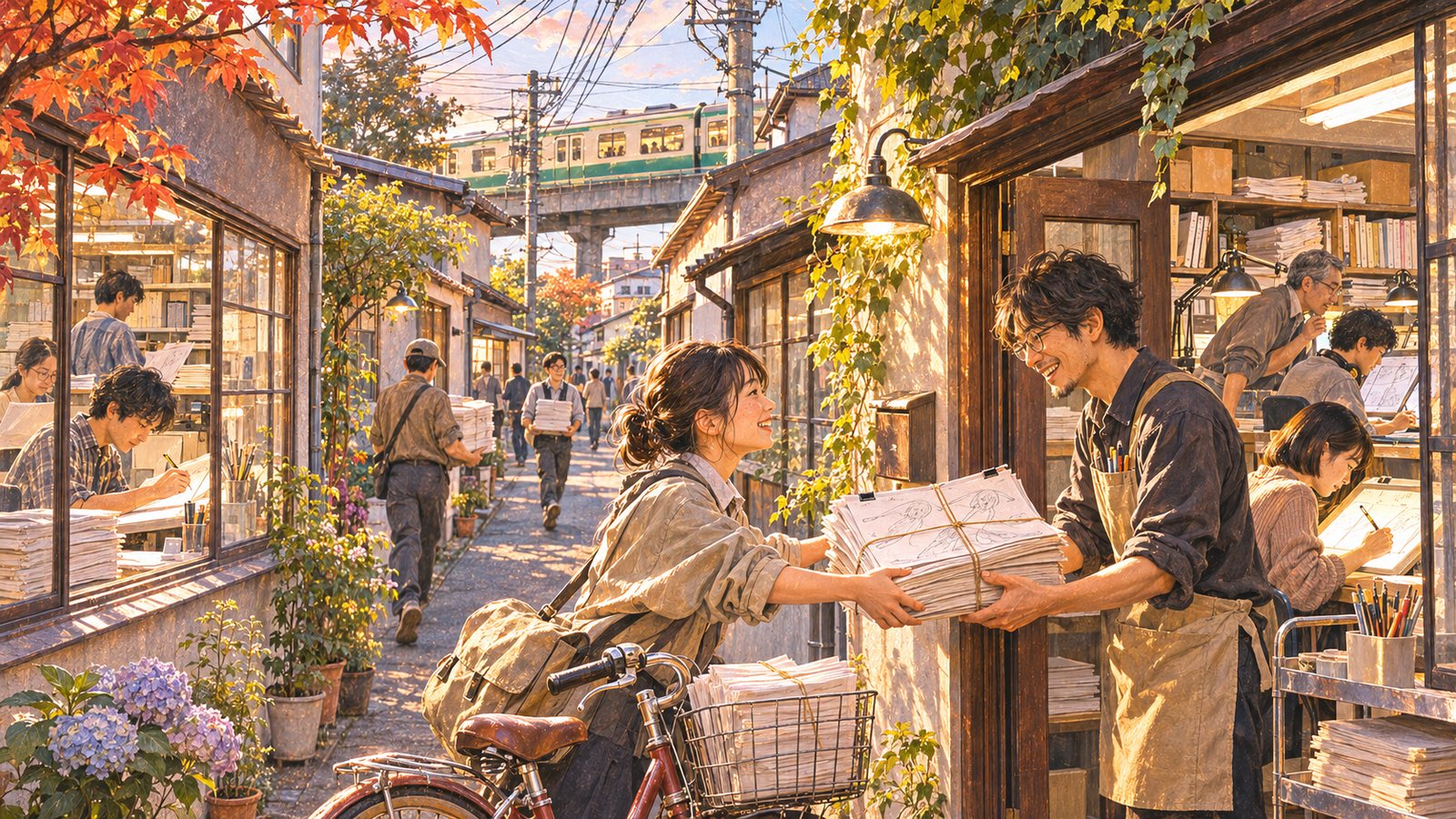
In Japan, a single shot of a TV anime may have been finished by a key animator in their own apartment in the middle of the night. It is a stack of pencil drawings, with holes punched along the top edge to keep each sheet in position. Before dawn, it has to reach another company, where someone fills in the in-between movements. After that it goes to yet another company for coloring, and another for filming.
Before the internet was everywhere, that stack of paper could not be “sent.” Someone had to carry it.
How much did that journey matter? One number shows it. In 2020 Japan had 811 anime production companies, and 692 of them had their head offices in Tokyo, more than 85%. Even more concentrated is Suginami Ward in western Tokyo: 149 companies, the most of any municipality in Japan. That means nearly a fifth of the country’s anime studios are packed into a residential ward of only about 34 square kilometers. Nerima Ward, its neighbor to the north, has another 103.
Tokyo is huge, so why these two wards? The answer starts with a film studio on farmland.
How many companies does one episode pass through? A map of anime studios is a relay route
First, one point to clear up: not every “anime studio” here makes a whole work from start to finish the way Studio Ghibli does. In a 2016 survey of 622 anime-related companies nationwide, only 141 were “prime contractors” responsible for entire productions. Most of the rest specialize in one step of the process, such as in-between animation, coloring, backgrounds or 3D computer animation.
The drawings for one TV episode flow between several companies. Key animators draw the key poses, in-between animators fill in the continuous motion, and then the work goes to coloring, backgrounds and filming. If any stage gets stuck, everything after it is delayed.
Mark these relay companies on a map of Tokyo and they line up along three train lines: the Seibu Ikebukuro Line running west from Ikebukuro, the Seibu Shinjuku Line running northwest from Shinjuku, and the JR Chuo Line heading straight west from Shinjuku. Suginami and Nerima lie between these three lines.
Cheap rent and quiet surroundings may have helped, but many places in western Tokyo’s suburbs fit that description. What really led the anime industry here was where two companies chose to settle.
It all started at a film studio in Nerima: why did Toei build its animation studio in Oizumi?
In 1935 the film company Shinko Kinema built a film studio in Higashi-Oizumi, Nerima, then still farmland. It was part of a prewar trend of film companies moving their studios to the suburbs. After the war the studio changed hands several times, and in 1951 it became the Tokyo studio of the newly formed Toei Company, which still operates there today.
In July 1956, Toei bought a small animation company, Nichido Eiga, and renamed it Toei Doga (today’s Toei Animation), aiming to become “the Disney of the East.” It came with only 23 animators. The following January, Toei Doga’s production facility moved from Shinjuku to Higashi-Oizumi, where Toei’s own film studio was.
The reason for choosing this spot can reasonably be guessed. Toei already had land, filming equipment and people who knew filmmaking in Oizumi, and animation is, in the end, a kind of film: it has to be shot, the film developed and edited. Placing it next to the film studio was simplest.
In October 1958, Toei Doga finished The Tale of the White Serpent in Oizumi, Japan’s first full-length color animated film. From then through Dragon Ball and Pretty Cure, Toei Animation’s production base has stayed in Oizumi-gakuen. The first seed of Japan’s anime industry was planted on the Seibu Ikebukuro Line.
Osamu Tezuka set up three stops away, and Astro Boy turned anime into a weekly delivery
The second seed was close by.
The manga artist Osamu Tezuka had worked with Toei Doga, and his assistants were also sent to help with Toei’s productions. In 1961 Tezuka founded his own animation studio in Yahara-cho, Nerima (today’s Fujimidai), which became Mushi Production. Fujimidai is on the same Seibu Ikebukuro Line as Oizumi-gakuen, three stops away.
On January 1, 1963, Mushi Production launched Astro Boy (鉄腕アトム), Japan’s first TV anime series airing weekly in 30-minute episodes. The first episode drew a 27.4% audience rating. At the time, most TV animation abroad ran about 10 minutes per episode, so delivering 30 minutes every week was an unprecedented workload. With limited staff, the team reused drawings heavily and animated only the mouths or parts of the image, a labor-saving approach known as “limited animation.”
Once Astro Boy became a hit, Tetsujin 28-go, 8 Man and Toei Doga’s own first TV series, Wolf Boy Ken, all appeared within the same year. TV stations needed something to air on schedule every week, and the anime industry went from “one film every few years” to “one episode every week.”
With an episode due every week, it was hard to do all the work inside one company. Small companies specializing in coloring, backgrounds or filming began to spring up to take on work the big studios farmed out. After Toei Doga, Mushi Production and Tokyo Movie settled in Nerima and Suginami in the 1960s, the small and mid-sized companies taking their work gathered nearby.
Why did they have to be nearby? Because what moved between them was physical.
How do you deliver a key frame? The map drawn by “production assistants”
Anime studios have a job called seisaku shinko, or production assistant, usually a newcomer’s first job in the industry. It includes managing schedules, finding key animators, collecting and checking layouts and key frames, sending out in-between work, and managing coloring and filming. Put simply, the job is to make sure every drawing moves from one person’s hands to the next on time.
In the paper era, much of this job was on the road. Key animators were mostly freelancers paid per piece who drew at home, so production assistants went to their homes to collect the work. Finished in-between drawings went to a coloring company, finished cels (drawings traced onto clear sheets and then painted) went to filming, and exposed film went to be developed. The industry calls chasing animators for their drawings “chasing pages.” If one stage was half a day late, the whole episode’s air date could be at risk. Even today, some studios list a driver’s license as a requirement when hiring production assistants.
Under these conditions, distance was time. A coloring company near Oizumi or Fujimidai could collect, return and fix work far faster, and key animators living nearby were more likely to get rush jobs.
The band of studios along the train lines is roughly the area a production assistant could cover in one night.
People who left didn’t go far: from Madhouse in Asagaya to Gundam in Kami-Igusa
Two forces spread the cluster from Nerima into Suginami. The first was that new companies also moved toward the area. In 1962 Tatsunoko Production set up its studio in Takanodai near Kokubunji on the Chuo Line. In 1964 Tokyo Movie (today’s TMS) was founded in Minami-Asagaya on the Chuo Line. It went on to make Star of the Giants and Tensai Bakabon, and in 1979 produced Lupin III: The Castle of Cagliostro, Hayao Miyazaki’s first feature as director. It is widely seen as the starting point of the Chuo Line anime cluster. In 1970 its subsidiary specializing in animation was set up in Ogikubo.
The second force was people going independent. Most anime companies in Suginami and Nerima were spun off by people from their previous employers, and specialist small studios are often founded by individuals. That makes sense. An animator who learned the craft at a big studio has, as their most valuable assets, the colleagues, partners and clients who know the quality of their work, and these people are all nearby. Opening a new company in the same neighborhood means losing neither clients nor staff.
Mushi Production’s people left in waves like this to start their own businesses. In 1972, former Mushi Production members founded Madhouse in Asagaya, which later made The Girl Who Leapt Through Time. The same year, another group of former Mushi Production members founded Sunrise, which launched Mobile Suit Gundam in 1979 and for many years had its head office in Kami-Igusa on the Seibu Shinjuku Line. By the time Mushi Production went bankrupt in 1973, its alumni had already opened new companies in Suginami.
At this point a question may arise: once companies grew, why not move somewhere with cheaper rent? Because for an anime studio, the most important asset is not the office but the network of people around it. Moving far away would mean leaving the familiar freelancers, subcontractors and peers who can step in at any moment. Subcontracting in anime often has very short deadlines and contracts are not always put in writing. It works because of trust between companies in each other’s skills and in paying on time, plus a labor market that keeps supplying skilled people and vocational schools that train newcomers. None of this can be taken along.
Key frames can be sent online now, so why did Sunrise move into Ogikubo?
If delivery distance started the cluster, digitization should have loosened it. To some extent it has. Cels disappeared long ago, more and more drawing and coloring is done on computers, and files can be sent straight overseas. Many new 3D computer animation companies have chosen sub-centers such as Shibuya, which had 52 anime production companies in 2020, behind only Suginami and Nerima. Toei Animation has also set up a new production base in Osaka.
But movement in the other direction is happening too. In December 2021, Sunrise, creator of the Gundam series (today’s Bandai Namco Filmworks), moved its head office from Kami-Igusa to Ogikubo on the Chuo Line. The new base was named “White Base,” after the warship the hero rides in Mobile Suit Gundam. The building brings together three Bandai Namco group companies and the Gundam business division, and runs a one-year animation school where working professionals teach aspiring animators. The Ogikubo area now has more than 15 anime studios.
How dense is the industry here? Along the Chuo and Seibu lines, people in the business remind each other not to talk about unannounced projects in public, because the person next to you may well be in the industry too.
The move from Kami-Igusa to Ogikubo shows that what keeps anime companies in this area is no longer just the delivery route. It is a group of people who know each other, who know who draws well and who delivers on time, along with the training paths that bring newcomers into the industry. Digitization lets drawings travel anywhere, but these relationships are much harder to send along with them.
Walk through the anime towns and you see a relay route
Suginami Ward recognized this early. In 2000 the ward office proposed the “Anime no Mori Suginami” (Anime Forest Suginami) plan, positioning anime as a local industry, the first local government in Japan to promote the anime business. In March 2005 the Suginami Animation Museum opened on the third floor of the Suginami Kaikan north of Ogikubo, described as Japan’s first museum covering the whole history of animation. It explains anime history and how anime is made, and visitors can even step up to a microphone and try voicing a character.
Heading north along the Seibu Shinjuku Line, a Gundam monument stands in front of Kami-Igusa Station. Proposed by residents in 2008 and made in cooperation with Sunrise, it is maintained by the local shopping street, and nearby schoolchildren volunteer to clean it once a month. Further north at Oizumi-gakuen Station on the Seibu Ikebukuro Line, the pedestrian bridge at the north exit has the “Oizumi Anime Gate,” shaped like a strip of film, with characters from Astro Boy, Galaxy Express 999, Tomorrow’s Joe and Urusei Yatsura standing on it.
Interestingly, Astro Boy was not made by Toei Animation. It came from Mushi Production, three stops away. By placing Astro Boy at the station by Toei’s studio, Nerima effectively counts the two seeds as one family history. Judging by the geography of the anime industry, that is exactly right.
These places look like ordinary residential neighborhoods, with shopping streets, apartments and commuting office workers. But walking these streets means walking the routes production assistants have used for decades to collect and deliver drawings. Japanese anime has kept its quality under the pressure of weekly broadcasts not because of one genius studio, but because of a group of people living close enough to take over the work at any moment. The anime towns of Suginami and Nerima are the track this relay race has left behind.
Notes
- Company counts come from the location survey in the Association of Japanese Animations’ Anime Industry Report. Suginami’s 149, Nerima’s 103, Tokyo’s 692 and the national 811 are 2020 data (published in the 2021 and 2023 reports); the 622 companies and 141 prime contractors are from the 2016 report. The figures include companies specializing in a single step and exclude sound production companies.
- Public sources do not state clearly why Toei Doga chose Oizumi; “placing it next to the film studio was simplest” is an inference based on the location of Toei’s Tokyo studio.
Sources
- 杉並區|アニメのまち杉並(區市町村別動畫公司數、杉並動畫博物館、上井草鋼彈紀念像、Sunrise 遷址荻窪)
- 杉並區|杉並區のアニメ産業について
- 三井住友トラスト不動產|このまちアーカイブス 荻窪:アニメのまち(東京 Movie 1964 年阿佐谷、Madhouse 1972 年、荻窪作畫公司 1970 年、博物館沿革)
- 三井住友トラスト不動產|このまちアーカイブス 石神井:東映東京撮影所(1935 年新興電影片廠、1951 年東映)
- Real Sound|荻窪、三鷹、吉祥寺、中野……アニメ制作会社が特定のエリアに集中した背景は?|2024 年 4 月
- 東洋經濟 Online|アニメ制作会社の立地調査(2016 年 622 家、杉並 138 家、練馬 103 家、三條電車線分布)
- 社史データベース|東映アニメーション:1956 年日動映畫收購(23 名動畫師、1957 年遷往東大泉、1958 年《白蛇傳》)
- 練馬區|ねりまキッズ:アニメのまち練馬(東映動畫、《原子小金剛》)
- 練馬區|「アトムが飛んだ」展報道資料(1961 年谷原町成立工作室)
- 電氣學會|でんきの礎:鉄腕アトム(1963 年 1 月 1 日首播、每週 30 分鐘)
- nippon.com|鉄腕アトムとテレビアニメの誕生(收視率 27.4%、有限動畫、1963 年後續作品)
- 內閣府|地域経済レポート:集積メリットの活用を模索する各地の実例(杉並動畫產業)
- 勞動政策研究・研修機構|アニメーション産業の現状と課題(2005,杉並與練馬公司訪查); 訪查資料
- 山本健太|東京におけるアニメーション産業集積の構造と変容|地理學評論 80 卷 7 號|2007
- GIGAZINE|日本動画協会が制作進行のマニュアルを無料公開|2020 年 8 月 13 日
- gamebiz|アニメ制作会社の制作進行求人(素材回收運搬、汽車駕照條件)
- 東京電視台|アド街ック天国 荻窪(白色基地、作畫塾、荻窪 15 家以上工作室)|2024 年 2 月 17 日
- Manga Wiki|Sunrise (company)(1972 年由前蟲製作成員創立)
- ルルブ キッズ|東京工芸大学 杉並アニメーションミュージアム(杉並會館三樓、配音體驗、免費入館)
- All About|西武池袋線「大泉学園駅」には何がある?(大泉動畫之門)
- gamebiz|東映アニメ、新たな制作拠点として「大阪スタジオ」設立
Follow the story in person
Join a small-group trip to the places in our stories and meet the people who live and work there.
See trips and dates
Water Mirror is a Tokyo-based company that helps more people step inside industries and explore the stories and cultures of different fields around the world. We design in-depth learning programs for individuals, companies, schools and organizations, combining company visits, exchanges with professionals, local learning and hands-on experiences, so participants can see how industries really work and meet the people and stories behind them. Water Mirror Perspectives is our content media, telling the distinctive stories of industries, local cultures and people, so that reading sparks curiosity and leads readers to go and see for themselves.
About Water Mirror →