Key Points
- Before a funeral, an encoffiner (nokanshi) washes the body, dresses it, applies makeup and places it in the coffin. The dressing is done entirely under a cloth, and families are often invited to take part.
- Akiko Omori became an encoffiner at 38 and has sent off more than 4,000 people in over a decade. She also trained in grief care, and believes farewell rituals are what the people left behind need in order to go on living.
- The job was once called “a disgrace to the family,” but it gained recognition through the memoir Nokanfu Nikki and the film Departures, which won the Academy Award for Best Foreign Language Film in 2009. A dedicated training academy opened in 2013.
- People who face death every day are no less afraid of it. What they know better is what “too late” looks like, so they say thank you early and say goodbye early.
In a room holding three refrigerated units for bodies, a woman in her thirties and her four-year-old daughter sat eating rice balls from a convenience store. Before the wake and funeral, bodies are kept in places like this. Her husband had been in a motorcycle accident a few days earlier. His face showed only a scrape on one cheek and a bruise on his chin.
The encoffiner, Akiko Omori, asked her whether she wanted to watch the makeup being done or wait outside first. The woman smiled and said, “Please, go ahead. Make him look handsome.” Her daughter told her father, “Daddy, you’re hopeless,” in the tone you’d use with someone still alive.
The funeral company staff thought it was strange that the woman kept smiling the whole time. Omori didn’t judge. After more than ten years in the job and over 4,000 farewells, she knew that the reactions of people who suddenly lose someone are often misread by outsiders.
Do people who face death every day understand better than the rest of us how to live? To answer that, we first need to understand what Omori does every day, and then return to the woman who kept smiling.
Changing the dead under a cloth: what does an encoffiner do?
Funerals in Japan are usually organized by a funeral company and come in two parts. The tsuya, or wake, is held the night before the funeral, when family and friends gather to spend a last night beside the deceased. The kokubetsushiki, the funeral the next day, is the formal farewell, after which the body is cremated.
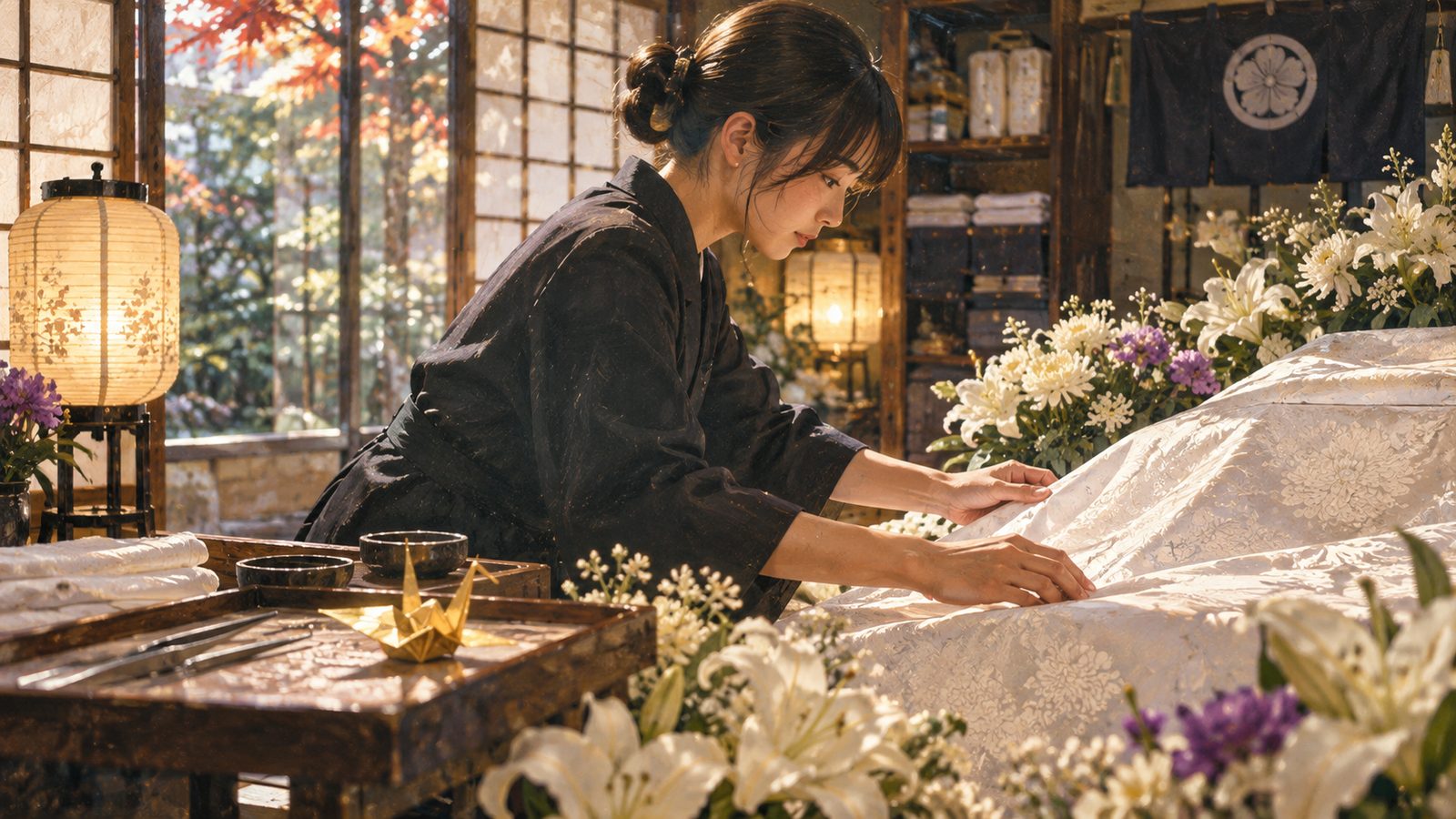
The encoffiner handles a more specialized part of this. They do one thing: help the deceased enter the coffin looking fit for a farewell. In practice, that means washing the body, dressing it, applying makeup, and finally placing the person in the coffin together with the family.
After death the joints stiffen, so an encoffiner first has to gently loosen the arms before the clothes can be changed. The traditional burial garment is a white robe cut like a kimono, though many families now choose to dress the deceased in clothes they loved in life. The changing is done entirely under a cloth, so the family never has to see the body exposed. The purpose of the makeup is to bring the face’s color close to how the person looked in life.
Families are often invited to help. For example, they may use cotton dampened with water to gently moisten the lips of the deceased, a gesture meant to give the person one last sip of water before the journey. A single encoffining takes about an hour, during which the body must be lifted and steadied again and again. Some encoffiners do three in a day.
Omori works for NK Higashi Nihon, a company in the Tokyo area that specializes in encoffining. New hires go through about six months of training, taking turns lying down to play the deceased while practicing dressing someone under a cloth. The instructor who drills them over and over is Omori herself.
No one ever taught her how to say goodbye
Omori was born in 1970 and worked in sales until she was 38. Back then, death felt very far away. She loved her father dearly, but after marrying and leaving her hometown she rarely went back. When her mother told her how long her father had left to live, she deliberately avoided facing it.
Looking back on that time, she said: “Death is sure to come, yet no one ever taught us how to say goodbye to the people who matter to us.”
At 38, she changed careers and became an encoffiner. Besides the hands-on skills, she also trained in grief care, a profession devoted to supporting the bereaved. It teaches you to understand the many ways people react after losing someone, including sometimes smiling nonstop like that woman, and how to support them from the side rather than rushing them to “get over it.”
That choice reveals how Omori understands her work: encoffining isn’t just about handling the dead. It’s about accompanying the living through their farewell.
A job once called “a disgrace to the family”
This work hasn’t always been respected in Japan.
In the 1970s, Shinmon Aoki was in charge of placing the dead in their coffins at a funeral cooperative in Toyama Prefecture. An uncle he hadn’t seen in more than ten years came forward to object, calling the job “a disgrace to the family” and threatening to cut ties unless he quit. Aoki wrote about these experiences in Nokanfu Nikki, published in 1993 (later translated into English as Coffin Man). The actor Masahiro Motoki read the book and felt the job was “very cinematic,” and that became the starting point for the film Departures. In 2009, Departures won the Academy Award for Best Foreign Language Film, and encoffining, something Japanese people usually avoid talking about, was suddenly seen by the whole world.
In the past, the craft of encoffining was mostly passed down from master to apprentice. The apprentice watched the master and copied what they did, with no set teaching materials. In 2013, Koki Kimura, son of the encoffiner Shinji Kimura who served as technical advisor on Departures, founded the Okuribito Academy, turning a craft passed on by word of mouth into a curriculum. Omori also teaches there. A job once seen as a family disgrace has, step by step, become a profession that can be taught and learned.
“I tried so hard, didn’t I?” The first time she cried, beneath her husband’s palm
Back to the room with the refrigerated units.
For the next four days, the woman came every day with her daughter, always timing her visits to when Omori came to replace the dry ice. In the days before a funeral, the body is kept cold with dry ice, and the encoffiner comes regularly to change it.
Bit by bit, the woman explained her situation. Her husband’s job meant frequent transfers, and she had no one to lean on in this city. She felt she had to hold it together for her daughter, and was afraid that if she stopped smiling, she would fall apart completely. The smiling, it turned out, was how she held herself up. As Omori listened, her eyes reddened, and the woman laughed instead: “Why is the encoffiner crying?”
On the day of the wake, the woman asked Omori to come with her to her husband’s side, and made a request. She wanted her husband to stroke her head and praise her, the way he used to.
His arms had already stiffened. Omori gently massaged the joints and slowly opened his hand. The woman rested her head beneath her husband’s palm and, for the first time, cried quietly. She said again and again that she had tried so hard. Beside her, Omori could only nod.
About two weeks later, the funeral company asked Omori to stop by. The woman and her daughter were waiting there. The daughter hung a gold medal made of folded origami paper around Omori’s neck, thanked her for making Daddy look nice, and reached up to stroke her head.
It was exactly how Daddy used to stroke Mommy’s head.
An encoffining usually lasts only about an hour, and families rarely come back afterward specifically to say thank you. Omori says this experience made her even more determined to keep going.
One sentence that lets the family come closer
There isn’t always a gold medal. More often, what Omori does is something small that makes the family feel able to come closer.
She has written about another family. A father who had made tatami mats his whole life died suddenly, and at first his family hesitated to approach the body. Many people are like this: once a loved one becomes a body, they suddenly feel like a stranger, and you don’t know whether you’re allowed to touch them or talk to them. While washing the old man, Omori noticed his fingers were dark and hardened, and said one thing: “This is the proof of all those years making tatami.”
Only then did the family gather around one by one, stroking their father’s hands and talking. One said, “It’s cold, but it’s Dad’s hand.” One complained that they’d told him long ago to wear gloves to protect his hands. Another noticed that the fingers on these hands looked exactly like their eldest brother’s.
Skill makes the body something the family can look at. One sentence lets the family come closer. The rest of the farewell, the family completes themselves. That’s why Omori believes a farewell ritual is “a ritual the people left behind need in order to keep on living.”
Those words carry special weight in Japan today. In 2024, more than 1.6 million people died in Japan, the most since records began. Yet “family funerals” attended only by close relatives have become the norm, and “direct cremation,” with no wake or funeral at all, is increasingly common. More and more people are dying, while the living have less and less time to say goodbye properly.
Facing death every day doesn’t mean making peace with it
Having read this far, it’s tempting to reach a warm conclusion: see enough of it, and you naturally come to terms with it. But it isn’t that simple.
In a study in the United States based on interviews with funeral workers, nearly all said their on-call schedules were taking a toll on their health, and some said that in this line of work, “we’re not supposed to ask for help.” Facing death every day is first of all heavy labor, not a free lesson in life.
Omori herself hasn’t gone numb. Her eyes still redden in front of families, and she keeps a notebook recording every farewell so she can remember each person. Koki Kimura once dressed a one-year-old child who had died suddenly. Every case is completely different, he says, but an encoffiner has to treat each one with the same “weight.” True professionalism isn’t getting used to death. It’s never getting used to it, every single time.
After 4,000 farewells, what she learned is to say thank you early
So after more than 4,000 farewells, what has Omori learned?
Before she started this work, she says, death felt very far away. Now she feels that “life and death are like the two sides of a card, and you never know when it will flip.” This isn’t making light of death. It’s knowing more clearly that the card won’t warn you before it flips.
She has carried this understanding beyond the encoffining room. In 2021, she published her first book, Saigo ni “Arigato” to Ieta Nara (If Only I Could Have Said “Thank You” at the End), a title that is itself the regret of many bereaved families. In 2025, she founded a nonprofit that runs grief-support workshops for people in medicine, caregiving and the funeral industry, as well as the general public.
So, do people who face death every day understand better than we do how to live? My answer is yes, but not in the way we imagine. They’re no less afraid of death, and often their lives are harder than ours. What they truly understand better is what “too late” looks like: children who didn’t thank a parent in time, families who never got to say a proper goodbye, and a wife who had to wait until her husband’s hand had already stiffened before he could stroke her head one more time.
After seeing that many “too lates,” it becomes hard to save what you need to say until the very end. That is what they know about living that we don’t: not making light of death, but saying goodbye early. While the hands are still warm, give the tenderness you mean to give.
Notes
- “More than ten years” is estimated from her entering the profession at 38 and publishing the account of the refrigerated room in 2021.
- The study of funeral workers is a small interview study of 14 workers in Wisconsin, USA, and can’t be taken to represent Japanese encoffiners directly. It’s cited here to illustrate the physical and emotional burden of the work.
References
- 大森あきこ|〈喪主なのにずっと笑顔、女性と4歳娘の悲しい理由〉(3 pages)|Toyo Keizai Online|2021-12-07 (the refrigerated room, the four days, the request to have her head stroked, the origami gold medal, the notebook)
- 大森あきこ|Toyo Keizai Online column, reprinted|Shukan Josei PRIME|2021-12-25 (changing careers at 38, her father’s prognosis, the tatami maker’s family, life and death as two sides of a card, rituals exist for those left behind, instructor at NK Higashi Nihon and the Okuribito Academy, grief care)
- 葬祭ジョブ|〈NK東日本の研修会に潜入取材してみた!〉|2022-07-01 (new-hire training, dressing under a cloth, up to three a day, Omori as instructor)
- ミツモア|〈通夜前に行う「納棺の儀」とは?〉|2024-06-28 (the encoffining ritual, moistening the lips, burial robes and makeup)
- 新潮社|『最後に「ありがとう」と言えたなら』book page (her first book)
- Shinchosha press release (via 公募ガイド)|『いつもの場所に今もあなたがいるようで』|2026-02-18 (Omori’s birth year, founding the nonprofit in 2025)
- 半田拓也|〈ソール・ベロー序論―死生観と『おくりびと』を中心に(Ⅰ)〉|Fukuoka University Review of Literature & Humanities, Vol. 42, No. 1 (how Shinmon Aoki entered the work, his uncle’s objection, publication of Nokanfu Nikki)
- シネマトゥデイ|〈『おくりびと』本木雅弘 単独インタビュー〉|2008-09-11 (Masahiro Motoki reading Nokanfu Nikki)
- Wikipedia|Departures (2008 film)>) (the film’s awards)
- 社長名鑑|木村光希 profile (his father as technical advisor on Departures, founding the Okuribito Academy in 2013, reforming the apprenticeship system)
- 木村光希|〈あたらしい「お別れの場」をつくりだした30代若き納棺師の死生観〉|PRESIDENT WOMAN Online|2020-12-22 (encoffining a one-year-old, “the same weight”)
- Ministry of Health, Labour and Welfare|令和6年(2024)人口動態統計月報年計(概数)の概況 (deaths in 2024)
- nippon.com|〈葬儀社の倒産、過去最多 「格安」に苦戦〉 (family funerals becoming the norm)
- Monroe P, et al.|Helping the helpers: mental wellbeing of the funeral professional|Frontiers in Public Health|2025-12-11 (interview study of U.S. funeral workers)
Follow the story in person
Join a small-group trip to the places in our stories and meet the people who live and work there.
See trips and dates
Water Mirror is a Tokyo-based company that helps more people step inside industries and explore the stories and cultures of different fields around the world. We design in-depth learning programs for individuals, companies, schools and organizations, combining company visits, exchanges with professionals, local learning and hands-on experiences, so participants can see how industries really work and meet the people and stories behind them. Water Mirror Perspectives is our content media, telling the distinctive stories of industries, local cultures and people, so that reading sparks curiosity and leads readers to go and see for themselves.
About Water Mirror →