Key Points
- Naoshima is a small island in Japan’s Seto Inland Sea. In the south are art sites such as the Chichu Art Museum and Yayoi Kusama’s pumpkin, drawing about 750,000 visitors a year. In the north, a Mitsubishi copper smelter has operated since 1917 and produces about 40 tons of gold a year.
- The islanders themselves invited the smelter in 1916. It brought jobs and tax revenue, and also stripped the hills bare for a time with its fumes.
- In 1960, Mayor Miyake divided the island into three zones: industry in the north, daily life in the center, culture and tourism in the south. In the late 1980s, the Fukutake father and son of Benesse took on the south and asked Tadao Ando to design a museum.
- The Art House Project, begun in 1998, brought art into old houses in Honmura village, with residents taking part in the work. Art didn’t replace industry. It was deliberately placed beside it.
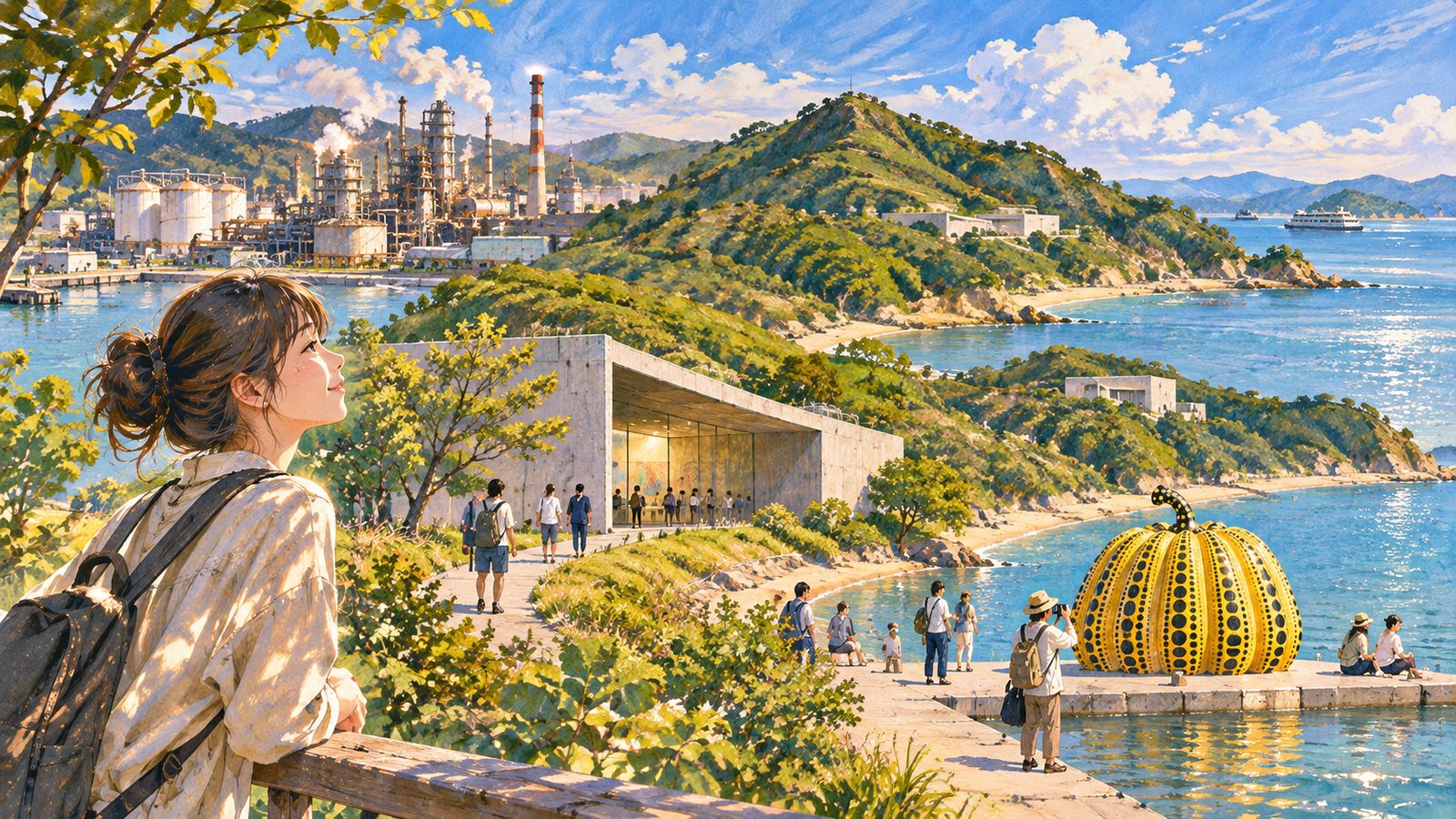
Take the ferry from Takamatsu port in Kagawa Prefecture, and in about fifty minutes you arrive at Naoshima’s Miyanoura port. The big red pumpkin with black dots by the pier is a work by Yayoi Kusama, and many people’s first act on landing is to queue for a photo with it before catching a bus to the south of the island. The Chichu Art Museum and the Lee Ufan Museum are there, and Monet’s Water Lilies are housed underground beneath a hill at the island’s southern tip.
Few people look north. At Naoshima’s northwestern tip is a copper smelter run by Mitsubishi Materials. It opened in 1917 and is still running, now producing about 40 tons of gold a year, more than anywhere else in Japan. On the slopes behind the plant, some patches are still bare rock and soil, the scars of a century of smelter fumes.
A small island of just 14 square kilometers with fewer than 3,000 residents: at one end it refines gold, at the other it hosts world-class museums. The common story is that “art saved a polluted island,” but that story has a hole in it: the factory has always been there and was never driven out. So how did these two faces end up on the same island? The answer begins with a zoning map drawn in 1960.
The islanders themselves invited the smelter
Naoshima’s soil is mostly sand weathered from granite, poorly suited to farming. By the 1910s, the island’s farming and fishing were in decline, the village budget was in deficit, and the surplus population couldn’t find work.
At just that moment, Mitsubishi was looking for a site for a new copper smelter. It’s worth explaining here why copper smelting harms the environment. The copper in copper ore is usually bound with sulfur, and to extract the copper, the sulfur has to be burned off at high temperatures. The burned sulfur becomes sulfur dioxide and goes out through the smokestack into the air. The gas withers plant leaves and turns to acid in rainwater. In Japan this kind of damage is called engai, “smoke damage.” So smelters at the time were often built on islands to keep the fumes away from people, and islands in the Seto Inland Sea had the added advantage of easy shipping.
In 1916, the Naoshima village council voted to invite the smelter to set up on the north of the island, hoping to solve its budget and employment problems.
The factory brought tax revenue and jobs, and Naoshima quickly became wealthier than the surrounding islands. It also brought smoke damage: the island’s forests were at one point scorched into bare ground, with the north hit hardest. Tree planting began after the Second World War and many areas slowly turned green again, but some northern slopes never recovered, because the soil had changed and saplings planted there wouldn’t survive.
In 1959, Naoshima’s population reached its all-time peak of 7,842. That same year, the island elected a new mayor.
A mayor cut the island into three
The mayor was Miyake. When he took office, Naoshima’s economy depended almost entirely on one factory: when the factory did well, so did the island; when the factory cut back, the island shrank with it.
In 1960, Miyake put forward a zoning plan. The north would be an industrial zone, with the smelter as its economic base. The center would be for residents’ daily life and education. The south would develop tourism using its natural scenery, history and culture. In his policy statement he wrote: the economy must be the foundation that supports people living cultured lives, not the sole goal of development.
He started with the middle zone, entrusting the design of the elementary school, gymnasium and town hall to a young architect, Kazuhiro Ishii. The town hall, completed in 1983, was modeled on the Hiunkaku, an ancient pavilion in Kyoto designated a National Treasure. A town hall on a small island that looked like a temple pavilion was a bold move for its time.
The south didn’t go so smoothly. The town invited the major tourism company Fujita Kanko to set up there, but the south lay within a national park, development was restricted by law, and the business never took off. In 1987, Fujita Kanko pulled out of Naoshima.
Around the same time, the factory in the north finished modernizing its equipment and needed fewer and fewer workers, and the island’s population fell along with it. On the map Miyake had drawn, the north was holding on, but the south had stood empty for more than twenty years.
A father’s children’s camp he never got to finish
In 1985, Miyake met Tetsuhiko Fukutake, founder of Fukutake Publishing, an educational publisher in Okayama that later became Benesse. Fukutake had long dreamed of finding a place in the Seto Inland Sea where children from around the world could gather. Miyake wanted to build a cultural and educational zone in southern Naoshima. Their ideas fit.
But Tetsuhiko didn’t live to see it begin. He died suddenly in 1986, and his 40-year-old son, Soichiro Fukutake, came back from Tokyo to Okayama to take over the company, and the plan along with it. In 1987, Fukutake Publishing bought up large tracts of land in southern Naoshima from Fujita Kanko and others. What the Fukutakes took on was precisely the south of that zoning map, empty for more than twenty years.
The following year, Soichiro invited the architect Tadao Ando to the island. Ando later wrote that when he first arrived and saw how desolate the depopulated island looked, he blurted out: a museum, in a place like this? Soichiro didn’t back down. He said: the economy is the servant of culture. Those words meant almost exactly what Miyake had written in his policy statement more than twenty years earlier.
In 1989, the Naoshima International Camp designed by Ando opened, finally realizing the camp Tetsuhiko had wanted to give children. In 1992, Benesse House, combining a hotel and a museum, opened in the south.
The museum was built, but islanders weren’t impressed
To many islanders, Benesse House was just an upscale hotel transplanted from the city, built at the southern tip far from the villages. The beach in front of the hotel was even designated private, and residents who had been used to swimming and walking there suddenly couldn’t go. Benesse later changed its approach and let residents pass freely, but relations were still far from close.
Over the next few years, the art program gradually changed direction. In 1994, Yayoi Kusama’s yellow pumpkin was left on a pier on the southern shore, later becoming Naoshima’s most famous sight. From 1996, the program began embracing site-specific art: rather than shipping in existing works to display, it invited artists to the island to create works that belonged only to a particular place, based on its history, terrain and light.
That direction eventually carried art out of the south and into the places where islanders lived.
125 islanders each set the speed of a light
Honmura, in central Naoshima, is the island’s oldest settlement. The village had a house called Kadoya, more than two hundred years old, which had stood empty for years and was growing more dilapidated. Neighbors worried it might collapse and raised it with the town hall, which asked Benesse for help with repairs. Benesse decided to restore the old house and then ask the contemporary artist Tatsuo Miyajima to turn it into an artwork.
Miyajima filled the inside of the house with a shallow pool of water and placed 125 LED digital counters in it, each counting from 1 to 9 and then starting over. What made it special was that the speed of each counter was set by a Naoshima resident. In 1998, 125 residents took part. Some chose fast speeds, some slow, and each received a certificate bearing their name and the position of their counter.
The residents who took part were proud to have become part of an artwork, and some began thinking about the village’s future. It was the first time Naoshima’s art truly took up residence in the village.
That was how the Art House Project began: turning Honmura’s empty houses and disused temples and shrines, one by one, into art spaces. In 2001, the textile artist Yoko Kano visited homes in Honmura, listened to each household’s story, and designed a noren curtain just for them to hang at the entrance. The effort was later taken over by a committee of residents themselves, and so many people wanted noren that the subsidies often ran short. Ando observed that the islanders, once somewhat closed toward outsiders, became proud of their home again after the Art House Project and started running guesthouses and cafés.
After art arrived, the smelter became more important, not less
Art came, but the smelter didn’t leave.
In 1991, Naoshima started up new smelting equipment developed by Mitsubishi, linking several furnaces with covered launders so sulfur dioxide no longer escaped. Today it’s captured and turned into sulfuric acid for industry.
In 2000, the town of Naoshima made a decision many didn’t see coming. On the neighboring island of Teshima, operators had been illegally dumping huge amounts of industrial waste since the 1980s, about 940,000 tons in total, one of the largest illegal dumping cases in Japanese history. The waste had to be removed, but where would it be processed? Kagawa Prefecture proposed building a treatment facility on the grounds of Naoshima’s smelter, and the town agreed. From 2003, Teshima’s waste was shipped to Naoshima boatload by boatload and melted down at high temperatures. The last of it wasn’t shipped until 2017.
Today, the plant also recycles large volumes of circuit boards from discarded appliances and computers, extracting gold, silver and copper from them. Some of the 40 tons of gold a year mentioned at the start comes from these thrown-away electronics.
In 2004, the Chichu Art Museum opened at the southern tip. To avoid spoiling the ridgeline, Ando buried the entire museum inside the hill, letting only daylight fall in from above. On the same island, the south hides its buildings inside green hills, while the north is still working to make its bare hills green again.
750,000 visitors, 2,847 residents
In April 2026, Naoshima’s population was 2,847, only a little over a third of the 1959 peak. The town hall estimates about 750,000 visitors come to the island each year.
The boundaries on that three-zone map are blurring, too. In May 2025, the Naoshima New Museum of Art opened on a hillside in Honmura. Art no longer stays in the south. It has moved into the middle zone originally set aside for residents’ daily life. More visitors have meant new restaurants and guesthouses, and some young people have moved to the island. But housing shortages and rising land prices have become new worries.
The factory in the north is still running. For many years, nearly half the island’s residents have been employees of the plant or related companies and their families.
Art didn’t replace industry. It was placed beside it
So did art really save Naoshima?
I think the more accurate way to put it is that Naoshima made two choices over the past century. The first was in 1916, when a poor village invited in a copper smelter and got jobs in exchange, along with bare hills. The second was in 1960, when a mayor decided the island wouldn’t be left with nothing but one factory. He kept the south of the map for culture and waited more than twenty years before finding a publisher, father and son.
Art didn’t replace industry. It was deliberately placed beside it. What Naoshima looks like today isn’t a miracle. It’s what a zoning map slowly grew into over sixty years. When you step off the ferry at Miyanoura and finish your photo with the red pumpkin, take a look to the north. Over there, they’re still refining gold. This island’s art grew up next to that factory.
Notes
- Naoshima’s population: the 1959 peak of 7,842 is from Kagawa Prefecture data; 2,847 as of April 1, 2026, is from Naoshima town data. Visitor numbers are the town’s estimates.
- “About 40 tons of gold a year” comes from a 2017 Mitsubishi Materials press release; actual annual output varies by year.
- A Kagawa University study attributes the failure of trees to regrow on the northern slopes mainly to soil conditions; that smoke damage turned the forests into bare ground comes from the Britannica International Encyclopedia entry on Naoshima. The link between the two is this article’s overall judgment.
- Miyake’s policy statement was originally written in Japanese; the wording here is a translation.
References
- Cabinet Office Regional Revitalization Promotion Office|直島町地域再生計画資料 (population trends, visitor numbers)
- Kagawa Prefecture|エコアイランドなおしまプラン 1-2 直島町の概要 (1959 population peak)
- Kagawa Prefecture|エコアイランドなおしま (smelter founded 1917, Japan’s largest gold producer, Teshima waste treatment facility)
- Prefectural University of Hiroshima, Bulletin of the Faculty of Regional Development|study of community development in Naoshima (1916 village council invitation, Miyake’s 1960 three-zone plan and policy statement, Fujita Kanko, meeting Tetsuhiko Fukutake in 1985 and his death in 1986, early islander reactions to Benesse House, Kadoya and the 125 residents)
- Yoshimoto|paper on Naoshima, Japan Women’s University Graduate School Bulletin No. 29 (granite soil, smoke damage and siting, 1987 land transfer, the noren project)
- Masuda, Kagawa University|research on greening the bare hills of northern Naoshima
- Kotobank|直島 (forests once turned to bare ground by smoke damage, about half of residents connected to the plant)
- Japan Copper Development Association, Do (Copper) No. 185|profile of Mitsubishi Materials’ Naoshima Smelter (the 1991 continuous smelting process, electronic waste)
- Mitsubishi Materials|press release on the Naoshima Smelter’s 100th anniversary (40 tons of gold a year)
- Kotobank|石井和紘 (Naoshima elementary school, town hall modeled on Hiunkaku)
- Benesse Art Site Naoshima|History (1989 international camp, 1992 Benesse House, 1998 Art House Project, 2004 Chichu Art Museum)
- Bungeishunju|Tadao Ando on Naoshima (first visit in 1988, “the economy is the servant of culture,” the Art House Project and islanders)
- HK01|瀨戶內海藝術聖地是如何煉成的 (the 1994 pumpkin, site-specific art from 1996)
- Environmental Dispute Coordination Commission|豊島産業廃棄物水質汚濁被害等調停申請事件 (2000 mediation, processing on Naoshima)
- Ministry of the Environment|press release on Teshima waste processing (processing schedule)
- Finding Naoshima|Tatsuo Miyajima (the 125 LEDs)
- Tokyo Art Beat|report on the opening of the Naoshima New Museum of Art (May 2025)
Follow the story in person
Join a small-group trip to the places in our stories and meet the people who live and work there.
See trips and dates
Water Mirror is a Tokyo-based company that helps more people step inside industries and explore the stories and cultures of different fields around the world. We design in-depth learning programs for individuals, companies, schools and organizations, combining company visits, exchanges with professionals, local learning and hands-on experiences, so participants can see how industries really work and meet the people and stories behind them. Water Mirror Perspectives is our content media, telling the distinctive stories of industries, local cultures and people, so that reading sparks curiosity and leads readers to go and see for themselves.
About Water Mirror →