Key Points
- Takefu Knife Village in Echizen, Fukui Prefecture, is a shared workshop used by more than a dozen knife companies, and its forging and sharpening areas are free to visit. As of 2026, about 15 companies and more than 50 craftspeople work there.
- The local tradition of Echizen Uchihamono, hand-forged blades, goes back about 700 years. From the 1970s, stainless steel knives and cheap stamped knives took the market, and with craftsmen aging and no one to take over, many family workshops closed.
- In 1973, a group of heirs in their 20s and 30s began meeting after work to talk about a way forward. In 1982 they brought in Fukui-born designer Kazuo Kawasaki to create a shared brand. In 1993, ten founding craftsmen each took on about 30 million yen in debt to build a shared workshop with no subsidies.
- Yuji Toya, the son of one of the founders, quit his office job at 28 to come home and learn sharpening, and took over the family business in 2020. He believes every generation has to do something new for the region to survive. Today, the number of young people moving in from other prefectures to learn the craft is rising every year.
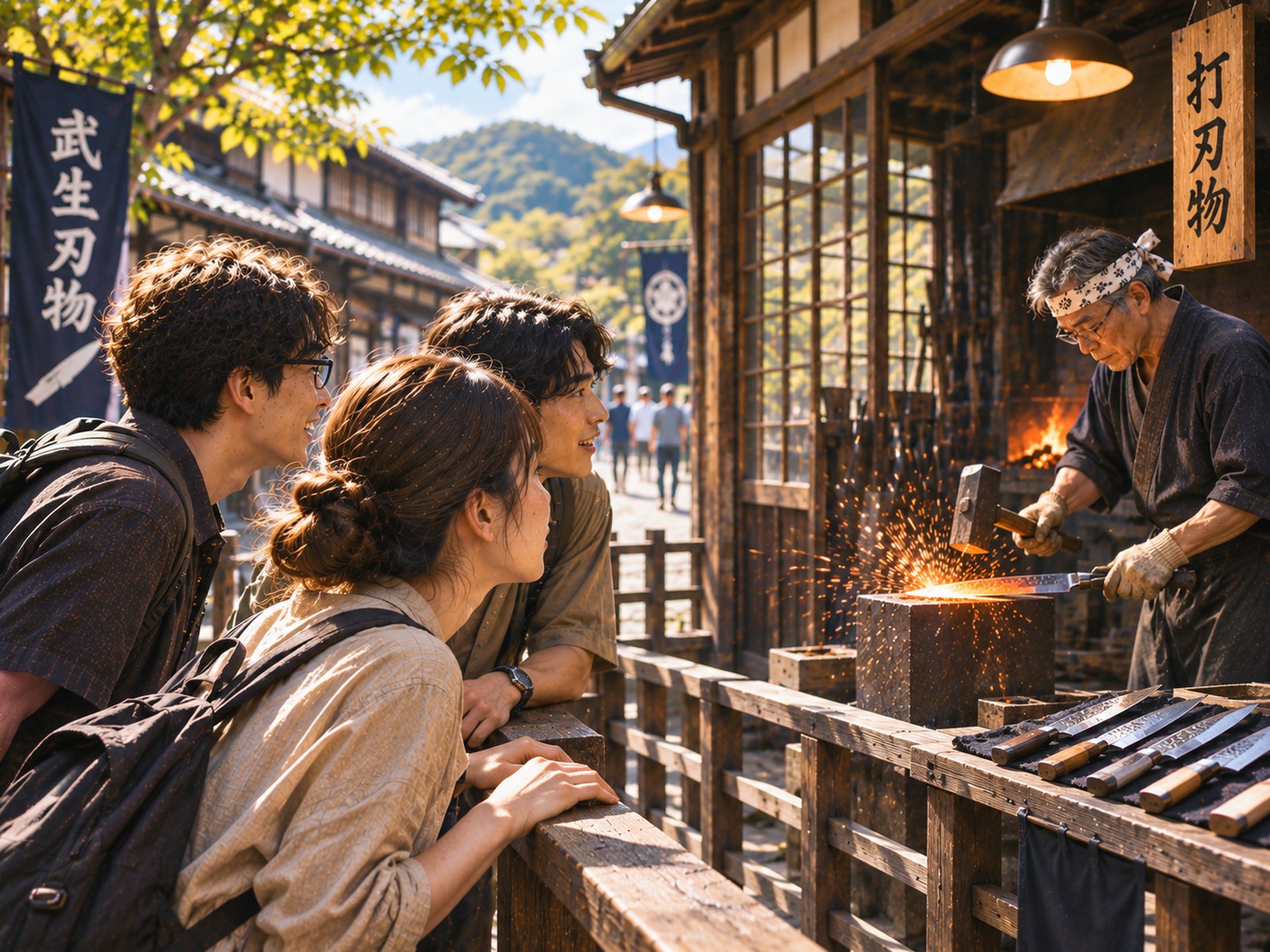
Among the fields on the outskirts of Echizen city stands a cylindrical building. Inside, a ramp spirals upward, and right beside it craftspeople are at work. Some feed glowing red steel under a power hammer; others bend over and push a blade across a whetstone again and again. Visitors don’t need a ticket or a reservation.
During two hours on one day in early 2026, the customers who came into the shop included a French couple and another group of foreign visitors. Staff here estimate that about 80% of the people who use Echizen knives are overseas.
The building is called Takefu Knife Village. “Takefu” is the former name of Echizen city, and the blade-forging families of this area have been making knives here for centuries.
Here’s what’s strange. Old-school Japanese craftsmen have never liked outsiders watching them work. Their skills are how they make a living. Yet in 1993, ten masters who ran family workshops each borrowed about 30 million yen, took not a single yen in government subsidies, closed their own workshops, and moved together into this building where strangers could watch freely.
One of them was the sharpener Toya, Yuji Toya’s father. Thirty years later, his son, sharpening blades under the same roof, said: “Our generation is just riding on the system our parents built.”
What exactly did that generation build? To answer that, we have to go back to why this town had so many blade-forging families in the first place.
Seven hundred years ago, a Kyoto swordsmith came here looking for good water
People in Echizen say the history of blade forging here begins in the 14th century. Around 1337, a Kyoto swordsmith named Chiyozuru Kuniyasu came to this area, then called Fuchu, looking for water suitable for forging swords, and settled down. Besides swords, he also forged sickles for local farmers.
The sickles matter. From the very beginning, Echizen’s blades weren’t just weapons, but tools farmers used every day. In the Edo period, the Fukui domain protected the craft, and sickles, hatchets and kitchen knives grew into a profitable local industry.
The blades made here are called “Echizen Uchihamono.” “Uchi” means striking: heating steel red-hot in a fire and shaping it blow by blow with a hammer, unlike knives cut directly from steel sheet. Echizen also has a distinctive technique called “nimai-hiroge,” in which two blade blanks are stacked and forged together. Stacked, they lose heat more slowly, so the iron doesn’t cool too fast and can be struck more times, producing a thinner, sharper edge.
In 1979, Echizen Uchihamono was designated a “Traditional Craft” by the Japanese government, the first blade-forging region to receive the designation. It requires that products be made mainly by hand, using traditional techniques, and passed down in the same area for more than a century.
In Echizen, a knife is usually not made from start to finish by one person. The blacksmith hammers out the shape. The sharpener puts on the edge that makes it truly sharp. And there are woodworkers who specialize in handles. Each step was a different family workshop, scattered around town. This division of labor lasted for centuries, until the business began to crumble piece by piece in the second half of the 20th century.
Stainless steel arrived, and the sound of hammers became a neighbor’s complaint
The first blow was farm machinery. Once machines spread through rural Japan, demand for sickles kept falling, and Echizen’s workshops had to switch to making kitchen knives.
The second blow came right after. In the 1970s, mass-produced stainless steel knives entered ordinary homes. They didn’t rust easily and were easy to care for. Even cheaper were stamped knives, punched out of steel sheet one at a time like cookies from a cutter, with no forging at all. A hand-forged knife takes a whole day to make, and it couldn’t compete on price.
Echizen’s craftsmen faced another problem at the time. Most of the knives they made went to wholesalers to sell, and many craftsmen weren’t even allowed to engrave their own names on their blades. When sales slumped, they had no brand of their own and no channel to reach customers directly.
The problems piled up. Knives didn’t sell, the masters were getting older, and young people didn’t want to take over. The power hammers were loud, and noise disputes with neighbors became a headache too. Many small family workshops closed this way.
In 1973, a few young craftsmen in their 20s and 30s who were expected to take over family businesses began meeting after work and formed the Takefu Cutlery Industry Research Group. They came from different steps of the process: some forged deba knives, some forged sickles and hatchets, some specialized in sharpening. Normally each worked alone. This study group was the first time they sat at the same table, exchanging techniques and thinking together about whether this region still had a future.
A designer delivered more than 30 sketches, and the craftsmen argued for a year
The group kept going for nearly ten years, and the turning point came in the spring of 1982. Echizen’s industrial research center introduced them to an industrial designer who had also been born in Fukui: Kazuo Kawasaki.
Industrial designers design the form and use of mass-market products. For craftsmen used to forging knives the way their masters had handed down, accepting a “designer” telling them what a knife should look like wasn’t easy. Kawasaki saw that shops in Tokyo mostly sold cheap household kitchen knives and decided to make something different. He handed over more than 30 sketches. The craftsmen made prototypes from the drawings and revised them over about a year, with plenty of arguments along the way.
That year, they also named their shared brand: “TAKEFU KNIFE VILLAGE.” Instead of each workshop hanging its own sign, the whole region would step out together.
In 1983, 17 new products were completed and shown at the AXIS building in Tokyo’s Roppongi. One knife used stainless steel, then still a new material, with a hollow handle that made it light to hold. Stainless steel had been the rival that knocked them down; now they were forging it by hand. After the exhibition, wholesalers kept placing more orders. In 1986 they took their knives to New York, where they were also a hit. To this day the craftsmen say, “We never dreamed hand-forged blades could go out into the world.”
They also wrote down seven principles. One said they would not pursue simple mass production and mass sales. Another put it even more bluntly: to cherish tradition, you sometimes have to deliberately “betray” tradition.
Thirty million yen each, for one roof
Once the brand was out there, a new problem followed. As orders grew, small workshops scattered around town working on their own struggled to deliver the volume and quality a shared brand needed.
Their answer: just move in together. In 1992, construction began on a new base, designed by architect Kiko Mozuna. The total cost was 300 million yen, with no subsidies to rely on, and each of the ten took on about 30 million yen in debt. By then they were no longer the young men of the study group. Most were in their 40s and 50s.
In May 1993 the building was completed. The ten companies closed their original workshops and moved under one roof, with a shared work area on one side and a shop selling directly to customers on the other. They set themselves three goals: make better knives, make Echizen Uchihamono known to more people, and train successors.
At first, the craftsmen weren’t used to being watched while they worked, and there was friction among them too. But from then on, the blacksmiths and sharpeners were in the same space, and whenever a question came up they could walk over, ask, and take a look.
Yuji Toya recalls that every one of the founding members took on huge debts back then, essentially betting everything.
A 28-year-old office worker returns to his father’s whetstone
Yuji Toya was born in Echizen. His grandfather and father were both sharpeners. At first he didn’t join the family business and became an office worker instead. At 28, looking at his salary and seeing no prospect of it rising, he quit in 2005, came home and began learning to sharpen from his father.
Sharpening is the step most people have never heard of. A blade that comes from the blacksmith already has its shape but no edge; it can’t even cut paper. The sharpener pushes and pulls the blade across a whetstone, keeping the angle constant and the pressure steady, until the edge can slice cleanly through a sheet of paper. Only after this step does a piece of steel truly become a tool. Learning basic sharpening takes about three years, and becoming fully independent takes about ten.
Toya says a sharpener isn’t an artist, but someone who works behind the scenes. His view of the job is very practical: “A tool exists for the person who uses it. Only when you can consistently make good knives do you count as a real craftsman.”
Yet in the decade or so after he came back, what he did looked less and less like behind-the-scenes work. From 2015 he held sharpening demonstrations and classes in Paris. In 2018 he earned the title of “Traditional Craftsman,” a national certification for traditional craft artisans that usually requires more than 12 years of hands-on experience and passing an exam. In 2020 he took over his father’s company and renamed it Sharpening four.
He says: “Our generation is just riding on the system our parents built. Every generation has to do something new, or we won’t survive.”
A transparent workshop draws young people from elsewhere
More than 30 years on, Takefu Knife Village has grown from ten companies to about 15, with more than 50 craftspeople. In 2020 a new triangular building went up on the site. Its ground floor is a knife shop with an entire glass wall hung with knives, and young people often come to take photos. A plaza next to the new building is set aside as a base for young craftspeople preparing to go independent.
The biggest change is in the people. More and more people are moving to Echizen from all over Japan hoping to become knife makers, and the number who start as trainees in a workshop and end up staying to work rises every year. In early 2024, Sawada, 23, was forging steel with a power hammer at Kamo Hamono Seisakusho inside the village. He moved from outside Fukui Prefecture, and his goal is to have his own workshop someday.
Fukui Prefecture has also opened a path for people who want to give it a try. Every year it recruits students and working adults for training of up to three months at workshops in Echizen. Training is free, and half of transportation and lodging costs are covered. For Echizen Uchihamono, the hosts are the local cutlery cooperative and Takefu Knife Village.
Looking back, what that 1993 debt bought was more than a roof. Family workshops scattered down back streets were invisible to outsiders, who had no idea which door to knock on. A workshop anyone could walk into and watch from start to finish lets a young person in their early 20s who has never held a hammer see the work with their own eyes first, and then decide whether to bet their life on it.
Forty years later, the son also brought in a designer
In 2022, Yuji Toya met product designer Kairi Eguchi. Together they launched Sharpening four’s first in-house brand, HATSU, in 2023, and its products went on to win international awards including Germany’s iF Design Award.
Exactly 40 years apart. In 1982, Toya’s father’s generation brought in designer Kazuo Kawasaki and sent Echizen’s knives out into the world under the region’s name for the first time. In 2022, the son brought in a designer again and put a sharpener’s name on his own knives. When his father was young, it wasn’t easy for a craftsman even to engrave his name on a blade.
The story of Takefu Knife Village is often told as “how a traditional craft held on,” but I think it’s closer to the opposite. What saved Echizen Uchihamono wasn’t guarding ancestral skills more closely, but a series of decisions to open the doors: letting a designer in to change what the knives looked like, letting tourists in to watch the forging, and letting young people from other prefectures in to learn the craft. That’s probably what the seven principles meant by “betraying tradition.”
So the next time someone walks up that ramp and watches a craftsman push a blade across a whetstone, what they’re seeing isn’t just a show. It’s a window that ten people bought more than 30 years ago, each betting 30 million yen.
Notes
- The number of companies and craftspeople at Takefu Knife Village varies by year and source: sources from around 2020 say 13 or 14 companies and 40-some craftspeople, while 2026 sources say 15 companies and more than 50 craftspeople. The main text uses the latest figures.
- The figure that “about 80% of Echizen knife users are overseas” is an estimate by the Takefu Knife Village cooperative’s office, not a precise statistic. Other reports say about 80% of the knives made in Echizen are exported.
- That Chiyozuru Kuniyasu came to Echizen around 1337 is a locally handed-down origin story.
References
- Takefu Knife Village|STORY (Japanese) (the 1973 research group, meeting Kazuo Kawasaki in 1982, the 1983 AXIS exhibition, the 1986 New York exhibition and craftsmen’s words, the seven principles, total cost of 300 million yen and 30 million yen of debt each, no subsidies, noise disputes, completion in May 1993, the three goals)
- Takefu Knife Village|Story of Takefu Knife Village (English) (English version of the above)
- Echizen City Tourism Association|”CRAFT TOURISM ECHIZEN” The Story of the Birth of a Joint Workshop That Changed the Production Area of Cutlery (MATCHA, 2023-04-19) (scattered workshops unable to supply a shared brand, Kawasaki’s 30-plus sketches and a year of prototypes, stainless steel and foreign stamped knives, early reluctance to be watched and friction, ten companies closing their workshops and moving in, craftspeople moving in from across Japan increasing every year, the 2020 new building and the plaza for young craftspeople)
- Discover Japan|《Takefu Knife Village》 What is the “village” where craftsmen of Echizen forged blades gather? (2026-07-17) (15 companies, more than 50 craftspeople, the power of wholesalers in the Showa era and craftsmen unable to engrave their names, founders in their 40s and 50s at the time, 30 million yen of debt each, Yuji Toya on his father’s generation’s seven principles, the hollow-handled stainless steel knife)
- Travel Voice|Article on Echizen Uchihamono and Takefu Knife Village (2026-02-04) (about 700 years of history, completed May 1993, the free-to-visit ramp and gallery, staff estimate that about 80% of users are overseas, French visitors during two hours of reporting)
- fuku-iro|Introduction to Takefu Knife Village (Chiyozuru Kuniyasu, the 1979 designation as the first blade-forging Traditional Craft, the nimai-hiroge technique, family workshops closing, 30 million yen of debt each, Yuji Toya quitting his office job at 28, his grandfather and father as craftsmen)
- JAF Mate Online|A trip on the Hokuriku Shinkansen to Echizen’s food and blade culture (2024-06-12) (Yuji Toya as a third-generation sharpener trained by his father, Traditional Craftsman in 2018, taking over and renaming the company Sharpening four in 2020, “not an artist but a sharpener,” “a tool exists for the person who uses it,” “our generation is riding on the system our parents built,” his father as a founder and the heavy debts, the sharpening process, three and ten years of training)
- Sharpening four|Official website (three generations of sharpeners, switched to sharpening in 2005, Paris demonstrations from 2015, Traditional Craftsman in 2018, founded 2020, launched HATSU in 2023 and won awards including the iF Design Award)
- Fupo|Sharpening four (Echizen) and the Echizen Uchihamono brand HATSU (2025) (Yuji Toya and designer Kairi Eguchi meeting at F-TRAD2022, sharpeners as the behind-the-scenes role supporting the region)
- Wa-Raku Web|Article on Echizen Uchihamono (Chiyozuru Kuniyasu arriving in Echizen in 1337, his first work being sickles for farmers, protection by the Fukui domain in the Edo period)
- ITmedia MONOist|覚悟を決めて値段を2倍に、「越前打刃物」の柄を蒔絵でモダンに彩る夫妻の挑戦 (2023-09-12) (the shift from sickles to kitchen knives after farm machinery spread, specialist handle makers)
- Ryoko Yomiuri (Tabiyomi)|To the town of hand-forged blades: Echizen Uchihamono (1) (2024-03-10) (young heirs’ after-work study group in the 1970s, a 23-year-old who moved from outside the prefecture forging with a power hammer at Kamo Hamono Seisakusho, his hope to have his own workshop)
- Fukui Prefecture|FY2026 Traditional Craft Artisan School (short-term) recruitment (training of up to three months, free training, half of transportation and lodging covered, Echizen Uchihamono hosted by the cooperative and Takefu Knife Village)
- kireaji|The Japanese Knife Evangelist 2-4 (Traditional Craftsman status requires more than 12 years of experience and passing written and practical exams)
- AFP|Japan’s hand-forged knives a slice of samurai metallurgy (2023-12) (Echizen’s crisis in the 1970s and ’80s, about 80% of Echizen knives exported, a single knife can take a whole day)
Follow the story in person
Join a small-group trip to the places in our stories and meet the people who live and work there.
See trips and dates
Water Mirror is a Tokyo-based company that helps more people step inside industries and explore the stories and cultures of different fields around the world. We design in-depth learning programs for individuals, companies, schools and organizations, combining company visits, exchanges with professionals, local learning and hands-on experiences, so participants can see how industries really work and meet the people and stories behind them. Water Mirror Perspectives is our content media, telling the distinctive stories of industries, local cultures and people, so that reading sparks curiosity and leads readers to go and see for themselves.
About Water Mirror →