Key Points
- Demand for natural lacquer in Japan has fallen by about 90% over 40 years, and domestically produced lacquer makes up less than 5% of the market. Lacquer can’t easily be made cheaper than plastic or synthetic coatings, but it’s durable, repairable and gets better with use. The new path is to let more people use it and see those qualities in everyday life.
- Tsutsumi Asakichi Urushi in Kyoto was founded in 1909 and handles more than 70% of Japan’s domestic lacquer. Fourth-generation owner Takuya Tsutsumi coats skateboards, surfboards and steel bicycles with lacquer, arguing that it’s tough, repairable, and that its scratches only gain character with use.
- The company has developed a refined lacquer that stands up to sun, wind and rain better than traditional methods, taking lacquer outdoors. It also works with forestry in Keihoku, turning cedar stripped by bears, which fetches poor prices, into lacquered surfboards.
- Tsutsumi Asakichi Urushi also plants lacquer trees in Keihoku, sells DIY lacquer kits, runs a hands-on workshop and hosts an annual “Urushi Festival” every November, building a new generation of buyers and craftspeople for Japanese lacquer.
Keihoku, north of Kyoto city, is a stretch of mountain forest that has supplied Kyoto with timber for more than a thousand years. Its cedars have a problem: Asian black bears strip off their bark. The trees survive, but twisted, irregular grain grows around the wounds, and the wood’s value plummets. Much of it is chipped for fuel or simply left in the mountains.
Since 2022, a group of people has been buying up exactly this wood. They have loggers fell the damaged cedars, pay a fair price for them, carve them into wooden surfboards, and finally coat them with natural lacquer, layer by layer. The twisted grain that once made the wood worthless becomes a pattern under the translucent lacquer.
Leading this effort is Tsutsumi Asakichi Urushi, a Kyoto lacquer refiner more than a century old. The lacquer used to restore national treasures and Important Cultural Properties like Nikko Toshogu Shrine and Himeji Castle comes out of its factory.
Why would a company that supplies lacquer for national treasures put it on surfboards? The answer starts with the crisis facing Japanese lacquer.
It’s hard to beat plastic on price. Lacquer can compete on something else
The lacquer here isn’t the paint sold at hardware stores. It’s urushi, the natural sap tapped from the trunk of the lacquer tree, also called natural lacquer. Once refined and applied, it dries into a hard, waterproof, glossy coating. It can coat bowls and furniture, and it also works as an adhesive. Lacquerware 9,000 years old has been excavated in Japan.
But people today rarely need it. Plastic dishes and synthetic coatings are cheap and good enough, and demand for natural lacquer in Japan has fallen by about 90% over 40 years. In 2018, Japan used less than 38 tons of lacquer a year, of which only 1.8 tons, under 5%, was domestic. Almost all the rest was imported from China.
Domestic lacquer is expensive because production is inherently limited. A Japanese lacquer tree has to grow for more than ten years before it can be tapped, and a single tree yields only about 200 grams in a season, roughly a bottle of milk. The dominant method today is to tap a tree completely over one summer and then cut it down, getting the most lacquer out of each tree. After it’s cut, new shoots sprout from the roots, and they can be tapped again in about ten years.
A material like this can’t compete with plastic by cutting prices.
So the real question isn’t “how do we make lacquer cheaper,” but “what can lacquer offer that plastic can’t, and who will pay for it?” Takuya Tsutsumi, the fourth generation of Tsutsumi Asakichi Urushi, came up with a very different answer.
The agriculture graduate called home to help
Tsutsumi didn’t originally plan to take over the family business. He studied agriculture at Hokkaido University, went into the meat industry after graduating, and even did a working holiday in New Zealand to learn about livestock farming. In 2004, when he was about 27, his father called and asked him to come back to Kyoto to help, and he returned to the factory.
What a lacquer refiner does is turn the raw sap tapped by lacquer harvesters into usable coating. First the raw material is checked, impurities are filtered out again and again, the lacquer is stirred for long periods to even out its texture, then heated slowly to evaporate moisture, and finally blended to the color and gloss each customer wants. The stirring alone takes one to three days. Every batch of raw lacquer behaves differently and has to be judged batch by batch. He says he “got hooked” right away, because the lacquer always kept him on his toes, and it felt like going head to head with nature.
The factory is his grandfather’s old house, and its machines run on belts and pulleys, with motors from the early 20th century. The previous generation’s catchphrase was: “Don’t waste a single drop of lacquer.”
Tsutsumi Asakichi Urushi handles more than 70% of Japan’s domestic lacquer, making it the leader in the field. The business itself is fairly stable, but Tsutsumi could see clearly that the industry as a whole was shrinking: domestic lacquer use was half what it had been when he started. If lacquer disappears, he says, he’ll have nothing to pass on to his son.
Lacquer gets scratched, so make the scratches beautiful
Tsutsumi noticed that people tend to have three impressions of lacquer: it’s expensive, it’s hard to care for, and it makes your skin itch. He thinks all of these come from not knowing it. Lacquer has drifted further and further from everyday Japanese life, seen only in high-end gift shops or temples.
His approach was to put lacquer on things that get used and scratched every day.
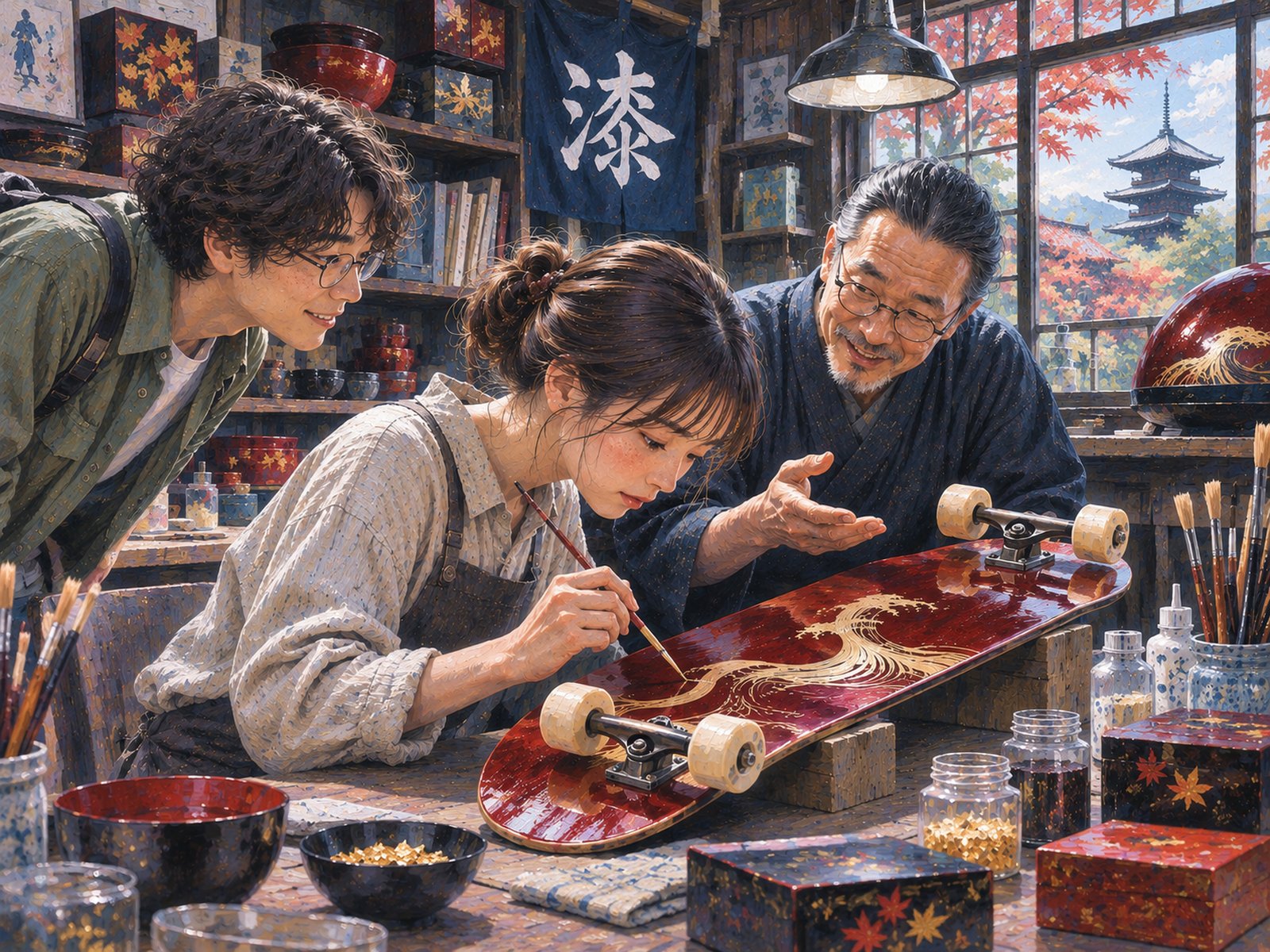
It started with skateboards. Skateboarding is part of his own daily life, and when a friend’s skateboard cracked and became unusable, he repaired it with lacquer. The lacquer soaked into the scratches on the deck and darkened, making them look like a pattern. “These scratches made me so happy!” he says. He went on to lacquer skateboards, BMX bikes and steel bicycle frames. For the bicycles he used a translucent lacquer that lets the steel show through, borrowing the name of “roiro,” a traditional technique for polishing black lacquer, to call it “tetsu-roiro,” or steel roiro. In 2018 he collaborated with Australian wooden surfboard shaper Tom Wegener to lacquer a traditional Hawaiian finless wooden board.
Tsutsumi has known since childhood that lacquer can fix things. When his model airplane broke as a boy, his grandfather glued it back together with lacquer. Lacquer isn’t just a film on the surface; it’s a powerful adhesive in its own right, and Japanese people have used it to mend bowls and furniture for hundreds of years. “Kintsugi,” which has become popular abroad, is the technique of gluing a broken bowl back together with lacquer and painting the cracks with gold.
Some say putting lacquer on skateboards is a waste of lacquer. Tsutsumi disagrees. Lacquer’s greatest strengths are that it’s durable, repairable and gains character with use, and those strengths show most clearly on something that gets dropped and scratched every day. When plastic gets scratched, it just looks old. When lacquer gets scratched, it can be repaired, and the marks become the board’s own pattern.
New technology that takes lacquer outdoors
Taking lacquer outdoors runs into a technical problem. Traditional lacquer is vulnerable to ultraviolet light and moisture acting together, and long exposure to sun and rain degrades the film. That’s why lacquerware is mostly used indoors, and why lacquered surfaces outdoors tend to need repairs.
Tsutsumi Asakichi Urushi developed its own “highly dispersed refined lacquer,” called Korin. Put simply, the lacquer’s components are processed more finely and evenly during refining, making the film more resistant to sun, wind and rain than traditional methods. That opened up the possibility of lacquering surfboards, bicycles and other things that spend all day outside.
This is exactly the kind of technology traditional crafts need most: not technology that replaces craftspeople, but technology that lets the same material be used in more places.
Bear-stripped cedar becomes lacquered surfboards
Back to Keihoku. In 2022, Tsutsumi Asakichi Urushi teamed up with Keihoku’s forestry workers and woodworkers to launch the BEARS WOOD PROJECT. Cedar stripped by black bears can’t fetch a good price on the market, but they deliberately use this wood, even the warped sections around the wounds. The surfboards are shaped in Keihoku by Rodrigo Matsuda, who has been making wooden surfboards for nearly 20 years, in a workshop set up in a century-old farmhouse beside the Katsura River, and then lacquered by Tsutsumi. In 2023 the line was officially launched under the brand siita.
Why surfers? Most surfboards are made of foam and resin, but there has always been a group of surfers who prefer handmade wooden boards and care where materials come from and what happens to them afterward. A board made of local cedar and natural sap that can be repaired when it breaks speaks directly to their values.
The project found value for two things at once. Unsellable wood found a use, and forestry workers gained income. Lacquer gained a new set of customers who would never have bought lacquerware: surfers and skateboarders.
Plant the trees first, then find the people: rebuilding the supply chain from the source
New uses create new demand, but there was never enough domestic lacquer to begin with. Tsutsumi knows that selling lacquer without planting trees won’t take the industry far. A lacquer refiner doesn’t grow trees itself; it relies on raw lacquer from harvesters. If new uses really do bring more orders and domestic production can’t keep up, the result may be more imported lacquer, or prices rising even further.
In 2019 he and his partners set up a general incorporated association called Perspective and, with the approval of Kyoto’s forestry authorities, brought volunteers and veteran loggers to plant lacquer trees in public forest in Keihoku. If all goes well, they can be tapped in about 15 years. They call the woodland the “Kogei no Mori,” the Craft Forest, aiming to let people see the whole journey from a single tree to a finished object. Tsutsumi argues that lacquer trees need to be grown as a form of agriculture if production is to increase. He also notes that some producing regions oppose planting new lacquer trees precisely because people fear lacquer will make their skin itch, so changing lacquer’s image is itself a way of finding people for the industry.
Finding people also means raising the next generation of buyers and craftspeople. In 2016 he self-published “Urushi no Ippo” (“A First Step into Lacquer”), a booklet about where lacquer comes from, and took it to schools for workshops. The company sells DIY kits for kintsugi (repairing broken bowls with lacquer and tracing the cracks in gold) and for wiping lacquer onto wood. Behind all this is a change in business model. A lacquer refiner’s customers used to be almost entirely lacquerware artisans, restorers and craft artists. Now Tsutsumi Asakichi Urushi has begun dealing directly with the general public and tourists. In April 2024 it opened “Und.” next to the factory, staffed by English speakers. The first floor sells lacquer and tools, and the third floor is a workshop where visitors can try wiping lacquer, with three or four young craftspeople usually refining and blending lacquer there. Since 2025 it has also hosted an annual Urushi Festival every November, a two-week program centered on November 13, “Urushi Day,” with themes including younger generations, technology and overseas audiences.
Japanese lacquer’s way forward is selling what plastic can’t
These efforts are still small. The vast majority of lacquer used in Japan is still imported, and no single lacquer shop can turn around domestic production. Tsutsumi himself admits the industry is still shrinking.
But his approach shows something. A traditional material doesn’t have to get cheaper to survive, and it doesn’t have to rely only on restoring national treasures. Lacquer can’t easily undercut plastic, but it can do what plastic can’t: it lasts, it can be repaired, it gets more beautiful with use, and it can tell the story of a tree and a forest. Find people willing to pay for that, and lacquer has a new market. With a market, the people who plant trees, tap lacquer and refine it, young craftspeople among them, will come back together.
That surfboard made of bear-stripped cedar is the best example. The wounds in the wood once made it unsellable. Coated in lacquer, the wounds became its most distinctive feature. Perhaps Japanese lacquer’s way forward is the same: not hiding its “flaws,” but finding the people who know how to appreciate them.
Notes
- Figures for Japan’s lacquer consumption vary by year and source. Forestry Agency statistics put it at about 37.7 tons in 2018 and 29.8 tons in 2023. Takuya Tsutsumi has said in an interview that it’s “about 50 tons, half of when I started,” referring to a different point in time. This article uses the Forestry Agency figures and cites his “half” remark.
- The claim that Korin is more weather-resistant than traditionally refined lacquer comes from Tsutsumi Asakichi Urushi’s company information. This article did not obtain specific test data.
- “Tetsu-roiro” is Takuya Tsutsumi’s own name. “Roiro” is a Japanese lacquerware technique in which black lacquer is polished repeatedly to a mirror-like shine.
References
- designboom|scars left by bears ripple through these japanese cedar surfboards: bear stripping and the value of cedar, BEARS WOOD PROJECT (2022), siita (2023), Rodrigo Matsuda, the farmhouse workshop by the Katsura River, Keihoku supplying Kyoto with timber for over a thousand years.
- OCEANS|Interview with Takuya Tsutsumi of Tsutsumi Asakichi Urushi: founded 1909, fourth generation, Hokkaido University agriculture, the meat industry and a New Zealand working holiday, returning home in 2004, refining steps and timing, “got hooked,” surfboards / skateboards / BMX.
- Kyoto City Official Travel Guide|Takuya Tsutsumi: cruising the streets on a lacquered skateboard: the friend’s cracked skateboard, “these scratches made me so happy,” tetsu-roiro, stereotypes about lacquer, opposition to planting, lacquer use halved, passing it on to his son.
- WIRED Brand Lab (sponsored by the Japanese government)|Japanese Lacquer Maker Coats Surfboards, Plants Trees (2020-12-17): the factory in his grandfather’s house, belts, pulleys and early motors, the 2016 booklet, the 2018 Tom Wegener collaboration, Perspective in 2019, planting lacquer trees in Keihoku, harvestable in about 15 years, demand down 90% in 40 years, under 38 tons in 2018, 1.8 tons domestic.
- Zaikei Shimbun (press release)|Tsutsumi Asakichi Urushi opens “Und.” (2024-03-05): Und. opening on 2024-04-20, DIY kintsugi and wipe-lacquer kits, third-floor workshop, more than 70% of domestic lacquer handled, three to four young craftspeople on site, the Craft Forest.
- VOIX|Introduction to Tsutsumi Asakichi Urushi: highly dispersed refined lacquer Korin more weather-resistant than traditional methods, used to restore Nikko Toshogu and Himeji Castle, the lacquered wooden straw suw.
- Oggi.jp|Tsutsumi Asakichi Urushi wins a PFV award (2025): the previous generation’s “don’t waste a single drop,” demand down about 90% in 40 years, Urushi no Ippo in 2016.
- PR TIMES|Urushi Festival URUSAI 2026: first held in 2025, November 1–14, 2026, Urushi Day on November 13, six themes, hosted by Tsutsumi Asakichi Urushi.
- CreativeMornings Kyoto|Takuya Tsutsumi (2025-05-17): SURF / BMX / SKATE × urushi projects, the newly developed high-dispersion refining method, promoting lacquer tree planting.
- Forestry Agency|FY2019 Annual Report on Forest and Forestry, Chapter 2: domestic lacquer consumption of 37.7 tons in 2018, 5% (1.8 tons) domestic.
- Ministry of Agriculture, Forestry and Fisheries|aff, November 2022 issue: the world of urushi in Japanese food culture: about 180–200 grams per tree per season, tapping methods.
- CiNii|Deterioration Phenomena of Urushi Films: Combined Effects of Ultraviolet Radiation and Water: degradation of lacquer films under combined UV and water exposure.
- Serai.jp|The art of lacquer tapping (2017-08-23): Japanese lacquerware has a history of about 9,000 years.
- Akita Prefecture Forest Learning and Exchange Center|Tree Series 100: Urushi: the difference between sustainable tapping and kill tapping, berries used for candles, the shift to kill tapping as candle demand fell, coppice regrowth saving on seedlings and growing fast early on.
Follow the story in person
Join a small-group trip to the places in our stories and meet the people who live and work there.
See trips and dates
Water Mirror is a Tokyo-based company that helps more people step inside industries and explore the stories and cultures of different fields around the world. We design in-depth learning programs for individuals, companies, schools and organizations, combining company visits, exchanges with professionals, local learning and hands-on experiences, so participants can see how industries really work and meet the people and stories behind them. Water Mirror Perspectives is our content media, telling the distinctive stories of industries, local cultures and people, so that reading sparks curiosity and leads readers to go and see for themselves.
About Water Mirror →