Key Points
- Toshio Suzuki is Studio Ghibli’s producer. He started out as an editor at Animage, an anime magazine published by Tokuma Shoten, and he doesn’t draw himself.
- In 1979, when Hayao Miyazaki turned down his interview request, Suzuki sat down next to him for three days until Miyazaki spoke. Their collaboration began there.
- When the company rejected Miyazaki’s film proposal on the grounds that “without source material, it can’t be made into a film,” Suzuki had Nausicaä of the Valley of the Wind serialized first as a manga in the magazine. It became a film in 1984, leading to Ghibli’s founding in 1985.
- He defines a producer as “the first reader”: someone who tells the director honestly where things are boring and picks topics for the director. Porco Rosso, Princess Mononoke and The Wind Rises all went through his input. He was also the producer of The Boy and the Heron, which won the Academy Award in 2024.
In 1979, at an animation studio in Tokyo, a 38-year-old animator was working flat out. His name was Hayao Miyazaki, and the project in his hands was Lupin III: The Castle of Cagliostro, the first feature film he would direct. A magazine editor in his early thirties walked in and said he wanted to interview him.
Miyazaki didn’t stop drawing or even look up. He later recalled thinking, “Here comes a suspicious character.” He told the editor: your magazine is cashing in on the anime boom, I don’t think much of it, and I don’t want to talk to you.
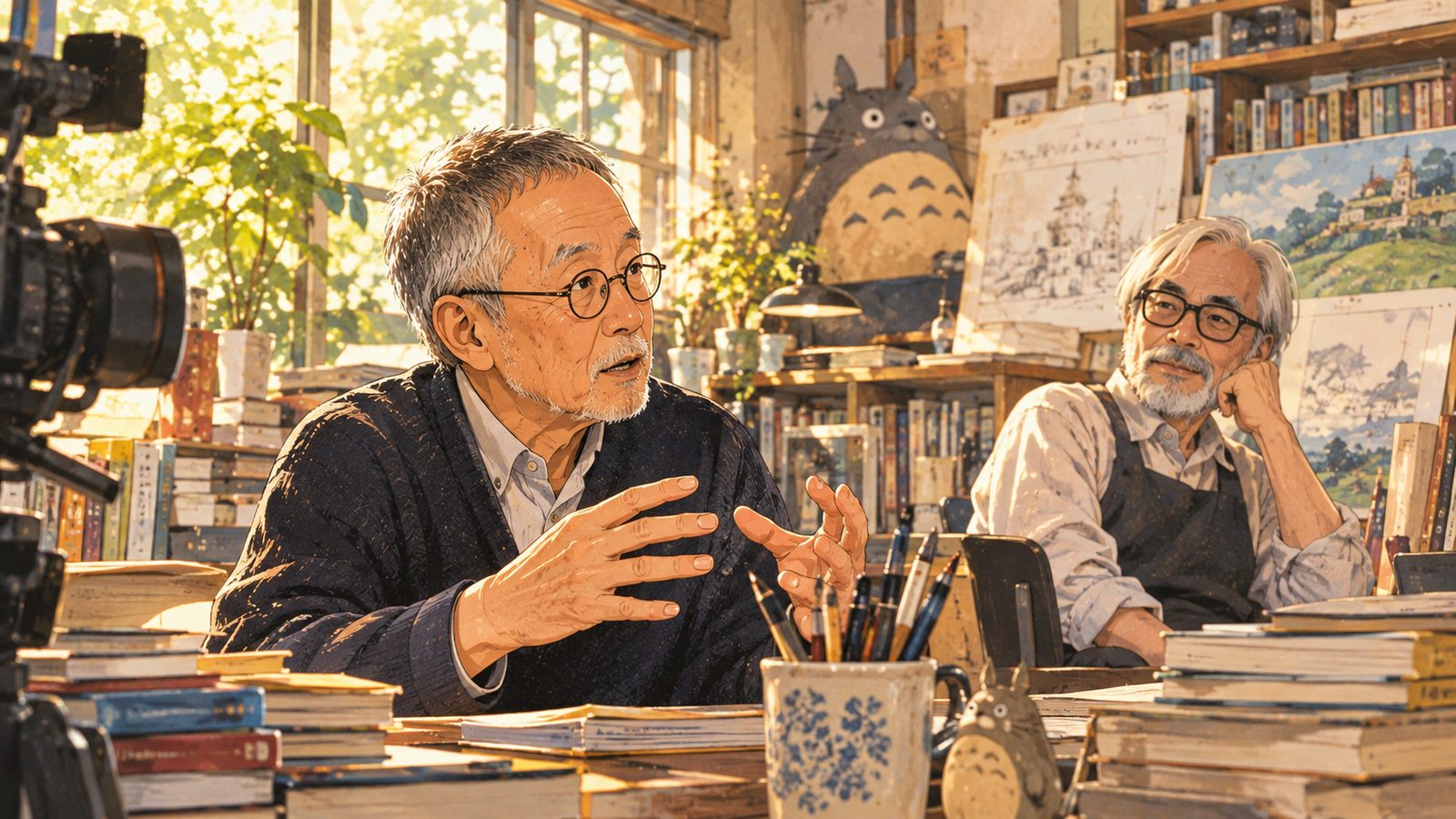
Most people would have packed up and left at that point. This editor got angry instead. He pulled up a chair and sat down at the desk next to Miyazaki’s. Miyazaki drew from morning until midnight, and the editor stayed with him from morning until midnight. On the first day, the two didn’t speak. On the second day, they didn’t either.
The editor was Toshio Suzuki. More than 40 years later, the whole world knows Studio Ghibli and Spirited Away, but few people know the man who sat next to him. Without him, Nausicaä of the Valley of the Wind might never have become a film, and Ghibli wouldn’t exist. How did a magazine editor who can’t draw end up at the very center of Japanese animation history?
On the third day, Miyazaki finally spoke
On the third day, Miyazaki finally spoke.
He was drawing the car chase that opens the film when he suddenly turned and asked, “What do you call it when this happens?” He was looking for a line to describe a car charging up from behind and overtaking in one burst. Suzuki’s colleague Osamu Kameyama was a keirin fan. Keirin is a Japanese track cycling race you can legally bet on, and when a rider accelerates around the outside to overtake in one burst, it’s called “makuru.” Kameyama told Miyazaki the word, and it became a line in the film’s opening chase.
From that moment, Miyazaki started talking to these editors.
This little episode says a lot about how Suzuki works. He didn’t try to persuade, and he didn’t throw his magazine’s weight around. He just stayed there, until the other person realized this guy might actually be useful. It was a way of working he had developed before he ever met Miyazaki.
A crime reporter assigned to an anime magazine
Toshio Suzuki was born in Nagoya in 1948. After graduating from Keio University in Tokyo, he joined the publisher Tokuma Shoten in 1972 and was assigned to a weekly magazine covering crime, show business and gossip. The stories he chased ran from celebrities to politics to the yakuza. He says what he learned in those years was to “write about events plainly,” without mixing in his own feelings, and he also learned realism.
In 1978, at 29, Suzuki was brought in by his senior colleague Hideo Ogata to help launch Tokuma Shoten’s new anime magazine, Animage. The outside editorial company originally in charge had fallen out with them, and the first issue’s deadline was only two weeks away.
The problem was that Suzuki knew nothing about anime. He remembered that a high school girl who loved anime had recommended an old 1968 film, The Little Norse Prince (Taiyo no Oji: Horusu no Daiboken). It had flopped at the box office but was revered as a classic within the anime world. He decided to feature it in the first issue and phoned its director, Isao Takahata.
Takahata picked up and spent about an hour explaining to Suzuki why he didn’t need to give this interview, then suggested Suzuki contact the other person who had made the film with him: Hayao Miyazaki. It turned out Miyazaki was right there listening. He took the receiver and said he’d do the interview, but he wanted 16 pages. In the end, the feature was dropped.
After that call, Suzuki started reading huge numbers of the books Takahata and Miyazaki had read, so he could keep up with their conversations. He also wrote down what the two said in notebooks, reorganizing and rewriting it three times. He believed someone who just sat beside them saying “oh, I see” was no use.
That led to the scene at the start. The following year, he walked into the studio where Miyazaki was racing a deadline, was turned down to his face, and sat down.
Told there was no film without source material, he made the film into a manga first
After The Castle of Cagliostro was released, one film Miyazaki wanted to make after another fell through. By then Suzuki was Animage’s deputy editor, and he found a chance to pitch one of Miyazaki’s film ideas inside Tokuma Shoten. It was rejected again. The company’s reason was simple: if there’s no source material, it can’t be made into a film.
That logic was easy to understand in the Japanese film business of the time. Films cost a lot of money, and backers wanted something “already proven to have an audience” to lower the risk, usually a bestselling novel or manga. Miyazaki wanted to make an original story, which amounted to asking the company to bet its money on a world nobody had seen.
Ogata and Suzuki came up with a solution: if they needed source material, they’d serialize a manga in Animage first and make that the source.
In 1982, Miyazaki’s manga Nausicaä of the Valley of the Wind began running in Animage. Once the serialization proved popular with readers, the editorial team started talking about an anime. Ogata initially said a five-minute pilot film would do. Miyazaki said ten minutes. About a month later, the plan had become a feature film. A magazine that reported on anime had become the starting point of a film.
“I gave Takahata fifteen years of my youth”
The film was going ahead, but Miyazaki had a condition: he wanted Isao Takahata as producer. A producer’s job is varied: raising money, finding people, controlling budgets and schedules, and mediating between the director and the investors. What Miyazaki wanted was someone he trusted, who understood animation, standing behind him.
For weeks, Suzuki went to see Takahata almost every day. Takahata refused every time, and in the end pulled out a notebook densely filled with analysis on one topic: why he wasn’t suited to be a producer.
Suzuki went back to Miyazaki and asked: does it have to be Takahata? Miyazaki took him out drinking, ended up in tears, and said: I gave Takahata fifteen years of my youth, and he’s never given me anything back.
Suzuki decided to try one more time. This time, what he said to Takahata was blunt: your friend is in trouble, so why won’t you help? Takahata agreed.
In March 1984, the film Nausicaä of the Valley of the Wind was released. Its success led Tokuma Shoten to finance, in 1985, an animation studio dedicated to making Miyazaki’s and Takahata’s work: Ghibli. The name originally refers to a hot wind that blows across the Sahara, and they hoped the studio would blow a hot wind through Japanese animation. In 1989, Suzuki left the magazine and joined Ghibli full time.
A producer’s job is to be “the first reader”
So what does this man who can’t draw actually do at Ghibli?
In a 2018 lecture at Tokyo University of the Arts, Suzuki gave a very simple answer: a producer’s role is the same as a book editor’s. He is “the first reader.” Every time Miyazaki finishes about 20 minutes of footage, he shows it to Suzuki first, and Suzuki’s job is to say honestly what he sees.
That’s how Porco Rosso grew. Miyazaki originally wanted to make a short film of about 15 minutes, a story about a group of children who are kidnapped and then rescued, and that was it. Suzuki was blunt in his lecture: honestly, those 15 minutes were really boring.
He asked Miyazaki: why is the hero a pig? Miyazaki got angry. But the next day he came back with new ideas, and the running time grew from 15 minutes to 30, then 60, and finally became a feature film of about 90 minutes.
Sometimes the role goes a step further, into choosing topics for the director. In the mid-1990s, Miyazaki wanted to make a film starring a caterpillar. Suzuki objected, arguing that what they should make now was an action film. That became 1997’s Princess Mononoke. Later, when Miyazaki wanted to make a sequel to Ponyo, Suzuki suggested he make a film about the designer of the Zero fighter plane instead. That became 2013’s The Wind Rises.
Being “the first reader” takes more than the nerve to tell the truth. You also have to have seen enough. Suzuki says both Miyazaki and Takahata pursue realism, and part of his job is gathering material and doing interviews, the same skills he used as a weekly magazine reporter.
Once, he and Miyazaki went to Otaru in Hokkaido and visited a “herring mansion,” a grand residence built by a Meiji-era Hokkaido fishing boss who grew rich from herring, as lavish as a palace. Years later, when Miyazaki showed him the sketch of the female leader’s residence in Princess Mononoke, Suzuki recognized it at once: it was that herring mansion, stretched to three times its original height. When he reads a work, he’s often reading things he has seen with his own eyes, so he can judge whether a change makes sense.
He manages money too, but first asks whether it’s fun
Suzuki manages money too, of course. My Neighbor Totoro was initially considered too plain to sell. It was he who came up with the idea of releasing it as a double bill with Takahata’s Grave of the Fireflies, which got it made. He remembers company executives yelling when they saw the proposal: “Ghosts and graves? What on earth is this?”
But he himself says he first thinks about whether making the film will be fun, and considers the box office afterward. In his book, he writes that he had no title at all at Ghibli in the beginning. He just kept getting involved because it was interesting, and by the time he noticed, he was the producer.
In 2003, Spirited Away won the Academy Award for Best Animated Feature, the first Japanese animated film to do so. In 2018, Isao Takahata died. In The Boy and the Heron, which Miyazaki later completed, Suzuki saw a character, the old man who lives in the tower, and that face was Takahata’s. He felt that in this film, Miyazaki had finally put down the heavy stone of Takahata that had weighed on him all his life. In 2024, The Boy and the Heron won the Academy Award for Best Animated Feature, and the name in the producer credit was Toshio Suzuki.
Sitting beside someone is a craft
Suzuki once said that Miyazaki really makes films for only one audience member, and that audience member was Isao Takahata. The reverse is also true: before Miyazaki’s films reached the world, they always passed through Toshio Suzuki’s eyes first.
I think what’s most remarkable about Suzuki isn’t how much money he raised, but that he brought the craft of “editing” into animated film. An editor doesn’t write the book, but knows where it should tighten and where it should open up. He tells the author “this part is boring,” and when the author is out of options, finds a way through, like turning a film into a manga first. Ghibli is Ghibli in large part because an editor has always been sitting next to the director.
He sat down in that chair in 1979 and has stayed there for nearly fifty years. In 2016, asked about his relationship with Miyazaki and Takahata, he counted and found it had already been 38 years. Then he said: “At this point, all I can do is stay with them to the end.”
Notes
- Accounts differ on how many days Toshio Suzuki sat next to Hayao Miyazaki. This article uses “three days,” as he describes it in his book Tensai no Shiko (The Thinking of Geniuses).
- Miyazaki’s words at the drinking session are quoted slightly differently in different places. This article follows the version in an ORICON feature.
- Porco Rosso’s final running time is about 93 minutes. Suzuki said “about 80 minutes” in his lecture, but this article goes by the actual running time and says “about 90 minutes.”
References
- 鈴木敏夫|天才の思考 高畑勲と宮崎駿 (Bunshun Shinsho)|Bungeishunju|2019 (how Animage was founded, Miyazaki refusing the interview, sitting beside him for three days, having no title at Ghibli)
- ルシルナ|Review of Tensai no Shiko|note (the two-week deadline, the high school girl recommending The Little Norse Prince)
- はーとぼいるどワンダフル。|鈴木敏夫と宮崎駿の出会いや熱いエピソードまとめ|2021-10-09 (Takahata’s hour-long refusal call, Miyazaki’s 16-page demand, “a suspicious character”)
- Anime Hack|Column on Lupin III: The Castle of Cagliostro (Miyazaki asking for a line, Kameyama supplying “makuru”)
- Kihon Dokusho|Review of Shigoto Doraku: Studio Ghibli no Genba|2010-10-25 (rewriting notes three times, Takahata’s notebook)
- Wikipedia|鈴木敏夫 (birth year, education, career at Tokuma Shoten, joining Ghibli full time in 1989)
- Forbes JAPAN|Interview with Toshio Suzuki (“write about events plainly,” invited to launch Animage at 29)
- Gendai Business|Interview with Toshio Suzuki (reading) (realism learned at the weekly magazine, gathering material and interviewing)
- Gendai Business|On the Nausicaä manga serialization (start of the serialization, rejected proposals, release in March 1984)
- Business Insider Japan|Hideo Ogata and Nausicaä (the five-minute pilot proposal, turning into a feature within a month)
- BATQUE|How Nausicaä of the Valley of the Wind became a film (“without source material, it can’t be a film,” serializing the manga first)
- ORICON NEWS|高畑勲と宮崎駿 2人の天才の“邂逅と別離” (Miyazaki’s words over drinks, “why won’t you help a friend in trouble,” Miyazaki making films for one audience member)
- Wikipedia|Studio Ghibli (Japanese) (founded 1985, origin of the name)
- Tokyo University of the Arts, Department of Design|Report on Toshio Suzuki’s special lecture|2018-08-29 (“the first reader,” Porco Rosso’s 15-minute story, the Otaru herring mansion, thinking about box office later)
- nippon.com (Kimie Itakura)|What’s Next on the Ghibli Storyboard? Catching Up with Producer Suzuki Toshio|2016-07-06 (the caterpillar idea and Princess Mononoke, the proposal for The Wind Rises, 38 years together)
- nippon.com|Interview with Toshio Suzuki|2016 (“all I can do is stay with them to the end”)
- Anime Hack|How My Neighbor Totoro and Grave of the Fireflies became a double bill (the double-bill idea, “ghosts and graves”)
- Bunshun Online|Toshio Suzuki on The Boy and the Heron (the old man in the tower has Takahata’s face)
Follow the story in person
Join a small-group trip to the places in our stories and meet the people who live and work there.
See trips and dates
Water Mirror is a Tokyo-based company that helps more people step inside industries and explore the stories and cultures of different fields around the world. We design in-depth learning programs for individuals, companies, schools and organizations, combining company visits, exchanges with professionals, local learning and hands-on experiences, so participants can see how industries really work and meet the people and stories behind them. Water Mirror Perspectives is our content media, telling the distinctive stories of industries, local cultures and people, so that reading sparks curiosity and leads readers to go and see for themselves.
About Water Mirror →