Key Points
- In 2020, 54 bottles of Hanyu distillery’s “Card Series” whisky sold in Hong Kong for about HK$11.89 million (about US$1.52 million), at the time a record for a complete set of Japanese whisky.
- Hanyu stopped production in 2000. In 2004, its new owner planned to dispose of the roughly 400 remaining casks of whisky. Ichiro Akuto borrowed money from relatives to buy them, stored them at Sasanokawa Shuzo in Fukushima, and bottled and sold them one cask at a time.
- Japanese whisky consumption fell steadily after the 1980s, and distilleries cut production. When global demand exploded in the 2010s, the aged whisky they hadn’t made during those years couldn’t be replaced.
- The sky-high price reflects that it can never be made again: every bottle from a closed distillery that gets drunk is one fewer in the world. And it’s this scarce precisely because, back then, no one was willing to wait.
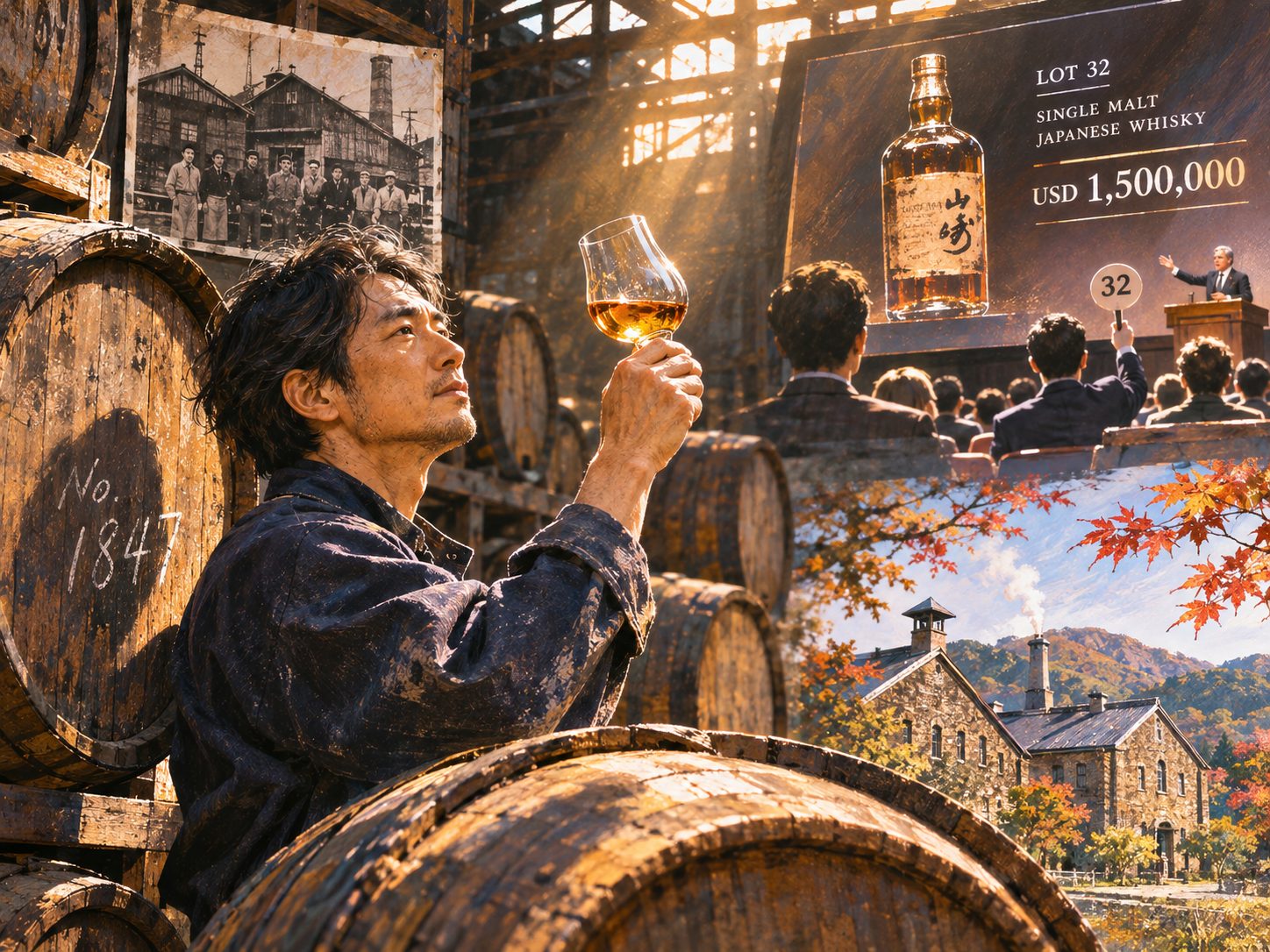
In November 2020, at a Bonhams auction in Hong Kong, one lot looked nothing like a luxury spirit: 54 bottles of whisky with playing cards printed on the labels. The ace of spades, the queen of hearts, the king of diamonds, all the way to two jokers, exactly a full deck.
This “deck” sold for HK$11,890,360, about US$1.52 million, at the time the auction record for a complete set of Japanese whisky.
What’s truly strange is where the whisky came from. All 54 bottles came from the Hanyu distillery in Saitama Prefecture, which had stopped production in 2000. In 2004, the distillery’s new owner had no interest in whisky and gave notice that if no one took the remaining stock by a deadline, it would be disposed of.
How did whisky that was nearly poured away become worth a fortune sixteen years later? The answer has to do with 400 casks one man saved, and with the days when Japanese whisky was seen as an imitation.
95% not whisky: what Japanese people used to drink
First, how whisky is made. Malted barley is ground, mixed with water and fermented into a beer-like liquid, then distilled in a still to make a clear spirit. That spirit has to age in wooden casks for years, absorbing color and aroma from the wood, before it becomes amber whisky. The industry calls whisky drawn from the cask, before any blending, genshu, or “original spirit.” However many years a cask has aged is the age that can go on the label.
Japan began making whisky by the Scottish method in the 1920s. But for a long stretch after the war, much of the “whisky” sold in large volumes on the Japanese market had little to do with that process.
Liquor tax at the time was levied by “grade.” Under the 1949 system, second-grade whisky only needed to contain at least 5% genuine malt whisky. Anything below that was third grade, where the share could be 1% or even zero. More than 95% of third-grade whisky was industrial alcohol made from molasses, with a little real whisky added for color and flavor. The Japanese themselves had a name for this cheap stuff: uisukii-modoki, “imitation whisky.” The grading system wasn’t abolished until 1989.
In other words, Japanese whisky’s early image was propped up in large part by “something that looked like whisky.” The Hanyu story begins in this era.
A family that brewed sake for 400 years bet on whisky at the worst possible moment
The Hanyu distillery belonged to the Akuto family. The Akutos had been brewing sake since 1625, an old brewery dating back to the Edo period. They later founded Toa Shuzo in Hanyu, in northern Saitama, and obtained a whisky-making license in 1946. For a long time, Hanyu’s whisky was mostly sold to other companies as blending stock.
In 1983, Ichiro Akuto’s father installed two copper pot stills and began making whisky the Scottish way. A pot still is shaped like a giant gourd and distills one batch at a time. It isn’t efficient, but it keeps more flavor.
The timing was terrible. 1983 was the peak year for whisky consumption in Japan, and it fell every year after that. Shochu, a Japanese spirit distilled from rice, barley, sweet potatoes and more, and chuhai, shochu mixed with soda, became popular in the 1980s. By 2008, whisky shipments were less than a fifth of their peak.
Ichiro Akuto himself joined Suntory in 1988 and left in 1996 to come home and help run the struggling family business. In 2000, Toa Shuzo filed for civil rehabilitation, a Japanese court-supervised procedure for reducing debt and restructuring. The Hanyu distillery stopped production the same year.
“If no one takes it, it gets disposed of”: the deadline for 400 casks
In 2004, the Akuto family sold Toa Shuzo to another alcohol company. The new owner wanted the sake equipment and inventory and had no interest in whisky. It set a deadline and said that if no one could be found to take the whisky, it would be disposed of.
At the time, Hanyu’s warehouse still held about 400 casks, some aged nearly twenty years. Akuto later said: “I couldn’t abandon a child who was about to turn twenty.”
Saving the whisky wasn’t just a question of money. In Japan, liquor tax is levied when alcohol leaves a licensed production site, and whisky aging in a warehouse hasn’t been taxed yet. Moving 400 casks to an unlicensed location would mean first paying tens of millions of yen in tax. Akuto needed a distillery with a whisky license that was willing to make room.
He found Sasanokawa Shuzo in Koriyama, Fukushima Prefecture. Their answer was: “This would be a loss for the whole industry. Use our warehouse.” The 400 casks were moved from Hanyu to Koriyama, paid for with money borrowed from relatives. In September 2004, Akuto founded Venture Whisky, a name so frank it was almost self-mocking: a startup with no distillery, only a batch of whisky someone else had been about to throw away.
When the first bottles didn’t sell, he went from bar to bar
In May 2005, the first product went on sale. Akuto filled empty wine bottles he happened to have in the warehouse, about 600 bottles in all, under the brand Ichiro’s Malt, his own name.
The bottles didn’t move on liquor store shelves. An unknown brand from a distillery that had already closed: consumers had no reason to pick one up. He took the whisky to Scotland looking for distribution, and one distributor took one look and said: “A 720 ml bottle? Whisky that isn’t in a 700 ml bottle won’t sell.” But he added: “It tastes good.”
So he changed tactics and went to bars at night. “The first people to support me were bartenders,” he said. “They don’t look at the brand. They look at the taste.” He visited three to five bars almost every day, about 2,000 bars in two years. Selling those 600 bottles took two years. Bartenders who tried the whisky introduced him to others in the trade, and word spread from counter to counter across Tokyo.
Why playing cards on a whisky label?
The Card Series was born in this period. In 2005, Akuto was releasing four casks at once and thought: four kinds, so why not the four suits of a deck of cards?
From then until 2014, he bottled Hanyu’s whisky one cask at a time, pairing each bottle with a card, until he had completed 52 cards plus two jokers. Each cask had a different distillation year and aging period, and some were moved into casks that had held sherry or into casks of mizunara, a native Japanese oak, to keep aging, so all 54 bottles taste different. The first release, the king of diamonds, soon received Whisky Magazine’s highest score for a Japanese whisky.
Playing cards had another effect: a deck of cards is something you naturally want to complete.
Whisky is made of time, and the years not made can’t be recovered
During the years Akuto spent going from bar to bar, the fortunes of Japanese whisky were just starting to turn.
In 2001, Whisky Magazine held a blind tasting in which first place went to Nikka’s Yoichi 10-year-old and second to Suntory’s Hibiki 21-year-old, ahead of a field of famous Scotches. The turning point at home came in 2008, when Suntory heavily promoted the highball, its Kakubin whisky mixed with ice and soda, making whisky an easy “first round” order at izakaya pubs. Within two years, the number of bars and restaurants serving it went from about 15,000 to more than 90,000.
In 2010, Suntory announced it would limit Kakubin shipments, because whisky can’t simply be produced in larger volumes on demand.
That is the key to the whole story. A 12-year-old whisky sold today was distilled 12 years ago. From the 1990s to the early 2000s, Japanese whisky wasn’t selling, every distiller cut production, and some closed outright. When the whole world wanted Japanese whisky in the 2010s, no one could make up for the whisky that wasn’t made during those years. In 2018, Suntory announced it was discontinuing Hakushu 12 and Hibiki 17 because it didn’t have enough aged whisky.
In a market like this, a closed distillery like Hanyu was in a special position. However short an ordinary distillery’s whisky runs, it will be replenished eventually. Whisky from a closed distillery gets scarcer with every bottle drunk. For collectors, there is no better target.
Complete sets of the Card Series sold in Hong Kong for HK$3.79 million in 2015, HK$7.19 million in 2019 and HK$11.89 million in 2020, more than tripling in five years. Many of the most expensive Japanese whiskies at auction come from distilleries that couldn’t survive back then, like Karuizawa, which also stopped production in 2000.
These prices aren’t so much a price on flavor as a price on the fact that it can never be made again. And it can never be made again precisely because, back then, no one wanted it.
After selling the whisky others left behind, he built his own distillery
The 400 casks would run out someday, and Akuto knew it. He decided to build his own distillery in his hometown of Chichibu, in the mountains of western Saitama, where the water is good and the cool climate suits whisky aging. He tried to lease land in a prefectural industrial park and was initially turned down because the company had no track record. Only after making a presentation did he get the lease.
Chichibu distillery began distilling in 2008. Whisky must age at least three years, so its first single malt didn’t come out until 2011. Since then, Chichibu’s whiskies have won repeatedly in international competitions, including being named “World’s Best” seven times at the World Whiskies Awards between 2017 and 2025. When one of the bartenders who had supported him back then saw the distillery, he said: “So you really built it.”
The Hanyu story isn’t over, either. In 2021, Toa Shuzo resumed distilling whisky in Hanyu, with new stills built from the old, preserved blueprints. Today there are two Hanyu bloodlines in the world: the rebuilt new Hanyu, and the old Hanyu that Akuto rescued from the warehouse, which only grows scarcer with every bottle.
The sky-high price isn’t for whisky. It’s for time no one was willing to wait
In 2018, Akuto named his next goal: to drink a 30-year-old whisky made in Chichibu. Chichibu’s earliest spirit won’t turn 30 until 2038.
Whisky makers are always betting on a market they can’t see. In 1983, his father bought stills and placed his bet at the very top of the market. In 2004, Akuto bet his family’s money that someone would want these 400 casks, when Japanese whisky shipments were still at rock bottom.
I think what that deck of cards at auction really put a price on was time. Part of it was the twenty-odd years the whisky spent in the cask. The bigger part was the period when Japanese whisky was ignored and distilleries cut back and closed. Precisely because no one was willing to wait back then, what the people who did wait left behind became so valuable.
Notes
- “About US$1.52 million” is the conversion at the time of the 2020 sale. Auction prices for each year are in Hong Kong dollars and have not been adjusted to a single year’s value.
- “Less than a fifth of their peak” refers to taxed domestic whisky shipments in Japan: about 381,000 kiloliters in 1983 and about 74,000 kiloliters in 2008.
References
- 文春オンライン|前代未聞のスピードで頂点に 肥土伊知郎が秩父で挑む究極のウイスキー (about 400 casks, the first ~600 bottles in wine bottles, the brand name, visiting about 2,000 bars)
- Saitama Prefecture|想いをカタチに 第7回:肥土伊知郎さん(株式会社ベンチャーウイスキー)|2018 (“a child about to turn twenty,” building the distillery, leasing land from the prefecture, the 30-year whisky goal)
- DRINK PLANET|【肥土伊知郎さん】世界から注目浴びる 埼玉県秩父発ウイスキーメーカー<後編> (Sasanokawa Shuzo’s answer, the origin of the playing-card naming, his words about bartenders, “so you really built it”)
- かがり火|イバラの道を乗り越えて、海外で高い評価の「イチローズ・モルト」をつくった肥土伊知郎さん (civil rehabilitation, the new owner’s disposal deadline, liquor tax and moving the casks, joining Suntory in 1988)
- PRESIDENT Online|前屋毅「ニッポンの小さな大企業」interview with 肥土伊知郎|2026-07 (founded September 2004, first release May 2005, the Scottish distributor’s comments)
- The Japan Times|Whisky distillery plays a winning hand|2013-02-08 (license obtained in 1946, the new owner’s lack of interest in whisky)
- Whisky Auctioneer|Hanyu distillery profile (pot stills installed in 1983, production stopped in 2000)
- Wikipedia|Chichibu distillery (founded 1625, sale of Toa Shuzo in 2004, Chichibu production from 2008, awards)
- Saveur|Why Does This Japanese Whiskey Cost $70 a Shot? (52 cards plus two jokers, re-casking)
- Whisky Auctioneer|Ichiro’s Malt Card Series (the first four releases in 2005)
- The Value|Hanyu Ichiro’s Full Card Series Set Record|2019 (2015 and 2019 set prices)
- Hypebeast|Hanyu Ichiro’s ‘FULL CARD SERIES’ Auctions for Record-Breaking $1,520,000 USD|2020-11-22 (2020 price and USD conversion)
- Wikipedia|Karuizawa distillery (Karuizawa stopped production in 2000)
- Gentosha Gold Online|article on Japan’s whisky grading system (the 1949 grading system, the 5% threshold for second grade, third-grade composition, “uisukii-modoki”)
- nippon.com|The Story of Japanese Whisky (1983 consumption peak, rise of shochu and chuhai, 1989 liquor tax reform)
- J-CAST News|酒場で「とりあえず」はハイボール|2010-07-02 (1983 and 2008 shipments, number of highball outlets, 2010 shipment limits)
- nippon.com|Japan Distills a World-Class Whisky Tradition (2001 competition results)
- Shanken News Daily|Beam Suntory To Halt Sales Of Two High-End Japanese Whiskies Amid Shortage|2018-06-25 (Hakushu 12 and Hibiki 17 discontinued)
- Zaikei Shimbun (Toa Shuzo press release)|羽生蒸溜所ビジターセンターをグランドオープン|2025-04 (distilling resumed at Hanyu in 2021, stills built from old blueprints)
Follow the story in person
Join a small-group trip to the places in our stories and meet the people who live and work there.
See trips and dates
Water Mirror is a Tokyo-based company that helps more people step inside industries and explore the stories and cultures of different fields around the world. We design in-depth learning programs for individuals, companies, schools and organizations, combining company visits, exchanges with professionals, local learning and hands-on experiences, so participants can see how industries really work and meet the people and stories behind them. Water Mirror Perspectives is our content media, telling the distinctive stories of industries, local cultures and people, so that reading sparks curiosity and leads readers to go and see for themselves.
About Water Mirror →