Key Points
- Japanese anime moved from hand-painted cels to digital coloring in the late 1990s. Toei Animation dropped cels entirely in 1997, Ghibli went fully digital the same year, and Sazae-san became the last TV anime to switch, in 2013.
- Computers took over the work of brushing on paint and waiting for it to dry, but the people who chose colors and judged the images stayed. Ghibli’s color designer Michiyo Yasuda started as a tracer and worked all the way to The Wind Rises, living through two rounds of her work being taken over by machines.
- After digitization, the number of shows actually grew: Japanese TV anime rose from 124 series in 2000 to 306 in 2006. The industry’s problem today is too few people, not too little work.
- AI is moving into repetitive steps like backgrounds, coloring and in-between frames. Toei Animation has been testing AI while growing its workforce from 528 to 1,048 people. Animators won’t disappear because of AI. What needs protecting is the entry point where newcomers learn the craft.
In March 1997, Studio Ghibli was racing to finish Princess Mononoke. Producer Toshio Suzuki went to Michiyo Yasuda, the head of the paint department, with a proposal: the studio would switch its coloring entirely to computers.
That summer, the paint department on Ghibli’s first floor was transformed. Eleven painters who had sat at drawing desks brushing paint onto clear sheets frame by frame now faced monitors and mice. The window blinds were pulled down so they could see the colors on screen. Princess Mononoke used about 580 colors, each one a real paint in a bottle. The studio’s thousands of bottles of paint were later put into storage at a Ghibli warehouse in Chofu, Tokyo.
Nearly 30 years later, the same scene is about to play out again, except this time what’s walking into the studio is AI. AI can already turn photos into anime backgrounds and color line art, and it’s starting to try filling in the frames between two movements. Many people are asking: will Japan’s animators lose their jobs?
To find the answer, there’s no need to predict the future. We can look at where those people went the last time a machine replaced the brush.
A single frame once passed through many hands
First, what is a “cel”? A cel is a clear plastic sheet, and in early anime the characters were drawn on it. Because it’s transparent, it can be laid over a separately painted background, so the characters move while the background stays still, and you don’t have to redraw the whole image for every frame.
A frame of cel animation came together roughly like this. An animator drew the character’s movement in pencil on paper. A tracer copied the pencil lines onto a cel, and a painter brushed paint onto the back. Once the paint dried, the cel was laid over the background, and a camera operator shot it one frame at a time. The Japanese anime industry calls the tracing and coloring stage “shiage,” or finishing, meaning the process that “finishes” an animator’s line drawings into the color images audiences see.
It was work that demanded enormous patience. A feature film could involve more than 100,000 drawings, every one colored by hand. The paint couldn’t stray outside the lines, and not a speck of dust could land on a cel. Coloring took a huge amount of labor, and many studios outsourced it to lower-wage countries in Asia.
That’s where Michiyo Yasuda started. In April 1958, fresh out of high school, she joined Toei Doga (now Toei Animation) and was assigned to the finishing department as a tracer.
Toei spent 150 million yen to throw out every cel
Within a few years of her arrival, tracing began to be taken over by machines. From the mid-1960s, Toei Doga gradually brought in xerographic tracing machines that transferred pencil lines straight onto cels, and hand tracing slowly disappeared. Yasuda didn’t leave the industry. She stayed in finishing and came to specialize in deciding colors. The 1978 TV series Future Boy Conan was the first work for which she handled the colors of an entire production.
Thirty years later, it was coloring’s turn.
Toei Animation was the first major studio to move. In 1992 it first tried an animation coloring program called RETAS! PRO. In 1996 it invested about 150 million yen in a full rollout, and in 1997 it stopped using cels altogether. The new workflow went like this: animators still drew on paper, the line drawings were scanned into computers, and coloring and photography were done entirely in software.
The savings were obvious. Kindaichi Case Files, which began airing in 1997, saved an average of about 1.17 million yen per episode, mainly on coloring and photography. Toei was airing about five TV series a week at the time, roughly 250 episodes a year, so TV anime alone saved about 300 million yen a year, and overall costs fell by 20%. Around the same time, Fujifilm stopped making cels for animation, and other studios followed. By around 2000, coloring and photography in Japanese anime had largely gone digital.
The last holdout was the national institution Sazae-san. In 2007 it was the only TV anime in Japan still made with cels, with about 120 people at its production studio and three or four other companies working on its cels. Taiyo Shikisai, which supplied the special paint for cels, saw its monthly revenue fall from about 20 million yen at its peak to about 500,000 yen. Its president said they would keep going anyway, because this was Japanese culture. In October 2013, Sazae-san switched to fully digital production too.
The machine took the hand that painted, not the eye that chose colors
Back to Ghibli in 1997.
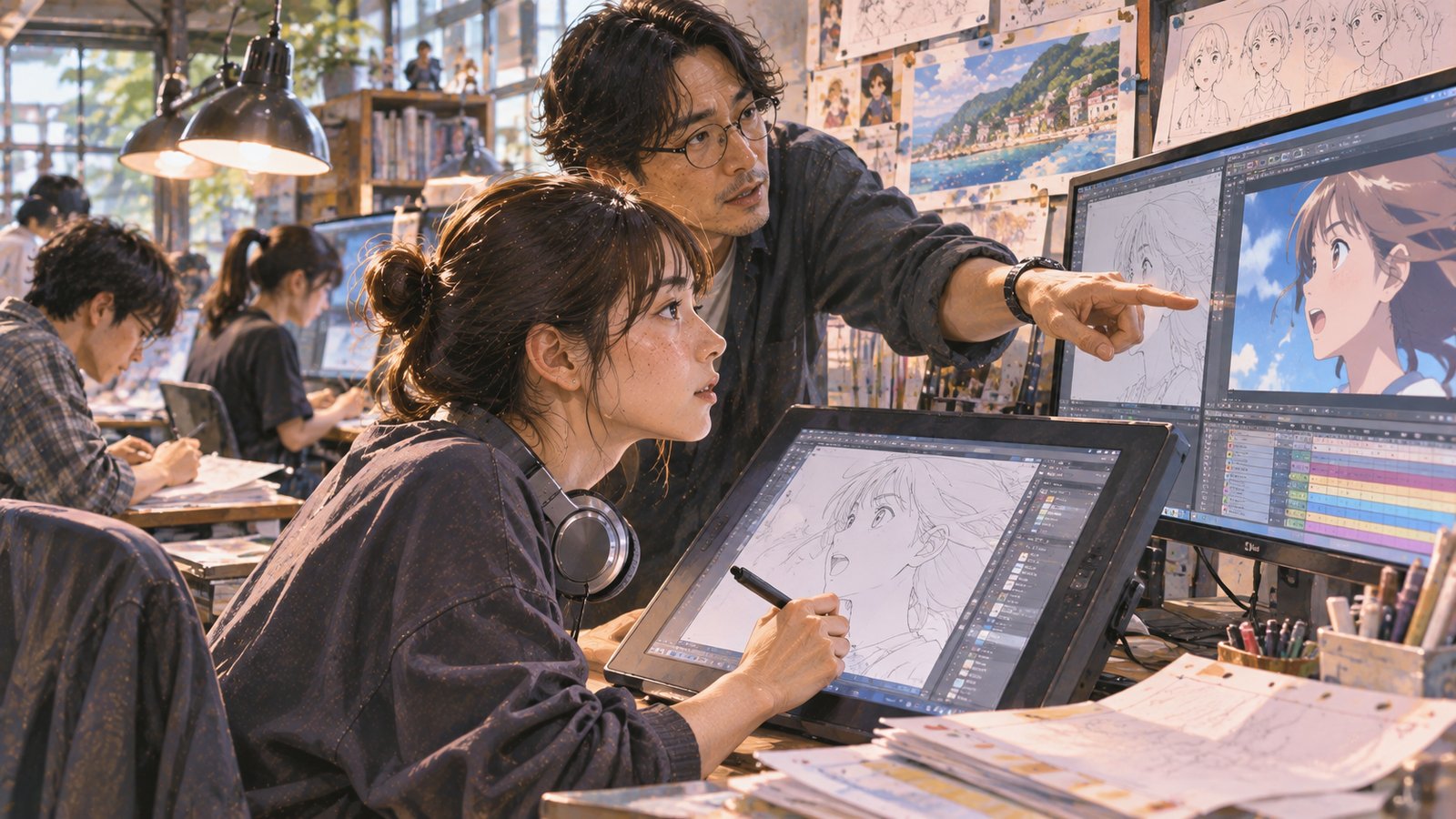
After the switch to computers, coloring became far faster. There was no waiting for paint to dry, and a large area could be filled with a single click. Yasuda estimated that, for the act of coloring alone, the speed was dozens of times faster than on Princess Mononoke.
But speed isn’t everything. A computer fills in color along the lines, but it can’t judge whether the lines are right. Painters still had to read the shape of each drawing and adjust lines and colors to match. In other words, what the machine took over was the act of brushing on paint. The parts that needed an eye and judgment stayed with people.
My Neighbors the Yamadas, released in 1999, was Ghibli’s first fully digital film. Its colors were very pale, and the colors on screen often didn’t match the colors once printed to film. The new technology didn’t make the work easier. It just moved the difficulty somewhere else.
Digitization also brought a change that was impossible in the cel era: color was no longer limited by how many bottles of paint were on the shelf. In the cel days, every color had to be a mixed bottle of paint. On a computer, colors are nearly unlimited. So “deciding which colors to use” became even more important. Anime studios today have a dedicated role called “color design,” which sets base colors for every character and prop, then designs variations for daytime, dusk and night, and even for a character’s changing emotions. A single TV series can have more than a hundred sets of character base colors.
Yasuda went on to handle the colors of nearly every Ghibli feature, including the Academy Award-winning Spirited Away. She formally retired after Ponyo in 2008, came back to the studio for Hayao Miyazaki’s The Wind Rises, and only truly stopped working in 2013. The tracing she started with was taken over by machines, and the paint department where she spent half her life was replaced by computers. Yet she herself stayed in animation the whole time, doing the thing hardest to replace: deciding what color a film should be.
Once coloring got faster, there was more anime, not less
Did those painters lose their jobs? Looking at the industry as a whole, the answer is the opposite.
In the late 1990s, late-night anime in Japan kept multiplying, and studios had to produce more episodes in less time. That was one reason studios rushed to switch to computers. Digital coloring made each episode cheaper and faster to finish, and the number of shows kept climbing: Japanese TV anime went from about 124 series in 2000 to 306 in 2006, nearly two and a half times as many in six years.
More shows meant more people were needed. Pictures still had to be drawn, colors still had to be chosen and checked, and photography changed from “shooting cels” into a new specialty of compositing light and effects on computers. Digitization took away a few motions, but the industry grew.
Something was lost, though. Once coloring and in-between frames could be sent over the internet, that entry-level work became easier to outsource overseas. The share of outsourcing kept rising, and so the basic work that newcomers in Japan could practice on shrank. Many animators had learned the trade through exactly this kind of basic work, working their way up step by step.
Today, the Japanese anime industry’s problem is too few people, not too little work. In 2025, total revenue at Japanese anime production companies was about 406.6 billion yen, topping 400 billion yen for the first time, but a shortage of animators has pushed many studios close to the limit of their capacity.
AI is standing where digital coloring once stood
AI’s path into Japanese anime looks a lot like the computer’s path 30 years ago: it starts with the most repetitive, labor-intensive steps.
Once again, Toei Animation moved first. In 2021 it worked with Japanese AI company Preferred Networks, using a tool called Scenify to turn real photos of Sasebo in Nagasaki Prefecture into anime-style background material for a roughly five-minute experimental short called URVAN. About two-thirds of the backgrounds in the film used the tool, and the art staff said the prep time for organizing photos was cut to about one-sixth. They used the time saved to paint the film’s freer, cyberpunk-style backgrounds.
Sony is doing something similar. In June 2025, Shunsuke Muramatsu, president of Sony Music Entertainment (Japan), said the company was developing AI coloring technology with its anime studios A-1 Pictures and CloverWorks. It was still trial and error, he said, but going well. The goal, they say, is to reduce repetitive labor so creators can spend their time on creative work.
What do animators themselves want AI to do? In a survey in the autumn of 2024, the Japan Animation Creators Association gathered responses naming things like the in-between frames that are very close together with little change, cleaning up rough sketch lines, filling in timesheets, and sorting invoices and tax paperwork. These are tasks animators have to do every day that don’t require creativity. In the same survey, some worried that relying too much on AI would leave young people with fewer chances to practice the craft.
That worry is about the same thing that was lost when coloring was outsourced 30 years ago.
Toei is using AI and has doubled its staff
If AI were really putting animators out of work, the first company to cut staff should be the one that adopted AI earliest. Toei Animation’s numbers are going the other way.
The Toei Animation group had 528 employees at the end of March 2013 and 1,048 at the end of March 2026, nearly double in 13 years. It plans to add several hundred more by March 2031, and in May 2026 it opened a new studio in Osaka. At Toei, at least, testing AI and hiring more people are happening at the same time. Toei’s public position on AI is that it isn’t meant to replace creators, but to help them focus their time on creating.
Toei is also handling the entry point for newcomers differently. In April 2023 it opened the Toei Animation Academy for key animators. Tuition is free, and trainees receive 150,000 yen a month. They study under veteran animators for a year, and if they pass an assessment, they become salaried staff animators. Newcomers used to hone their skills slowly by drawing huge numbers of in-between frames. Now the company pays directly to carry that apprenticeship period.
Steps will disappear; the entry point has to be protected
Looking back at that history, the pattern is clear. Tracing machines replaced the tracer’s hand, computers replaced the hand that brushed on paint, and each time what was taken was a repetitive motion. The people who decide how lines should be drawn, how colors should go together, and whether an image works were always there, and as the number of shows grew, more of them were needed.
AI will follow the same path. It will take over the most mechanical in-between frames, the prep work on background photos, large areas of flat color, and the paperwork animators least want to do. Japan’s animators won’t disappear because of it. In an industry that’s already short of hands, AI is more likely to be a tool that lets the same group of people make more work.
The real risk isn’t whether animators will lose their jobs. It’s where the next Michiyo Yasuda will get her start.
When Yasuda joined Toei straight out of high school, she did the most basic tracing work, one sheet after another, before working her way up to deciding the colors of entire films. Once AI takes over this basic work, newcomers will need another way to learn the craft. Toei’s academy offers one answer: the apprenticeship can no longer be propped up by masses of low-paid entry-level work, so the company has to pay directly to train people.
Ghibli’s thousands of bottles of paint all went into storage. Yasuda, who started as a tracer, went on choosing colors on computers for more than a decade. Tools change. The industry has always needed people who can make the judgment calls.
Notes
- Michiyo Yasuda’s estimate that digital coloring was “dozens of times faster” than on Princess Mononoke, along with details such as the 11 painters and the paint stored in Chofu, comes from a series of articles on the making of My Neighbors the Yamadas in the Hochi Shimbun in February 1999 (English summary).
- Toei Animation’s investment in digitization, per-episode savings and cost reduction come from Sakamoto (2021), citing Kimura (2020).
- The figures of about 120 people working on Sazae-san and Taiyo Shikisai’s revenue come from a 2007 Asahi Shimbun report, six years before Sazae-san went fully digital.
- The period when Toei Doga introduced tracing machines (1964 to the early 1970s) comes from anime.eiga.com‘s introduction to Toei Doga’s early works.
- The figures of 124 TV anime series in 2000 and 306 in 2006 are from the Association of Japanese Animations.
- The 2025 anime production market of about 406.6 billion yen (406.586 billion yen) is an estimate by Teikoku Databank based on anime production companies’ revenue, and is not the same as the entire anime-related market.
- The Japan Animation Creators Association (JAniCA) AI survey was an open online survey with only 33 valid responses. It reflects the views of some industry workers and doesn’t represent all animators.
- Sony’s AI coloring development comes from Shunsuke Muramatsu’s comments in an interview connected to Sony’s June 2025 business briefing. No concrete results have been published yet.
References
- The Yamadas News Clip 8 (English translation of a Hochi Shimbun series, February 1999): Toshio Suzuki proposes full digitization in 1997, 11 painters switch to computers, paint stored in Chofu, coloring speed, about 580 colors in Princess Mononoke, My Neighbors the Yamadas as Ghibli’s first fully digital film
- Walkerplus|Ghibli Museum cel exhibition article: Princess Mononoke as Ghibli’s last film to use cel paint, 580 colors, Michiyo Yasuda as color designer
- Wikipedia|Michiyo Yasuda: joined Toei Doga as a tracer in 1958, first handled the colors of a whole production on Future Boy Conan, retired after Ponyo, worked on The Wind Rises, died in 2016
- anime.eiga.com|Toei Doga “on film” screening program: Toei’s digital workflow in 1997, tracing machines introduced from 1964 to the early 1970s
- Sakamoto (2021), Chiba University of Commerce paper: Toei tries RETAS! PRO in 1992, invests 150 million yen in 1996, drops cels in 1997, Kindaichi Case Files saves 1.17 million yen per episode, about 300 million yen saved per year, costs down 20%, Fujifilm ends cel production, growth of late-night anime drives digitization
- Anime News Network|Sazae-san Is Last TV Anime Using Cels, Not Computers|2007-08-29: about 120 people on Sazae-san, Taiyo Shikisai’s revenue and its president’s comments
- The Japan Times|Hand-drawn ‘Sazae-san’ going digital|2013-09-28: Sazae-san goes fully digital in October 2013
- Web Japan|Trends in Japan: Digital Animation|1999: labor-intensive cel coloring, outsourcing to low-wage Asian countries
- Anime News Network|Industry Group Head Says Anime Is a Bubble That Burst|2009-05-04: Association of Japanese Animations figures, 124 TV series in 2000 and 306 in 2006
- Real Sound|Interview with Doga Kobo color designer Kei Ishiguro|2024-05: what color designers do, about 120 sets of character base colors
- Ministry of Economy, Trade and Industry|FY2022 survey report on the digitization of anime production: finishing and photography digitized around 2000, more overseas outsourcing of in-betweens and coloring reduced entry-level work for newcomers in Japan
- GameBusiness.jp|Teikoku Databank survey of the anime production market|2026-08-20: 2025 anime production market about 406.6 billion yen, animator shortage pushing capacity to the limit
- CGWORLD|Toei Animation and Preferred Networks’ AI background experiment|2021-03-19: Scenify, URVAN, prep time cut to about one-sixth, used for about two-thirds of backgrounds
- Anime Corner|Sony Is Developing AI Anime Technology for Coloring|2025-06-20: Shunsuke Muramatsu on AI coloring development and the goal of reducing labor
- Japan Animation Creators Association|AI survey report|2024: work animators want to hand to AI, concerns about passing on skills
- gamebiz|Toei Animation’s talent strategy|2026-07: staff growth from 528 to 1,048, the academy, the Osaka studio, stance on AI
Follow the story in person
Join a small-group trip to the places in our stories and meet the people who live and work there.
See trips and dates
Water Mirror is a Tokyo-based company that helps more people step inside industries and explore the stories and cultures of different fields around the world. We design in-depth learning programs for individuals, companies, schools and organizations, combining company visits, exchanges with professionals, local learning and hands-on experiences, so participants can see how industries really work and meet the people and stories behind them. Water Mirror Perspectives is our content media, telling the distinctive stories of industries, local cultures and people, so that reading sparks curiosity and leads readers to go and see for themselves.
About Water Mirror →