Key Points
- An in-between drawing in Japanese anime, the transitional drawing between key poses, pays about 200 yen, barely up from about 160 yen 35 years ago. A new animator may earn less than 20,000 yen in their first month.
- Animators’ average annual income overall is about 4.446 million yen, roughly the same as an office worker’s. Low pay is concentrated at the entry level: in-between animators average about 2.28 million yen, while directors average about 7.34 million yen.
- In-betweening is an animator’s apprenticeship, and the quality of the work is mostly safeguarded by veterans such as key animators and animation directors. But about 80% of in-between work is outsourced overseas, leaving fewer chances for newcomers in Japan to practice.
- Studio Ghibli’s full-time employment, the Agency for Cultural Affairs’ young animator training program, streaming platforms’ scholarships and studios moving to salaried staff are shifting the cost of apprenticeship off young animators. Japanese anime is good because of the people who made it through the low pay, not because of the low pay.
In March 2024, a Japanese animator who had just entered the industry posted their first month’s invoice on social media: 82 drawings in all, for a total of 19,844 yen, or about 220 yen a drawing. In the second month, the animator drew 162 drawings and was paid 35,640 yen.
These weren’t doodles. One after another, they go into a TV anime to become the frames where a character turns their head, blinks or waves. Japanese anime is famous worldwide for its detailed images and carefully crafted movement, but some of the people drawing those movements are paid a little over 200 yen per drawing.
With pay this low, how is the work still this good?
There are two common answers. One says Japanese animators are running on passion; the other says the industry simply exploits them. Neither explains clearly who actually creates an anime’s quality, or who bears the low pay. To answer that, we have to start with the price of a single drawing.
In 35 years, a drawing went up just 40 yen
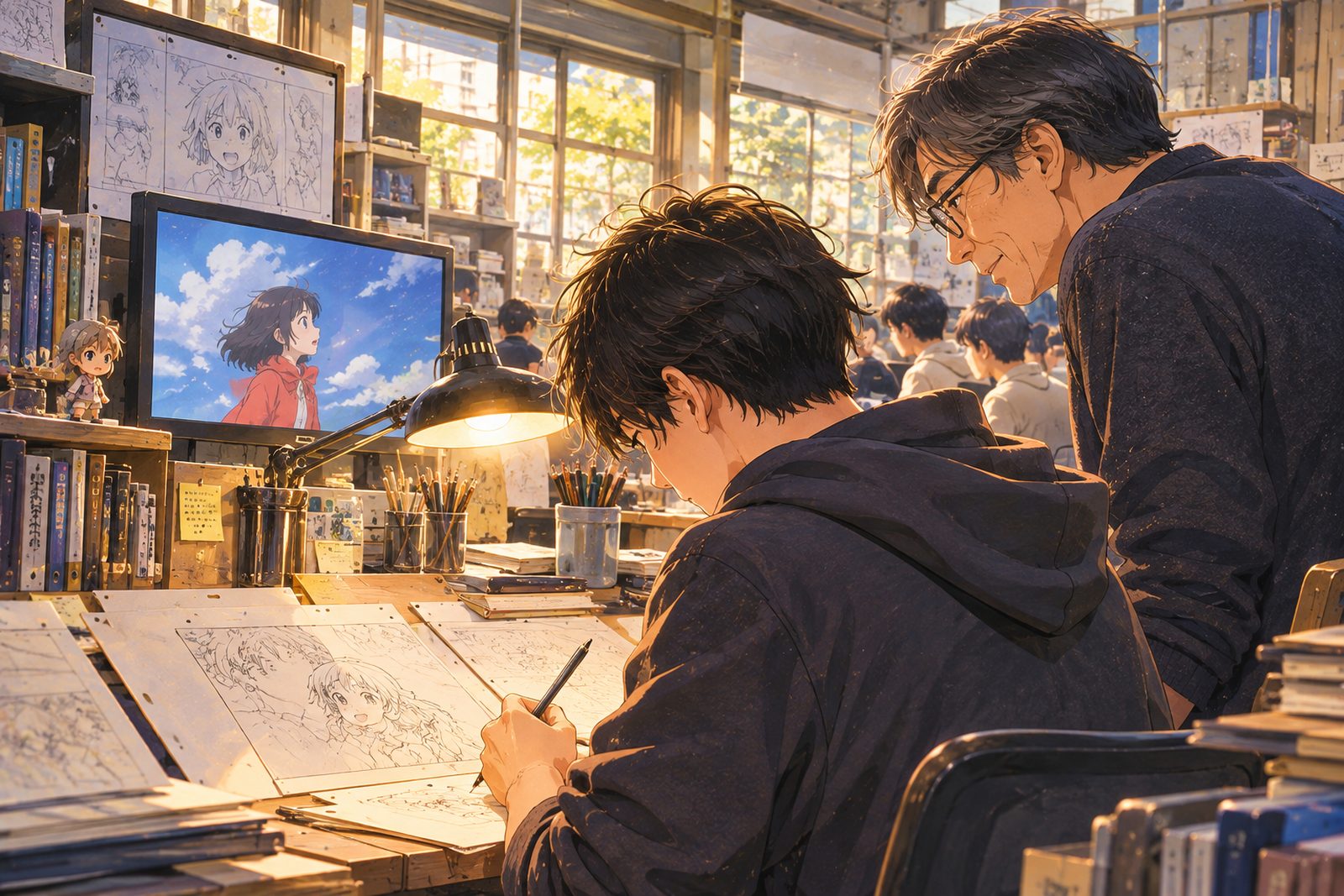
Character movement in Japanese anime is mainly divided between two kinds of animators. Key animation, or “genga,” is handled by experienced animators who draw the most important poses in a movement. If a character throws a punch, the key animator draws the moment the fist gathers power and the moment it lands and stops. The other kind of animator fills in the transitional drawings between those poses. Their job title in Japanese is “douga,” and the drawings they make are known as in-betweens. Key animation sets the skeleton of the motion; in-betweens connect it smoothly.
A single TV episode of about 23 minutes needs anywhere from 3,000 to more than 10,000 in-betweens. The newcomer at the start of this story was drawing in-betweens, paid per drawing.
In 2019, veteran animator Toshiyuki Inoue talked about this price online. Inoue is known in the industry as “the perfect animator.” The motorcycle scenes in AKIRA and the bicycle scenes in Kiki’s Delivery Service come from his key animation. He recalled that when he started about 35 years earlier, an in-between paid 160 yen, and a TV key animation cut paid about 1,700 yen. By the late 2010s, key animation had risen to about 4,000 yen, more than double, but in-betweens were still around 200 yen.
Over those 35 years, anime images became far more detailed, and Inoue points out that a single in-between now takes longer to draw than it used to. Yet the price of the drawing at the very bottom barely moved. By his calculation, at the old ratio between key animation and in-between rates, an in-between today should be worth around 400 yen, and at least 300.
Average income is like an office worker’s. The low pay sits at the entrance
Reading this far, it’s easy to assume that all Japanese animators live on a few tens of thousands of yen a month. But the overall numbers tell a different story.
The Japan Animation Creators Association (JAniCA), a group of animators and directors, regularly surveys workers’ incomes. Its latest survey, in autumn 2025, collected 983 valid responses. Respondents’ average annual income was about 4.446 million yen, not far from the roughly 4.6 million yen average for Japanese office workers.
So what about that invoice? The answer is in how pay is distributed by role:
| Role | Average annual income (10,000 yen) |
|---|---|
| In-between (douga) | about 228 |
| Key animation | about 415 |
| Animation director | about 522 |
| Director | about 734 |
Respondents aged 20 to 24 averaged only about 2 million yen a year. Those in their 40s and 50s mostly fell between 5.9 and 6 million yen. Low pay in Japan’s anime industry isn’t spread evenly across everyone. The lowest prices fall on the youngest, least experienced people.
So why does anyone still walk through this entrance?
What 200 yen buys is a place as an apprentice
Because in-betweening isn’t just a job. It’s also a period of training.
In-betweening looks like tracing, but it’s actually a fine craft. The animator has to grasp the key animator’s intent and decide how the motion moves between two poses, which drawings sit closer to the first pose and which to the second, so the movement has rhythm, speeding up and slowing down. Japanese labor researchers pointed out long ago that in-betweening is this industry’s “training period.” Newcomers start with in-betweens and move up to key animation once their skills are good enough. After years of key animation, some become animation directors, others move into directing.
Hitomi Tateno, who worked at Studio Ghibli for more than 20 years on films including My Neighbor Totoro and Spirited Away, later founded Sasayuri, a training school for new animators. She puts it plainly: in-betweening is the entrance to being an animator.
So when a newcomer draws an in-between for 200 yen, what they’re also getting is a place to hone their skills in a professional setting. It’s a lot like a traditional apprenticeship: apprentices are paid very little because the master is teaching them at the same time.
That also explains why low pay hasn’t directly dragged down quality. Whether an anime looks good depends above all on key animation, storyboards and animation direction, and those stages are mostly in the hands of veterans who have already made it through their apprenticeship.
Take the animation director. Key animation for one TV episode may be split among dozens of key animators working at once, each with a slightly different touch. Put together as is, the same character’s face might look different in every shot. The animation director goes through all the key drawings and corrects the off-model faces one by one so the whole episode looks as if one person drew it. Much of the “visual consistency” viewers see is the animation director’s corrections. And animation directors are usually paid a fixed amount per episode, so the more uneven the key animation that comes in, the more they have to fix, without earning a single extra yen.
In other words, Japanese anime’s high quality relies on a structure of layered quality control. At the bottom is a large group of young people trading low pay for experience; at the top is a group of veterans absorbing extra corrections for fixed fees. This structure has worked for decades on one condition: that today’s in-between animators become tomorrow’s key animators.
Quality is made by veterans, but the veterans are the ones who made it through a low-paid apprenticeship. For years, that tuition has been paid by the young people themselves.
About 80% of the apprentice positions have moved overseas
The problem is that the first rung of this ladder is disappearing.
The industry generally estimates that about 80% of in-between and coloring work for Japanese anime is contracted out to overseas animation companies, mainly in other Asian countries. For producers it’s a practical choice: one season of anime needs tens of thousands of in-betweens, more than domestic staff can draw. When several anime in Japan were postponed in a row from late 2022 to spring 2023, the industry pointed to this heavy reliance on overseas production as one of the causes.
But when in-betweening goes overseas, the apprentice positions go with it. Big studios used to have in-house in-between departments, where newcomers sat next to veteran animators and learned to draw by having their drawings sent back for corrections, one after another. Now that most in-betweens are done abroad, newcomers in Japan have fewer chances to practice and to be corrected face to face by senior colleagues.
The deal of an apprenticeship is “low pay in exchange for learning.” When the chances to learn shrink, all that’s left is the low pay. JAniCA’s first large-scale survey, in 2009, found that animators in their 20s earned an average of about 1.1 million yen a year, under 100,000 yen a month, a struggle even to cover rent in Tokyo.
Meanwhile, the veterans are getting older. Respondents’ average age rose from 33.7 in 2005 to 37.8 in the latest survey. The structure depends on a steady stream of newcomers climbing up. If fewer climb up, the veterans at the top will eventually retire.
Someone has started paying young people’s tuition
Fortunately, people have begun redoing the math.
The earliest attempt came from Studio Ghibli. Only Yesterday, released in 1991, was the first Ghibli film made with full-time employees, as animators switched from piece rates to fixed monthly salaries. Producer Toshio Suzuki later reflected that keeping a staff meant having to make one film after another without stopping. Ghibli kept it up for more than 20 years until it disbanded its production department in 2014. It showed that employing animators is possible, but the studio has to carry heavy fixed costs.
Another approach is government funding. Since 2010, Japan’s Agency for Cultural Affairs has funded a young animator training program. Each year it selects a few studios and pays production costs for each to make a short anime with animators in their 20s. Veterans provide guidance, and correction work is deliberately left to the young animators themselves. Little Witch Academia, which later became a series, came out of this program.
In the streaming era, platforms have joined in. In 2021, Netflix and animation studio WIT STUDIO launched the WIT Animator Academy, with a curriculum designed by Tateno’s training school and Netflix scholarships covering six months of tuition and living expenses for trainees.
A bigger change is in how animators are hired. In surveys of anime creators, the share of freelancers paid by the piece fell from 69.6% in 2019 to 47.3% in 2023. More and more studios are bringing animators on as employees, partly to compete for talent: there are only so many good animators, and only studios that can offer stable income can keep them. The average annual income of in-between animators rose from about 1.11 million yen in 2015 to more than 2.6 million yen in 2023, and average monthly working hours fell from about 231 to about 191.
These numbers are still far from “good pay,” and animators in their early 20s still earn only about 2 million yen a year on average. But the direction is clear: the tuition young people used to pay themselves is gradually shifting onto studios, platforms and government.
Japanese anime isn’t good because of low pay
Back to that 220-yen invoice.
On the surface, it’s a symbol of low pay. From the industry’s point of view, it’s closer to tuition. Japanese anime has maintained high quality for decades not because of animators’ selfless passion, nor simply because of exploitation, but because of a tightly organized master-apprentice structure: veterans control quality, newcomers trade low pay for the chance to grow, and those who make it through become the next generation of veterans.
So “pay is low, yet the work is so good” should be read the other way around. Japanese anime was never good because of low pay. It’s good because generation after generation of people made it through the low pay. As for those who couldn’t, we’ll never get to see what they might have drawn.
Toshiyuki Inoue says an in-between should be worth at least 300 yen. It’s not a big number, but the idea behind it is clear: the cost of an apprenticeship shouldn’t be paid by the apprentice alone. Whether Japanese anime stays this good from here on depends on how much of that tuition can be moved out of young animators’ pockets and onto the people who actually profit from the work.
Notes
- The invoice amounts at the start come from figures the animator published themselves. The rate of about 220 yen per drawing is estimated from the breakdown.
- The prices Toshiyuki Inoue mentions are his recollections of rates when he entered the industry (around the mid-1980s) and in the late 2010s. Actual rates vary by studio.
- Income figures by age and role come from JAniCA’s Anime Creators Survey 2026 (conducted October–December 2025, 983 valid responses). That survey put average in-between income at about 2.275 million yen, lower than about 2.63 million yen in the 2023 survey, but sample compositions differ between surveys, so increases and decreases shouldn’t be compared directly. The figures “about 1.11 million yen in 2015 and more than 2.6 million yen in 2023” come from a compilation of past surveys in a report commissioned by the Ministry of Economy, Trade and Industry.
- The average annual income of about 4.6 million yen for Japanese office workers comes from the National Tax Agency’s Statistical Survey of Private Sector Salaries.
- “About 80% of in-between and coloring work contracted overseas” is a common estimate in industry and JAniCA materials, not a precise statistic.
References
- Anime News Network|Veteran Animator Toshiyuki Inoue Gives Young Animators Advice to Negotiate Better Wages|2019-03-05 (Toshiyuki Inoue on in-between and key animation rates)
- AUTOMATON WEST|Japanese animator’s first monthly wage is barely over $100|2024-03-07 (a new in-between animator’s invoice)
- Japan Animation Creators Association (JAniCA)|Anime Creators Survey 2026 report|2026 (income, age and role distribution, working hours, average age)
- Ministry of Economy, Trade and Industry / Mitsubishi UFJ Research and Consulting|Survey report on working conditions in anime production|2026-03 (changes in income by role across past surveys)
- nippon.com|Labor issues in the anime industry|2025 (freelancer share from 69.6% to 47.3%, the shift to in-house production)
- JAniCA (桶田大介)|Anime production workflow and roles centered on animators and directors (Ministry of Health, Labour and Welfare material 4-3)|2023-10-03 (number of in-betweens, fixed pay for animation directors, overseas outsourcing share)
- 勇上和史|Labor in the anime industry (Japanese Journal of Labour Studies No. 549)|2006-04 (in-betweening as a training stage, outsourcing weakening training)
- ITmedia|20代アニメーターの平均月収は10万円以下――JAniCAシンポジウム2009|2009-05-28 (the 2009 survey)
- ASCII.jp (まつもとあつし)|アニメの放送延期が続出した原因は「海外依存8割の動仕」にあるが解決は困難|2023-09-23 (80% reliance on overseas work, 2022–23 postponements)
- Sakugabooru Blog|The Long Quest To Fix Anime’s Collapsing Mentorship|2023-03-31 (the young animator training program, Little Witch Academia, the shrinking of in-house in-between departments)
- AV Watch|Netflix、WIT STUDIOとアニメーター育成「WITアニメーター塾」|2021-02-12 (WIT Animator Academy)
- KAI-YOU|Hitomi Tateno (Hitomi Tateno’s career)
- Hon no Hanashi (Toshio Suzuki)|汗まみれジブリ史 今だから語れる制作秘話|2014-09-21 (Only Yesterday as the first film made with full-time staff)
- nippon.com|Interview with Toshio Suzuki|2016 (the production department disbanded in 2014)
- Anime! Anime!|Article on Toshiyuki Inoue’s TBS Radio appearance|2018-08-09 (“the perfect animator” nickname, signature scenes)
Follow the story in person
Join a small-group trip to the places in our stories and meet the people who live and work there.
See trips and dates
Water Mirror is a Tokyo-based company that helps more people step inside industries and explore the stories and cultures of different fields around the world. We design in-depth learning programs for individuals, companies, schools and organizations, combining company visits, exchanges with professionals, local learning and hands-on experiences, so participants can see how industries really work and meet the people and stories behind them. Water Mirror Perspectives is our content media, telling the distinctive stories of industries, local cultures and people, so that reading sparks curiosity and leads readers to go and see for themselves.
About Water Mirror →