Key Points
- In 2018, a kohaku (red-and-white) koi named “S Legend” sold for ¥203 million, the highest price ever paid for a single koi.
- A koi’s value comes mainly from bloodline and competitions: S Legend won Grand Champion at the 2017 All Japan Combined Koi Show out of 1,882 entries, and fewer than 0.01% of fry ever become good enough to win at a show.
- Koi originated in the 19th century from carp raised for food beside rice terraces around Yamakoshi in Niigata Prefecture. The 2004 Chuetsu earthquake killed about 1.3 million koi, but the best bloodlines survived.
- Japan’s top shows accept entries only from domestic breeders, so foreign owners often keep their fish in Japan to compete. Nearly two-thirds of entries at the 2024 show belonged to overseas owners, and koi exports reached ¥9.97 billion in 2025.
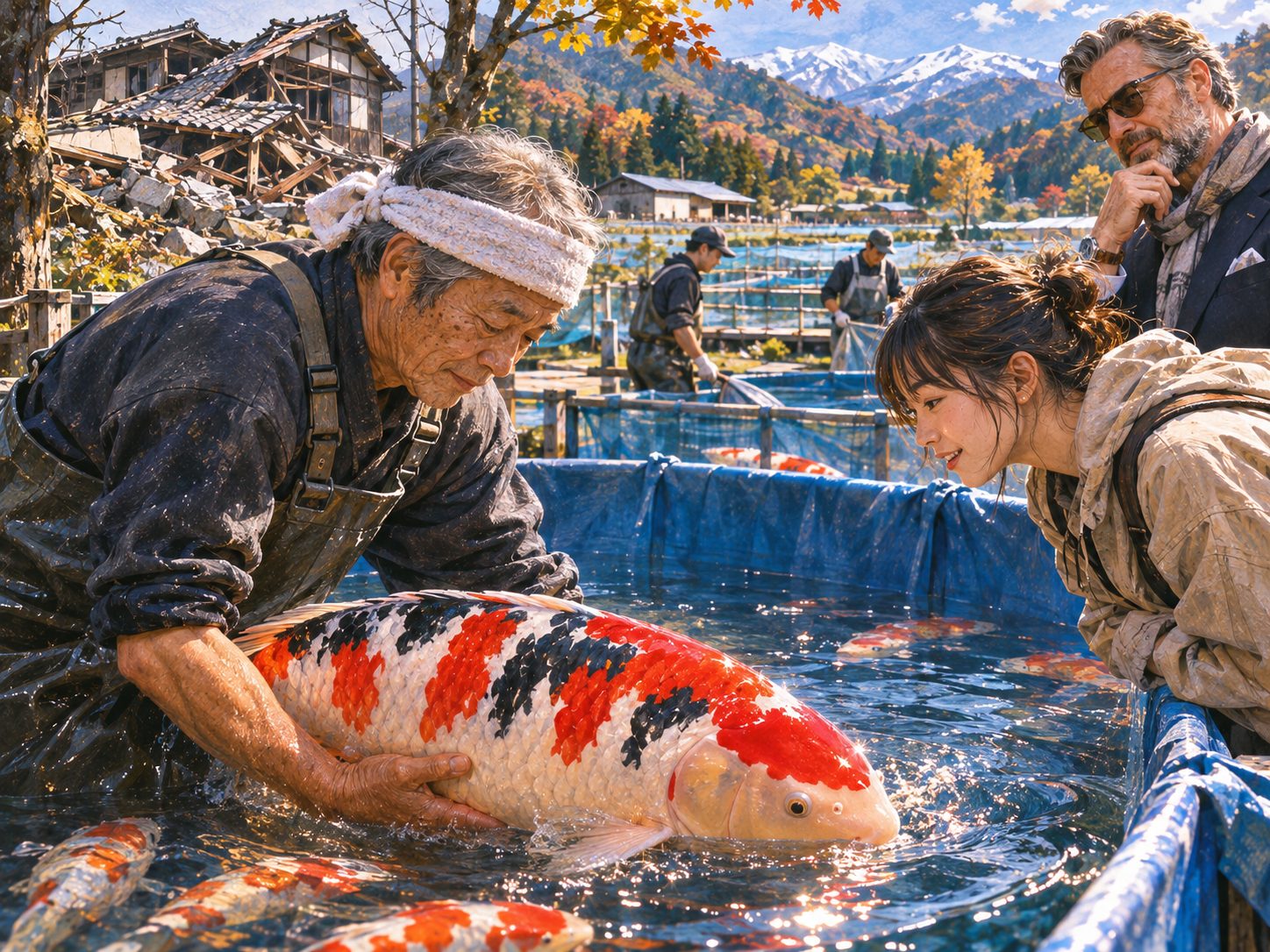
In the autumn of 2018, Sakai Fish Farm in Hiroshima Prefecture held an auction. The lot was a 9-year-old female koi, 101 centimeters long, her white body covered with a few patches of vivid red. In Japan this color pattern is called kohaku, the oldest and most fundamental koi variety.
Bidding see-sawed between two buyers until a collector won with a bid of ¥203 million, about $1.8 million at the time. It was the highest price ever paid for a single koi, more than three times the previous record.
The fish was called S Legend. She eats fish food and lives in a pond. In the end, she’s a carp. In rural Japan, carp were originally something you ate, and in many places you can still buy them at the fishmonger. How can the same species be dinner at one end and, at the other, worth as much as a luxury apartment in central Tokyo?
The answer is that most of that ¥200 million didn’t buy the fish. It bought a kind of certification that only Japan can issue.
Before she ever reached the auction block, she had already been certified
The auction wasn’t the first time S Legend had been seen.
She was born at Sakai Fish Farm, and at 16 months old she was picked out from three or four candidates by a Japanese hobbyist named Daishiro Shirasaka. At 28 months she entered her first show and won nothing.
The turning point came in January 2017. At the 48th All Japan Combined Koi Show, she took Grand Champion out of 1,882 entries. Organized by the industry body the All Japan Nishikigoi Promotion Association and held in Tokyo every year, the show is regarded as the largest and most prestigious in the koi world. Winning Grand Champion is something like a great racehorse winning the most important race of the season. Shirasaka had finished second five times before and been nicknamed “the eternal runner-up.” This was his first Grand Champion. The “S” in her name stands for both the breeder, Sakai, and the owner, Shirasaka.
What do koi shows judge? Judges look mainly at three things: body shape, color and pattern, and overall presence. Breeders often say body shape matters most: viewed from above, the ideal koi looks like a full spindle, and her body doesn’t wobble as she swims. The colors must be pure, the red deep and even, the white clean, and the boundary between them crisp. The last quality is hard to quantify. The industry uses the word hinkaku, roughly “dignity,” to describe a fish’s presence in the pond.
So when S Legend went up for auction, buyers weren’t looking at just a beautiful fish. They were looking at a fish that had already been certified by Japan’s most prestigious competition.
Among 10,000 fry, there may not be a single champion
S Legend had one more especially valuable trait: she was female.
A mature female carp can lay hundreds of thousands of eggs at once, but a koi’s pattern is a mix of genetics and luck. Most offspring of the same parents end up with lopsided patterns or poor body shape. Breeders cull them again and again as they grow, and in the end only about 0.5% can be sold as commercial koi, and fewer than 0.01% are good enough to win at a show.
In other words, among 10,000 fry, there may not be even one of champion quality.
So part of the value of a prizewinning female is really the odds of a champion appearing in the next generation. Buying S Legend meant buying a proven set of genes along with her.
So where did this system of culling and certification come from? Why does the power to judge good koi from bad still rest in Japan? The answer goes back two hundred years, to a mountain village sealed in by heavy snow every winter.
The ancestors of koi were carp that snow-country farmers raised for food
The mountains of central Niigata Prefecture were once home to some twenty-odd mountain villages, one of them called Yamakoshi. The area is one of Japan’s famously heavy-snow regions. Villagers carved terraced rice paddies out of steep slopes and dug many small water-storage ponds beside the paddies, where they raised black carp for food, a source of protein for winter when snow cut the mountains off.
In the first half of the 19th century, mutant fish with red markings appeared among these food carp. Normally you’d eat them, but the farmers here kept them and bred them to see whether even more beautiful ones would appear. That was the beginning of koi breeding.
It wasn’t entirely chance. In spring, farmers released the young fish into the terraced paddies so the carp grew alongside the rice. After the autumn harvest, they moved the carp into ponds beside the paddies, and before the snow fell, into ponds near the house for the winter. Scooping up each fish, looking it over and moving it like this every year, a farmer would easily notice which one looked different.
Over the next century, the number of patterns kept growing. Three varieties, kohaku, taisho sanshoku and showa sanshoku, are still the “big three,” the most highly regarded at shows today. In 1914, these mountain villages sent their colored carp to an exposition in Tokyo, where they drew attention, and the name nishikigoi gradually spread. Nishiki refers to richly colored brocade. Even earlier, in 1912, the villages had already held their first show. From then on, “putting carp side by side and having experts judge which is better” became inseparable from what koi are.
An earthquake nearly cut koi bloodlines
On October 23, 2004, a magnitude 6.8 earthquake struck the Chuetsu region of Niigata Prefecture. Landslides cut off the roads in and out of Yamakoshi, and all of its more than 2,000 residents were evacuated by helicopter. The village-wide evacuation lasted a full three years.
For koi breeders, the earthquake didn’t just topple houses. It destroyed ponds. Earthen ponds collapsed or cracked, the water drained away, and the koi died in the mud. Across the Chuetsu region, about 1.3 million koi died. Tadao Tanaka, a breeder in Yamakoshi, had kept tens of thousands. After the earthquake, he had 26 left. When the koi died, he says, he couldn’t even speak.
Even after the evacuation, some breeders went back to the village through the aftershocks and used generators to pump air into the surviving ponds. Eventually about 250,000 koi were rescued. That isn’t many compared with the 1.3 million that died, but Mamoru Kodama, a koi dealer who helped with the rescue, said the very best bloodlines had not been wiped out.
That’s crucial. Koi value rests on bloodlines, and bloodlines can’t be built from scratch. As long as a few good parent fish survived, Yamakoshi could rebuild.
After the earthquake, Yamakoshi’s population fell from about 2,100 to about 730. At Marushige Koi Farm in the same village, 80% of the fish died, there was no income at all for three years, and it took ten years for the business to truly stabilize. Later all three sons came home to raise koi, with the eldest in charge of exports. One day in 2017, standing beside Marushige’s ponds were a Dutch dealer who had done business with them for nearly 20 years and customers from Singapore and Hong Kong. Seventy to eighty percent of the koi produced locally are sold overseas.
A mountain village that lost two-thirds of its people got back on its feet with orders from the other side of the world.
Why do wealthy foreigners keep their fish in Japan?
First, the numbers. In 2003, Japan’s exports of ornamental fish (mostly koi) were worth about ¥1.4 billion. In 2025, koi exports alone reached ¥9.97 billion, a record. More than 60% of koi produced in Japan are raised for export.
In this growth, Chinese buyers hold a special place. Yutaka Suga, a professor at the University of Tokyo, says that in China, carp swimming upstream symbolize perseverance and success, linked to the legend of the carp leaping over the Dragon Gate. As China’s wealthy class grew rapidly from the 2000s, koi became collectibles with both cultural meaning and status value.
But many of these foreign buyers’ fish don’t live with them.
The reason lies in the rules. Japan’s top koi shows accept entries only from domestic breeders. So many foreign owners, after buying a fish, leave it at a Japanese koi farm, pay the breeder to raise it, and enter it in shows under the breeder’s name. Once the fish has made a name for itself, they take it home.
It’s a lot like horse racing: the owner pays for and owns the horse, but a professional stable feeds and trains it every day. A koi owner buys a promising young fish and has a Japanese breeder keep raising it, hoping it will grow into a champion a few years later. For the koi farm, boarding fish is a business in itself.
How big is this system? The 2024 All Japan Combined Koi Show had 1,843 entries, 1,189 of them belonging to overseas owners. At Japan’s most prestigious koi show, nearly two-thirds of the fish belonged to foreigners.
That also explains why foreigners will pay so much for Japanese koi. They believe the fish’s value will be continually confirmed by a recognized system: Japanese bloodlines, Japanese breeders, Japanese shows and Japanese judges. Only there does its value count.
The biggest buyer suddenly stopped importing, yet the market hit a record
At the end of October 2023, this system took its first hard knock.
To export Japanese koi to China, they must first complete quarantine at koi farms approved by the Chinese side. Those approvals expired one after another without renewal, and the last one lapsed on October 30, 2023. From November, Japanese koi effectively could no longer be exported to China. At the time, China accounted for about a fifth of Japan’s koi exports by value.
You’d expect the market to plunge when its biggest customer suddenly vanished. It didn’t. In 2024, China accounted for only about 4% of exports, but total exports still rose from ¥6.66 billion to ¥7.23 billion. The United States, Vietnam and Hong Kong became the largest markets, and European countries also took a sizable share. In October 2024, China partially resumed imports, and in 2025 exports jumped to ¥9.97 billion.
My reading is this: Chinese buyers did change the market, but not by dominating it. In the 2010s, they pushed the price ceiling for top koi sharply higher, reminding collectors worldwide how much a Japanese champion koi could be worth. When China temporarily stepped away, buyers from other countries took over a market whose prices had already been raised.
What really worries the Japanese industry is that breeding has started abroad too. Some breeders fear that foreign-bred koi could trade on the Japanese name the way Australia raised huge numbers of “WAGYU” cattle from Japanese bloodlines. So the All Japan Nishikigoi Promotion Association has developed a “certificate of production,” and the industry is studying implanting microchips in high-value fish to keep an identity record for each one.
What ¥200 million buys is an appraisal issued by Japan
Look again at S Legend’s name.
That “S” stands for two Japanese family names: Sakai, who bred her, and Shirasaka, who raised her into a champion. Her name records every step she took in Japan: which koi farm she was born at, who picked her out, and at which show she was chosen from nearly 1,900 fish.
That record is valuable because behind it lies a whole set of things others find hard to copy: the habit, two centuries old, of picking out colored carp beside snow-country rice terraces; standards built up over more than a hundred years, one show at a time, by people who know the fish; and the bloodlines saved after the 2004 earthquake by breeders who went back through the aftershocks with generators.
So why can a single koi sell for ¥200 million? I think the more accurate way to put it is this: what the buyer pays for is an appraisal issued jointly by a mountain village, a bloodline and a show. The fish can swim anywhere in the world, but that appraisal can still only be issued in Japan.
Notes
- Koi export figures: before 2018, the statistical category was “ornamental fish (excluding goldfish)”; from 2019 it became “ornamental fish: carp,” so the scope differs slightly.
- The claim that the first show was held in 1912 comes from local records (Fisheries Agency materials describe it as “said to have been”).
- S Legend’s buyer was a collector from Taiwan.
References
- Khaleej Times|World’s most expensive fish bought for Dh6.7 million|2018-10-05 (S Legend’s sale price and length)
- Oddity Central|World’s Most Expensive Live Fish Bought for a Whopping $1.8 Million|2018-12-24 (¥203 million, auction location, egg count, previous record)
- PTS News (Taiwan)|日世界冠軍錦鯉 在台5500萬天價得標|2018-10-09 (buyer, age 9 and 101 cm)
- Hikari (Kyorin)|Mr. Daishiro Shirasaka interview (how Shirasaka bought her, growth record, Grand Champion, origin of the name, “eternal runner-up”)
- Hikari UK|2017 All Japan Grand Champion fed and raised on Saki-Hikari|2017 (48th Grand Champion)
- Niigata Prefecture|錦鯉について(錦鯉の歴史) (birthplace, timeline of varieties, 1914 exposition, 0.5% and 0.01%)
- MAFF Hokuriku Regional Agricultural Administration Office|Japanese Nationally Important Agricultural Heritage System「雪の恵みを活かした稲作・養鯉システム」 (food carp raised in ponds beside terraces as winter protein)
- Japan Tourism Agency multilingual commentary database|山古志の錦鯉 (red-marked mutant carp, moving fish from terraces in spring to ponds in autumn)
- Cabinet Office disaster management|特集 新潟県中越地震から20年|2024 (village-wide evacuation, population change, aerating ponds with generators, about 250,000 rescued)
- Shimbun Akahata|被災地はいま 新潟中越地震 支援求めるニシキゴイ産地|2004-11-27 (Tadao Tanaka’s losses and words, 1.3 million fish)
- Nishiki Colorful Koi (reprint of Mamoru Kodama’s appeal)|October 23rd, a Day to Remember (the best bloodlines were not wiped out)
- な!ナガオカ (Nagaoka City)|「錦鯉」で世界とつながる!若きブリーダー3兄弟が描く、地域復興の未来図|2017-12-13 (Marushige Koi Farm’s losses and recovery, the three brothers, overseas customers)
- Fisheries Agency|内水面関係情報(錦鯉) (export trends, 2024 export destinations, production value and export share, domestic vs. overseas owners at the 55th show)
- JETRO|錦鯉業界の新たな取り組み|2026 (¥9.97 billion in exports in 2025, certificates of production, microchips)
- Wire report (via The Jakarta Post)|Koi story: priceless Japanese fish make a splash|2018-01-07 (top shows limited to domestic breeders, foreign owners boarding fish, Yutaka Suga’s view)
- Gendai Business|article on designating nishikigoi as Japan’s national fish|2019-03-25 (boarding contracts in Japan, foreign-bred koi compared to WAGYU)
- AP (via ClickOnDetroit)|Koi emerges as new source of souring relations between Japan and China|2023-11-10 (China about one-fifth of exports, October 30 expiry)
- The Japan Times|China resumes imports of Japanese koi|2024-10-22 (resumption of exports)
Follow the story in person
Join a small-group trip to the places in our stories and meet the people who live and work there.
See trips and dates
Water Mirror is a Tokyo-based company that helps more people step inside industries and explore the stories and cultures of different fields around the world. We design in-depth learning programs for individuals, companies, schools and organizations, combining company visits, exchanges with professionals, local learning and hands-on experiences, so participants can see how industries really work and meet the people and stories behind them. Water Mirror Perspectives is our content media, telling the distinctive stories of industries, local cultures and people, so that reading sparks curiosity and leads readers to go and see for themselves.
About Water Mirror →