Key Points
- The first karaoke room is generally said to be Yellow Box Karaoke Plaza, which opened in 1985 on the outskirts of Okayama, Japan. Its owner, Yoichi Sato, ran an udon shop beside an industrial road. Singing was bothering his noodle customers, so he moved the karaoke equipment into an old truck container, and realized he could simply run the business inside it.
- The container worked because three conditions came together. Old containers were cheap, could be dropped in place and lifted away, and landowners in the bubble economy were happy to rent out land. New karaoke machines let customers choose songs themselves and showed lyrics on screen, so no staff were needed in the room. And roadside land on the outskirts was plentiful, easy to reach by car, and far from neighbors who might complain about noise.
- The private room changed karaoke from “singing for strangers in a bar” to “singing behind a closed door with people you know.” Housewives, students, young women and whole families became new customers. The number of karaoke rooms in Japan rose from 52,578 in 1990 to a peak of 160,680 in 1996.
- What a karaoke room really sells is a soundproof private room rented by the hour. That is why it can now serve as a place to sing alone, work remotely or join online meetings. In fiscal 2023, Japan still had 8,298 karaoke box businesses with 112,600 rooms.
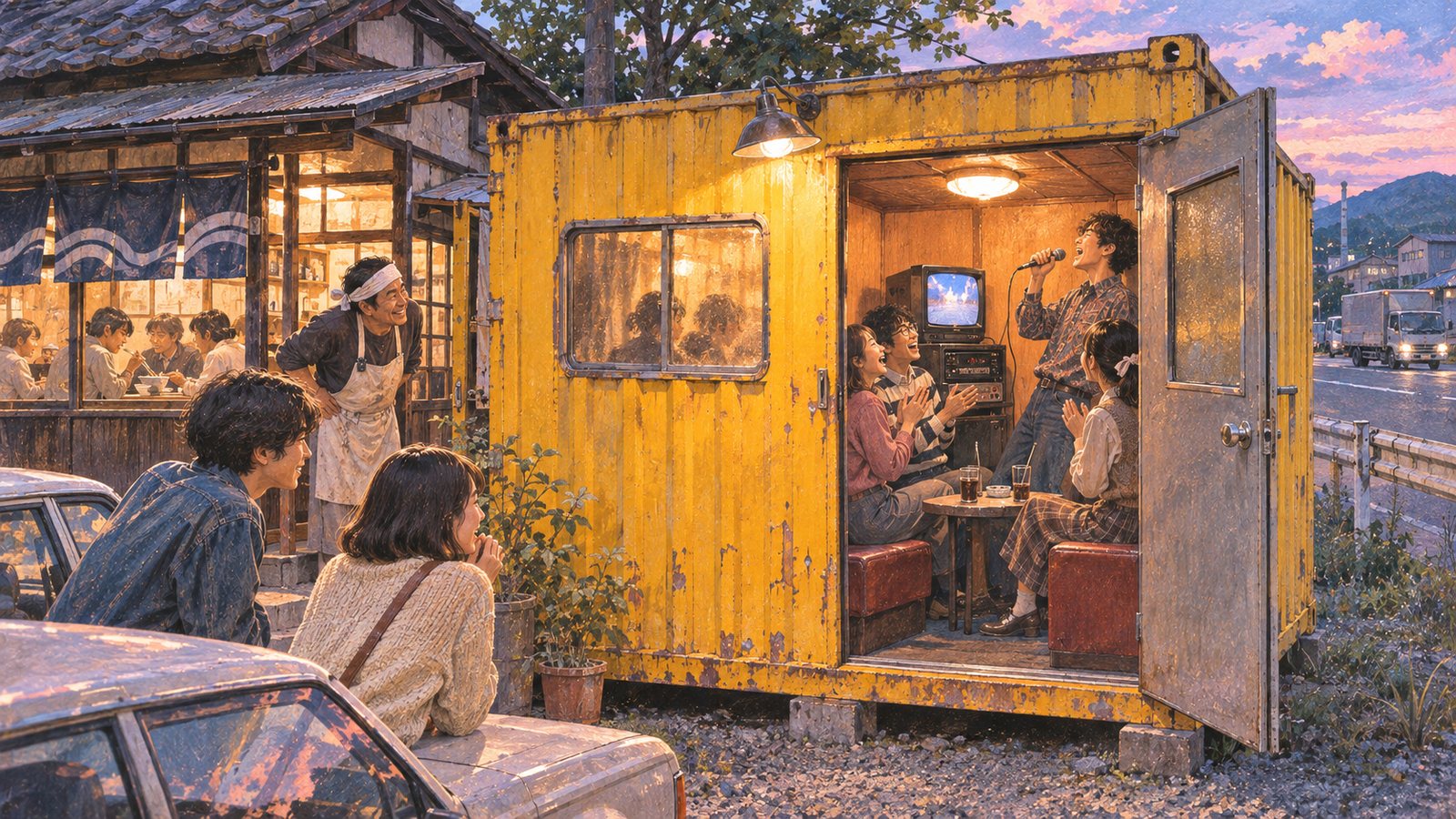
On May 9, 1985, a new shop opened beside an industrial road on the outskirts of Okayama. It was not really a shop but old shipping containers sitting on empty land, painted a bright yellow that drivers could see from far down the road. Inside were karaoke machines. Customers closed the door and sang whatever they liked.
It was called Yellow Box Karaoke Plaza (イエローBOXカラオケ広場), and it is generally considered the world’s first karaoke room. Business was so good that customers had to phone ahead, and waits of three to five hours were common.
Nearly forty years later, in fiscal 2023, Japan had 8,298 karaoke box businesses with more than 110,000 rooms. From Seoul and Shanghai to New York, there are private rooms where friends close the door and sing, called KTV in some places and noraebang in others. Few people realize that this form of entertainment, now found worldwide, began with a steel box for carrying freight on a country roadside.
Why a container? And why the outskirts of Okayama rather than downtown Tokyo or Osaka? To answer both questions, we need to go back to a noodle shop.
Noodle customers complained about the noise, so karaoke moved into a container
Yoichi Sato had been a truck driver. He noticed that huge numbers of trucks used the industrial road on the edge of Okayama every day, yet there were few places along it to eat. So he opened an udon shop beside the road to serve the drivers, and also ran a karaoke kissaten so customers could sing a few songs after eating. A kissaten is a traditional Japanese coffee shop serving coffee and light meals, and some had karaoke machines to draw in customers.
Later Sato’s wife was hospitalized, and he had to run both businesses by himself. He moved the karaoke equipment into the udon shop, but the noodle customers complained it was too noisy. To get the machine out of the way, he installed it in an old truck container. Once it was set up, he had an idea: why not just run the business inside the container?
The idea sounds simple, but at the time it was new. In 1980s Japan, karaoke lived mostly in snack bars (スナック). A snack bar is a common type of small Japanese bar, usually run by a hostess known as the mama-san, with regulars who are mostly middle-aged office workers stopping by after work. Customers requested songs, staff ran the machine, and when your turn came you took the microphone and sang in front of everyone in the bar, strangers included. Karaoke back then was a sideshow to drinking; people sang to make the drinking more fun.
Sato’s container turned that order around. You came here to sing, and the only people in the room were you and your friends.
Why a container? Cheap, easy to move, and landowners liked it
The first reason for a container was that it was cheap and ready-made. Sato used retired truck containers. He cut in doors and windows, added insulation and furnished the inside like a living room. It cost far less than putting up a building.
A container had another advantage: put it down and you could open for business, and if things didn’t work out, lift it away. That appealed especially to landowners. The late 1980s were the years of Japan’s bubble economy. Land prices kept rising, and many people with land were looking for business. Building something to rent out cost a lot and was hard to undo. Placing a few container rooms on an empty lot took little investment, could be removed quickly, and brought in decent income. For landowners it was a low-risk business, and karaoke rooms soon popped up on empty lots across the country.
Roadsides on the edge of town also happened to suit the business. Land was wide, parking was easy, and customers could drive in. Singing gets loud, and with few neighbors on the outskirts, fewer people complained. Noise problems at karaoke businesses only became serious later, after they moved into quiet residential areas.
Readers might ask: containers had been around for a long time, and so had karaoke machines. Why did nobody do this until around 1985?
The answer lies in the machines. Early karaoke used eight-track tapes, each holding several backing tracks. To sing a particular song, staff had to find the tape and swap it in, while customers leafed through a lyrics book. That kind of machine was hard to put in a small room with no staff. In the first half of the 1980s, karaoke on video discs (LaserDisc) appeared, with lyrics shown on the TV screen and changing color as you sang. Then came the “autochanger,” a machine loaded with many discs at once, so customers could pick songs themselves by entering a number.
Once choosing songs and reading lyrics no longer needed help, a room with its door closed could run on its own. Sato’s container arrived just as these technologies matured.
Who were the customers queuing for five hours?
The customers of the yellow containers were very different from the regulars at snack bars.
In the morning came older customers and housewives. At midday there were junior high and high school students, and late at night young people, plus families arriving by car. The songs changed too: the enka popular in snack bars gradually gave way to the pop songs young people loved. Private rooms also got many more women singing karaoke; housewives would meet friends to sing while their children were at school.
Most of these people had rarely gone to snack bars before, and the reasons are easy to see. A snack bar is a place for drinking, not suitable for students or families with children, and singing in front of strangers is a bit awkward for many people. The private room removed all these barriers at once: no need to drink, no waiting for strangers to finish, and only your friends hear whether you sing well.
There was another background factor. Urban development had left less room to play outdoors, and young people were already used to entertaining themselves in their own rooms, so they took to “playing behind a closed door” especially quickly. By the early 1990s, the biggest group of karaoke room customers was women in their twenties, while office workers mostly still went to bars.
Pricing was simple too. The first container rooms charged 100 yen per song, with no need to order drinks or pay a seat charge, so students could afford it with their pocket money. Later most karaoke rooms switched to charging by room and by time, so a group could split one room and sing as many songs as they liked.
In the end, what a karaoke room sells is a space just for your own group. Karaoke machines had been in snack bars for more than a decade. What the private room changed was who could sing, where they sang and who they sang with.
From containers to buildings, and online song delivery takes rooms nationwide
After the yellow containers opened, morning TV shows and magazines covered them, and karaoke rooms quickly caught on across Japan.
But container rooms also drew criticism. A row of closed steel boxes by the road, where no one could see inside, made some people worry they would become hotbeds of crime or gathering spots for teenagers. Operators began moving karaoke rooms into buildings in downtown and commercial areas, dividing each floor into many soundproof rooms, which is the form familiar today.
What truly made karaoke rooms multiply was “online karaoke” in the early 1990s. With disc-based karaoke, every new song meant another disc, and it often took a long time before a newly released song could be requested in a shop. In 1992, JOYSOUND launched online karaoke that delivered songs over phone lines: backing track data was sent from a remote computer to the shop, so new songs became available quickly. By the mid-1990s, a single machine held more than 10,000 songs.
More songs, updated faster, gave people more reasons to keep coming back. Karaoke rooms numbered 52,578 in 1990 and 160,680 in 1996, tripling in six years. The number of people doing karaoke reached about 58.9 million in 1994, roughly one in every two Japanese people.
Some people rent the room without singing
After 1996, both the number of rooms and the number of people doing karaoke stayed near their peak, then slowly declined. During the COVID-19 pandemic, about one in ten karaoke box businesses closed, and participants fell to about 25.9 million in 2021.
But karaoke rooms did not disappear. In fiscal 2023, participants recovered to about 37.8 million, and rooms increased by 1,400 to 112,600, the first rise since 2020.
What has changed is how people use the rooms. “Hitokara,” going to karaoke alone, has become more and more common: some people just want to sing to their heart’s content, others go to practice. And some people do not sing at all. In Shibuya, Tokyo, one chain offers a solo plan on weekday daytimes for just 180 or 290 yen per 30 minutes, plus a drink order, to use a fully soundproof room for online meetings. A freelance worker said cafés don’t let you talk out loud, internet café seats are separated only by partitions, but a karaoke room is always a private room, and central Tokyo has more karaoke rooms than internet cafés, often empty during the day.
The karaoke room has also gone beyond Japan. In April 1991, an arcade in Busan, South Korea, partitioned off small rooms and put modified karaoke machines in them, at 300 won per song. The next year, more than 10,000 noraebang (노래방) were registered across South Korea. Today the KTV familiar in China, Singapore, the US and Canada is likewise a private room where friends close the door and sing.
Why is it still called a “box”?
Today’s Japanese karaoke rooms are in bright buildings, with touchscreen song selection, scoring systems and high-quality sound, very different from the steel boxes by the road. Yet the Japanese still call them “karaoke boxes” (カラオケボックス). The name is a trace of its birth in a shipping container.
Looking back, Sato’s invention was not the karaoke machine; machines existed before him. What he did was take singing out of the bar and put it into a soundproof room rented by the hour, belonging only to your own group. Because of that room, housewives, students and families started singing. Today, because of that same room, remote workers walk in too.
What has kept the karaoke room popular in Japan for forty years and carried it around the world is the room itself. It started as a container for a very practical reason: in 1985, on the outskirts of Okayama, the fastest and cheapest way to make a room with a door you could close was an old shipping container.
Notes
- Accounts differ on the year and place of the first karaoke room. Karaoke Hishi (A Secret History of Karaoke) quotes Sato as giving the opening date as May 9, 1985, while Karaoke Shinkaron (The Evolution of Karaoke) gives 1986. Records also differ on whether the first shop was in Hayashima town or in Okayama city. There are also claims that similar rooms appeared earlier elsewhere in Japan. This article follows the general account of the All-Japan Karaoke Industrialist Association and most books on the subject.
- Room numbers are the “number of karaoke box rooms” compiled by the All-Japan Karaoke Industrialist Association. The 1994 figure of 58.9 million participants is from The Japan Times, based on the White Paper on Leisure. Fiscal 2023 figures are from the Karaoke White Paper 2024.
- The remote work prices are as reported in October 2024 and may have changed.
Sources
- 岡山縣立圖書館(國立國會圖書館 レファレンス協同データベース)|カラオケボックスの発祥は岡山県、というのは本当か。(整理《カラオケ秘史》《カラオケ進化論》等專書的開業日期與說法)
- アイコム|日本が生んだ世界的エンタテイメント”カラオケ”第9回(佐藤洋一、產業道路、黃色貨櫃、排隊三到五小時、自動換片機與變色歌詞)
- あさよる|『カラオケ秘史 創意工夫の世界革命』書評(佐藤洋一的經歷、太太住院、搬進貨櫃的經過、地主投資、「箱子」名稱的由來)
- こうめいのブログ|カラオケ秘史 創意工夫の世界革命(客層變化、選曲由演歌轉向流行歌、路邊店先驅)|2018-01-24
- 日本の発祥地|【岡山県】カラオケボックスの発祥の地と誕生秘話(早島店或岡山市一號店、路邊貨櫃遭批評、搬進大樓、電視報導帶動流行)
- 鍛冶博之|カラオケの商品史(『社会科学』第40卷第4號,同志社大學人文科學研究所;包廂與女性及年輕人、噪音問題)
- nippon.com|カラオケの過去・現在・未来(貨櫃包廂一首 100 日圓、技術演進、市場規模、疫情約一成包廂關門、非唱歌用途)
- The Japan Times|Low key, off key, but anyway it’s your way(1990 年 52,578 間、1996 年 160,680 間、1994 年參加人口高峰、一人卡拉OK)|2008-07-01
- The Christian Science Monitor|Karaoke Boom Turns High-Tech(1993 年包廂最大客群為二十多歲女性)|1993-10-20
- XING|Corporate Profile(1992 年推出 JOYSOUND 連線卡拉OK)
- 全國カラオケ事業者協会|カラオケ白書 2024(2023 年度參加人口約 3,780 萬人、8,298 家、112,600 間)
- J-Net21(中小企業基盤整備機構)|カラオケボックス(2019–2022 年參加人口)|2024-05-15
- マネーポストWEB|カラオケボックスでテレワーク(平日一人方案價格、使用者說法)|2024-10-28
- Korea JoongAng Daily|Sing, sing a song: Noraebang turns 20(1991 年釜山第一間練歌房、改裝卡拉OK機器)
- 부산일보|노래방 변천사(1991 年 4 月、一首 300 韓元、隔年全國超過一萬家)|2019-05-28
- Wikipedia|Karaoke box(KTV、練歌房等各地名稱)
Follow the story in person
Join a small-group trip to the places in our stories and meet the people who live and work there.
See trips and dates
Water Mirror is a Tokyo-based company that helps more people step inside industries and explore the stories and cultures of different fields around the world. We design in-depth learning programs for individuals, companies, schools and organizations, combining company visits, exchanges with professionals, local learning and hands-on experiences, so participants can see how industries really work and meet the people and stories behind them. Water Mirror Perspectives is our content media, telling the distinctive stories of industries, local cultures and people, so that reading sparks curiosity and leads readers to go and see for themselves.
About Water Mirror →