Key Points
- Founded in 578 AD and headquartered in Osaka, Kongo Gumi builds and repairs Buddhist temples and Shinto shrines. It is the oldest company still operating in Japan.
- It lasted 1,400 years thanks to three things: a permanent client in Shitennoji temple, which needed rebuilding again and again; choosing successors on merit rather than blood, including adopting sons-in-law; and family precepts that demanded diligent use of the abacus and focus on the core business.
- After expanding into general construction in 1955, it underbid for contracts when Japan’s bubble economy burst, went years without holding board meetings, and fell into crisis in 2005.
- From 2006, a new Kongo Gumi set up by Takamatsu Construction took over the temple and shrine business. Returning to temples and shrines alone, it swung back to profit. The Kongo family left management, but the craft of the temple carpenters lived on.
In the mid-2000s, a construction company made a request of its creditors: could it repay only 70% of what it owed?
In Japan, a request like this usually means a company is on its last legs. Strangely, almost everyone agreed. A full 99% of creditors accepted a 30% cut.
The company was Kongo Gumi, headquartered in Osaka, whose main business is building temples and shrines. It was founded in 578 AD, before China’s Sui dynasty had even been established. It is the oldest company still operating in Japan.
Stranger still, as the company was collapsing, its employees had no idea.
How does a company live for 1,400 years? And why, after living so long, did it nearly die? The answer to both questions is actually the same.
Half the world’s century-old companies are in Japan
First, some context. Kongo Gumi may be the oldest, but in Japan it’s far from alone. As of the end of 2025, Japan had 46,708 companies that had been in business for more than a century, and 11 that were more than a thousand years old. A 2022 international comparison found that half of all companies in the world over a hundred years old are in Japan.
The most common of these old businesses are office leasing, sake brewing and traditional inns. What they share is stable demand, deep local roots and resistance to being replaced by new technology: people will always drink, need somewhere to stay and need somewhere to work. Temples are the same; they don’t disappear when the economy turns.
Kongo Gumi is this logic taken to the extreme. But stable demand alone isn’t enough to keep a company alive for 1,400 years.
Reason one: a client that would always need it
Kongo Gumi’s story begins with a temple.
In the late sixth century, Buddhism had only recently arrived in Japan, and the country had no craftsmen capable of building large temples. Prince Shotoku, who championed Buddhism, asked the Korean kingdom of Baekje for help. Baekje sent three craftsmen. One of them, Shigemitsu Kongo, was the founder of Kongo Gumi.
They helped build Shitennoji in Osaka, Japan’s first temple founded by the imperial court to pray for the nation. After it was finished, Shigemitsu didn’t return to Baekje but stayed on to look after the temple. For more than a thousand years afterward, the Kongo family served as Shitennoji’s dedicated carpenters, receiving a fixed stipend from the temple, something like a hereditary salary.
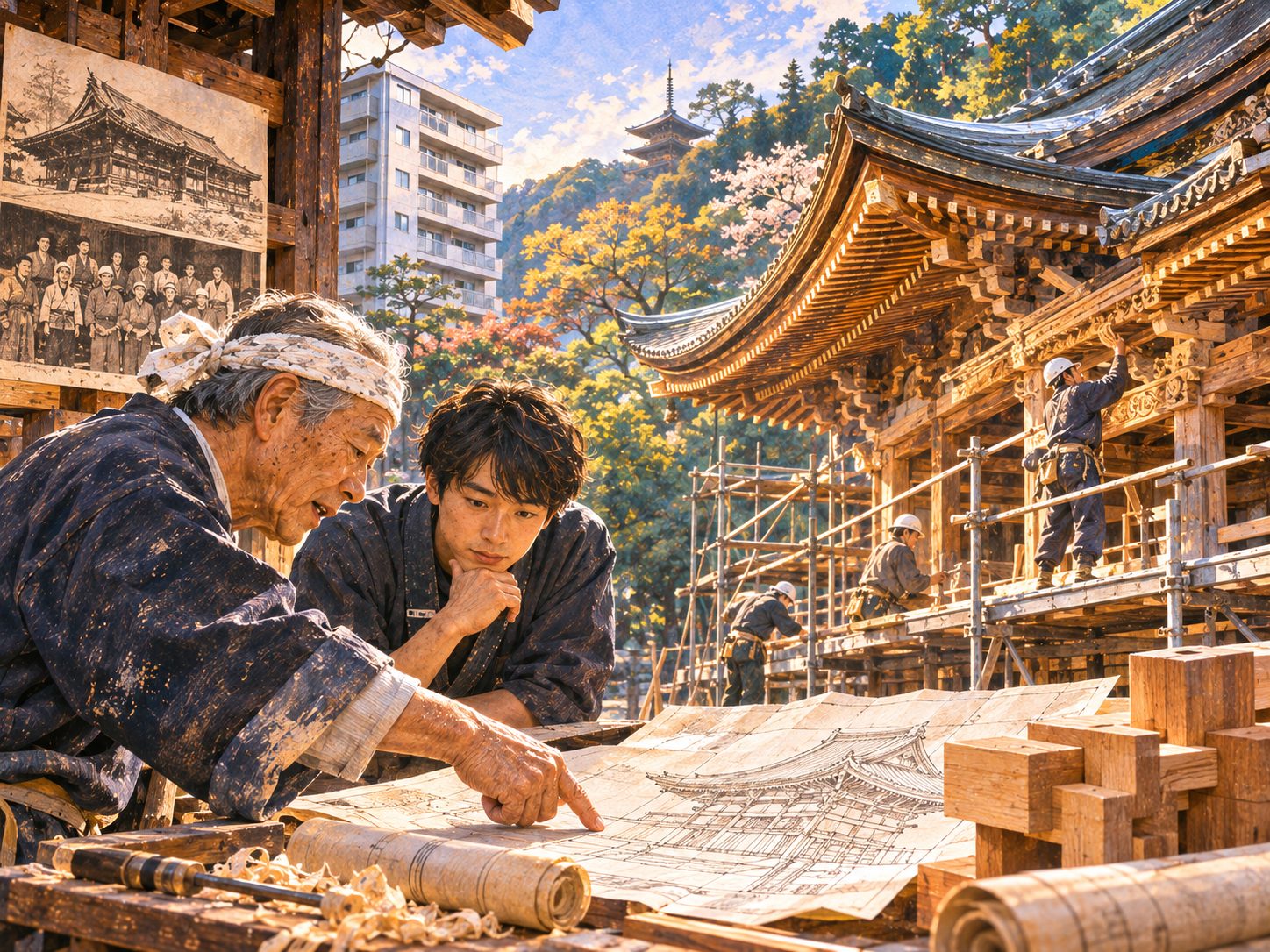
Carpenters who specialize in building and repairing temples and shrines are called miyadaiku in Japan. They must master ancient joinery techniques in which pieces of wood interlock without a single metal nail, and their training is slow: it’s said to take thirty years to become fully independent.
For a company, Shitennoji was a near-perfect client. It would never go out of business, never switch suppliers, and it kept getting destroyed. It burned to the ground in war in 1576, burned again in 1614, and in 1801 lightning struck its five-story pagoda and set off a great fire. Shitennoji’s pagoda has been destroyed seven times in its history, and Kongo Gumi rebuilt it every time.
A temple repeatedly destroyed by war and lightning would be a disaster for any other industry. For Kongo Gumi, it was a thousand years of uninterrupted orders.
Reason two: if the son isn’t fit, replace him
No matter how stable the client, there’s one thing that can still kill a company: a weak successor. Many family businesses don’t survive the third generation, because capable founders don’t necessarily have capable sons.
Kongo Gumi’s approach was to not let blood decide who led the family. Toshitaka Kongo, the 39th head, said during his lifetime that the Kongo family’s successors were “chosen on ability, not by eldest-son inheritance.” Records from the Edo period show that even an eldest son would be passed over if judged unfit, and one man who became master carpenter had his name struck from the family records for not taking his work seriously.
What if none of the sons were suitable? Bring in a son-in-law. Japan has a practice called mukoyoshi, in which a son-in-law marrying into a family is simultaneously adopted by his in-laws, takes his wife’s family name and becomes legally the family’s son. Toshitaka Kongo himself was an adopted son-in-law.
This isn’t unusual in Japan. For a long time, the Japanese ie, or household, functioned more like a business unit that had to be continued, and the family name and business could be handed to someone adopted in. An economic study tracking postwar Japanese listed companies found that family firms that handed control to sons-in-law or adopted sons performed better than those that handed it to biological sons. The reason isn’t hard to see: the pool of candidates is larger, and biological sons know they could be replaced at any time.
Reason three: a carpenters’ family creed that insisted on the abacus
The third reason is written in a will.
Yoshisada Kongo, the 32nd head, who led the rebuilding after the great fire of 1801, left his descendants sixteen precepts that later became the Kongo family creed. They include diligent study of reading, writing and the abacus, and focus on the core business, plus one especially concrete rule: when bidding, submit a low and honest estimate, and never seek excessive profit.
A carpenters’ family creed placed bookkeeping on par with craftsmanship. Yoshisada seems to have understood clearly that a family of craftsmen who could build but couldn’t do the accounts would sooner or later run into trouble.
More than a century later, his fear came true.
After losing its one client, Kongo Gumi had to find work on its own
In 1868, the new Meiji government ordered the separation of Shinto and Buddhism, which had long been intertwined. Shitennoji lost its lands and income, and the Kongo family’s stipend was abolished with them. Over 1,200 years of fixed income vanished overnight.
Kongo Gumi had no choice but to take work from other temples and shrines. But for a family of craftsmen who had dealt with a single client for generations, finding clients was an entirely new skill. Haruichi Kongo, the 37th head, was a first-rate craftsman but poor at sales. The Great Depression of the early 1930s left even temples without money for repairs, and Kongo Gumi’s work dried up. In 1932, Haruichi took his own life in front of his ancestors’ grave.
His wife, Yoshie Kongo, took over as head, becoming the first woman master carpenter in the family’s history. During the war, when the government forced small and medium-sized businesses to merge, she negotiated with the government herself and kept Kongo Gumi independent. The company got through the war making wooden crates for the military.
Every time Kongo Gumi fell into crisis, it was because the foundation it lived on had been pulled away. Every time it survived, it was because someone held on to the craft and the name, then went out to find the next job.
Why did becoming a construction company mean losing more with every job?
After the war, Kongo Gumi made a decision that seemed perfectly sensible: diversify. In 1955 it reorganized as a joint-stock company, began taking on general construction, and opened branches across the country. At its peak, its annual sales reached about ¥13 billion.
The problem was that in general construction, its competitors were the major general contractors. In the 1980s, to raise its profile, Kongo Gumi began accepting jobs on razor-thin margins. After the bubble economy burst in the early 1990s, to keep sales up, it forced its way into general construction such as apartment buildings, hotels and facilities for the elderly. Some jobs were contracted for ¥500 million but cost ¥600 million to build.
Why take jobs you know will lose money? Cash. In Japanese construction, it’s customary for the client to pay about a third of the price up front when the contract is signed. Sign a new job and you have cash in hand to plug the holes in old ones. But that only pushes the problem down the road, and every money-losing job you take makes the future hole bigger. And since an apartment building runs around ¥500 million while a temple’s main hall runs around ¥80 million, losses on general construction were many times larger than on temples.
Even more critically, almost no one could see any of this. After reorganizing in 1955, Kongo Gumi never held a board meeting, and its finances were never disclosed inside the company. That’s the answer to the mystery at the start: employees didn’t know the company was about to collapse because no one had ever shown them the books.
Its thousand-year strengths were the reason it fell
Looking back, every step Kongo Gumi took toward crisis was the flip side of a strength it had relied on for a thousand years.
Shitennoji gave it a client that would never leave, and also meant it never had to learn how to do business. Kenichi Tone, who later took over management, said that when he joined Kongo Gumi he found a feeling inside the company that “sales will follow on their own.” That feeling made perfect sense for a temple’s dedicated carpenters in the Edo period. For a modern company bidding against major contractors, it was fatal.
The authority of the family head held the team of craftsmen together for a thousand years, and also let a company that had become a corporation go years without board meetings or telling its employees about its finances. Even the family creed: Yoshisada wrote “focus on the core business” and “practice the abacus,” and postwar Kongo Gumi had set aside exactly those two rules.
So rather than saying Kongo Gumi was brought down by the bubble economy, it’s more accurate to say it was trying to fight a modern construction price war with a survival strategy designed for the Edo period. The bubble only exposed that gap sooner.
When outsiders took over, the first thing they did was return to the family creed
In 2005, Takamatsu Construction, a mid-sized general contractor also based in Osaka, stepped in to rescue it. Its then-chairman, Takamatsu, said something that has been quoted again and again: letting Kongo Gumi go under would be a disgrace to Osaka.
Takamatsu Construction set up a new Kongo Gumi and moved the temple and shrine business, the employees and the miyadaiku over to it. The old company filed for bankruptcy in 2006. The Kongo family’s management of the business, after more than 1,400 years, came to an end.
The new president, Ogawa, came from banking. The first thing he did was, in effect, pull Kongo Gumi back to Yoshisada’s family creed: no work other than temples and shrines. The books were opened, with monthly management meetings to report results. Timber was bought with cash, no longer paying 30% more by using promissory notes. Within a year of his arrival, the company was back in the black.
The second thing he did was subtler: separate management from craft. The company’s management was put back on a normal footing, but the craftsmen’s work was left alone, a relationship he described as “reigning but not ruling.” In his six years as president, not a single miyadaiku left.
Later, when president Kenichi Tone was watching a craftsman plane a piece of wood, he suggested it might be done a little more efficiently. The master carpenter in charge, Shigeo Kiuchi, asked back: “Are you telling me to cut corners?” Tone says that was the moment he understood the work of the miyadaiku can’t be measured by efficiency. Kiuchi has said that the true value of a piece of work only becomes clear two or three hundred years after it’s built.
Without the Kongo family, is Kongo Gumi still alive?
Today Kongo Gumi is a subsidiary of the Takamatsu Group, with about 100 miyadaiku who still build temples and restore cultural properties across Japan. Descendants of the Kongo family work at the company but have no role in management.
So did Kongo Gumi survive, or did it die?
If a company is a family, Kongo Gumi ended in 2006. But looking back over 1,400 years, the Kongo family itself never saw it that way. They replaced unfit eldest sons, brought in sons-in-law who took the family name, and handed the business to a widow. Every time, this family chose to keep the craft alive, even if it meant giving up the order of blood. What Takamatsu Construction did in 2005 simply took that logic one step further: to keep the craft alive, even the Kongo family itself was moved out of management.
I think this is the secret behind Japan’s many century-old businesses. They last not because some family is especially good at holding on, but because at the crucial moment, someone is willing to admit that the work matters more than the family. Kongo Gumi nearly collapsed during exactly those decades when it forgot this.
Notes
- “Half the world’s century-old companies are in Japan” comes from a 2022 survey by Nikkei BP Consulting’s Shunen Jigyo Lab. Company registration systems differ by country, so the proportion should be treated as a rough indicator.
- Some English-language sources say Kongo Gumi made coffins during the war; this article follows the company’s official history, which says military wooden crates.
References
- Teikoku Databank|全国「老舗企業」分析調査(2025年)press release (reprint)|2026-03-27 (46,708 companies over 100 years old, 11 over 1,000 years, breakdown by industry)
- coki|citing Nikkei BP Consulting’s 2022 survey「世界の長寿企業ランキング」 (Japan’s share of the world’s century-old companies: 50.1%)
- Kongo Gumi|沿革 (company history) (craftsmen from Baekje in 578, Shitennoji, repeated disasters, Yoshisada’s precepts, loss of the stipend in 1868, Haruichi’s suicide in 1932, Yoshie’s succession, wartime military crates, 1955 reorganization, the new Kongo Gumi in 2006)
- Kongo Gumi|official homepage (about 100 miyadaiku, member of the Takamatsu Group)
- nippon.com|feature on Kongo Gumi (Traditional Chinese) (pagoda destroyed seven times, years to train a miyadaiku, Takamatsu’s remark, no miyadaiku leaving under Ogawa)
- Nikkei|金剛組、「日本最古」を支えるのは古来の実力主義 (中沢康彦)|2020-12-10 (merit-based succession, the 39th head as adopted son-in-law, low-margin bidding in the 1980s, Kenichi Tone on “sales will follow on their own”)
- OBT人財マガジン|株式会社金剛組 代表取締役社長 小川完二さん (parts 1 and 2)|2010-09, http://www.obt-a.net/web\_jinzai\_magazine/person/2010/09/1400-1.html (“low and honest estimates” in the creed, profitability within a year, ¥500 million contracts costing ¥600 million, one-third deposits, no board meetings, peak sales, cost of main halls vs. apartments, 99% of creditors agreeing to a 30% cut)
- NTT West BizClip|最古の会社、「本業を磨く」で復活へ (interview with 小川完二)|2016-11-02 (employees unaware of the trouble, timber 30% more expensive with promissory notes, no work outside temples and shrines, “reigning but not ruling”)
- Discover Japan|現存する世界最古の会社《金剛組》創業1445年の歩み【後編】|2023-07-31 (Yoshie’s negotiations with the government, the wood-planing episode and Kiuchi’s words)
- Takamatsu Construction|世界最古の企業を再建させたとして、ベスト・プロデュース賞を受賞|2022 (the 2005 crisis, Takamatsu’s remark)
- Nikkei Business|金剛組は倒産したのか 長寿企業を目指すには|2019-12-06 (bankruptcy of the old company, transfer of the business to the new one)
- The Epoch Times (Chinese)|report on the Kongo family creed|2015-09-08 (the sixteen precepts, non-eldest-son succession and adopted sons-in-law)
- Mehrotra, Morck, Shim & Wiwattanakantang|Adoptive Expectations: Rising Sons in Japanese Family Firms|Journal of Financial Economics, 2013 (performance of non-blood successors)
Follow the story in person
Join a small-group trip to the places in our stories and meet the people who live and work there.
See trips and dates
Water Mirror is a Tokyo-based company that helps more people step inside industries and explore the stories and cultures of different fields around the world. We design in-depth learning programs for individuals, companies, schools and organizations, combining company visits, exchanges with professionals, local learning and hands-on experiences, so participants can see how industries really work and meet the people and stories behind them. Water Mirror Perspectives is our content media, telling the distinctive stories of industries, local cultures and people, so that reading sparks curiosity and leads readers to go and see for themselves.
About Water Mirror →