Key Points
- “Live house” is a Japanese coinage for a small venue built for live band performances. Nishiogikubo Loft, opened in 1973, is often called Japan’s first live house, and these rooms of a few dozen to a few hundred people are still where new Japanese bands start out.
- Many small Japanese live houses use a ticket quota system called “noruma”: a band must sell a set number of tickets, usually 15 to 30, and covers the shortfall itself, sometimes paying 20,000 to 30,000 yen per show. The practice spread after the band boom of the 1980s, when the number of venues exploded.
- Small venues don’t make stars by “discovering” them. They book bands, give feedback, and push them up one step at a time. Shiga band Arakezuri started at Shibuya O-Crest playing to fewer than 20 people, moved through O-WEST, CLUB QUATTRO and LIQUIDROOM, and sold out the 1,500-capacity Zepp Shinjuku in January 2026.
- What small venues really teach bands is how to make a stranger come back. Social media can get a song heard, but turning listeners into ticket-buying fans still has to be learned show by show in rooms of one or two hundred people.
In January 2026, Arakezuri, a rock band from Shiga Prefecture, played a sold-out headline show at Zepp Shinjuku in Tokyo. The venue sits beneath a high-rise in Kabukicho and holds 1,500 people.
Muro, the manager of Shibuya’s O-Crest, couldn’t make it. The reason was simple: that same night, his own club was full.
O-Crest is a live house that holds at most 250 people. A few years earlier, when Muro watched Arakezuri play there, fewer than 20 people were in the audience. He later recalled that the songs and the stage show were already solid, a performance that could reach people’s hearts. There just weren’t many people there to hear it.
How does a band that plays to a dozen people end up in a 1,500-capacity hall? More surprising still, in Japan many bands that play these small rooms not only go unpaid, they have to pay up front. So what exactly do small venues do along the way?
“Live house” is a Japanese invention
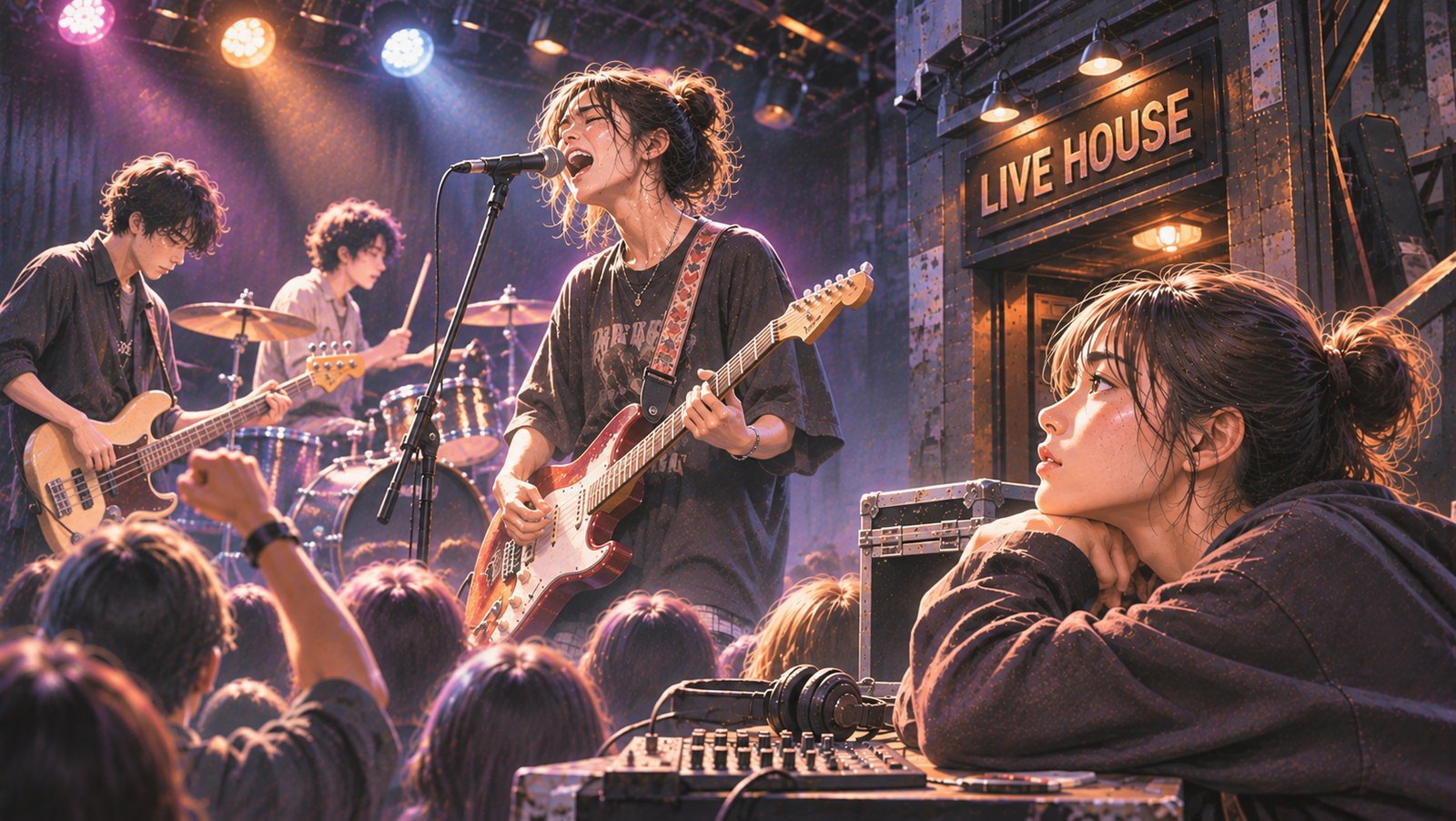
In English, “live house” isn’t a common phrase. It’s a Japanese coinage for a small venue dedicated to live bands, usually with a bar. Most of Tokyo’s live houses today are tucked into basements, their entrances plastered with gig posters, holding anywhere from a few dozen to a few hundred people.
The person most often credited with bringing this kind of venue into Japanese life is Yu Hirano. In 1971, at age 26, Hirano opened a jazz bar of just seven tsubo (about 23 square meters) near Chitose-Karasuyama Station in Tokyo’s Setagaya ward. The bar didn’t have enough records, so regulars brought their own, and the little place gradually became a spot for swapping rock music, even though Hirano himself says he had no interest in rock at the time.
In June 1973 he opened a second place, Nishiogikubo Loft, and let bands play live inside. It’s often called Japan’s first live house. Branches in Ogikubo and Shimokitazawa followed, and in September 1976 he opened Shinjuku Loft, which held about 300 people. It served coffee by day, hosted band rehearsals and shows from evening until 10 p.m., and turned into a rock izakaya late at night, staying open until 4 a.m. Hirano knew from the start that live shows alone couldn’t keep a venue afloat.
How did bands get paid back then? Hirano split the door with them based on attendance, which he says was probably the first such system in Japan. Before that, the industry paid musicians a flat fee, which he believed no venue could survive on. As for making bands guarantee ticket sales in advance, he says that in those days it was something nobody “even thought of.”
These small venues became the starting point for many legends. In May 1981, producer Daiko Nagato brought a band he introduced as a “Gunma biker gang” to Shinjuku Loft. That band would later rename itself BOØWY and become one of the defining Japanese rock bands of the 1980s.
After the band boom, you had to buy your way onto the stage
In 1982, Tokyo’s rock musicians had roughly two places to play: Shinjuku Loft and Shibuya La.mama. Within a few years, live houses grew to dozens, then hundreds.
What drove the change was the “band boom” of the mid-1980s. Bands that came up through small venues, like THE BLUE HEARTS and BOØWY, signed with major labels one after another, and huge numbers of young people formed bands hoping to follow the same path. The number of bands wanting to play shot up, but the number of people willing to pay to see unknown bands didn’t. As venues multiplied, flat fees for musicians all but disappeared. In their place came the ticket quota, or “noruma” (originally meaning “quota”).
Here’s how it works. The live house and the band agree that the show must sell at least 20 tickets. A ticket costs about 2,000 yen. If the band sells 25, it gets a share of the money from the extra five. If it sells only 15, the band pays for the missing five after the show. In Tokyo the quota is usually 15 to 30 tickets, and it’s not unusual for an unsigned band to lose 20,000 to 30,000 yen on a single night.
That sounds unfair, but the venue’s books tell a different story. Even a 100-capacity live house has to pay central Tokyo rent, keep a sound engineer on the desk from start to finish, and provide amps, a drum kit and lighting, all fixed costs every single night. And audiences rarely show up for bands they’ve never heard. Ian Martin, a British writer who has covered Tokyo’s music scene for years, puts it bluntly: in Tokyo’s small live houses, the real customers are often the musicians, not the audience. Some bookers, on the other hand, say many venues would have closed long ago without the system, and that because bands share the costs, acts that aren’t commercial and have no company behind them can still get a slot.
So what this money actually buys is a proper stage, a professional sound engineer, and a night of being seen. The problem is that a stage alone isn’t enough. Someone has to be in the room.
Four or five strangers a night: the small venue as a school
The most common kind of show at a small Japanese live house is the “taiban,” a multi-band bill put together by the venue’s booker. Four or five bands play in one night, about 30 minutes each, and they often don’t know one another.
These nights look loose, but they are the small venue’s most important function. The booker decides which bands share a night and in what order, which amounts to finding each band an audience that might like them. The manager and staff are in the room from start to finish too. Watching different bands every night, they know better than anyone whose set can hold a crowd.
That’s how Muro watched Arakezuri. He doesn’t give bands much feedback, usually speaking up only when a show falls short, and when he does, he’s direct. He once told Arakezuri, “Why not practice your vocals a bit more?” and “Why not get a better guitar tone?” Frontman Shirai admits that at first the club felt hard to approach, “not the kind of place you could just walk into,” but he wanted to get close to it anyway.
Muro wants O-Crest to be “a place young bands want to come to, whatever the era,” so he doesn’t want it to become a closed clique. He has even fine-tuned the distance between the stage and the audience, stage height included, so that people feel “it’s close” without it being right in their faces.
This is what’s hardest to replace about small venues. A band that’s just starting out rarely has anyone around who will honestly tell it what isn’t working. In a room of one or two hundred people, there’s a group of people who listen to live music every night and will tell you straight.
One step at a time: from 250 to 1,500
Arakezuri is a four-piece based in Shiga Prefecture, with frontman Shirai writing the songs. For a band from the Kansai region, O-Crest was their first home in Tokyo. Shirai says the first time they sold out a headline show at a venue of around 200 people, it was at O-Crest. Interestingly, around the same time, they still hadn’t sold out a headline show at B-FLAT, the live house they played most often back home in Shiga.
The turning point came with the pandemic. For a while live houses couldn’t admit audiences. O-Crest’s staff repainted the walls themselves and, with no budget for a camera crew, rigged their own gear to stream shows with no audience. Muro says all they could do in that period was “not give up, and do everything we could.” Shirai treated the months without shows as an opportunity and got serious about social media, since many bands around them were still reluctant to. Before long, views of their song “Taisetsu” took off, and tickets started selling.
The path after that can almost be drawn as a staircase. In February 2024 they headlined Spotify O-WEST, a bigger room in the same Shibuya O-Group. In July, every date of their tour sold out, ending at Shibuya CLUB QUATTRO. In December they played LIQUIDROOM in Ebisu, then Spotify O-EAST, and finally Zepp Shinjuku in January 2026. Along the way they played around 120 shows a year. In October 2024 they even went back to O-Crest and held a two-band show every week for five weeks straight, calling it “CREST JACK,” as in taking over the whole club.
Muro is blunt about it. If the audience doesn’t grow along with a band, the band can’t keep playing O-Crest forever, and if the band doesn’t move up, the club can’t stay with it forever either. So a band that wants to keep playing there has to bring more people, and once it brings enough, he pushes it on to bigger venues. He even feels that “skipping grades,” blowing up overnight thanks to a TV drama theme song, isn’t Arakezuri’s way.
That’s how small venues make stars, with two forces at once: pushing bands to bring an audience, and pushing out the bands that sell out. The room only holds 250 people. Once a band can fill it every time, it’s time to see whether it can fill a bigger one.
Can you make it without live houses?
Today a band can go viral on social media overnight. Do small venues still matter?
Even live house operators are asking. Yoshimura, the manager of Shimokitazawa SHELTER, says that treating live houses as a band’s stepping stone to a debut is, in some ways, a bit out of step with the times. He’d rather stress something else: the “house” in live house means “home.”
Arakezuri’s story shows what social media and small venues each did. Videos got more people to hear “Taisetsu,” but view counts don’t automatically turn into ticket buyers. Getting a stranger to come once, fall for the band, and bring a friend next time took more than a hundred shows a year, many of them honed in small rooms of one or two hundred people. Shirai says the core of the band is “getting songs across to the people in front of us.”
Small venues also hold on to the bands that outgrow them, in their own way. Since 2012 O-Crest has run an outdoor festival, MURO FESTIVAL. The first one was held at a waterfront plaza in Tokyo’s Harumi, with 17 bands. Arakezuri was invited for the first time in 2023, and Shirai says he had “always wanted to play it.” In 2025 they closed one of the stages. His goal now is to close the whole festival. Muro says that once bands grow up they can’t come back every month, but when the club turns 20 or 30, they’ll come back to help.
What small rooms teach is how to make people come back
Back to the opening question: how does a live house that holds only one or two hundred people nurture the next star?
The answer isn’t a talent scout sitting in the crowd waiting to discover a genius. The way Japan’s small live houses make stars is more like a school that charges tuition. Bands pay the quota and get a stage, a sound engineer, and a group of people who watch live music every night. The manager doesn’t say much, but everything he says is direct. The room is small enough that you can see every audience member’s reaction, and small enough that once a band sells it out, it has to move up.
Social media has made it much faster for songs to be heard, but there is still no shortcut to turning listeners into an audience.
On an album released at the end of 2025, Shirai wrote O-Crest’s long staircase into a song. Before they stepped onto a stage in front of 1,500 people, they had climbed those stairs many times. In the very beginning, fewer than 20 people were waiting at the top.
Notes
- There are no official statistics on the total number of live houses in Japan, and estimates range from about 1,000 to about 2,000, so this article does not give a total.
- Quota sizes and amounts vary widely by venue, region and era. The figures here (15 to 30 tickets, about 2,000 yen per ticket, 20,000 to 30,000 yen per show) come from English-language music writing about small Tokyo venues and represent a common range, not every venue. We also found no public information on whether O-Crest itself uses a ticket quota, so this article makes no judgment about how it charges bands.
- The claim that splitting the door by attendance was “the first in Japan” is Yu Hirano’s own.
References
- Real Sound (Dai Tanaka)|ArakezuriがO-Crestから学んだもの 白井竣馬×室清登|2026-03-06 (fewer than 20 in the audience, feedback, first meeting around 2019, first 200-capacity sellout, views of “Taisetsu”); page 2 (self-made streams during the pandemic, social media, “if the audience doesn’t follow, the band can’t stay,” 20th/30th anniversaries); page 3 (stage distance, skipping grades, MURO FESTIVAL, O-Crest full on the Zepp Shinjuku night, the staircase in a song)
- Billboard JAPAN|Arakezuri 渋谷CLUB QUATTRO live report|2024 (members, Shiga base, about 120 shows a year, O-WEST 2/9, QUATTRO 7/16, LIQUIDROOM 12/20, CREST JACK)
- Gendai Business (Masashi Hosoda)|Yu Hirano interview, part 1|2018-08-13 (the seven-tsubo bar in Karasuyama, Nishiogikubo Loft in 1973, Shinjuku Loft at about 300, opening hours, door split, “no ticket quotas”)
- Gendai Business (Masashi Hosoda)|Yu Hirano interview, part 2|2018 (BOØWY’s first Shinjuku Loft show in May 1981)
- PRESIDENT Online|Yu Hirano interview (opened the bar at 26 in 1971, no interest in rock at first)
- The Japan Times (Ian Martin)|Band boom of the 1980s left a handy indie infrastructure|2015-05-22 (only Loft and La.mama in 1982, the venue boom, the end of flat fees and the spread of pay-to-play)
- The Japan Times (Ian Martin)|Cruel to be kind: Does noruma work in bands’ favor?|2011-10-27 (15 to 30 tickets, 20,000 to 60,000 yen, the “musicians are the customers” point)
- Live Music Exchange (James Hadfield)|The pervasive curse of pay-to-play in Tokyo|date unknown (about 2,000 yen per ticket, 30,000 to 40,000 yen per show, Ian Martin’s “musicians are the customers” quoted, bookers’ defense)
- Ticket Ryutsu Center|ライブハウスのノルマとは|2023-04 (a 20-ticket quota, how surpluses and shortfalls are calculated)
- Real Sound|長瀬有花、下北沢を学ぶ ー下北沢SHELTER編ー|2023-04 (SHELTER’s manager on live houses as a stepping stone and “house means home”)
- Natalie|晴海「MURO FESTIVAL」にアルカラ、ランク、鴉ら17組|2012 (July 14, 2012, Harumi, 17 acts)
- Ticket Jam|Spotify O-Crest venue information (capacity 250)
- Tokyu Corporation|Tokyu Kabukicho Tower press release (Zepp Shinjuku, 1,500)
- Wikipedia|Live house (Japanese coinage, the 1980s band boom made live houses a springboard to a debut)
Follow the story in person
Join a small-group trip to the places in our stories and meet the people who live and work there.
See trips and dates
Water Mirror is a Tokyo-based company that helps more people step inside industries and explore the stories and cultures of different fields around the world. We design in-depth learning programs for individuals, companies, schools and organizations, combining company visits, exchanges with professionals, local learning and hands-on experiences, so participants can see how industries really work and meet the people and stories behind them. Water Mirror Perspectives is our content media, telling the distinctive stories of industries, local cultures and people, so that reading sparks curiosity and leads readers to go and see for themselves.
About Water Mirror →