Key Points
- Before its anime premiered in 2019, the Demon Slayer manga had about 4.5 million copies in circulation. By October 2020 it had passed 100 million. In 2025, the film Infinity Castle Part One grossed about 117.9 billion yen worldwide, making it the highest-grossing Japanese film ever.
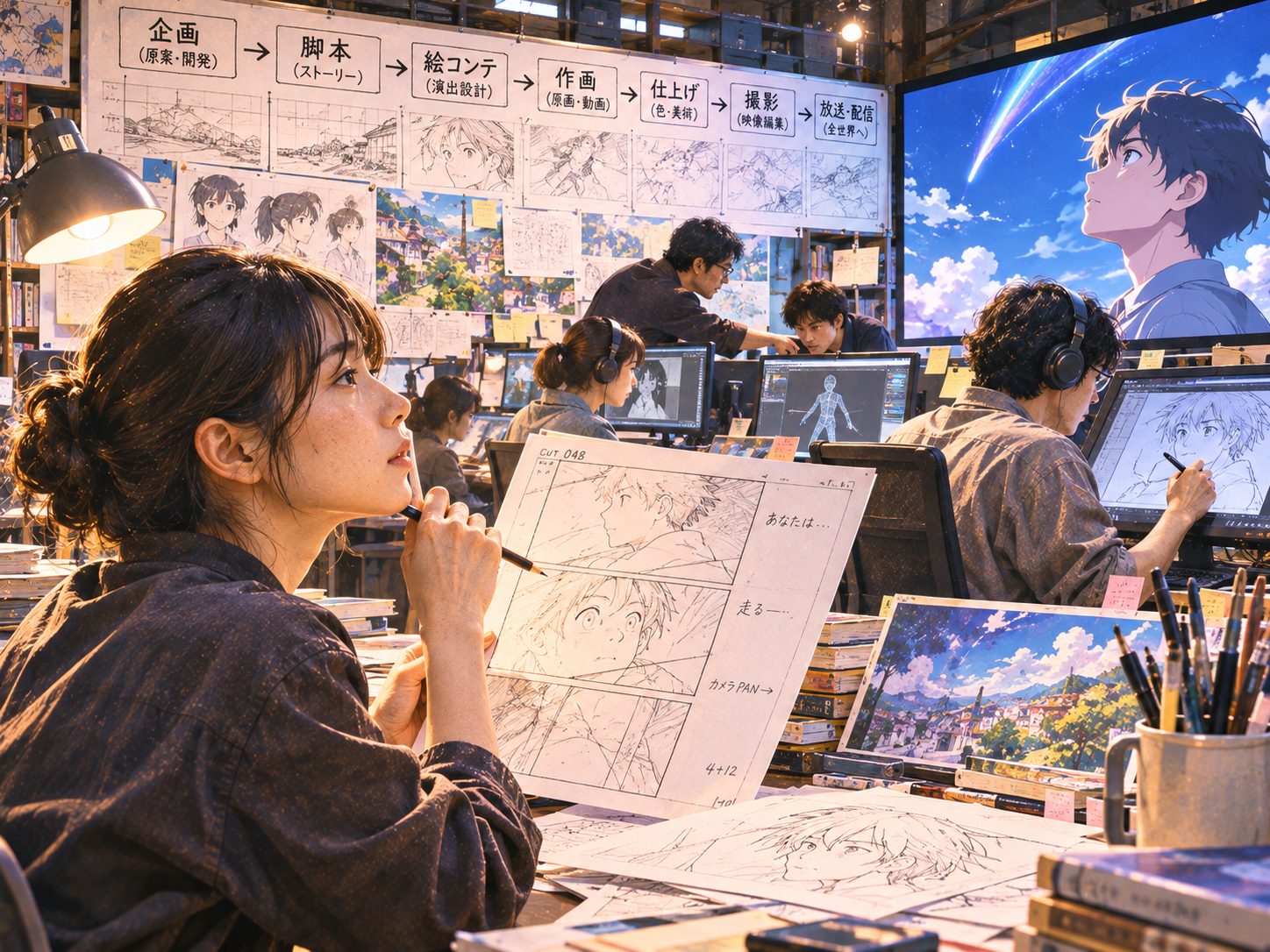
- Japanese anime is usually financed by a “production committee” of several companies that split the risk, then made by a studio through storyboards, key animation, in-between animation, coloring, compositing and effects, and voice recording.
- Demon Slayer was planned by Aniplex and produced by ufotable. Only three companies are listed as rights holders: Shueisha, Aniplex and ufotable. That means the studio that actually makes the anime shares in the profits too, which is rare in Japan.
- The first season aired on only about 20 mostly local TV stations, but it streamed on 22 platforms at the same time. Viewers finished the anime and went on to read the manga, and the biggest growth came after the season ended.
In March 2019, a manga that had been running in Weekly Shonen Jump for three years had about 4.5 million collected volumes in circulation. Not a bad number, but in the magazine that gave the world Dragon Ball and One Piece, hardly legendary. The story follows Tanjiro Kamado, a boy who sells charcoal in Japan’s Taisho era. His family is killed by demons, and his only surviving sibling, his sister Nezuko Kamado, is turned into a demon herself. To turn her back into a human, he sets out on the path of a demon slayer.
A year and a half later, the same series passed 100 million copies in circulation, more than twenty times as many. Demon Slayer: Kimetsu no Yaiba – The Movie: Infinity Castle Part One, released in 2025, grossed about 117.9 billion yen worldwide, becoming the highest-grossing Japanese film in the world.
What happened in between?
The answer you hear most often is “the anime was just that good.” That’s true, but it explains almost nothing. Who decided to make the anime? Where did the money come from? How many hands does a rough sketch pass through before it becomes one second on screen? Follow Demon Slayer from the beginning, and you can see how a Japanese anime is born.
Before the first drawing, someone decided to take on the risk
The typical path for a Japanese manga goes like this: the author publishes one chapter a week in a magazine, and once enough pages pile up, they’re collected into tankobon, standalone volumes you can buy. Total copies of these volumes in circulation are the most common measure of whether a manga has succeeded. Hit series easily reach tens of millions.
Demon Slayer’s author, Koyoharu Gotouge, was a newcomer, and this was their first serialization. A rookie’s series at 4.5 million copies sat in Jump’s “steady, but not yet a flagship” tier.
What really put it in the spotlight was someone deciding to make it into an anime. That someone was Yuma Takahashi, a producer at Aniplex, a company that specializes in planning, financing and distributing anime. Takahashi pitched an adaptation to Shueisha, the manga’s publisher, and then handed the actual production to an animation studio Aniplex had worked with for years: ufotable.
From that moment, an anime truly began to be born.
In Japan, the people who pay and the people who draw are two kinds of “production”
To understand the process, you first need to separate two Japanese words that are pronounced the same, “seisaku,” but mean different things. One, written 製作, refers to the side that puts up the money, manages the rights and handles distribution. The other, written 制作, refers to the studio that actually draws the anime.
The most common way to finance anime in Japan is the “production committee.” Making an anime costs a lot of money, and nobody can guarantee it’ll be a hit, so several companies, such as publishers, record labels, TV stations and toy makers, invest together. If it makes money, they split it in proportion; if it loses money, they share the loss. Each company then earns in the way it does best: the publisher sells manga, the record label sells the theme song, the toy maker sells merchandise.
The system spreads risk, but it has a side effect. The studio that does the drawing is often just a contractor, paid a fixed production fee, and may not share in rights income even if the series becomes a huge hit.
Demon Slayer is a bit different. Only three companies are listed as rights holders: Shueisha, Aniplex and ufotable. The studio doing the drawing is tied to the work too, sharing in its success or failure.
Aniplex was willing to set things up this way because the two companies had already worked together for more than ten years. In 2005, Atsuhiro Iwakami, now Aniplex’s president, saw a TV anime by ufotable and approached the studio himself. The two went on to make seven Garden of Sinners films and several entries in the Fate series, and ufotable made its name with dazzling, light-and-shadow-filled battle scenes. They knew what each other could do.
How many hands does it take to turn one storyboard into one second?
Once the plan is set and the script written, the real “rough sketch” appears: the storyboard.
The storyboard is like the anime’s blueprint. It breaks the script into simple frame-by-frame images, marking the camera angle, how characters move, which lines they say and how long each shot lasts. The pacing of the whole anime is largely decided here. Hikaru Kondo, ufotable’s founder, supervises the storyboards. He says storyboards are a “starting point” for drawing out more ideas, not a blueprint that has to be copied stroke for stroke.
From the storyboard comes a long relay. Key animators first draw the most important poses in a movement, like the moment of gathering strength before swinging a sword, and the pause after the blade has passed. Another group of animators then fills in the transitional drawings between those poses to make the motion continuous; these inserted drawings are called in-betweens. Once the line art is colored, it’s composited with backgrounds and 3D computer animation made by other teams, then edited, and finally voice acting, sound effects and music are added.
Film runs at 24 frames per second, but to save labor Japanese anime often uses about eight drawings per second, holding each drawing for three frames. That’s not cutting corners. It’s a craft of trade-offs: which shots can use fewer drawings and be carried by pauses and composition, and which need every drawing so the motion is fluid enough to make audiences hold their breath. The smoothness viewers see is really the result of many people calculating, over and over, “where we can save, and where we absolutely can’t.”
Demon Slayer’s flames and water were made in “photography”
Demon Slayer’s visuals have one instantly recognizable feature: water that surges like an ukiyo-e print, and flames that blaze along the blade. Much of this comes from a stage of the process called “satsuei,” or photography.
The name is a holdover from the film era. Anime used to be drawn on transparent cels, layered over backgrounds and shot frame by frame with a camera. In the digital age, “photography” became the umbrella term for compositing and effects: where the light comes from, what should be blurred, how sparks scatter, all decided at this stage.
ufotable set up its own in-house photography department in its early days and has experimented with lighting for years, for example lighting hand-drawn characters from three directions so that skin that was once a single flat color shows gradation and looks more three-dimensional. Kondo says all of ufotable’s roughly 300 staff are in-house, many of whom have worked together for years, so he knows exactly which animator is good at which kind of shot. Trying things in 2D, then in 3D, and adjusting again and again under deadline pressure is where their skills come from.
All this came into view for everyone in the summer of 2019. In episode 19 of the TV series, Tanjiro, in desperate straits, unleashes the “Hinokami Kagura,” the Dance of the Fire God passed down from his father, and the whole battle erupts in flames and music together. In the manga, the scene is only a few pages long, but after it aired it was discussed endlessly on social media, and viewers called it a “kami-kai,” a “god-tier episode.”
Airing only on local stations, how did it become a national hit?
Interestingly, Demon Slayer’s first season wasn’t a big production everyone in the country could see. It aired from April to September 2019 on about 20 stations, mostly local channels like TOKYO MX. Many people in Japan couldn’t even find it on their TV.
What changed things was outside of TV. The anime was available on 22 streaming platforms at the same time, so anyone who missed the broadcast could catch up on their phone whenever they liked.
The numbers say it all. The manga had about 4.5 million copies in circulation before the anime premiered, about 12 million when it finished airing, and more than 100 million in October 2020, a little over a year after the season ended. The steepest growth didn’t come while it was airing, but after it ended. Viewers binged all 26 episodes on streaming, couldn’t wait for season two, and bought the manga to find out what happened next. The anime became the manga’s best advertisement, and the manga brought even more people back to the anime.
In October 2020, the film Mugen Train opened in the middle of the pandemic, earning about 40.4 billion yen at the box office and becoming the highest-grossing film in Japanese history. By 2025’s Infinity Castle Part One, overseas box office of about 77.7 billion yen was nearly double the roughly 40.2 billion yen earned in Japan.
The anime market makes 4 trillion yen. Studios get about a ninth
Reading this far, it’s easy to assume that if an anime looks good enough, it’ll be a hit and everyone will make money. The industry’s numbers tell a more complicated story.
In 2025, Japan’s anime-related market reached a record of about 4.4491 trillion yen, with 57% coming from overseas. That figure covers everything anime-related that people spend money on: streaming subscriptions, movie tickets, merchandise, game licensing and more. But anime production companies themselves earned about 505.5 billion yen, roughly a ninth of the total.
That gap maps directly onto the two kinds of “production” described earlier. Most of the money flows to companies that own rights and can negotiate licenses. The studios that create the images mainly earn production fees. In 2025, half of the studios serving as lead producers saw their profits fall or posted losses, and those with steady profits were mostly companies that owned the rights to their own works.
That’s why MAPPA, the studio behind the Jujutsu Kaisen anime, chose to fully finance Chainsaw Man itself in 2022. Its president, Manabu Otsuka, said production committees tend to avoid risk from the outset, and that if a studio wants to grow, it has to take on risk itself.
In this industry structure, ufotable being listed as a rights holder for Demon Slayer is unusual in itself. When the work makes money, the studio shares in it, and that gives it room to do more. ufotable has opened its own cinema and café in Tokushima, Kondo’s hometown on the island of Shikoku, and every spring and autumn it runs the anime event “Machi Asobi” in the city, turning Tokushima Station, shopping arcades and the riverside into venues.
An anime isn’t born on the day of its first sketch
Looking back at Demon Slayer, its birth turns out to be much earlier, and much longer, than we might imagine.
I think the moment an anime is truly born isn’t the day the first sketch is finished, but the day a chain of choices connects: someone willing to put up money and take on the risk first, someone worth trusting, people redrawing again and again under deadline pressure, and someone making sure viewers can find it any time. Without any one of these links, that 4.5-million-copy manga might have stayed at 4.5 million.
Demon Slayer reached the whole world not just because it was beautifully drawn, but because the people who drew it so well happened to be in a position to share in its success. Only when a studio is not just a hired hand but one of the work’s owners can it hold on to talent, sustain its technology, and make the next work the whole world wants to watch.
Notes
- Some sources put the manga’s circulation before the anime premiered at about 3.5 million (at 14 volumes), while others say about 4.5 million in March 2019. This article uses 4.5 million, which can be checked against month-by-month figures. Circulation figures include digital editions.
- The 2025 anime-related market size is a preliminary figure estimated from consumer spending. Anime production companies’ revenue is measured on a different basis, so the ratio between the two is only a rough guide to proportions.
- “Half saw profits fall or posted losses” is the combined share of lead and turnkey production studios reporting lower profits (21.9%) or losses (28.1%).
- Infinity Castle Part One’s overseas box office was originally in U.S. dollars and has been converted to yen at each month’s average exchange rate. Figures are as of April 9, 2026.
References
- PRESIDENT Online|Demon Slayer’s circulation figures and streaming strategy|2020-11: about 4.5 million in March 2019, about 12 million when the season ended, 100 million in October 2020, about 20 TV stations, 22 streaming platforms
- GameBusiness.jp|「鬼滅の刃 無限城編 第一章」国内興収は402億で終映!全世界総興収は約1179億円を突破|2026-04-11: domestic and worldwide box office for Infinity Castle Part One
- ORICON NEWS|Article on Koyoharu Gotouge: Gotouge’s first serialization
- Real Sound Eiga|『鬼滅の刃』はなぜ世界的作品になったのか? アニプレックス×ufotableの先見性|2025-07: Yuma Takahashi’s pitch, Atsuhiro Iwakami’s history with ufotable, rights credits, Mugen Train’s 40.4 billion yen
- The Hollywood Reporter Japan|『「鬼滅の刃」無限城編』誕生の裏側をufotable創設者が語る: about 300 in-house staff, Hikaru Kondo on storyboards and iterating in 2D and 3D
- Real Sound Eiga|『鬼滅の刃』『君の名は。』大ヒットの要因に ufotableと新海誠から探るアニメーションの”撮影”の重要性|2020-12: the photography stage, ufotable’s in-house photography department, three-point lighting
- Gendai Business|Article on Jujutsu Kaisen and Demon Slayer’s episode 19|2021-02: episode 19’s “Hinokami Kagura” becoming a talking point
- Kyoto Prefecture|コンテンツを学ぶ「勝手読書会」第2回:アニメ制作: the Japanese anime production process, 24 frames per second and the common use of 8 drawings
- Association of Japanese Animations (PR TIMES)|日本のアニメ産業 市場規模 4兆円を超える 2025年速報値|2026-10-30: 2025 anime-related market size, overseas share, production companies’ revenue
- GameBusiness.jp|アニメ制作市場、初の4千億円突破もピークアウトの可能性 (Teikoku Databank survey)|2026-08-20: half of lead studios with lower profits or losses, the importance of owning IP
- Real Sound Tech|アニメ『チェンソーマン』異例となる「100%出資」の理由は?|2022-10: MAPPA’s Manabu Otsuka on full financing
- GIGAZINE|マチ★アソビとは何か|2011-10-08: Hikaru Kondo’s Tokushima roots, event venues
- YOUSAKANA|ufotable acquires the former Mizuho Bank Tokushima branch building|2026-05-18: ufotable CINEMA and café
Follow the story in person
Join a small-group trip to the places in our stories and meet the people who live and work there.
See trips and dates
Water Mirror is a Tokyo-based company that helps more people step inside industries and explore the stories and cultures of different fields around the world. We design in-depth learning programs for individuals, companies, schools and organizations, combining company visits, exchanges with professionals, local learning and hands-on experiences, so participants can see how industries really work and meet the people and stories behind them. Water Mirror Perspectives is our content media, telling the distinctive stories of industries, local cultures and people, so that reading sparks curiosity and leads readers to go and see for themselves.
About Water Mirror →