Key Points
- The base fee for a rookie Japanese voice actor on one 30-minute TV anime episode is about ¥15,000. It is set by an actors’ union rank system and hasn’t gone up in years.
- With low fees and agencies taking only 20%, both voice actors and agencies needed income beyond dubbing. From the late 1980s, producers and record labels started having voice actors sing, host radio shows and appear at events.
- Fans pay because in anime, the voice is the only part of a character that is truly “alive.” If you want to meet a character, the only way is to meet the person who gives it a voice.
- Megumi Hayashibara, Hekiru Shiina (the first voice actor to play the Budokan) and Nana Mizuki (the first voice actor to appear on Kohaku) pushed the idolization of voice actors to its peak. Idol work became an outlet for the voice’s value, and also an extra burden on voice actors.
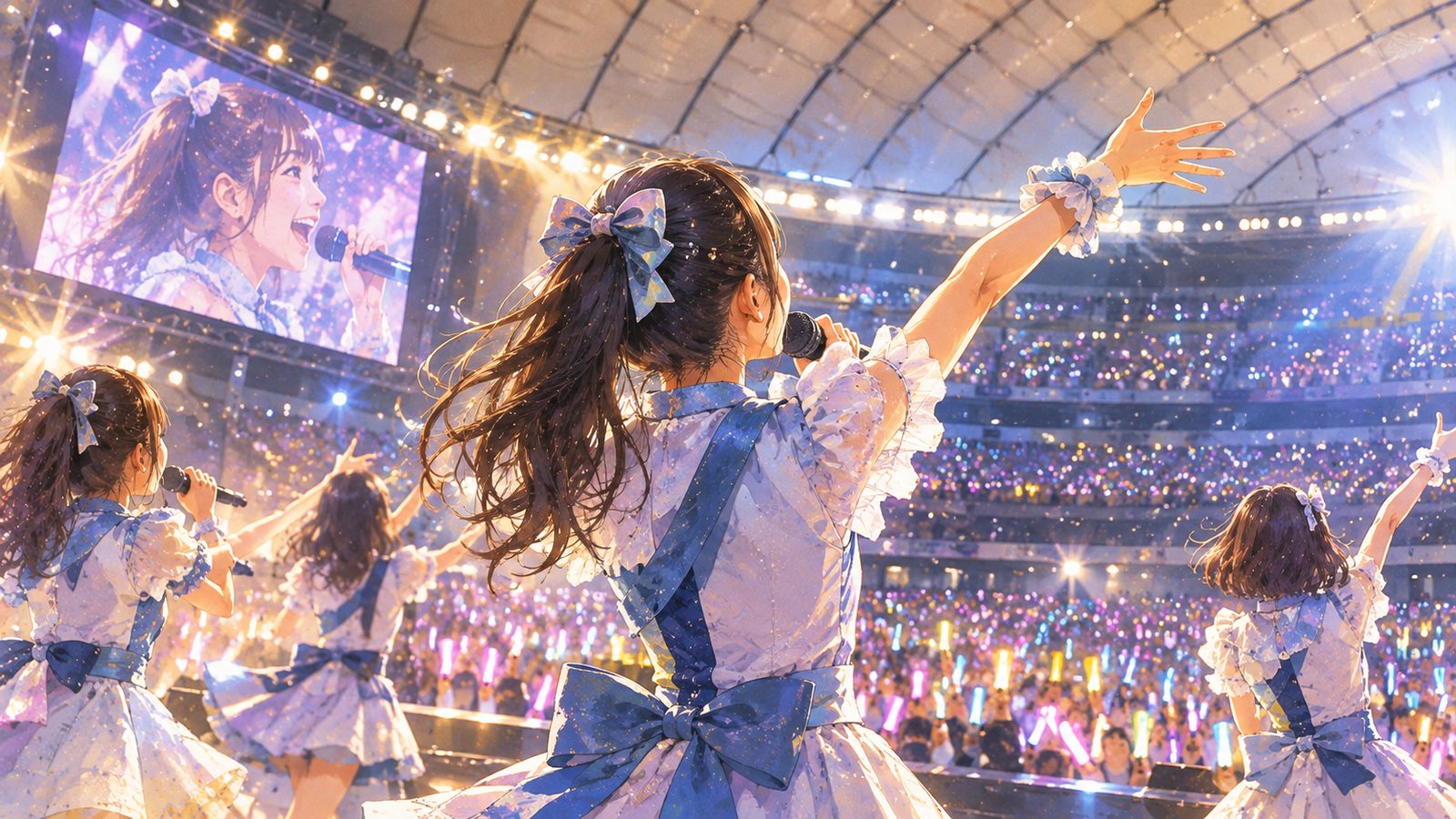
On December 3 and 4, 2011, the Tokyo Dome hosted two consecutive nights of concerts, with about 40,000 people each night. The woman on stage, Nana Mizuki, didn’t come from an idol group and wasn’t the singer of a rock band. Her day job is voicing anime characters. As the crowd chanted her name, she said it was the happiest moment of her life so far.
Now jump eleven years ahead. In 2022, Atsuko Enomoto, a voice actor with 24 years in the business, mentioned a number during an online talk: ¥15,000. That is the base fee a rookie voice actor gets for one 30-minute TV anime episode. Even if someone wanted to raise it to ¥18,000, she said, people on the production side would call it too expensive. “I’ve done anime work for 24 years, and that has never changed.”
At one end of the same industry is a 40,000-seat dome. At the other is a ¥15,000-per-episode fee that hasn’t risen in years. Many people explain the idolization of voice actors with “Japanese people love fandom,” but that skips a more basic question: if voice work itself is worth so little, why are fans willing to spend so much to watch voice actors sing? And why do voice actors have to sing at all?
The answer starts with that ¥15,000.
A rate card from 15 to 45, where the floor became a ceiling
Fees for Japanese anime voice work are mostly calculated under a “rank system.” It is administered by Japan’s largest actors’ union. Actors declare their own rank, from 15 to 45, with each step worth ¥1,000. Rookies usually start at rank 15, or ¥15,000 an episode, and stay there for several years. After that the rank rises with experience, up to a maximum of ¥45,000 an episode.
The system was originally meant to protect actors. In the 1970s, voice actors were treated very poorly, and in 1973 about 200 actors marched in the streets demanding fair pay. The point of the rank system was to set a floor: once an actor declares a rank, producers can’t push the price down as they please.
The problem is that a floor, given enough time, becomes a ceiling. The higher the rank, the less producers want to hire you. When veteran voice actors move up a rank, they may actually get less work, and some simply stay at the rookie rate. When Enomoto said “even ¥18,000 is called expensive,” this is exactly what she meant: everyone is stuck at ¥15,000, and whoever raises their rate risks being replaced.
What kind of life does ¥15,000 buy? Nearly all Japanese TV anime is recorded in Tokyo, so voice actors have to live in Tokyo. If a rookie lands regular roles in four weekly anime series at once, that’s about 16 episodes a month and an income of ¥240,000, roughly a new university graduate’s starting salary. And that’s already a pretty lucky rookie.
The agency side looks even worse. The voice acting industry traditionally splits fees 80% to the actor and 20% to the agency. When a rookie voices one episode, the agency gets just ¥3,000. That isn’t enough to pay managers and promotion staff, let alone develop new talent.
Both voice actors and agencies needed income beyond voice work. Where that money came from is where the idolization of voice actors begins.
Fans have chased a voice since 1965
That said, fans fell for voices decades before idol voice actors existed.
In 1965, the American TV series The Man from U.N.C.L.E. aired in Japan and at one point drew ratings of 40%. Nachi Nozawa, who dubbed one of the show’s secret agents, suddenly had a following of devoted fans. This was Japan’s first “voice actor boom.” Nozawa later hosted a late-night radio show, which proved that voice actors and radio were a perfect match: listeners couldn’t see a face, but they could listen to that familiar voice talk for two hours.
In 1977, the theatrical film of Space Battleship Yamato drew 2.3 million moviegoers. Young anime fans at the time didn’t just watch the shows. They started caring about who did the voices, and would wait outside recording studios for voice actors to come out.
Voice actors in this period had fans, but they weren’t idols yet. What fans loved was the combination of voice and character. What truly pushed voice actors into the spotlight was a business problem ten years later.
Anime characters can’t sing. Only the people who voice them can
In the late 1980s, Japanese anime began relying on a kind of work that never aired on TV and was sold directly on videotape or LaserDisc. It was called OVA (original video animation). LaserDiscs were expensive, and the people who could afford them were mainly working men with an income, so the market was small. To get this small group to open their wallets, production companies found the most effective method was to cast young female voice actors as heroines, then have them appear at events, do photo shoots and sing, as the promotional face of the work.
Record labels had their own clear math. Anime characters can’t sing. The only ones who can are the people who voice them. To fans, a song sung by a voice actor is the character’s song, and fans will buy it.
Megumi Hayashibara debuted right at this time. When she started out, she just wanted to focus on voice acting and had no plans to become a singer. In 1989 she sang an insert song for a Gundam OVA, and released her first single the same year. The person who pushed her in front of the microphone was King Records producer Toshimichi Otsuki, whose standard approach to anime was to have the voice actors sing the theme songs. He later became the producer of Neon Genesis Evangelion.
Once Hayashibara became popular, she got so many singing offers that she began to worry: “If this keeps up, I’ll get used up in some strange way.” In the end she signed an exclusive singer contract with King Records under her own name, a first for a voice actor. In 1992 she started her own radio show, and her releases have reached the top 10 of the charts in every decade from the 1990s to the 2020s.
The first voice actor to play the Budokan
If Megumi Hayashibara proved voice actors could sell records, Hekiru Shiina proved they could sell tickets.
1994 was a key year for voice actors. Shiina released her first solo album, and that same year, Japan’s first magazines devoted to voice actors appeared. Magazines let fans see voice actors’ faces and lives, and radio let fans hear voice actors themselves every week, rather than a character’s lines. From this point on, fans could love a voice actor without first loving a character she played.
In February 1997, Shiina played two concerts at the Nippon Budokan, becoming the first voice actor to perform there. The Budokan was built for the judo events of the 1964 Tokyo Olympics, and after the Beatles played there in 1966, it became sacred ground for Japanese singers. By 2000, she had played her 200th concert, averaging one every two or three days. She said: “I came into this business wanting to be a voice actor. I never imagined making music my career.”
The picture can be redrawn. The voice is the only living part of a character
At this point, the industry’s motive is clear: voice acting fees were held down, and records, radio and concerts brought in another stream of income. But that only explains why the industry wanted voice actors to be idols. It doesn’t yet explain why fans were willing to pay.
Hideaki Anno, director of Neon Genesis Evangelion, said something in 1996 that gets right to the point. The drawing on a cel, he said, is just a symbol. Draw Asuka’s shape with a marker, and as long as Yuko Miyamura’s voice comes out of it, that is fully Asuka. Yuko Miyamura is Asuka’s voice actor.
In an anime, the pictures can be redrawn and the script can be rewritten. The only part that is truly alive, that breathes and speaks in front of you, is the voice. When fans fall in love with a character and want to meet that character, there is only one way in the world to do it: go and meet the person who gives that character a voice.
Japan’s anime industry turned this feeling into a very concrete mechanism. Take the first Blu-ray volume of Chainsaw Man, released in 2023: it was priced at ¥7,480 and included a priority lottery ticket for an event where the main characters’ voice actors would appear together on stage. If you wanted to see the voice actors in person, the surest way was to buy the Blu-ray first. Packing voice actor event tickets into discs has become a common practice in Japan.
From enka dreams to Kohaku, the idolization of voice actors reaches its peak
Nana Mizuki was born in 1980 and studied enka (a traditional Japanese ballad style) from childhood. Her original goal was to become an enka singer. She became a voice actor instead, debuted as a singer in 2000, and has done both ever since.
In 2009, her album reached number one on the weekly chart, the first time in 41 years that a voice actor had topped the album chart. On New Year’s Eve that year, she took the stage at NHK’s Kohaku Uta Gassen, Japan’s biggest annual New Year’s Eve singing show, which only invites the year’s most talked-about singers. It was the first time a voice actor had appeared on Kohaku. Two years later came the two nights at the Tokyo Dome from the opening of this article.
Nearly fifty years passed between the fans who chased Nachi Nozawa in 1965 and the 80,000 people who chanted Nana Mizuki’s name in 2011. Fans’ feelings for voices were always there. What changed was that the industry found a way to turn those feelings into income.
The pay for voice work didn’t grow, but the workload did
This mechanism has run for thirty years, and its problems have become increasingly clear.
In 2025, Japan’s anime industry hit a record market size of ¥4.4491 trillion, yet voice acting fees have barely grown in decades.
The 2023 book What’s Wrong with Idol Voice Actors? points out that voice actor agencies originally only handled voice-work bookings. In the 2000s, some popular voice actors even had to proofread magazine copy and check CD cover photos themselves, all of which would be a manager’s job elsewhere in show business. Today voice actors sing, dance, do photo shoots and appear on shows, but agencies still take only 20%, and they lack both staff and experience. The author observes that the more idolized a popular voice actor is, the more likely they are to burn out.
Idol work began as a way to make up for low fees. Now it has become an extra job.
That voice is worth more than its price
So why were Japanese voice actors able to become idols?
The usual answers are fan passion, or that voice actors are good-looking. Both are true, but neither is the root cause. I think the root cause is the big gap between the price Japan’s anime industry puts on a voice and what that voice is actually worth.
On the rate card, the voice for an episode of anime is worth ¥15,000, about the same as a part-time job. But in fans’ hearts, the voice is the only living part of a character, the reason a drawing can make people cry or laugh. That value can’t be collected in the recording booth. It can only be cashed in somewhere else: records, radio, events, concerts. The idolization of voice actors is the outlet that value found.
The 40,000 people chanting Nana Mizuki’s name at the Tokyo Dome were really paying the part of the price the recording booth couldn’t afford. And as long as the rate card stays at ¥15,000, voice actors will have to keep taking the stage to make up the difference.
Notes
- “¥15,000” refers to the base fee for one 30-minute TV anime episode at the rookie rank. Actual payments may include additional fees such as reuse fees depending on how the work is used, but the base fee itself hasn’t changed in years.
- The ¥240,000-a-month estimate assumes four regular roles and about 16 episodes a month, before tax and transportation costs, and doesn’t represent the actual income of most rookies.
- “80% to the voice actor, 20% to the agency” is the industry’s traditional description; practices have varied among agencies in recent years.
- “Idolized voice actors are more likely to burn out” is the observation of the author of What’s Wrong with Idol Voice Actors?, not statistical data.
References
- 日本俳優連合|外画・動画のランクについて|2025 (ranks 15–45, no work accepted below the declared rank)
- 文春オンライン|「ギャラ配分は声優が8割、事務所が2割」それでも新人声優が「食っていく」のが難しすぎるワケ|2023-11-23 (rookie rank, higher rank can mean less work, the 80/20 split, monthly income estimate, anime recorded in Tokyo)
- J-CAST ニュース|「1万5000円からギャラ上げられない」 現役声優が訴えたアニメ現場の「過酷な労働実態」|2022-03-02 (Atsuko Enomoto’s remarks)
- 文春オンライン|「アフレコによる収入だけでは食っていけない」声優が「アイドル・タレント化」してしまった特殊事情|2023-11-25 (agencies only handling voice work, voice actors handling copy and photos themselves)
- 文春オンライン|「アイドル化した人気声優ほど衰弱しやすい」“活動休止する声優”が急増した「2つの理由」|2023-11-25 (idolized voice actors burning out)
- 佐藤桂一|「第一次・第二次声優ブーム」を通して見る声優業の進化と分化|Meiji University, Bungaku Kenkyu Ronshu No. 51|2019-09 (Nachi Nozawa and the first boom, 2.3 million viewers for the Yamato film, the 1973 protest)
- 内藤豊裕|「スター化」する声優|Gakushuin University, Jinbun Kagaku Ronshu XXVI|2017 (voice actor magazines launched in 1994, Hekiru Shiina’s Budokan concerts and 200th concert)
- Business Insider Japan|【声優・緒方恵美のいる時代】|2021-10-25 (LaserDisc buyers mainly working men, OVAs using young female voice actors as promotional faces)
- ORICON NEWS|林原めぐみ アーティスト活動 30 周年インタビュー (Hayashibara not wanting to sing at first, worry about being “used up,” exclusive singer contract, radio show, top 10 in every decade)
- Real Sound|声優音楽の“今”は、一体どうなってる?|2019-10-19 (Hayashibara’s 1989 single debut, Shiina’s first Budokan, Mizuki’s first Kohaku)
- 映画.com (Wikipedia mirror)|大月俊倫 (having voice actors sing theme songs, producer of Neon Genesis Evangelion)
- Real Sound|椎名へきるはこれからもファンと一緒に歩んでいく|2024-05-08 (Shiina in her own words on wanting to be a voice actor)
- J-CAST ニュース|水樹奈々、平野綾、堀江由衣… 声優は今やアイドルだ|2009-12-06 (Mizuki’s enka background, singer debut in 2000, first voice actor album number one)
- J-CAST ニュース|声優史上初「水樹奈々の紅白」|2009-12-31 (first voice actor on Kohaku in 2009)
- マイナビニュース|水樹奈々、初の東京ドーム公演「LIVE CASTLE 2011」|2011-12-18 (two nights at the Tokyo Dome, Mizuki’s remarks)
- 文春オンライン(CDB)|「エヴァ」アスカ役・宮村優子の“苦労人すぎる人生”|2023-04-06 (Hideaki Anno’s 1996 remarks on Asuka and Yuko Miyamura’s voice)
- 電撃オンライン|アニメ『チェンソーマン』BD&DVD1巻が発売!|2023-01 (Chainsaw Man Blu-ray with priority event application ticket)
- Wikipedia|Nippon Budokan (origin of the Budokan, the Beatles’ concerts)
- 日本動画協会(PR TIMES)|日本のアニメ産業 市場規模 4兆円を超える 2025年速報値|2026-10-30 (2025 market size)
Follow the story in person
Join a small-group trip to the places in our stories and meet the people who live and work there.
See trips and dates
Water Mirror is a Tokyo-based company that helps more people step inside industries and explore the stories and cultures of different fields around the world. We design in-depth learning programs for individuals, companies, schools and organizations, combining company visits, exchanges with professionals, local learning and hands-on experiences, so participants can see how industries really work and meet the people and stories behind them. Water Mirror Perspectives is our content media, telling the distinctive stories of industries, local cultures and people, so that reading sparks curiosity and leads readers to go and see for themselves.
About Water Mirror →