Key Points
- In Japan, an “idol” is a young performer who sings and dances and wins fans through personal charm. When Momoiro Clover Z formed in 2008, they couldn’t afford to rent a venue, so they performed on Sundays on the zelkova-lined avenue by Yoyogi Park, often to just a few dozen people.
- In 2009, the members toured Japan in a single van and played 104 free shows at 24 electronics stores, sometimes to only about ten people. That’s when fans who followed them across prefectures first appeared.
- The team made a habit of announcing its goals publicly. Before their major debut they said they wanted to appear on NHK’s Kohaku Uta Gassen, and did so in 2012. The next day they declared their next goal, the National Stadium, and in March 2014 drew about 110,000 people over two days, becoming the first female group to hold a solo concert there. Their 10th-anniversary concert in 2018 was held at Tokyo Dome.
- What the idol industry sells is a rise that fans can watch with their own eyes and walk alongside. Bigger stages look better, but what people pay for is the distance from the sidewalk to the stadium.
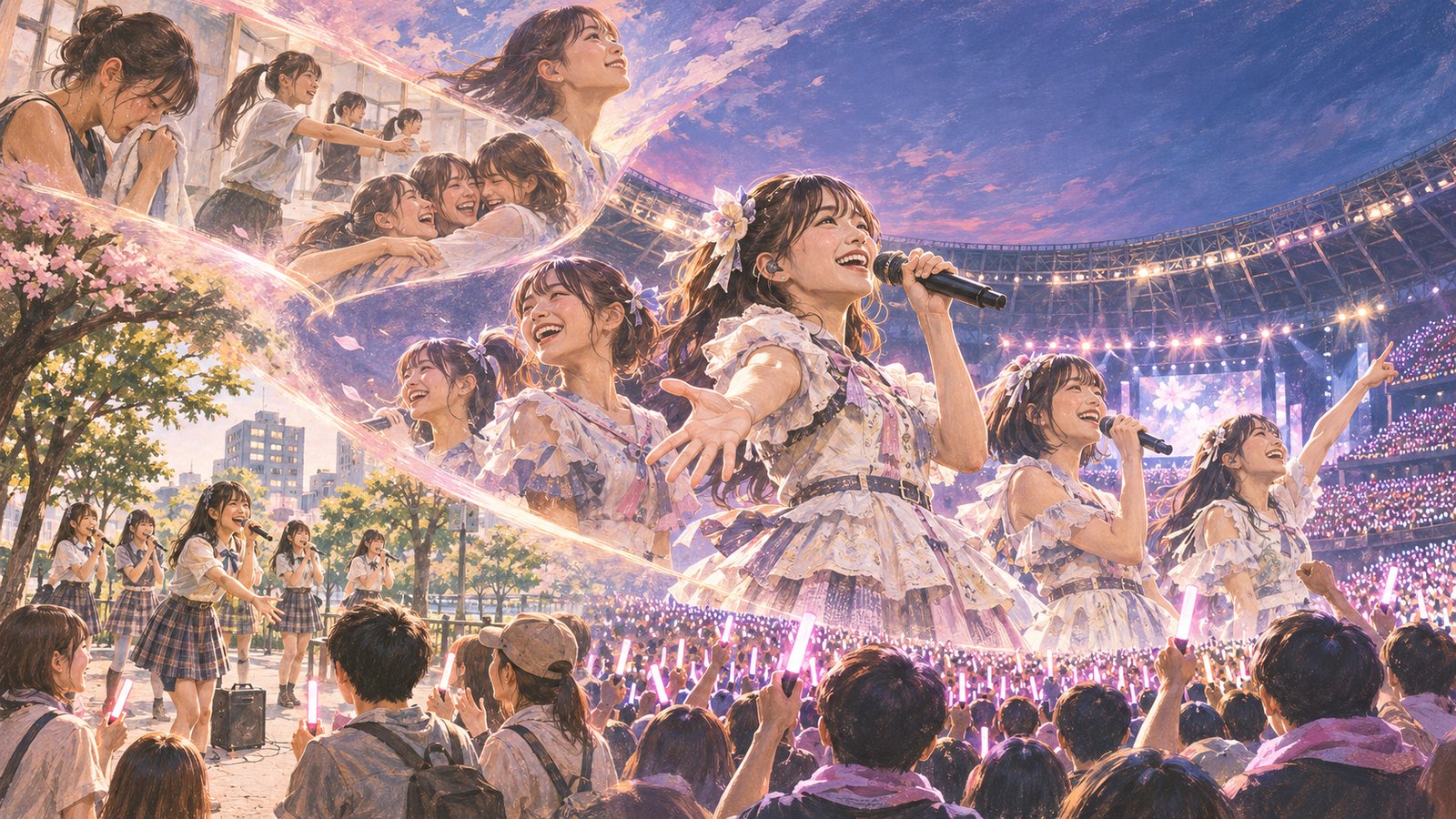
On the night of March 15, 2014, about 55,000 people filled Tokyo’s National Stadium. It had been the main stadium of the 1964 Tokyo Olympics and was already slated to be demolished and rebuilt. As the concert began, five girls walked to the edge of the stadium and lit the cauldron used at those Olympics.
They were Momoiro Clover Z, a Japanese girl idol group. Their two shows drew about 110,000 people in total, and they became the first female group to hold a solo concert at the National Stadium.
Go back six years. In the summer of 2008, the same group was singing on a sidewalk in Yoyogi Park, a few kilometers away. There was no stage and no original songs. The tickets were homemade by staff, the speakers ran off a modified car battery, and the audience was maybe a few dozen people.
From a few dozen to 110,000. The usual explanation is “they got famous.” But there are many ways to get famous. Some people break through with one viral song, others with one TV drama. Momoiro Clover Z didn’t. Their audience was built up one show at a time, and what that audience paid for answers a question: what is Japan’s idol industry actually selling?
“Come here on this day, and you’ll see these girls”
First, what does “idol” mean in Japan? Japanese idols are usually young performers whose work centers on singing and dancing. What fans value often isn’t just vocal or dance skill, but personality, the effort they see, and the feeling of “watching her grow.” Idols of the 1970s and ’80s mostly lived on TV. Audiences watched through a screen and rarely had a chance to see them in person.
Momoiro Clover Z was formed on May 17, 2008. Their manager, Akira Kawakami, had never managed idols before. He went to see other idol groups perform and realized how important a fixed stage was: fans knew where to find the group. The problem was that they couldn’t afford to rent one.
So he took the stage outdoors. Next to Yoyogi Park runs an avenue lined with zelkova trees. Every Saturday the team handed out flyers, and every Sunday they performed there, setting up their own sound system. Kawakami later said he wanted fans to know one thing: come here on this day, and you’ll see these girls.
Leader Kanako Momota later recalled those days: everyone wrote flyers and handed them out together, and since they didn’t have their own songs yet, they played other people’s songs on a portable stereo and made up their own choreography.
There’s a small coincidence in where that avenue is. It’s right next to the NHK Broadcasting Center, and NHK’s New Year’s Eve show, Kohaku Uta Gassen, is broadcast live from NHK Hall nearby. Kohaku is Japan’s oldest year-end music show, and being invited to perform is like being recognized by the whole nation. A group of girls singing on the sidewalk performed every Sunday right next to that stage.
Later, when they could no longer perform that way in the park, the team phoned department stores themselves and borrowed their rooftops for events. The roof of Tobu Department Store in Ikebukuro was one stop. They had no money for an event company, so they did everything themselves.
One van, 24 electronics stores, 104 shows
In 2009 they released their first single, “Momoiro Punch.” The label’s parent company was the Japanese electronics retail chain Yamada Denki. The members and staff assumed that releasing a CD meant an official debut, but later learned it was an independent single sold mainly in Yamada Denki stores.
Since the CD was sold in electronics stores, the shows were held in electronics stores too. From May to August that year, the five members squeezed into a van and drove from Morioka in the north to Fukuoka in the south, playing 104 free shows at 24 branches. The stairways and atriums of suburban megastores were their stage and seating.
There was a very practical reason they could tour the whole country this way. At the time, Japan’s expressways had a discount: cars using electronic toll collection (ETC) paid at most 1,000 yen in tolls on weekends on expressways outside the big cities, however far they drove. Kawakami says he modeled it on pro wrestling tours: everyone rides in the same vehicle and moves from stop to stop like a traveling theater troupe.
At some shows, only about ten people were watching. The members came up with ideas themselves, suggesting they hand out balloons to draw in passing shoppers. Kawakami says he wanted the members to think for themselves, because they weren’t people who had started out at the top.
Early on they also held an outdoor evening show where the lighting wasn’t bright enough, so the staff lined up four cars and turned on their headlights to light the stage. Kawakami says that when things like this happened, they didn’t hide it. They told fans plainly what trouble they were in, almost as if asking the fans for advice.
After the tour, “Momoiro Punch” reached No. 23 on Oricon’s weekly chart, Japan’s best-known record sales chart. For a single sold mainly in electronics stores, that wasn’t bad. But Kawakami says the biggest thing the tour gave them was something else: he discovered there was a group of fans who would follow them across prefectures, stop after stop. He only found that out once the tour was over.
What those fans followed wasn’t a show that got better every night. They followed a group of girls trying hard to hold on to shoppers in megastore stairwells. Someone who has seen a stage lit by car headlights isn’t just an audience member anymore. They’re a witness.
Say the goal out loud, and fans have a reason to follow
In 2010 the group made its major-label debut. At the debut press conference, the members publicly stated two goals: to appear on Kohaku Uta Gassen and to play the Nippon Budokan. The Budokan is a Tokyo arena that holds more than 10,000 people, and in Japanese music it’s often treated as a byword for “making it.”
Announcing goals is risky. If you don’t reach them, everyone sees. Kawakami thought the opposite: he believed public goals could bring fans along. Once a goal is spoken, every show becomes a step along the way, and fans can see how far the group still has to go.
In November of that year, they went back to Yoyogi Park and held a free concert on the park’s outdoor stage. About 3,000 people came, and about 15,000 watched the online stream. On stage, Momota said their goal was Kohaku, and she was happy to hold the last show of their tour right in front of NHK Hall. Two years earlier, they had been on a sidewalk in the same park, singing to a few dozen people.
That year, so many idol groups emerged at once that the media called it the “idol warring states era.” TV idols felt far away from audiences, but groups like Momoiro Clover Z emphasized that “you can meet them right now.” On stage they sweated, did flips and danced all out, looking much more like real people.
Fans saw every setback too
The road wasn’t smooth. In the spring of 2011, the sub-leader left the group, and the remaining five added a “Z” to their name. Anime song singer Ichiro Mizuki, who taught them the Z hand pose, said Z is the last letter of the alphabet and stands for “ultimate,” and that after Z comes A again, so it also means always keeping a beginner’s spirit.
On New Year’s Eve 2012, they appeared on Kohaku Uta Gassen for the first time, reaching the goal they’d announced at their debut in less than three years. The next morning, on a livestream, they announced their next goal: the National Stadium.
Kawakami later wrote in a book that the moment they said the words “National Stadium” out loud, a lot of things started to move. In the summer of 2013 they played to about 60,000 people at Nissan Stadium in Yokohama, and on Christmas that year they announced on stage that they would play the National Stadium the following spring.
On those two nights in March 2014, they lit the Olympic cauldron and also sang old songs from their indie days. On the second night, Momota told the crowd that they hadn’t come there to beat anyone in the idol world or show business. They wanted to make everyone happy with their smiles, and to reach the top that way.
On New Year’s Eve that same year, they appeared on Kohaku for the third time. Member Momoka Ariyasu had pulled out the day before with the flu. The other four cut pieces from her green costume and sewed them onto their own outfits to perform. Green was Ariyasu’s member color in the group. The stage was one person short, but her color was still there.
What fans pay for is that distance
Back to the original question: from the sidewalk to the National Stadium, what were fans actually buying?
Looking at those ten years, the answer isn’t “a perfect performance.” Perfect performances are available on TV and streaming anytime. What Momoiro Clover Z sold was a public, unfinished journey. The team said its goals out loud, laid its difficulties out in front of fans, and let fans watch them climb from a sidewalk with a few dozen people. With every step up, the people who were there early gained another memory of “I saw them singing in a megastore stairwell,” a memory only those who followed all along can have.
Kawakami has said that the only one who can “produce” an artist is the artist. The members took part in planning meetings for the National Stadium concert from the very start. The manager provided opportunities and an environment, but the members did the climbing, so the effort fans saw wasn’t just a packaged script.
This model has its own difficulty. The road has to keep going up for fans to have a reason to follow. After the National Stadium, what’s the next goal? In 2015, after three straight years on Kohaku, they weren’t selected again. This may be the hardest thing about the idol industry: the story needs a next goal, but stages can only get so big.
Their answer was to change the goal from “bigger” to “longer.” In May 2018, their 10th-anniversary concert was held at Tokyo Dome, drawing more than 80,000 people over two days. Momota shouted from the stage, “Everyone, follow us!”
Fifteen years later, back to the same park
In May 2023, they held a concert for their 15th anniversary at Yoyogi National Gymnasium First Gymnasium. That arena stands right next to the zelkova avenue from all those years ago.
Momota said they had started out on the sidewalk next door in Yoyogi Park, so they had always known there was a big arena right beside them, but this was their first solo concert there, and it meant a lot.
The sidewalk and the arena are right next to each other. It took them 15 years to walk from one to the other. What Japan’s idol industry really sells is that distance, and fans are willing to pay because they walked that road too.
Notes
- Figures such as about 110,000 over two days at the National Stadium, more than 80,000 over two days at Tokyo Dome and about 60,000 at Nissan Stadium are approximate numbers announced by organizers or the media.
- The 24 locations, 104 shows and “from Morioka to Fukuoka” of the 2009 Yamada Denki tour come from Akira Kawakami’s interviews and retrospective articles in music media. The account of some shows having only about ten people comes from a review summarizing his book, Momokuro-ryu.
- Quotes from Kanako Momota and Akira Kawakami are paraphrased translations.
References
- Bunshun Online|ももクロ 国立競技場大会(2014 年 3 月 15–16 日)回顧 (about 110,000 people, first female group, lighting the cauldron, Momota’s “not to beat anyone”)
- Real Sound|ももいろクローバーZ、女性グループ前人未到の国立競技場ライブ成功の裏にあったもの|2024-05 (goal declared on New Year’s Day 2013, announced at Christmas, Kawakami’s “once you say it, things start to move”)
- Pia Music|ももいろクローバーZの歴史を紐解く 第1回:“ライブアイドル”としての下積み時代 (July 2008 street shows on the zelkova avenue, no money for a venue, 104 shows at 24 locations in 2009, the van and the 1,000-yen ETC cap)
- Hobonichi School|「ももクロ」が出来ていく過程。川上アキラ的発想って? (“come here on this day and you’ll see them,” flyers on Saturdays and shows on Sundays, Morioka to Fukuoka, pro wrestling tours, fans crossing prefectures, headlight lighting, public goals)
- Excite News (大山くまお)|マネージャーが明かす「自分で考える」ももクロ育成術『ももクロ流』|2014 (street shows for a few dozen, the car battery, department store rooftops, audiences of about ten and the balloons, “only the artist can produce the artist,” members in planning meetings)
- Natalie|ももクロ結成15周年、代々木公園での路上ライブを懐かしむ|2023-05 (Momota: handwritten flyers, dancing to other people’s songs on a portable stereo)
- Mynavi News|結成15周年! ももいろクローバーZ百田夏菜子「代々木公園の路上ライブから始まったので…」|2023-06-09 (15th anniversary at Yoyogi National Gymnasium First Gymnasium, “we knew there was a big arena next door”)
- ORICON NEWS|ももいろクローバーの代々木公園フリーライブにファン3000人が熱狂|2010-11 (about 3,000 people, about 15,000 on the stream, final show in front of NHK Hall)
- Real Sound|ももクロ 2010 年回顧|2021-03 (the idol warring states era, “idols you can meet now,” distance from TV idols)
- Wikipedia|ももいろクローバーZ (formed May 17, 2008, goals at the debut press conference, 2011 name change, three years on Kohaku, Ariyasu at the 2014 Kohaku, not selected in 2015, Tokyo Dome 2018 with over 80,000, meaning of Z)
- Wikipedia|Momoiro Punch (released August 5, 2009, No. 23 on Oricon’s weekly chart)
- crank-in!|ももクロ、東京ドームで10周年を祝福|2018-05 (Tokyo Dome, May 22–23, 2018, Momota’s “everyone, follow us”)
Follow the story in person
Join a small-group trip to the places in our stories and meet the people who live and work there.
See trips and dates
Water Mirror is a Tokyo-based company that helps more people step inside industries and explore the stories and cultures of different fields around the world. We design in-depth learning programs for individuals, companies, schools and organizations, combining company visits, exchanges with professionals, local learning and hands-on experiences, so participants can see how industries really work and meet the people and stories behind them. Water Mirror Perspectives is our content media, telling the distinctive stories of industries, local cultures and people, so that reading sparks curiosity and leads readers to go and see for themselves.
About Water Mirror →